-
-
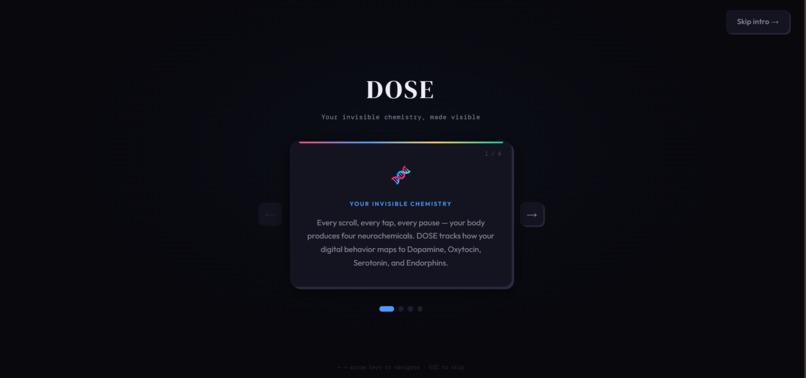
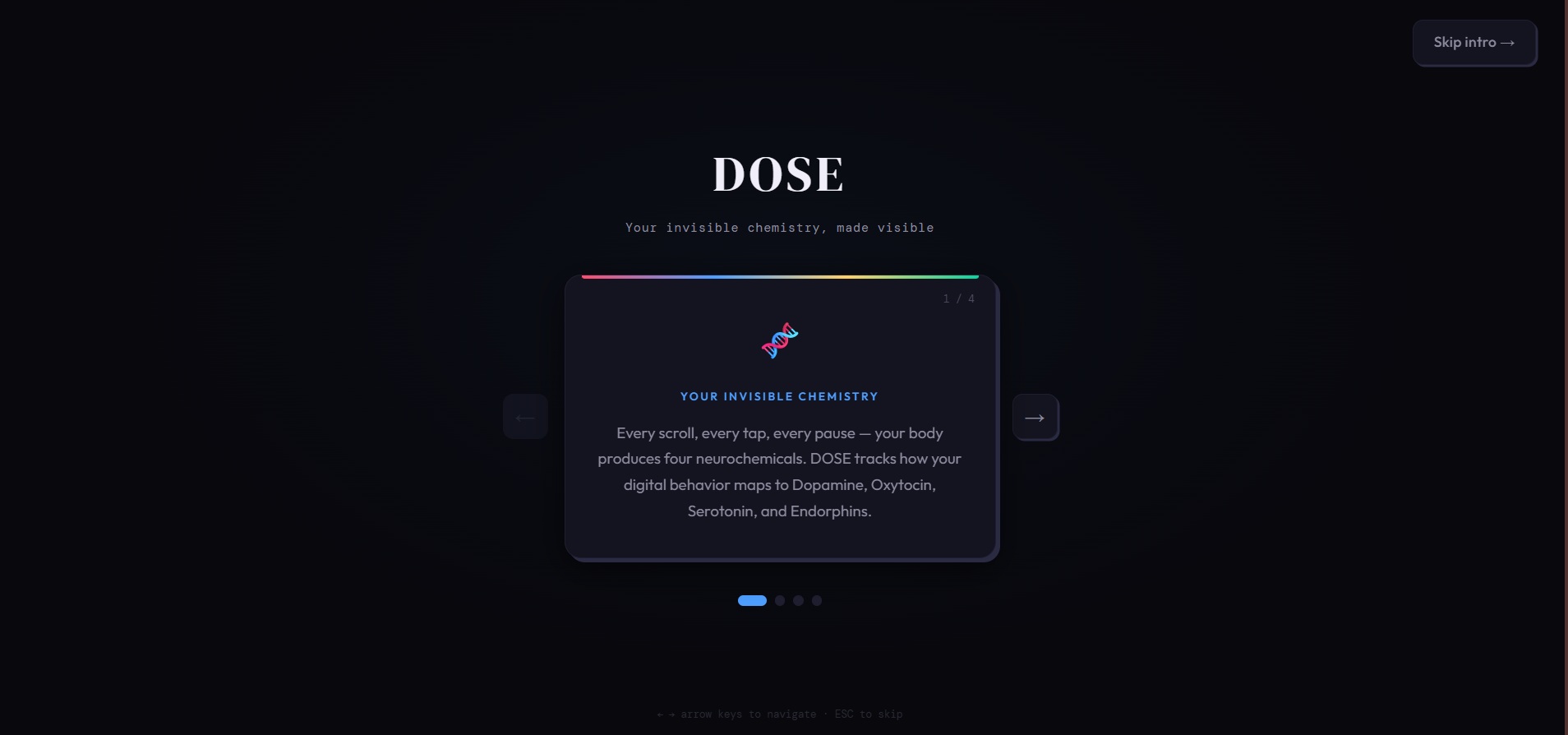
Onboarding
-
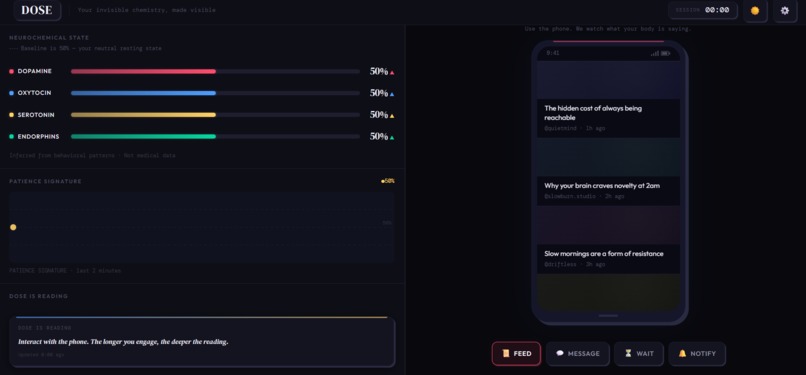
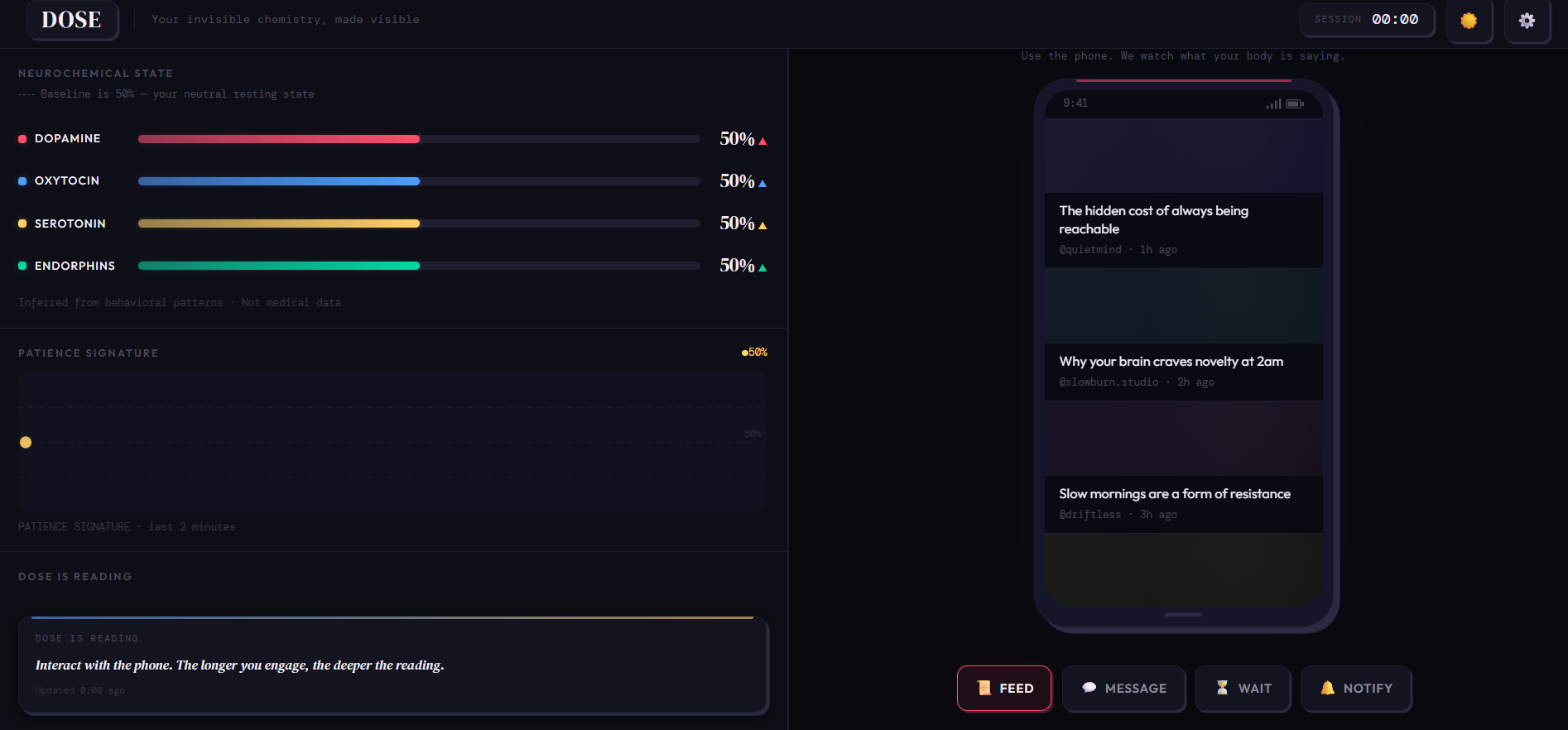
Dashboard
Inspiration
It started with a simple, uncomfortable observation.
We were scrolling — not because we wanted to, not because anything was interesting but because stopping felt harder than continuing. We put the phone down, picked it up 40 seconds later without deciding to, and couldn't explain why.
Traditional health tools measure what the body does: heart rate, steps, sleep cycles. But they miss the layer underneath — the invisible neurochemical negotiation happening before every behavior. The dopamine dip that sends you back to the feed. The oxytocin deficit that makes you check notifications for the fifth time in ten minutes. The serotonin pressure that makes your typing aggressive and full of corrections.
We kept coming back to one question: what if your phone already knew your chemistry — and just never told you?
The "Quantified Self" movement of the 2000s gave us dashboards for the body's measurable outputs. We wanted to build Quantified Self 2.0 tools that interrogate the invisible internal states that drive behavior before the behavior happens. Not your heart rate. Your patience threshold. Not your step count. Your tolerance latency the measurable gap between an urge and your response to it.
DOSE was born from the belief that the most important health data isn't coming from a sensor on your wrist. It's already encoded in how fast you scroll, how long you wait, how you type, and whether you can sit still while a video buffers.
What it does
DOSE infers your real-time neurochemical state: Dopamine, Oxytocin, Serotonin, Endorphins, entirely from how you behave on your phone.
Four interaction modes, each targeting a different chemical:
- FEED : scroll speed reveals dopamine-seeking patterns
- MESSAGE: typing rhythm and corrections reveal serotonin state
- WAIT: a deliberately buffering video tests your patience threshold. Wait 45 seconds without tapping and a single line appears: "Still here. That's rare."
- NOTIFY: how fast you clear notifications reveals oxytocin depletion
A live dashboard updates in real time: chemical bars shift, a patience waveform draws itself, and an AI reads your last 60 seconds of behavior and reflects it back in one sentence. No scores. No advice. Just a mirror.
How we built it
Built entirely in Figma Make using a three-pass approach, shell first, interactivity second, polish third and lot of iterations.
The behavioral tracking engine logs every scroll, tap, keystroke, and wait event into a session state object. DOSE values recalculate every 5 seconds. AI chat in MESSAGE mode and the insight card that updates every 60 seconds.
The hardest piece: the WAIT mode buffer loop, a precise 60-second patience test with rage-tap detection, phase tracking, and the exact timing of the "Still here" moment.
Challenges we ran into
No navigation inside the phone. Every mode had to be a self-contained, infinitely looping world. No back button. No home screen. This constraint made each mode significantly sharper.
Getting the AI tone right. The insight card had one rule: never name a chemical, never give advice, never use the word "should." Getting AI to speak observationally, poetic but grounded took more prompt iteration than anything else in the build.
The 60-second buffer. Too short feels trivial. Too long loses the room during a live demo. 60 seconds is where anticipatory dopamine fatigue actually begins, the point where waiting shifts from tolerable to genuinely difficult.
Accomplishments that we're proud of
A live-drawing SVG line that shifts color from warm red (impatience) through amber (neutral) to teal (endorphin stability) as the session progresses. It's the most honest summary of a person's inner state we've ever seen on a screen.
What we learned
Patience isn't a personality trait. It's a measurable signal with a threshold, a recovery curve, and a chemical substrate. It deserves to be tracked.
The most powerful health data doesn't require new hardware. It requires a new lens on behavior you're already generating.
What's next for DOSE
Running passively in the background — measuring real behavior, not simulated. Longitudinal patterns across 30 days. And eventually, intervention: when your chemistry dips, DOSE doesn't warn you. It quietly changes your environment to bring you back.
The body has always been communicating. We're just finally learning to listen to the right signals.
Built With
- figma
- figmamake


Log in or sign up for Devpost to join the conversation.