Inspiration
My grandma, and other people around me who came from Korea, have had a hard time adjusting to English. They don't like Duolingo. It felt confusing and overstimulating to them, and my grandma quit.
I'm on the other side of the same problem. I'm learning Korean, and I text my friends in it, but friends answer what you meant. They don't fix how you said it.
Everyone I just described already knows how to text. So I put the tutor there.
What it does
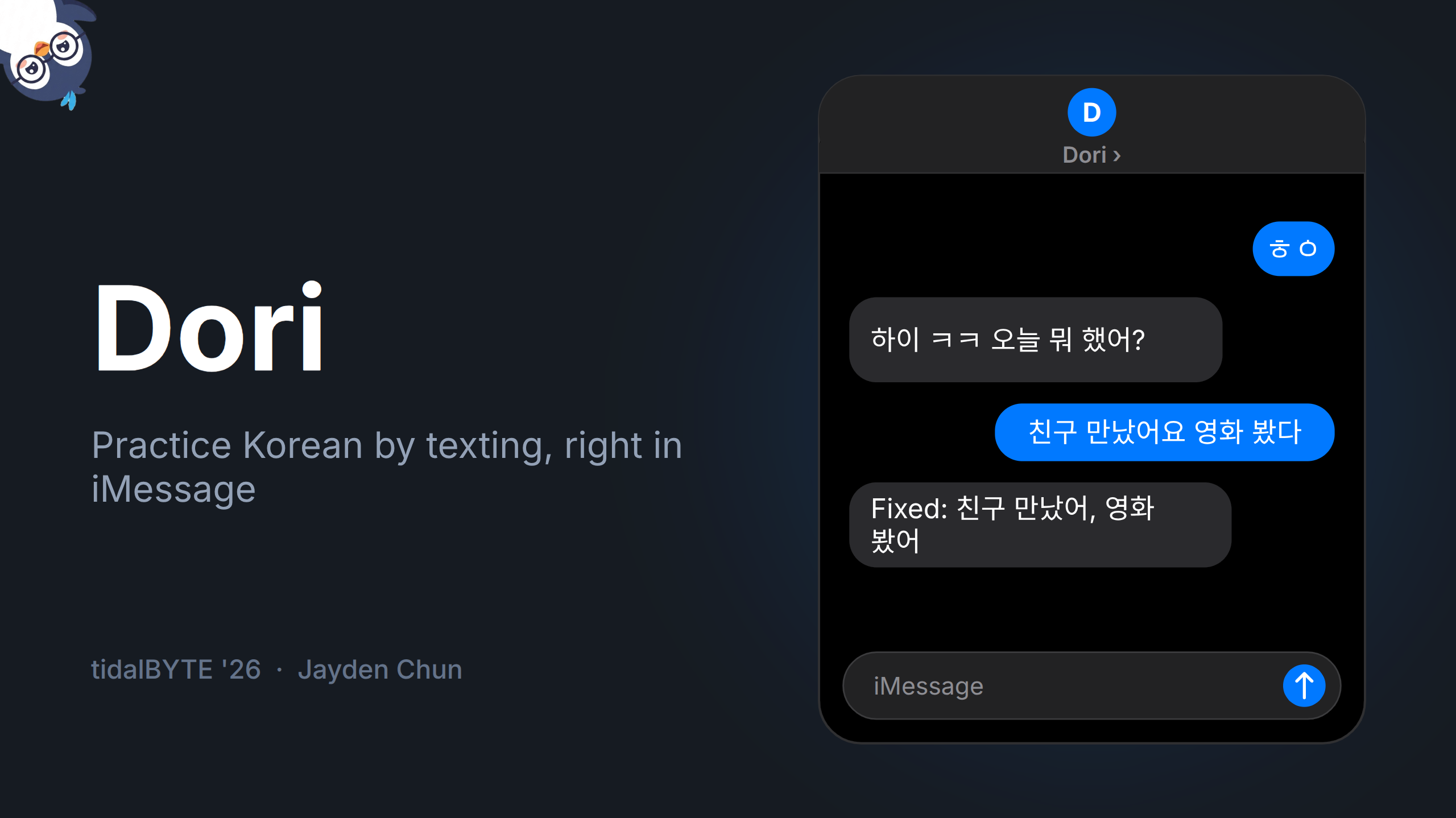
Dori is a contact in iMessage. You text it, and it texts back in the language you're practicing, in the style you pick: casual, friendly, romantic or business.
- It works both ways: Korean speakers practicing English, and English speakers practicing Korean.
- When you make a real mistake, it replies in the thread under your message with the fix and a one-line reason, then keeps the conversation going.
- React to any of its messages with the question mark tapback and it explains that message in your own language.
- Ask "what does 대박 mean?" and it answers, then goes back to chatting when you do.
- The same sentence can be fine with a friend and a mistake with a colleague. Dori corrects for the style you picked, slang included.
How I built it
LoopMessage delivers each text and tapback to my server as a webhook and sends the replies back, including threaded replies.
The server is Python and FastAPI. It checks a shared secret, drops duplicate deliveries and answers right away. Then it waits a few seconds so a burst of short texts becomes one turn, and runs each person's turns one at a time.
Each turn is one call to NVIDIA Nemotron 3 Ultra, which returns JSON with the intent, the corrected sentence, the reason and the reply. Nemotron 3.5 Lightning is the fallback. Profiles, message history and webhook dedupe live in SQLite.
The model proposes and the code decides. The code decides when onboarding is finished, and it drops corrections that only change punctuation, remove a particle that was fine, or come from the fallback model.
Challenges
- My code read the tapback from a field named
reaction, but real webhooks sendreaction_type, so my first question mark reaction was ignored. Logging every payload is what found it. - NVIDIA rate limits Ultra hard. On my own phone today it answered 429 on 10 of 80 turns, so Dori now waits and asks Ultra again before it falls back.
- The model liked to fix things that were not wrong, like adding periods to texts or dropping particles I had written correctly.
What I'm proud of
- It works on a real phone: 117 turns today without a crash, and a median model reply under 2 seconds.
- Corrections depend on who you're texting. The same Korean sentence passes in a casual chat and gets fixed in a business one.
- A scoring script runs the prompt over fixed learner messages, and Ultra matched 37 of 37 in the last full run. A second script drives 21 whole conversations through the real app.
What I learned
- A prompt change needs a test set. Each time I tightened one rule something else moved, and the scoring script is how I saw it.
- The smaller model returned valid JSON with wrong Korean in several of its fixes. Parsing correctly told me nothing about whether the fix was right.
What's next
- A progress view that shows which mistakes you keep making.
- Voice memos. LoopMessage already sends a transcript.
- More languages. Today Dori warns you if you pick one it isn't tuned for.
