-
-
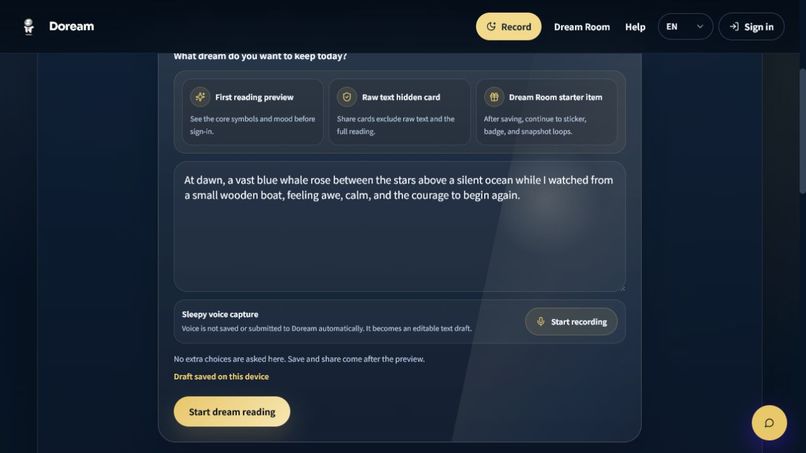
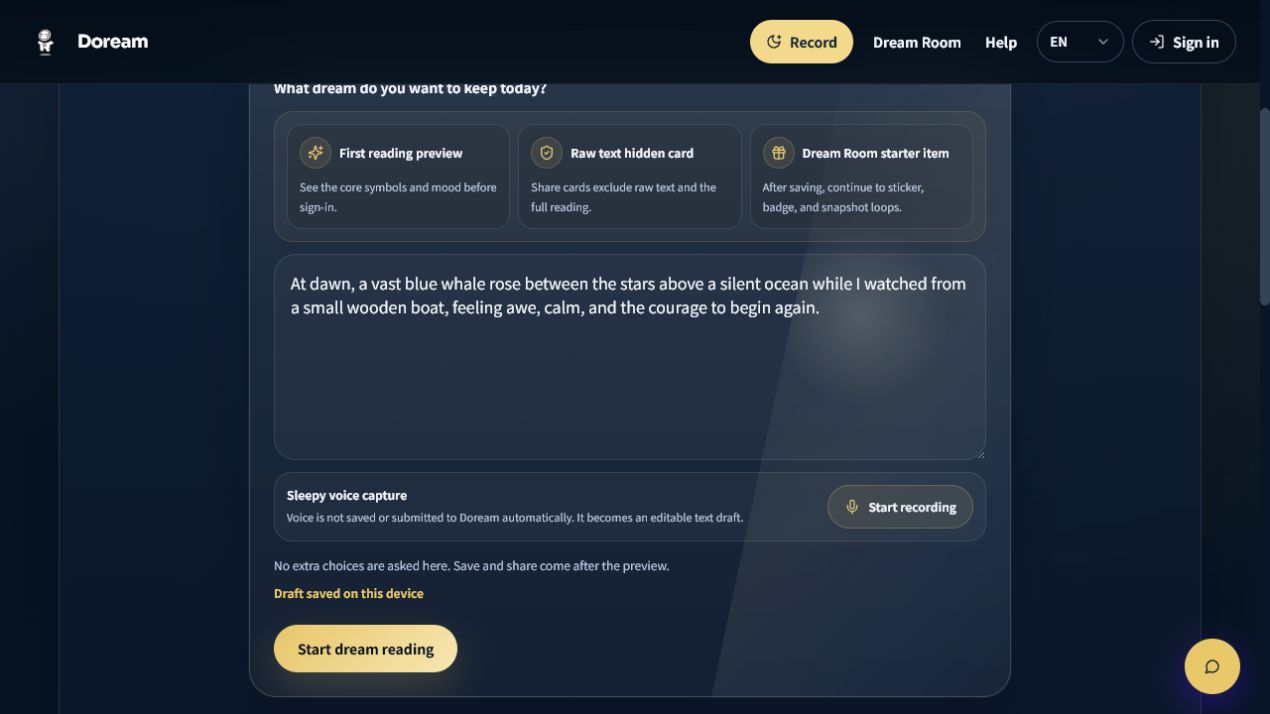
Live English record flow: one remembered scene, no complex tags, and raw text kept private by default.
-
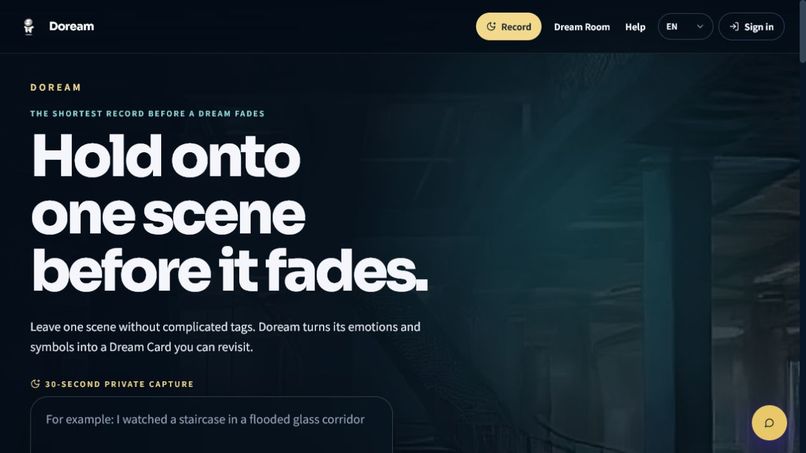
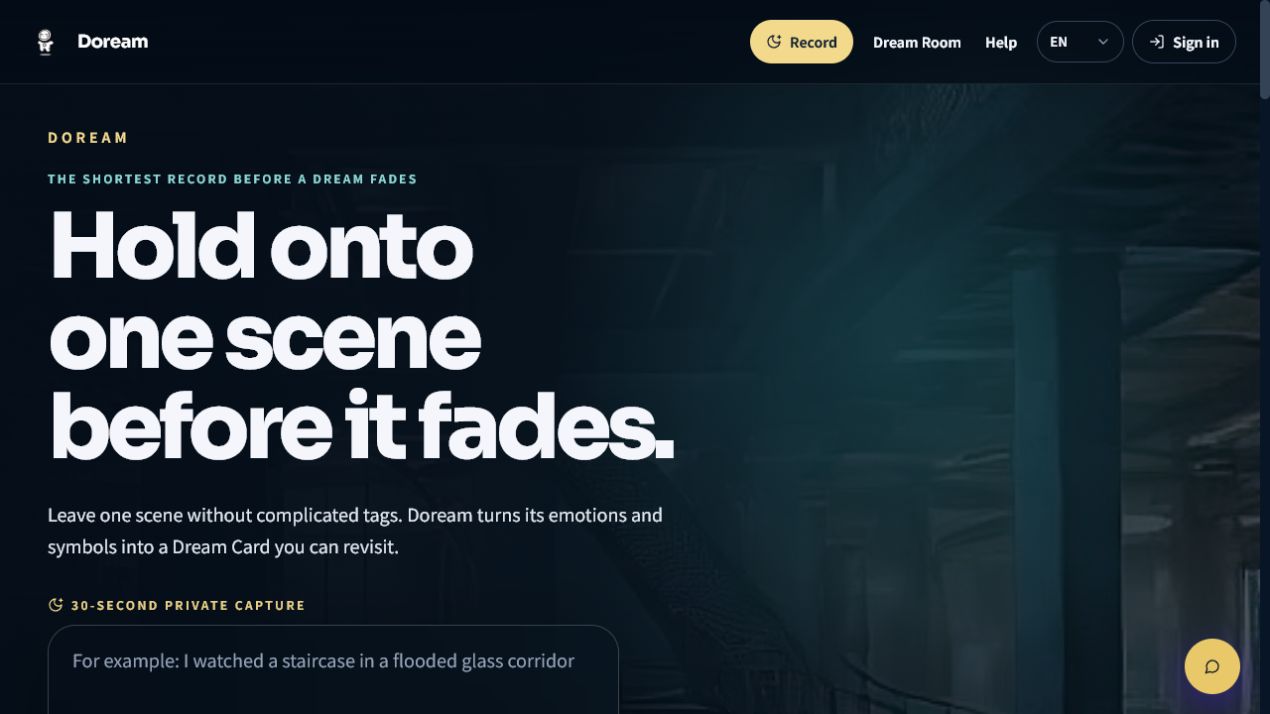
Live product home: a private 30-second capture for one remembered scene before it fades.
-
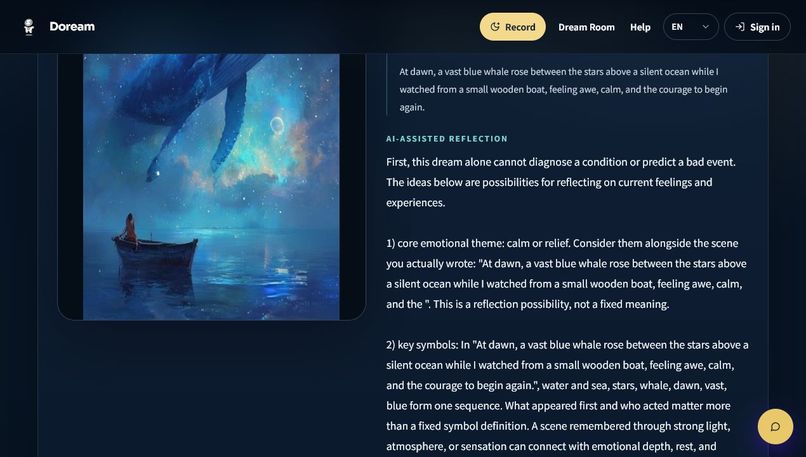
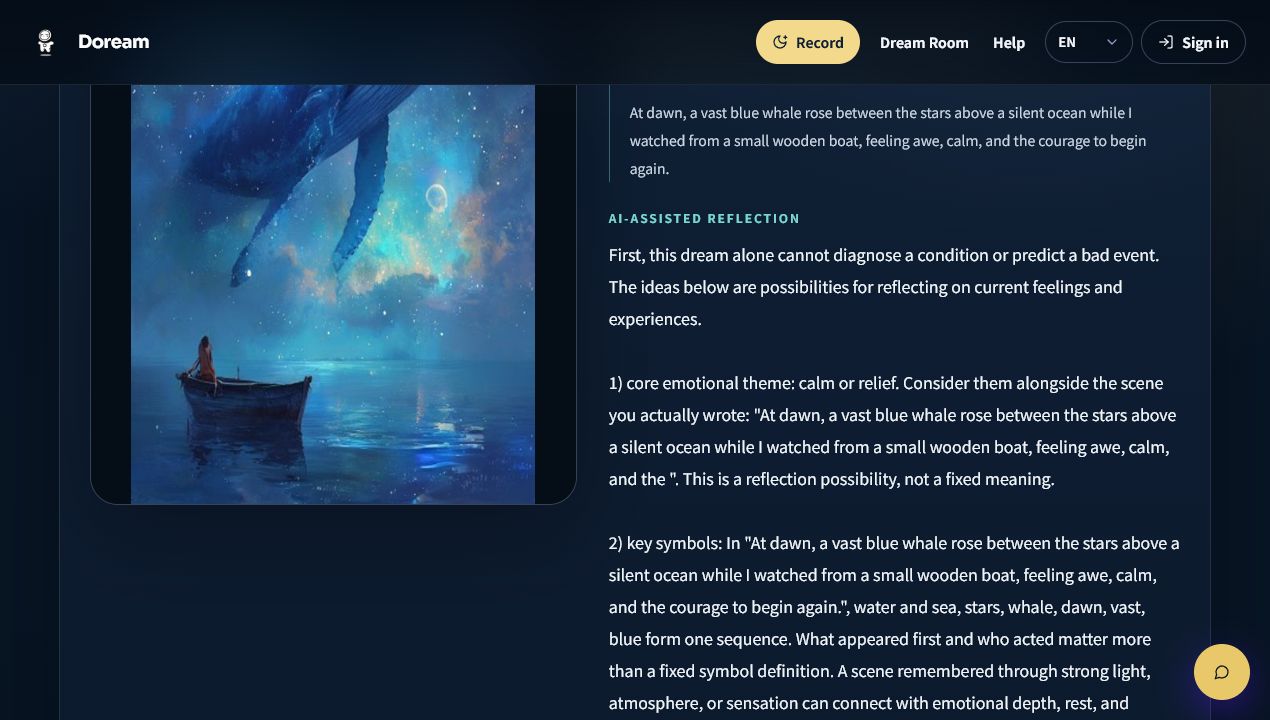
Live English Dream Card: generated imagery and a non-diagnostic reflection grounded only in the user's own words.
-
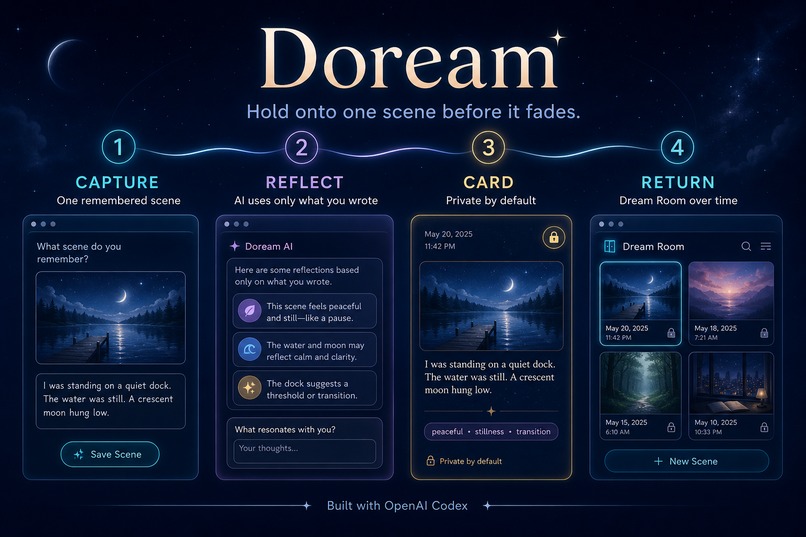
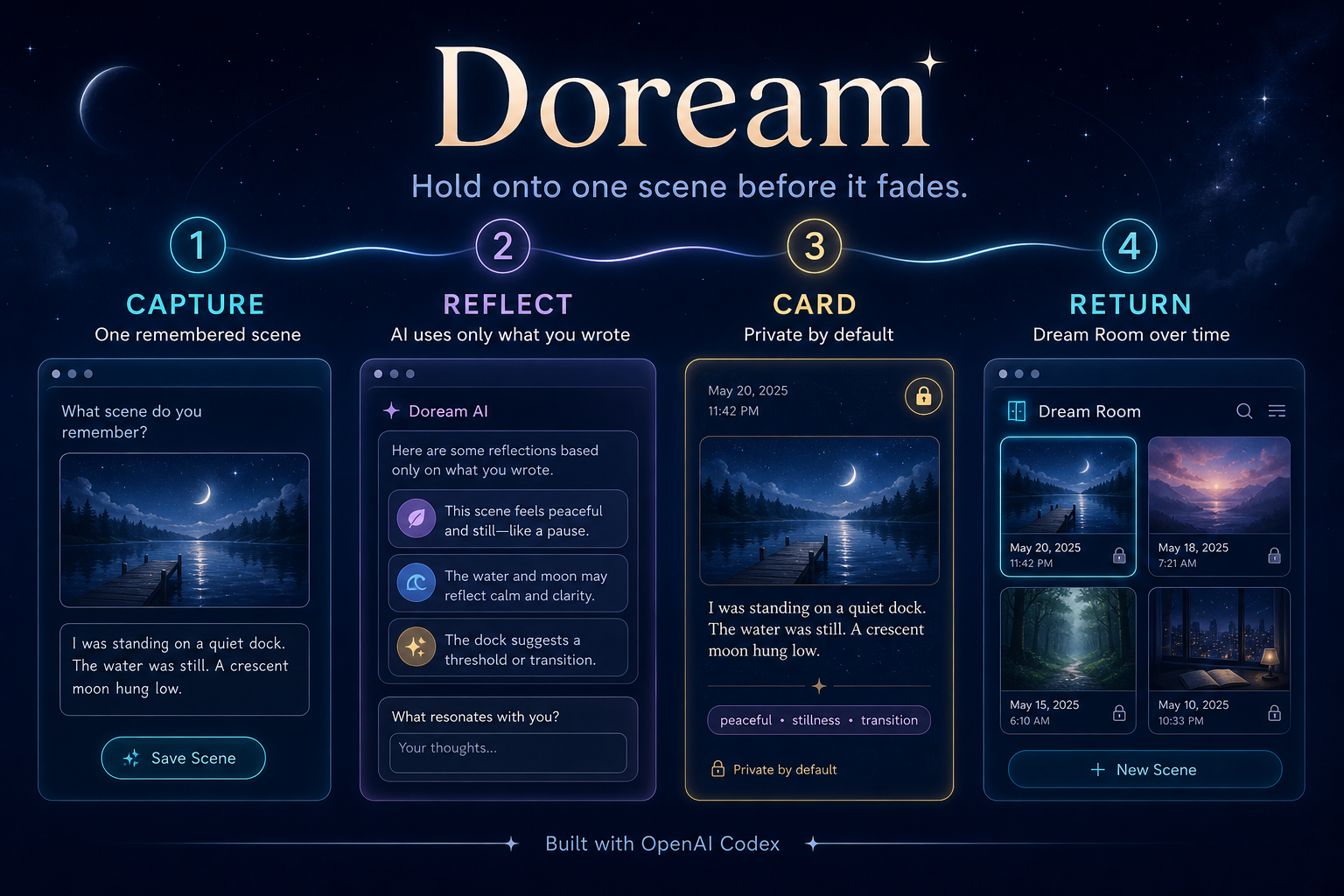
Doream product flow: one scene, grounded AI reflection, a private Dream Card, and a Dream Room to revisit over time.
Inspiration
Most dreams disappear within minutes of waking. Doream began with a simple question: can a person capture one fading dream scene in under a minute, before it disappears, and receive a private reflection grounded only in what they actually wrote?
Why Doream
Doream combines Do and Dream. Do is the action loop: record a dream, keep it as a private journal, turn it into a Dream Card, and—on the roadmap—optionally transfer a card so part of future transaction value can support others. Dream carries two meanings: the dream a user remembers and the future dreams of children we hope to support through a transparent, child-focused Impact Reserve. The submitted product implements the private capture, AI-assisted reflection, Dream Card, and Dream Room experience; trading, ownership transfer, and donations are future opt-in roadmap features, not current claims.
What it does
Doream lets a user record a remembered scene without complicated tags. AI organizes the emotions, symbols, and real-life context already present in the user's words into a private Dream Card. The card returns to a private Dream Room, where the user can revisit the memory and notice patterns over time. Raw dream entries are private by default, sharing is optional, and the experience is explicitly non-diagnostic.
What changed during OpenAI Build Week
The live product existed before the event. During Build Week I used GPT-5.6 through Codex to add and validate a grounded-reflection contract for sensitive dream data. The new behavior:
- mirrors only details supplied by the user;
- separates observation from possible meaning;
- preserves uncertainty;
- avoids diagnosis and invented facts;
- asks one optional clarifying question only when context is too thin.
I isolated the work on a dedicated branch, added 22 contract checks, and documented a reviewer-readable pull request so the existing main branch remained untouched.
How I built it
I am a solo technical founder with more than 18 years of IT development and consulting experience. Codex acted as an engineering force multiplier: it inspected the existing React and TypeScript flow, traced unsupported-inference risks, helped implement the contract, added automated validation, and prepared the release evidence.
The qualifying build session used GPT-5.6 in Codex. The scoped validation passed TypeScript typecheck, 22/22 grounded-reflection checks, and a production build.
Challenges
- Sensitive reflection can drift into invented facts, overconfident symbolism, or diagnostic language.
- The new work had to be isolated from the pre-existing product and evidenced clearly.
- Validation had to improve without exposing private dream content.
- Tool use had to be proven honestly without presenting the tools themselves as the product moat.
Accomplishments
- A live seven-language consumer AI product with a one-minute capture wedge.
- Private-by-default Dream Cards and Dream Rooms.
- A grounded-response contract for emotionally sensitive reflection.
- TypeScript, 22/22 contract checks, and production build passing in scoped CI.
- A public 2:20 English demo with product screens and engineering evidence.
What I learned
For personal and emotionally sensitive AI, restraint is a product feature. A useful system should preserve what the user actually said, show uncertainty, and invite reflection instead of presenting a single authoritative interpretation.
What's next
- Add multilingual grounded-reflection evaluation cases.
- Measure first-card completion, Dream Room revisit rate, latency, and per-card AI cost.
- Improve mobile capture and privacy controls.
- Keep optional ownership transfer, trading, and a child-focused Impact Reserve clearly labeled as roadmap until implemented.
Evidence
- Live product: https://doream.org
- Pull request: https://github.com/DreamersDreaming/dreamverse-nft/pull/20
- Scoped CI: https://github.com/DreamersDreaming/dreamverse-nft/actions/runs/29596704112
- Codex Session ID: 019f6d59-b92d-7683-b188-2e1192b49a82
Built With
- ai
- gpt-5.6
- node.js
- openai-codex
- react
- typescript
- web

Log in or sign up for Devpost to join the conversation.