Inspiration
Doppel was born during our very first hackathon as current freshmen who had never built a full product under pressure before. We walked in unsure of our skills, unsure of our direction, and quickly overwhelmed by the intensity of the environment. Over two sleepless nights, we battled crashing code, broken integrations, and constant self-doubt. There were moments at 2 a.m. when nothing compiled, our logic made no sense, and we genuinely questioned whether we belonged there. But instead of giving up, we kept rebuilding, refactoring, and learning in real time. We discovered that growth happens when you push past exhaustion and fear, that Progress = Effort × Resilience Doppel became more than a project; it became proof to ourselves that even as beginners, we could take an idea, survive the chaos, and turn it into something real.
What it does
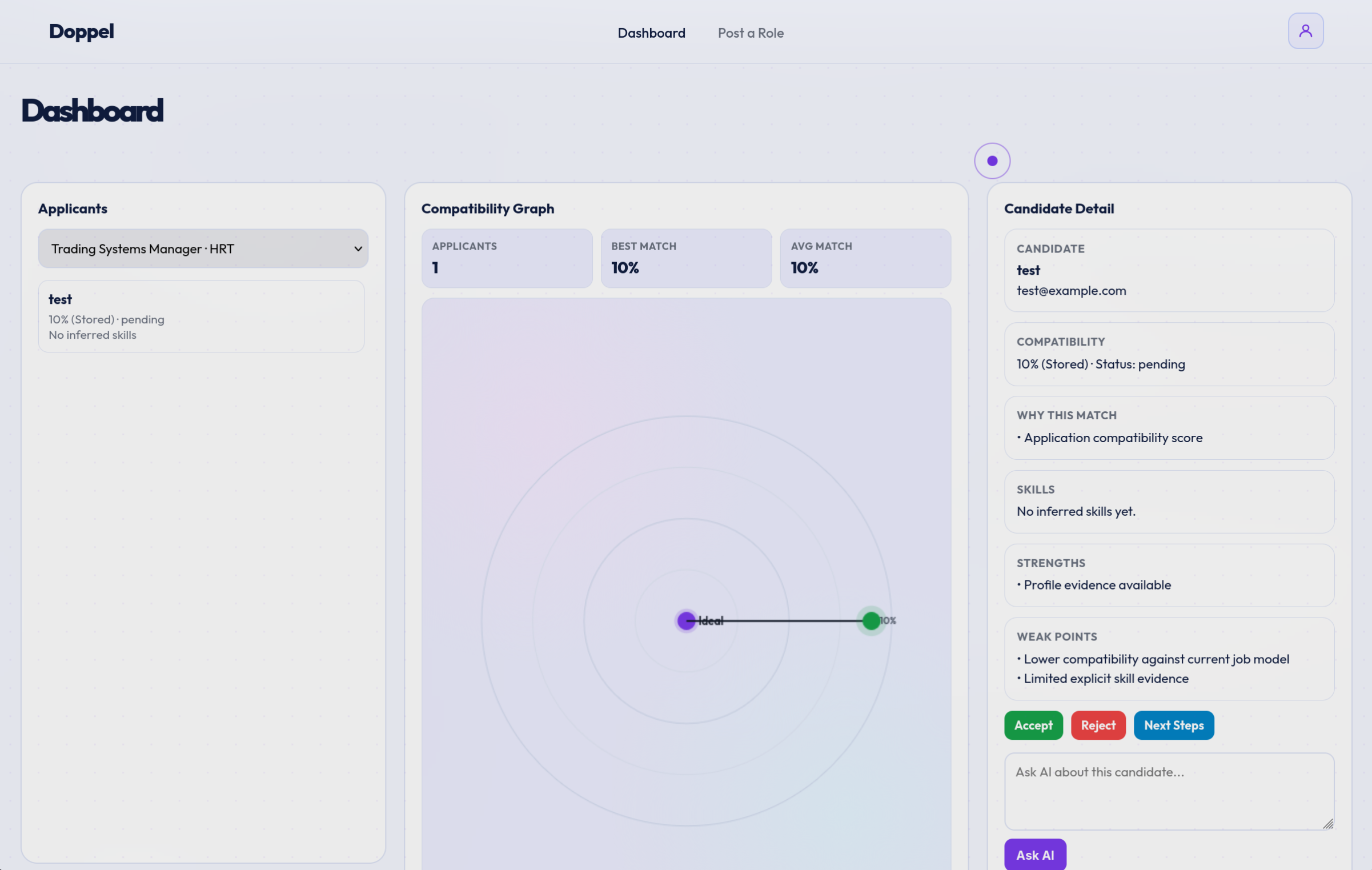
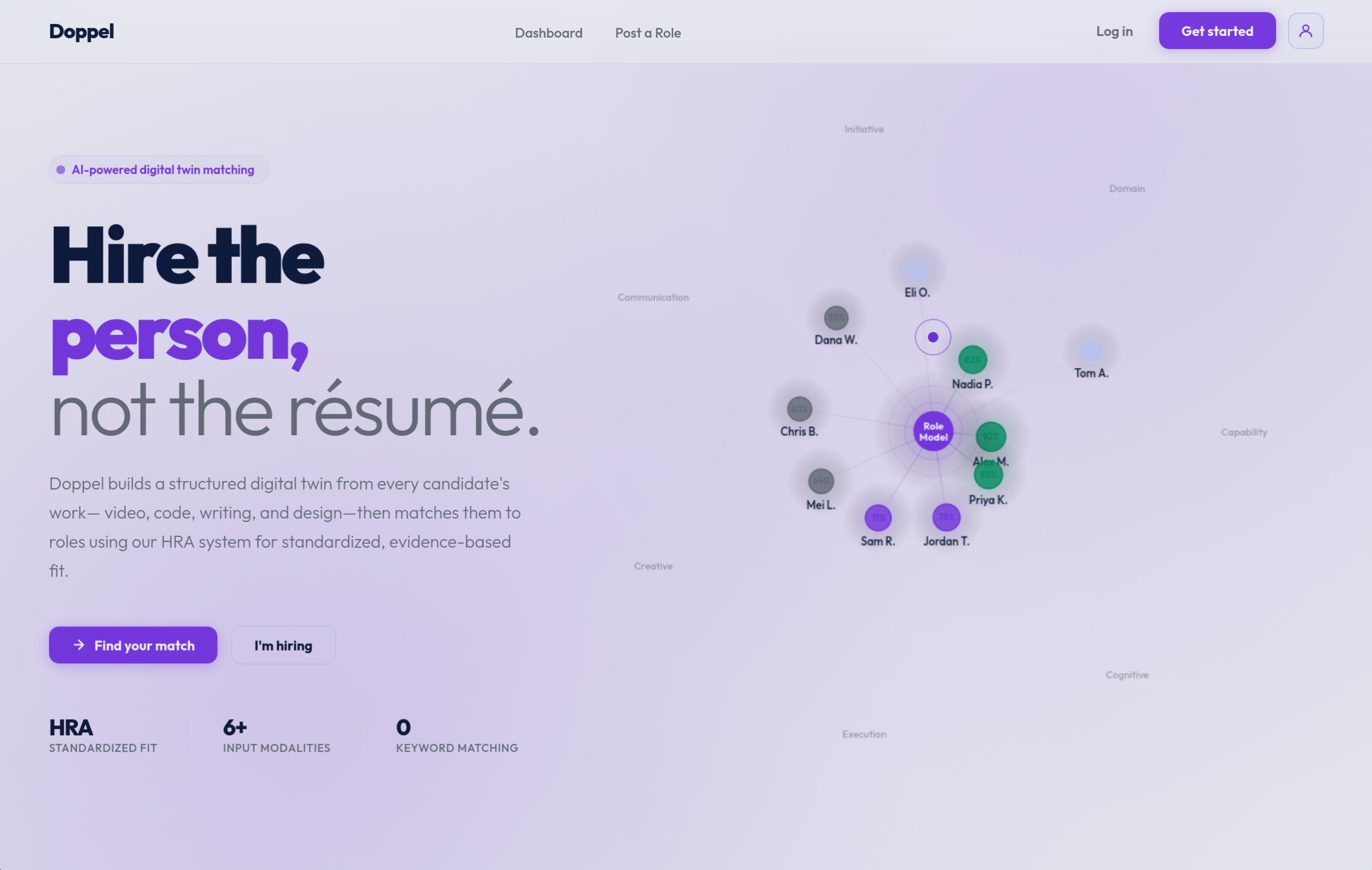
Doppel is an AI hiring platform that replaces the traditional resume-and-keyword-filter process with something fundamentally deeper. Instead of asking candidates to compress their entire career into bullet points, Doppel lets them upload anything - resumes, code, research papers, writing samples, PDFs, project descriptions, and builds a structured digital twin of who they actually are professionally. The AI reads all of it, extracts signals like communication clarity, execution evidence, domain expertise, and initiative, then synthesizes everything into a single unified candidate model. On the employer side, recruiters paste a job description and the system builds a matching structured model of what the role actually requires, not just keywords, but a full profile across seven evaluation dimensions called HRA axes (things like Capability Depth, Execution Reliability, and Cognitive Approach). These scores are intentionally hidden from candidates so no one can game the system. Matching then happens in two layers: semantic similarity via OpenAI embeddings, and Euclidean distance across all seven HRA axes. The result shows up as an interactive graph where candidates are plotted as colored dots around a central job anchor — proximity equals fit. Recruiters can lasso clusters, click candidates to see their full twin profile, and ask the AI natural language questions like "who shows the most initiative?" or "who are your strongest communicators? The core idea is that both candidates and employers are bad at articulating what they want until they see it. Doppel gives them infinite interview depth without the time constraints or bias of in-person screening, matching on demonstrated capability rather than polished presentation.
How we built it
We built Doppel in a fast-paced, high-pressure environment as first-time hackathon freshmen learning as we went. With limited experience and no prior roadmap, we started by breaking the idea into core components: candidate input, evaluation logic, and matching output. We divided responsibilities across frontend, backend, and scoring design, working in parallel to maximize the short timeframe. We began with a simple prototype to validate the concept, focusing first on building a working flow rather than perfection. Once we had a basic structure, we layered in smarter evaluation logic to move beyond static filtering. Instead of relying on rigid criteria, we designed a weighted scoring system. We built quickly, tested immediately, failed often, and adjusted in real time. What started as a rough prototype evolved into a functional system through persistence, collaboration, and rapid iteration under pressure.
Challenges we ran into
Building Doppel was a crash course in first-time hackathon chaos. As freshmen, we had never navigated a project of this scale, and the pressure hit hard. One of our biggest challenges was time — with only 48 hours, we faced two sleepless nights of coding, debugging, and redesigning features on the fly. APIs failed, frontend components broke unexpectedly, and our evaluation logic often returned nonsensical results. Another challenge was translating an abstract idea like “potential” into something measurable. We struggled with how to fairly score skills, mindset, and growth without relying on traditional résumé metrics. Balancing ambition with feasibility forced us to make hard decisions about what features to prioritize and what to cut. Finally, working as a completely inexperienced team brought its own hurdles. Coordination, decision-making under stress, and maintaining focus while exhausted were constant battles. Despite everything, each challenge taught us resilience, rapid problem-solving, and how to turn setbacks into progress.
Accomplishments that we're proud of
Even as first-time hackathon freshmen, we built a fully functional prototype of Doppel in just 48 hours, turning a raw idea into a tangible product. We successfully designed a scoring system that evaluates candidates beyond résumés, factoring in skills, mindset, and growth potential. We overcame technical roadblocks, late-night debugging, and constant uncertainty, proving that determination and collaboration can compensate for inexperience. Most importantly, we transformed a personal moment of frustration into a solution that has the potential to make hiring more human and fair.
What we learned
Through building Doppel, we learned that growth often comes from pushing through discomfort and uncertainty. Facing tight deadlines, technical failures, and the chaos of our first hackathon taught us resilience, rapid problem-solving, and the value of teamwork under pressure. We also realized that abstract concepts like potential can be thoughtfully measured with the right framework, and that empathy can drive innovation just as much as technical skill. Most importantly, we learned that even as beginners, persistence and collaboration can turn an idea born from frustration into something real and impactful.
What's next for Doppel
Moving forward, we plan to refine our evaluation system to better capture skills, mindset, and growth potential, making it more accurate and scalable. We aim to run pilot programs with startups and mid-sized companies to test and validate our approach in real hiring scenarios. Future updates will include AI-guided feedback for candidates, helping them grow even if they aren’t selected, and evolving professional profiles that reflect a candidate’s continuous learning and achievements. Ultimately, our goal is to create a hiring ecosystem where opportunity is defined by ability and potential, not just the résumé ensuring that no talent goes unnoticed.

Log in or sign up for Devpost to join the conversation.