DopaLearn – Project Story
About the Project
💡 What Inspired Me
I repeated my second year of baccalaureate.
I felt sleepy after one hour in math class. My head hurt. I couldn't focus.
But I learned AI by myself in months. Because I enjoyed it.
That contradiction haunted me. Why can I learn AI for 12 hours straight, but can't sit through a 1-hour math class?
The answer wasn't discipline. It was dopamine.
When I build AI projects, I get immediate feedback. I see results. I fail, fix, and succeed. My brain rewards me.
When I sit in class, I receive information passively. No feedback. No discovery. No dopamine. Just boredom.
So I asked myself: What if learning was designed around dopamine, not around lectures?
That's DopaLearn.
🔍 What I Learned
I learned that education isn't broken because teachers don't care, or because students are lazy.
Education is broken because it's designed around the wrong reward system.
- 74% of students in Morocco leave high school without a diploma.
- 53% don't complete middle school.
- Only 1 in 4 earns a baccalaureate.
- The Minister of Education said: "They feel bored and leave to the alley."
The system assumes students will learn because they should. But the brain doesn't work that way. The brain learns because it wants to. And it wants to when dopamine is involved.
I also learned that failure is the most underused tool in education.
In traditional systems, failure is punished. In DopaLearn, failure is data. Students analyze it, learn from it, and try again. Every failure is a step on the map to success.
🛠️ How I Built It
DopaLearn is an AI-powered educational agent that teaches through conversation, not lectures.
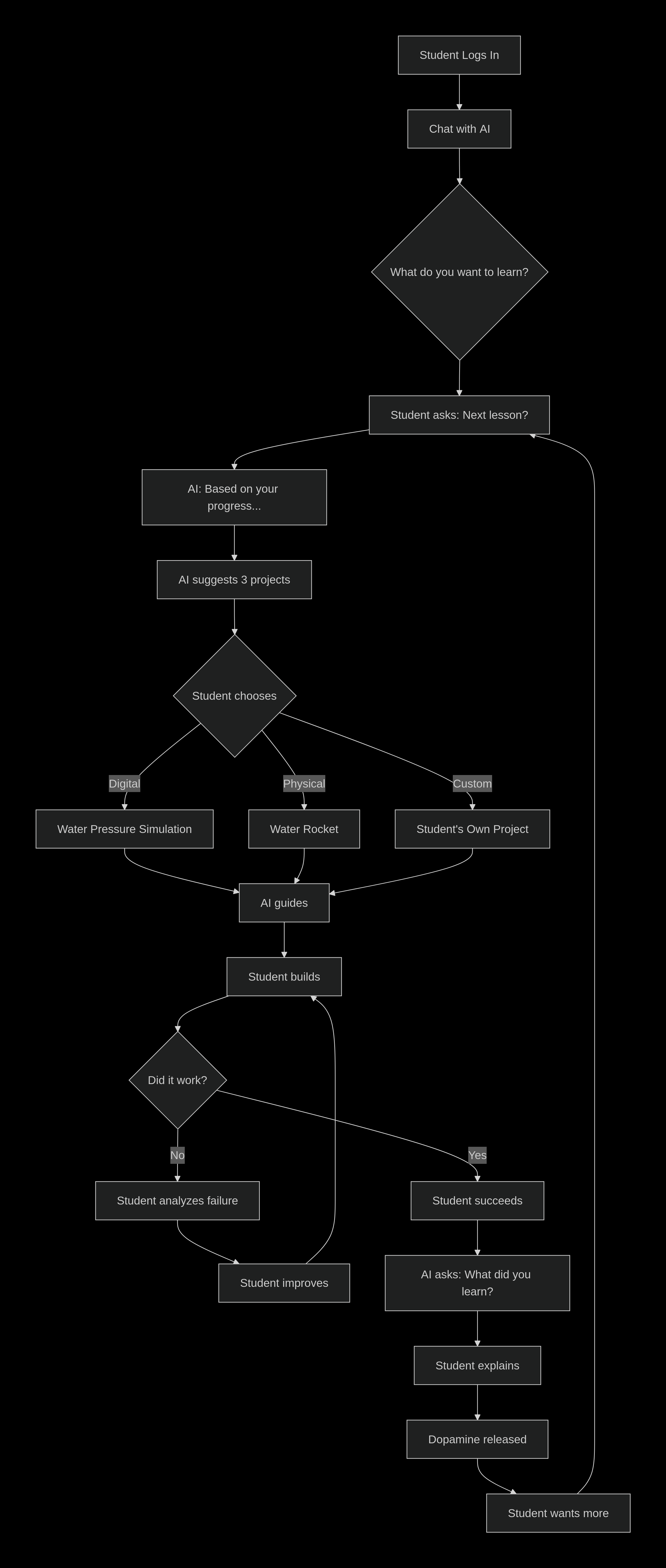
The core loop:
- Student asks: "What is the next lesson in physics?"
- AI responds: "Based on your progress, the next lesson is Pressure & Fluids."
- Student asks: "What are the project suggestions?"
- AI suggests: Digital, physical, or custom.
- Student chooses. AI guides.
- Student builds, fails, analyzes, succeeds.
- AI asks: "What did you learn?"
- Dopamine released. Student wants more.
What makes it different:
- The AI never gives answers directly. It asks guiding questions.
- The AI never does calculations. It guides the student to do them.
- The AI makes the student rely on memory gradually.
- The AI connects new lessons to previous ones.
- Failure becomes a friend, not a curse.
What I built:
- Interactive mockup (HTML/CSS) — 4 screens: login, chat, profile, settings.
- Flowchart (Mermaid) — showing the full learning loop.
- Presentation (16 slides) — explaining the problem, solution, impact, and roadmap.
- Video (2-3 minutes) — synced with voiceover.
- Agent architecture — designed for a production system.
Tech stack:
- Manim for the video
- MoviePy for audio sync
- HTML/CSS for the mockup
- Mermaid for the flowchart
- Groq + Whisper for transcription
🧗 Challenges I Faced
1. The video sync problem.
I needed the video to match the voiceover exactly. But Manim doesn't know the audio duration. I solved it by writing a sync_to() function that waits until each scene reaches its target timestamp.
2. The corrupted file problem.
Colab kept cutting off mid-render. Scene2_Solution.mp4 was corrupted (moov atom not found). I solved it by rendering at lower quality (-pqm) and saving each scene to Google Drive immediately.
3. The "AI shouldn't do the work" problem.
My first design had the AI doing calculations. But that defeats the purpose. The student must do the work. The AI must guide. I redesigned the entire flow around Socratic questioning.
4. The "no images" constraint.
I couldn't rely on images. So I used Manim to generate everything programmatically: text, shapes, colors, transitions.
5. The personal story problem.
I wasn't sure if sharing my failure (repeating a year) would hurt my application. But then I realized: the failure is the story. Without it, DopaLearn is just another edtech idea. With it, DopaLearn is a solution to a problem I've lived.
🌍 Why This Matters
DopaLearn isn't just an app. It's a philosophy:
Education shouldn't be painful. It should be addictive.
If we design learning around dopamine, students won't just tolerate school. They'll crave it.
If we treat failure as data, students won't fear mistakes. They'll learn from them.
If we let AI guide instead of answer, students won't memorize. They'll understand.
That's the future I want to build.
👤 About Me
I'm Youssef Lamin, 18, from Morocco.
I repeated a year. I know what boring education feels like.
I built The Lone Engineer (playable narrative demo), G.T.B v2 (agentic AI orchestrator on Strands Agents SDK), Opt-MobileNet (0.13 MB classifier, top 2.3% in Arm Create, 57/2476), and Atlantis (meta-evaluation agent, 3 axes, 4 models).
I'm not a traditional engineer. I'm a Systems Architect who designs multi-agent workflows and evaluation loops. I direct AI to write code while I focus on architecture, design, and verification. Evidence over pedigree.
Let's make learning addictive.
🔗 Links
- GitHub: github.com/glitch144420
- LinkedIn: linkedin.com/in/youssef-lamin-48704934b
- Medium: medium.com/@Socratically
- Email: [email protected]
Built With
- english

Log in or sign up for Devpost to join the conversation.