-
-
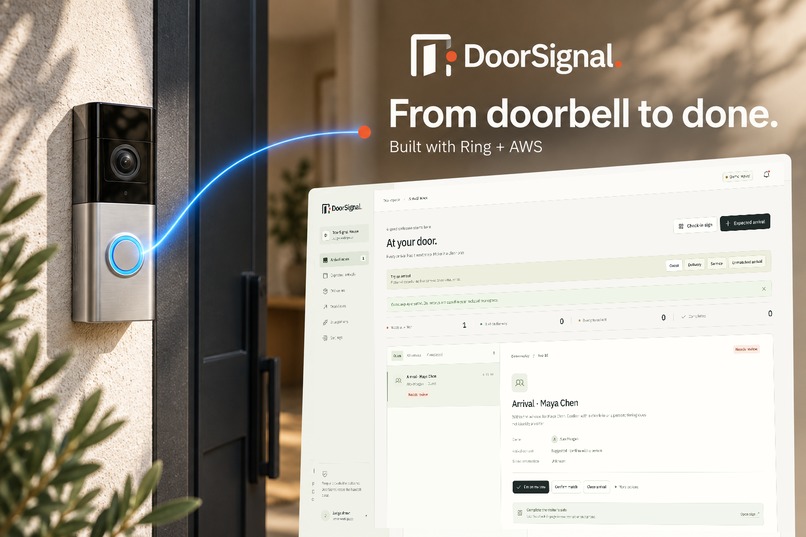
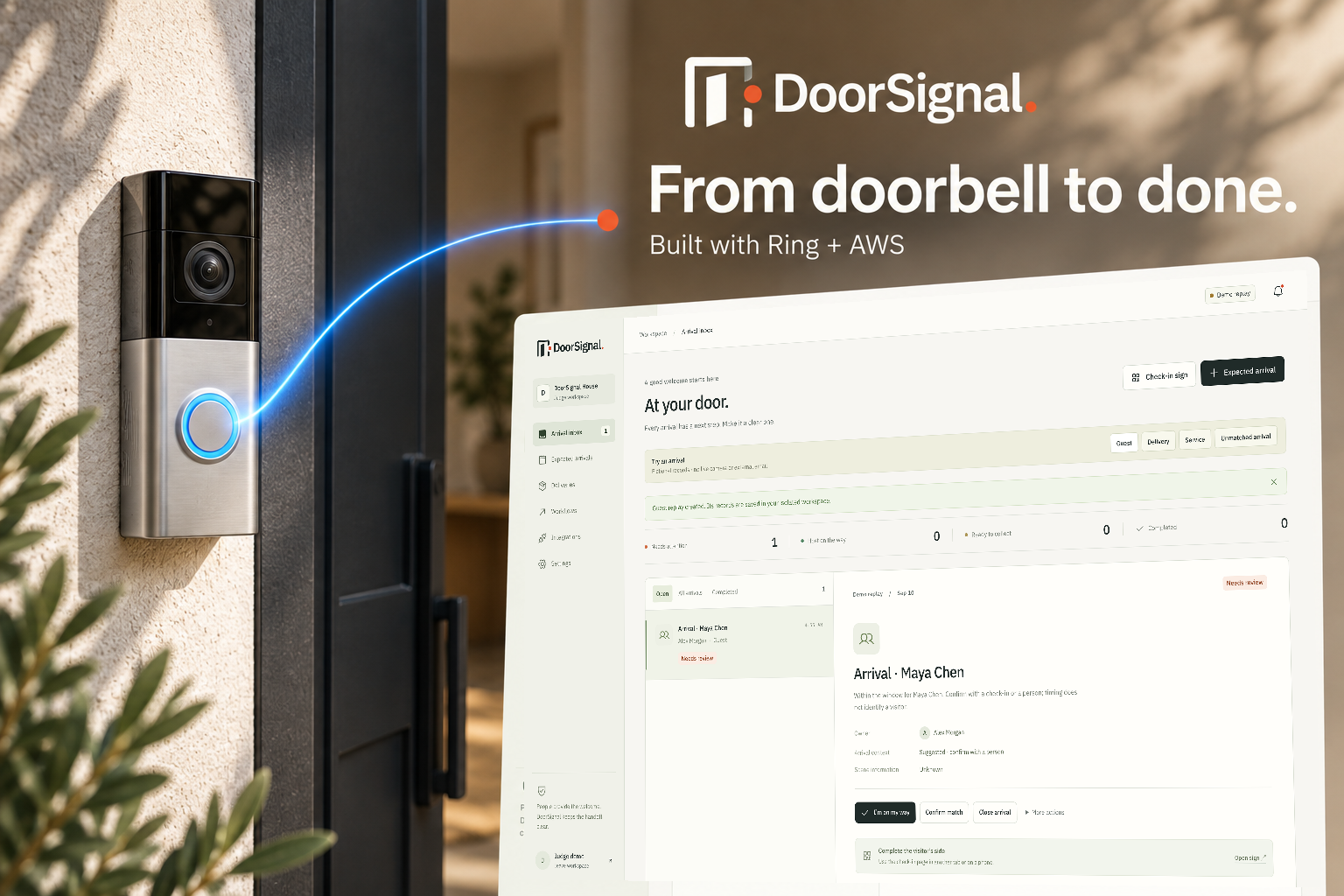
DoorSignal — Ring events become accountable guest, delivery, and service workflows.
-
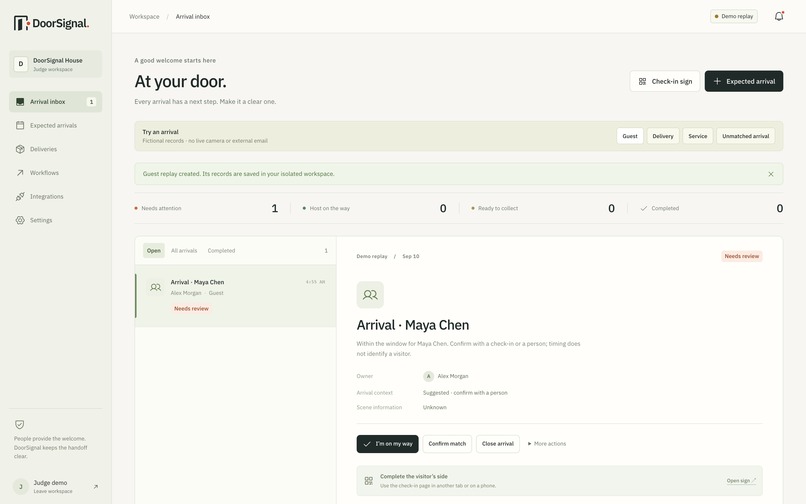
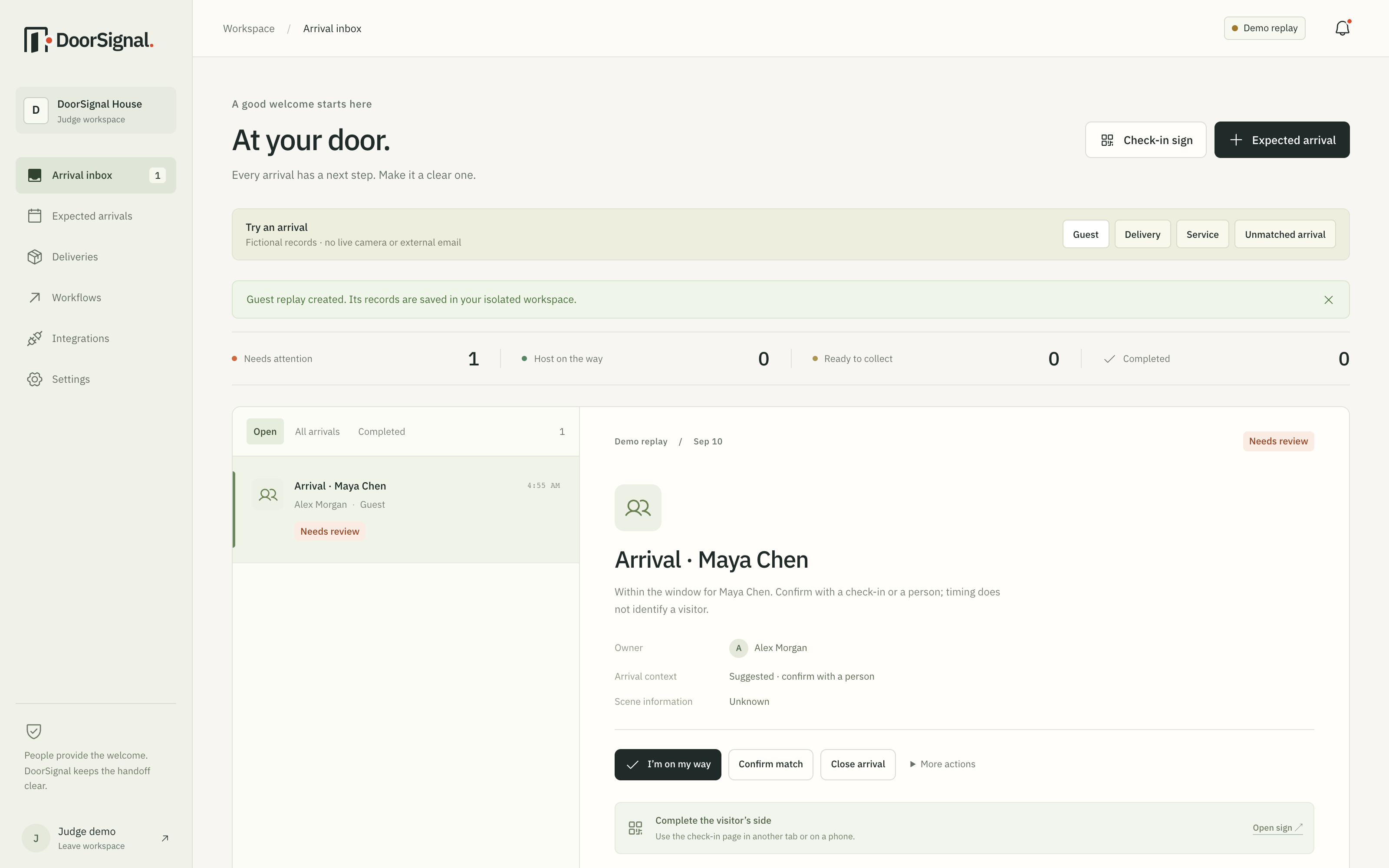
Operator inbox — clear ownership, evidence, status, and next action.
-
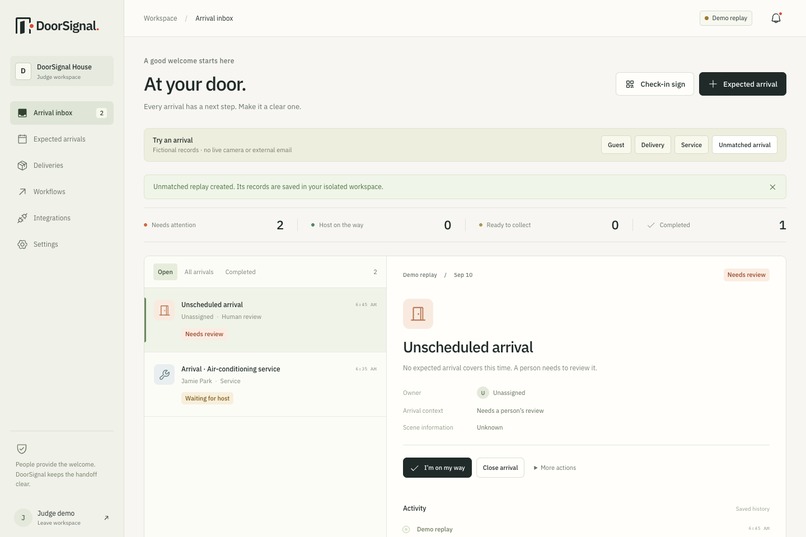
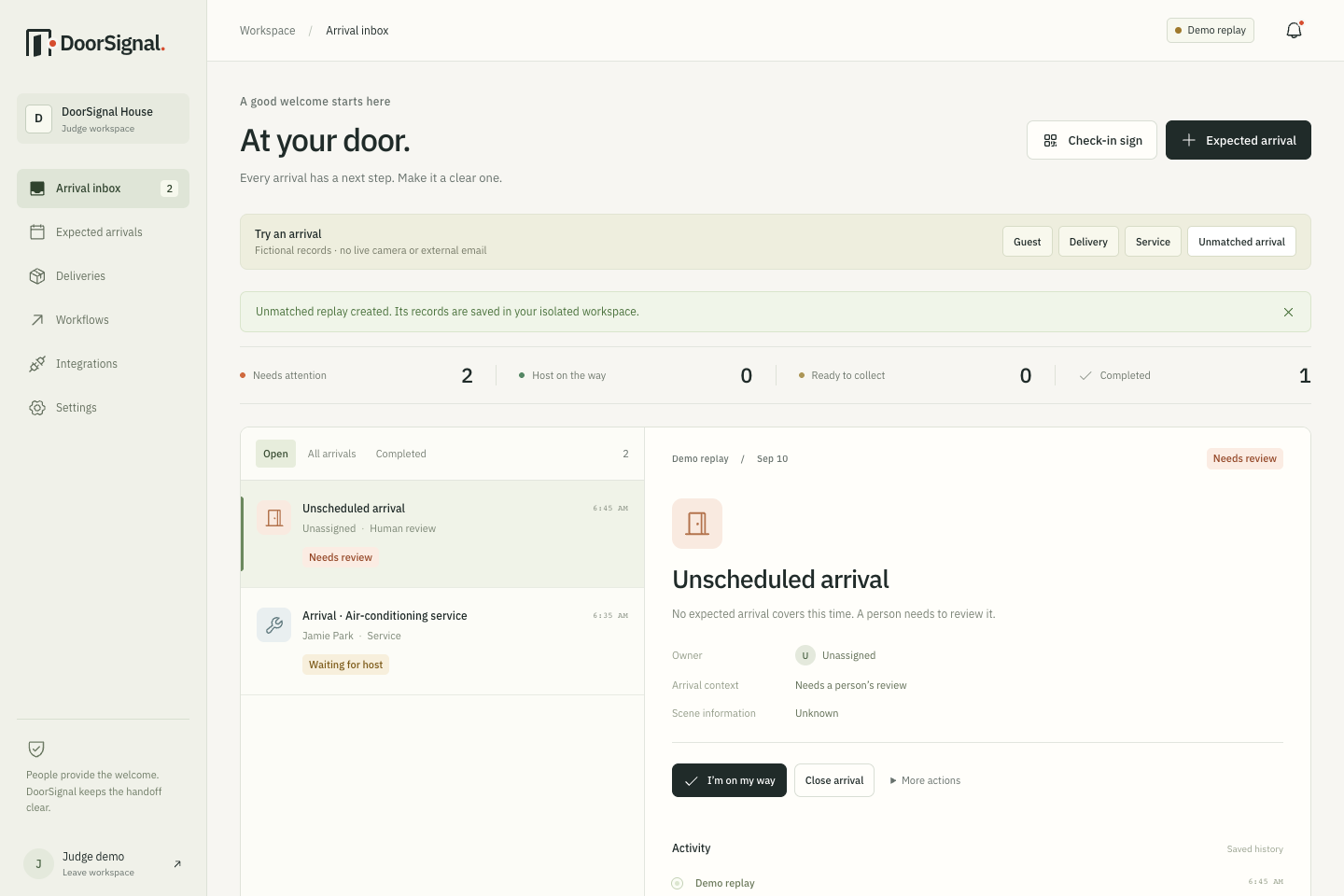
Scheduled service versus unmatched after-hours arrival — human review stays in control.
Inspiration
A small studio can have a smart doorbell, a schedule full of visitors, deliveries arriving throughout the day, and no receptionist connecting those facts. A generic motion alert still leaves the team asking: why is this person here, who should respond, and did anyone finish the handoff?
DoorSignal treats the front door as a shared operational inbox. It adds context and ownership while keeping identity decisions with people.
What it does
DoorSignal turns a Ring button press or motion event into a durable arrival case. It compares the event with expected guest, delivery, and service windows, then shows what matched and who owns the next step. A printable QR sign lets a visitor check in from their own phone. When the host responds, that status appears on the visitor's page.
Three workflows make the handoff concrete:
- A guest arrival is associated with a scheduled visit, strengthened by voluntary QR check-in, and acknowledged by the host.
- A delivery moves from received to collected with accountable actions and timestamps.
- A scheduled service visit can be suggested, while an unmatched after-hours arrival is described objectively and sent to human review.
DoorSignal does not perform facial recognition. A schedule is only a suggestion; check-in evidence or a human confirms the context. Amazon Nova 2 Lite can return coarse facts such as whether a person, package, or vehicle is visible. Invalid or unavailable model output becomes unknown, and the model cannot take actions.
How we built it
The Next.js 16 application runs on AWS Lambda through Lambda Web Adapter and HTTP API Gateway. Cognito protects operator controls. Production records live in DynamoDB with optimistic transactions, TTL, and site isolation. A signed Ring webhook is verified against its original bytes and persisted before acknowledgment. DynamoDB Streams forwards accepted work to EventBridge; a Lambda worker retries processing and sends exhausted work to SQS.
The server-side Ring adapter uses api.amazonvision.com for account and device discovery, recent event history, transient images, and receive-only WHEP session creation and deletion. Short-lived playground credentials and the webhook secret live in Secrets Manager.
Nova 2 Lite is invoked through the Bedrock Converse API with a fixed schema, two attempts, a 128-token output limit, and no identifying prompt. In-app notifications are durable. SES email tracks queued, accepted, and failed states and is disabled in the public judge replay.
The public demo uses a unique one-day partition with fictional data, so judges can test every workflow without accessing a live Ring account or sending external notifications. The UI adapts a clear activity inbox and shared ownership model across desktop, tablet, and phone.
Challenges
The original prototype used an incorrect webhook shape and in-memory simulations. Correcting it required preserving the exact request bytes, validating Ring's v1.1 envelope, joining JSON:API device relationships, and treating missing device state as unknown. WHEP cleanup also needed strict same-origin validation so credentials could never follow an arbitrary URL.
Durable asynchronous work was another challenge: receiving a webhook is not the same as finishing it. DoorSignal records acceptance first, then lets Streams, EventBridge, Lambda retries, and the dead-letter queue own processing. Tests cover duplicate deliveries, restarts, concurrent actions, token expiry, offline devices, malformed model output, and notification failure.
AWS deployment revealed a custom Budget date-format mismatch at CloudFormation time and an account verification restriction on new CloudFront distributions. We documented both observations and deployed the app through the API Gateway hosting path while retaining the CloudFront/private-S3 configuration for an account where CloudFront creation is enabled.
What we learned
Confidence at a physical doorway should come from explicit evidence, not a model's guess. The strongest product experience came from showing the reason for a match, preserving unknown, and giving one person a clear next action. We also learned to separate local tests, deployed infrastructure, live Ring calls, model invocation, and email delivery evidence; each proves something different.
What's next
After the hackathon, the next gates are a stable Ring partner credential flow, SES production access, site-specific privacy review, accessibility testing with real participants, and a monitored pilot at one consenting workplace. Future integrations would enter through the same expected-arrivals API rather than adding unverified provider badges.
Built With
- amazon-api-gateway
- amazon-bedrock
- amazon-cloudwatch
- amazon-cognito
- amazon-dynamodb
- amazon-eventbridge
- amazon-nova-2-lite
- amazon-ses
- amazon-sqs
- aws-budgets
- aws-cdk
- aws-lambda
- aws-secrets-manager
- dynamodb-streams
- lambda-web-adapter
- next.js
- qrcode
- react
- ring-api
- ring-developer-playground
- typescript
- vitest
- whep
- zod

Log in or sign up for Devpost to join the conversation.