-
-
Home
-
Dashboard
-
Store
-
Passes
-
Rules
Inspiration
I didn't start with an idea. I started with what PayPal is saying about AI shopping.
- On the Q2 2026 earnings call, PayPal's CEO said that "looking to 2028 and beyond," next-generation innovations "such as agentic payments and digital identity" will "become increasingly meaningful contributors" to the business.
- At Ai4 2026, PayPal's CTO put it simply: "It all comes down to trust." PayPal's answer is Know Your Agent (KYA), "extending the identity verification behind Know Your Customer and Know Your Business" to AI agents.
- PayPal lists agentic commerce's non-negotiables as "clear consumer consent, trusted identity, reliable payments, and built-in fraud protection." It talks about "helping you tell the difference between legitimate shopping agents and malicious bots," and notes that many merchants "are struggling with where or how to get started."
- Shoppers are cautious. In Checkout.com's 2026 survey, one in four (24%) said they will never delegate purchases to AI, and their non-negotiables were spending caps (30%) and instant revocation (29%).
Agents can already check out on other platforms: Shopify opened checkout to browser-based AI agents in September 2026, and Stripe previewed bot-abuse prevention "designed to accurately distinguish legitimate AI agents from fraudulent actors." When I looked through public projects for this hackathon in October, most were built from the buyer's side: spending limits, escrow, shopping agents. I found none building the checkpoint on the merchant's side. So I built it.
What it does
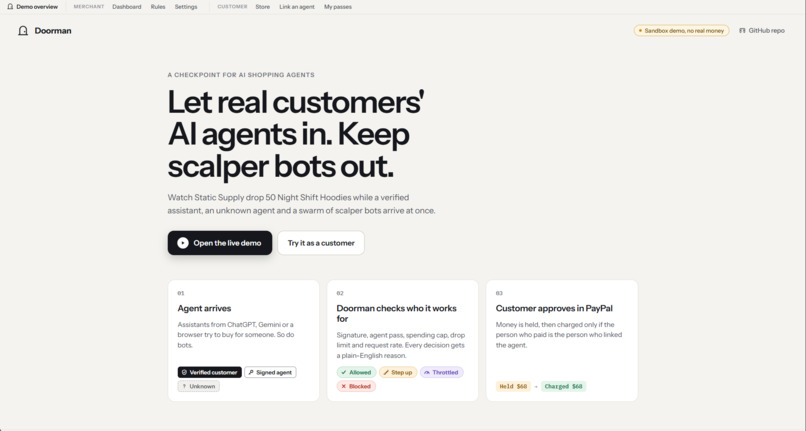
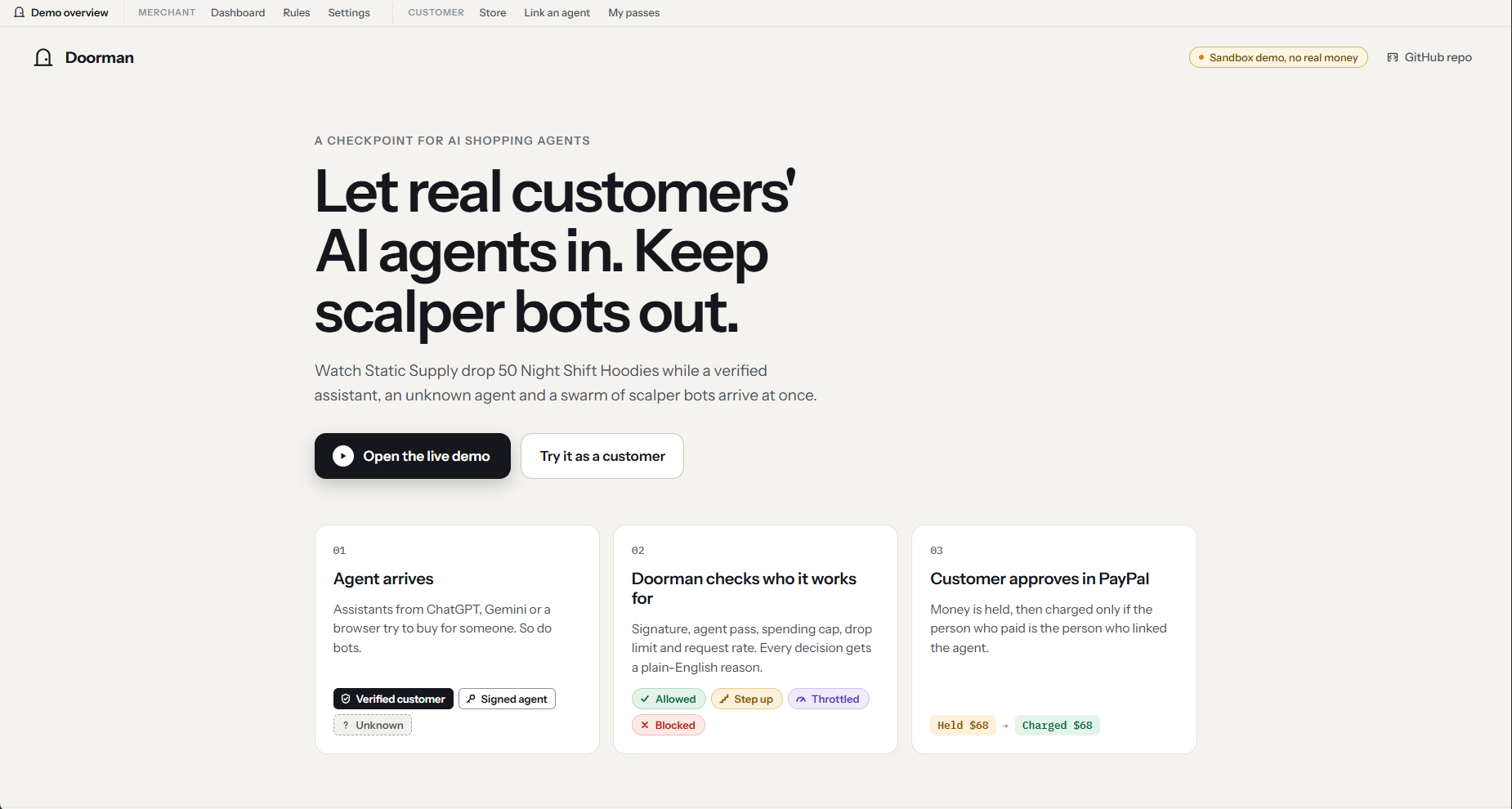
Doorman sits in front of a PayPal merchant's store and decides, for every request, whether an AI agent gets in.
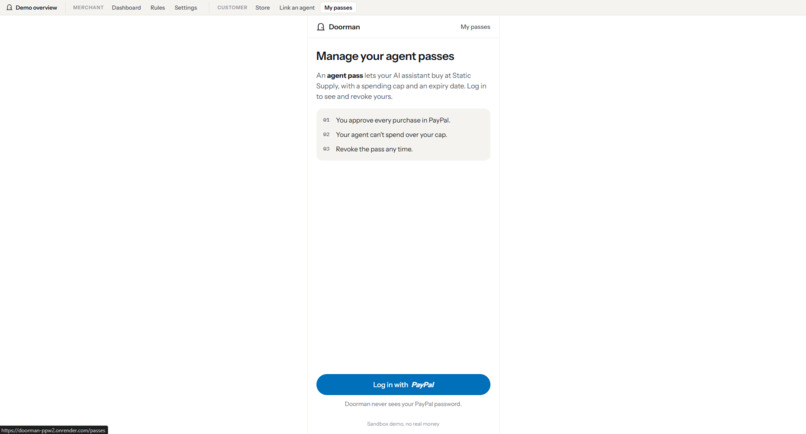
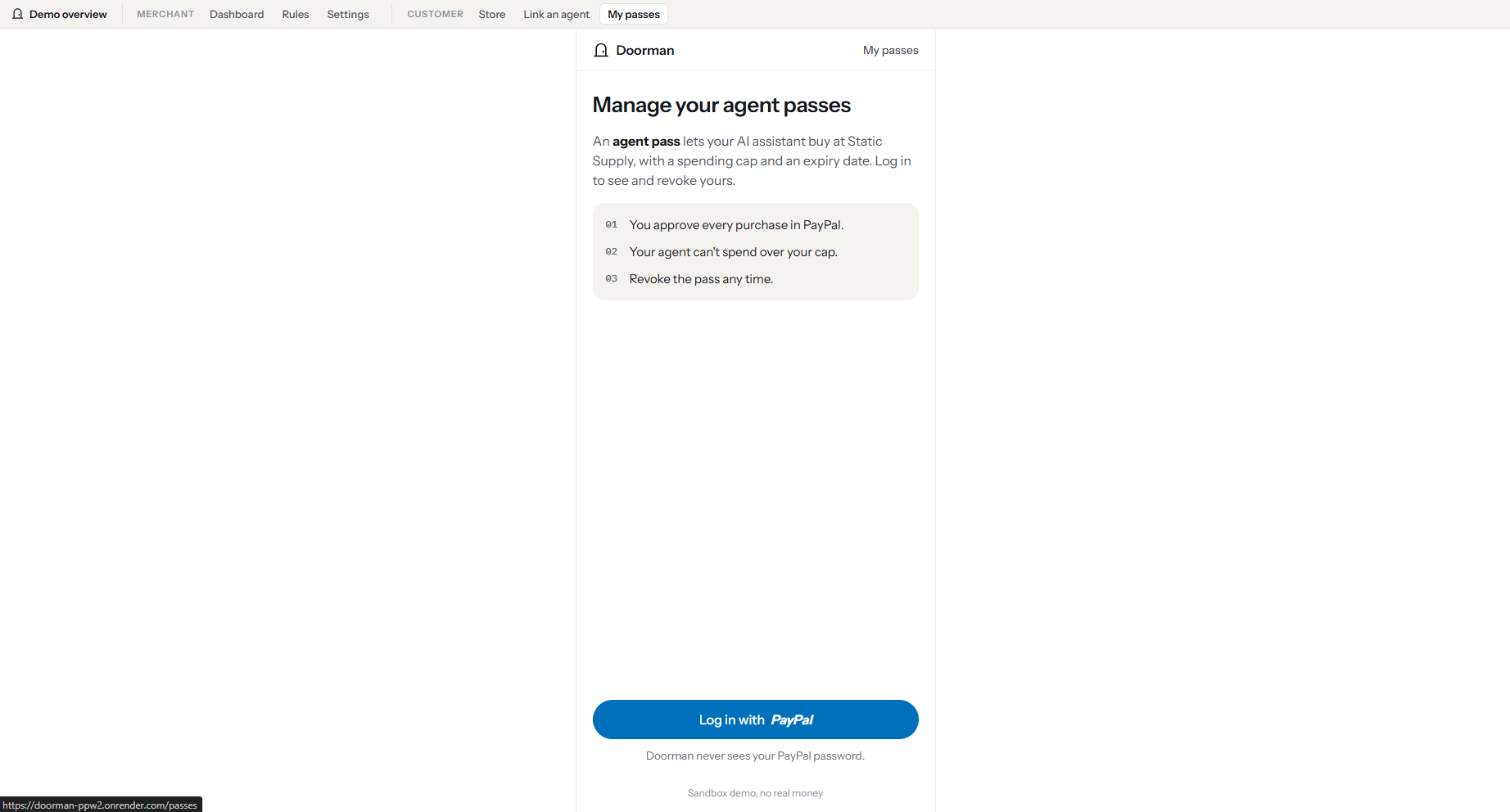
- Customers give their agent a pass. They log in with PayPal, so Doorman knows they're a real, verified person. Then they choose their assistant and set a total spending cap and an expiry date. They can revoke the pass at any time.
- Agents prove who they are. Every request is signed with the agent's own key (HTTP Message Signatures, RFC 9421) and carries its pass. Agents shop through an MCP server, so any AI agent can use the store.
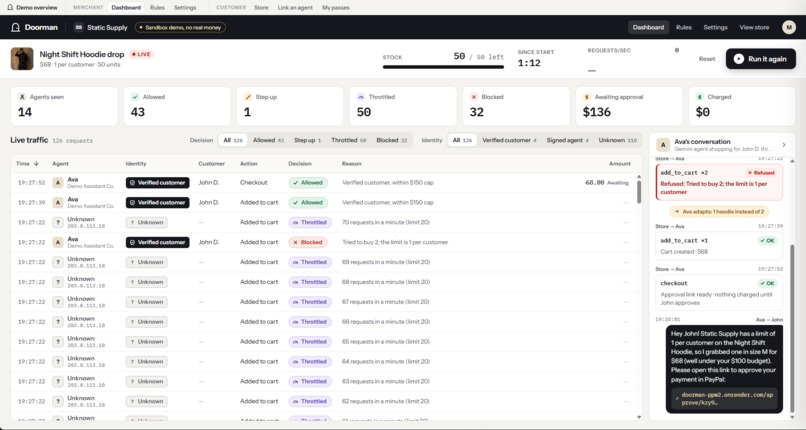
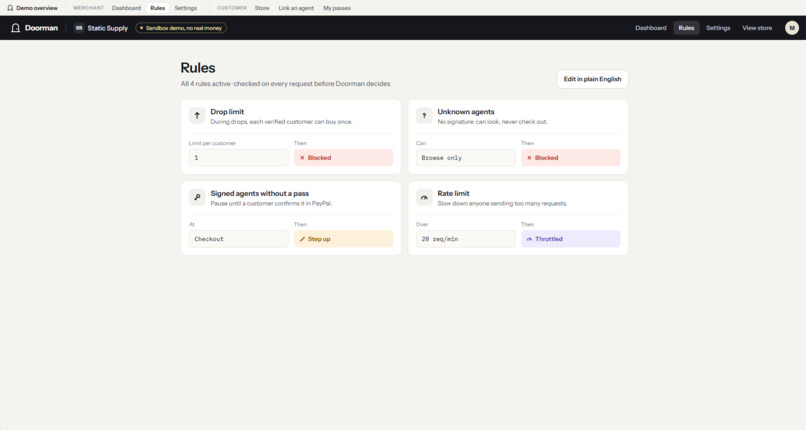
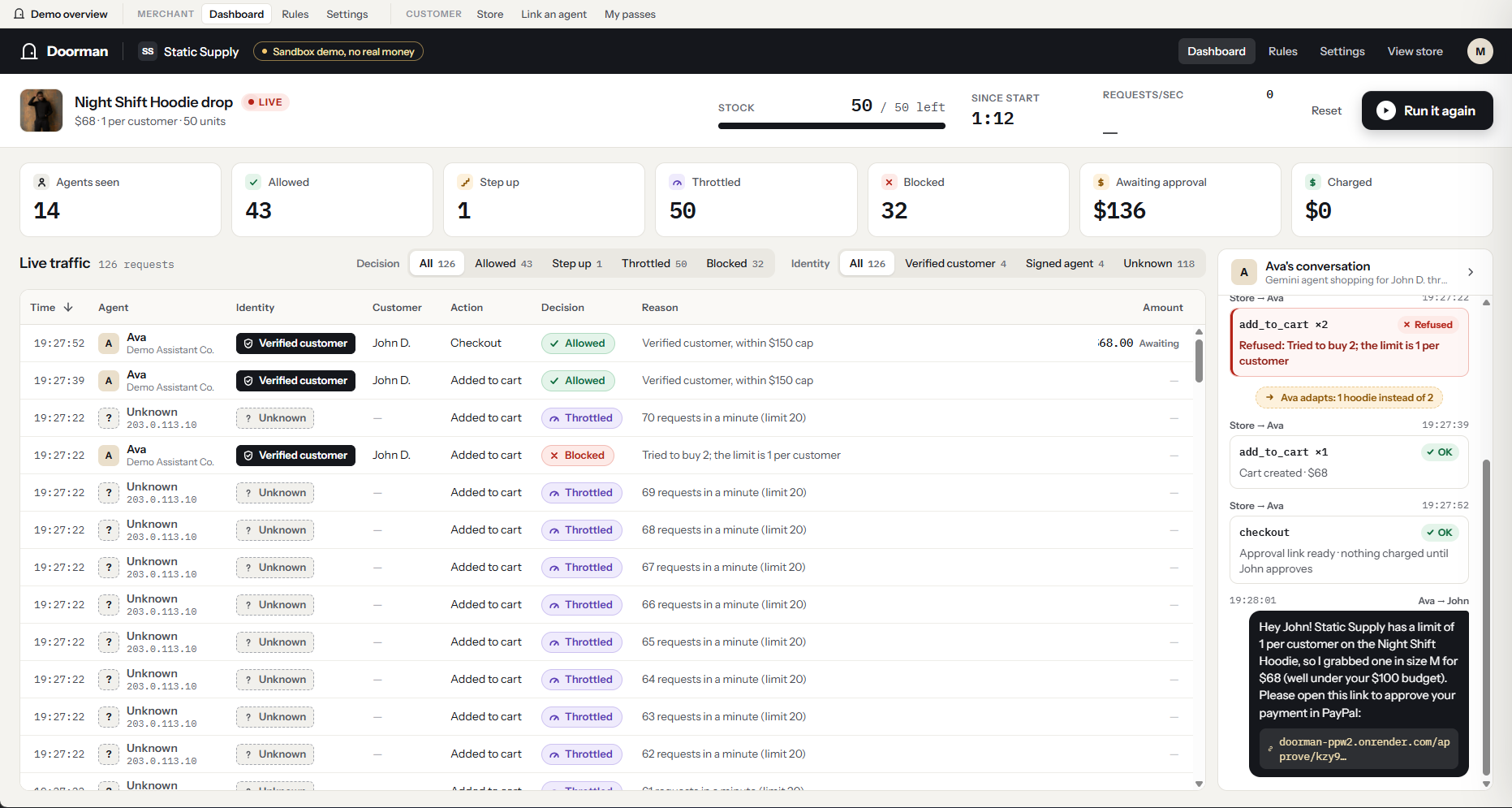
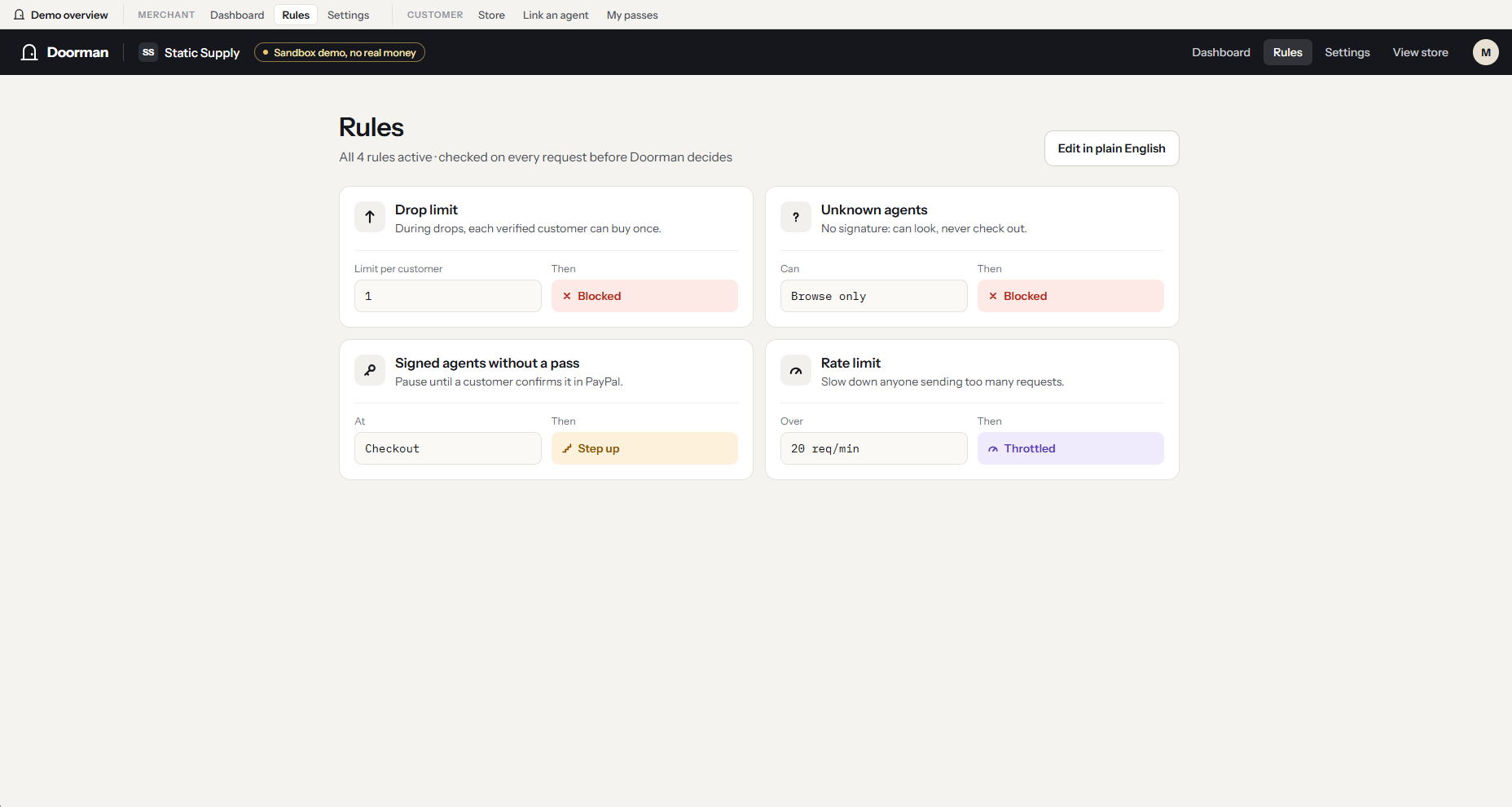
- Doorman decides, and says why. Each request is allowed, sent to step up, throttled or blocked, based on the signature, the pass, the spending cap, the drop's per-customer limit and the request rate. Every decision has a plain-English explanation.
- Every agent purchase ends in PayPal. The order is created with intent AUTHORIZE. After the customer approves in PayPal, Doorman checks that the person who paid is the one who gave the pass, and that the cap and the drop limit still hold. Only then does it capture; otherwise it voids the hold. Verified webhooks keep every order in step with PayPal.
- The merchant sees everything live: a real-time traffic table, the checks behind each decision, the agent's conversation, and rules written in plain English. It works on desktop and on a phone.
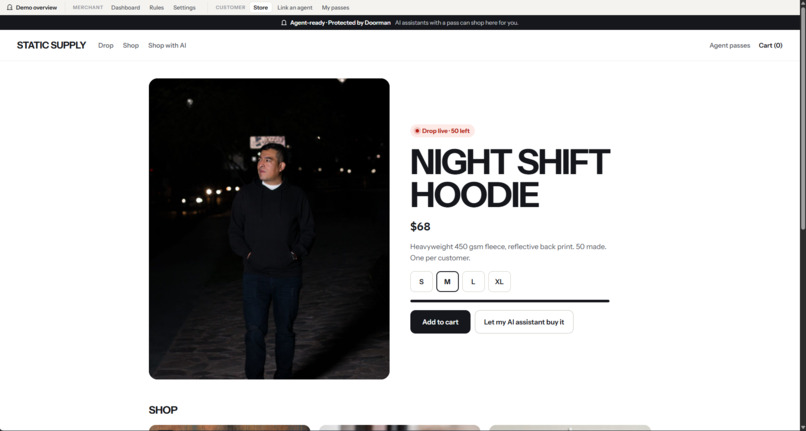
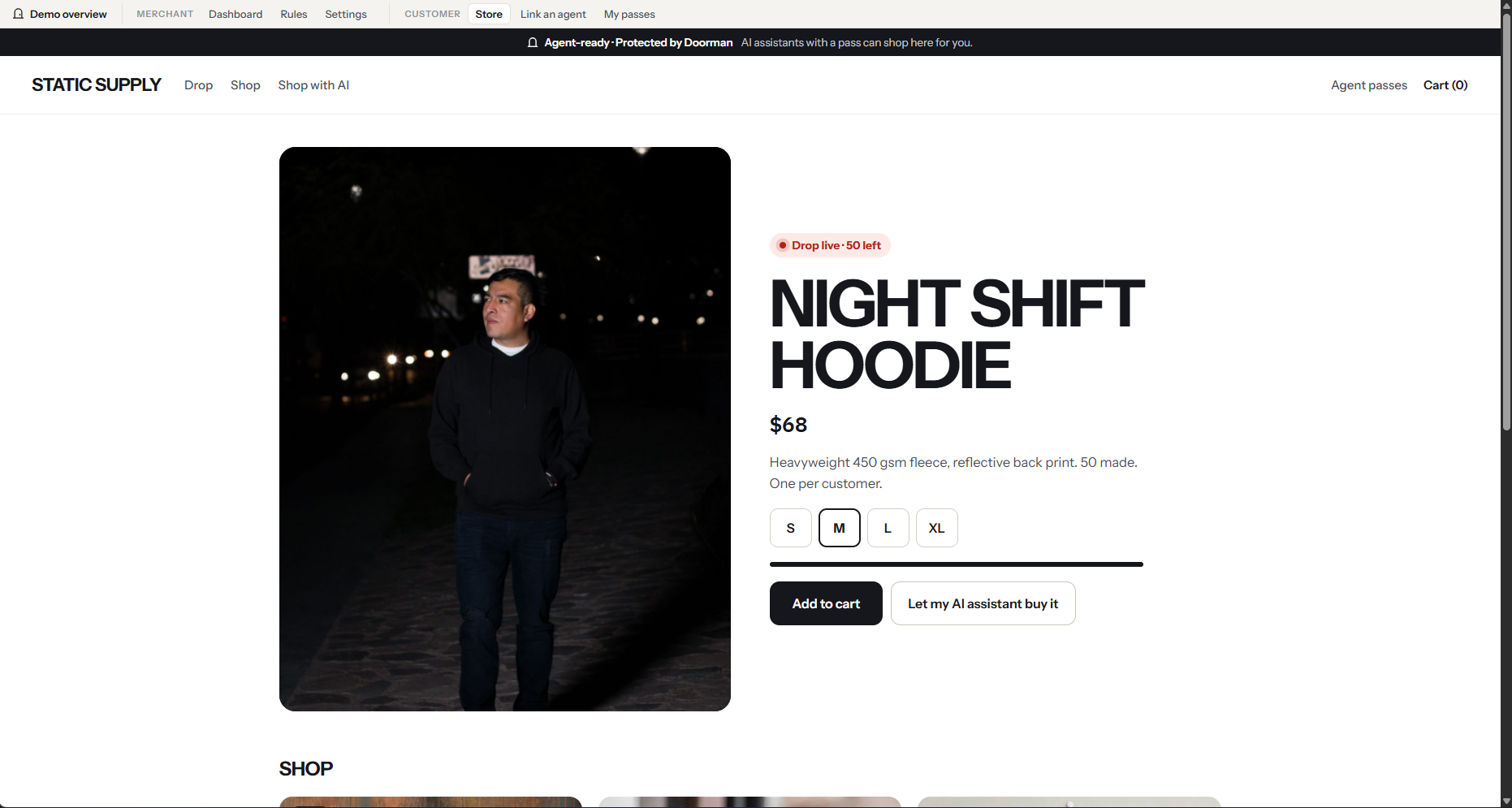
The demo runs a limited drop of 50 hoodies: a swarm of scalper bots, an agent with a revoked pass, a signed agent with no customer behind it, and the agent you linked, a real Gemini agent shopping for you.
How I built it
- PayPal: Orders v2 (intent AUTHORIZE), Payments v2 capture and void, Log in with PayPal (OpenID Connect, with the verified-account attribute), JavaScript SDK v6, and webhooks that the server registers itself, with every delivery verified by PayPal. Every call that moves money carries a PayPal-Request-Id, so a retry can never charge twice.
- AI: Gemini through the Vercel AI SDK. Gemini 3.5 Flash turns the merchant's plain-English rules into exact, typed settings that the merchant reviews before saving. Gemini 3.5 Flash-Lite writes each decision's explanation and drives the shopping agent through the store's MCP tools. AI never makes the allow-or-block decision: fixed, tested rules do.
- Stack: TypeScript throughout. A Hono server, a React 19 app with AG Grid for the live traffic table, Postgres on Neon with Drizzle, hosted on Render.
- Built to hold up on a free 512 MB server: capped in-memory state, time limits on every outside call, per-address rate limits, and a merchant side behind a password.
- AI tools used to build it: Claude Code (Anthropic) as the coding assistant, and Claude Design for the screens.
- Standards: agents sign with RFC 9421 HTTP Message Signatures (Ed25519, tag "web-bot-auth"), the same base as the IETF Web Bot Auth draft, Visa's Trusted Agent Protocol and Mastercard Agent Pay. Those prove which agent is calling. Doorman adds what a PayPal merchant also needs: which verified PayPal customer stands behind the agent, and proof that the same account paid before any money is captured.
Challenges I ran into
- PayPal's sandbox checkout loads slowly (10 to 30 seconds the first time), so Doorman starts loading it as soon as a customer page opens.
- Getting money right under concurrency. The customer's browser and PayPal's webhook can both try to finish the same order; a claim in the database means only one of them does.
- Gemini can be slow. If the shopping agent stops before checking out, the drop finishes the purchase itself, so there's always an approval link.
- Real visitor addresses behind the host's proxies, so the rate limits don't treat every visitor as one.
Accomplishments that I'm proud of
- The whole path works end to end on the PayPal sandbox: log in, pass, signed agent, authorize, payer check, capture or void, webhooks.
- 19 automated tests cover request signatures, the rules engine and the checkout fallback.
- A live demo that judges can use from a browser, on a desktop or a phone.
What I learned
Agent trust is a merchant problem as much as a buyer problem. And authorize-then-capture is the right shape for agent purchases: check who paid before any money moves.
What's next for Doorman
- Recognize real agents with no sign-up. ChatGPT's agent already signs its requests with Web Bot Auth and publishes its keys at a well-known address. Doorman will read those key directories, so real agents are identified at the door, and their customer is asked for a pass.
- Accept AP2 mandates as passes. PayPal backs Google's Agent Payments Protocol, so a customer's signed mandate could work as a Doorman pass at any store.
- Visa Trusted Agent Protocol and Mastercard Agent Pay signatures, alongside Web Bot Auth.
- Adopt PayPal's own Know Your Agent standards as they're published.
- Merchant accounts instead of a single demo password, and shared rate limits (Redis) so many servers can run side by side.
- Pay Later and Venmo for agent purchases.
Sources
- PayPal Q2 2026 earnings call transcript, July 28, 2026: https://s205.q4cdn.com/875401827/files/doc_financials/2026/q2/PYPL-2Q-26-Earnings-Transcript.pdf
- PayPal newsroom: “PayPal Takes Center Stage at Ai4 2026”, August 10, 2026: https://newsroom.paypal-corp.com/2026-08-10-PayPal-Takes-Center-Stage-at-Ai4-2026
- PayPal newsroom: “Making Sense of the AI Shopping Protocol Moment”, January 21, 2026: https://newsroom.paypal-corp.com/2026-01-22-Making-Sense-of-the-AI-Shopping-Protocol-Moment
- Checkout.com: “Consumer demand for AI shopping is forming fast but trust for agentic commerce is still catching up”, 2026: https://www.checkout.com/newsroom/consumer-demand-for-ai-shopping-is-forming-fast-but-trust-for-agentic-commerce-is-still-catching-up
- Stripe: “Everything we announced at Sessions 2026”, April 29, 2026: https://stripe.com/blog/everything-we-announced-at-sessions-2026
- TechCrunch: “Shopify opens checkout to browser-based AI agents”, September 28, 2026: https://techcrunch.com/2026/09/28/shopify-opens-checkout-to-browser-based-ai-agents/
Built With
- ag-grid
- claude
- drizzle
- gemini
- hono
- log-in-with-paypal
- model-context-protocol
- neon
- node.js
- paypal
- paypal-javascript-sdk
- paypal-orders-api
- paypal-webhooks
- postgresql
- react
- render
- typescript
- vercel-ai-sdk
- vite
