Inspiration
What it does
How we built it
Challenges we ran into
Accomplishments that we're proud of
What we learned
What's next for DoorBridge Access
DoorBridge Access
Every Doorstep. Every Voice. Everyone Included.
💡 Inspiration
A visitor at the door should never become a communication barrier. For people who are deaf or hard of hearing, non-speaking, elderly, or facing language barriers, communicating with an unexpected visitor can be difficult.
We wanted to explore a simple question: What if answering the door was more accessible, understandable, and always under the homeowner's control?
That question inspired DoorBridge Access, an accessibility-first visitor communication prototype designed to make doorstep interactions more inclusive.
🚪 What It Does
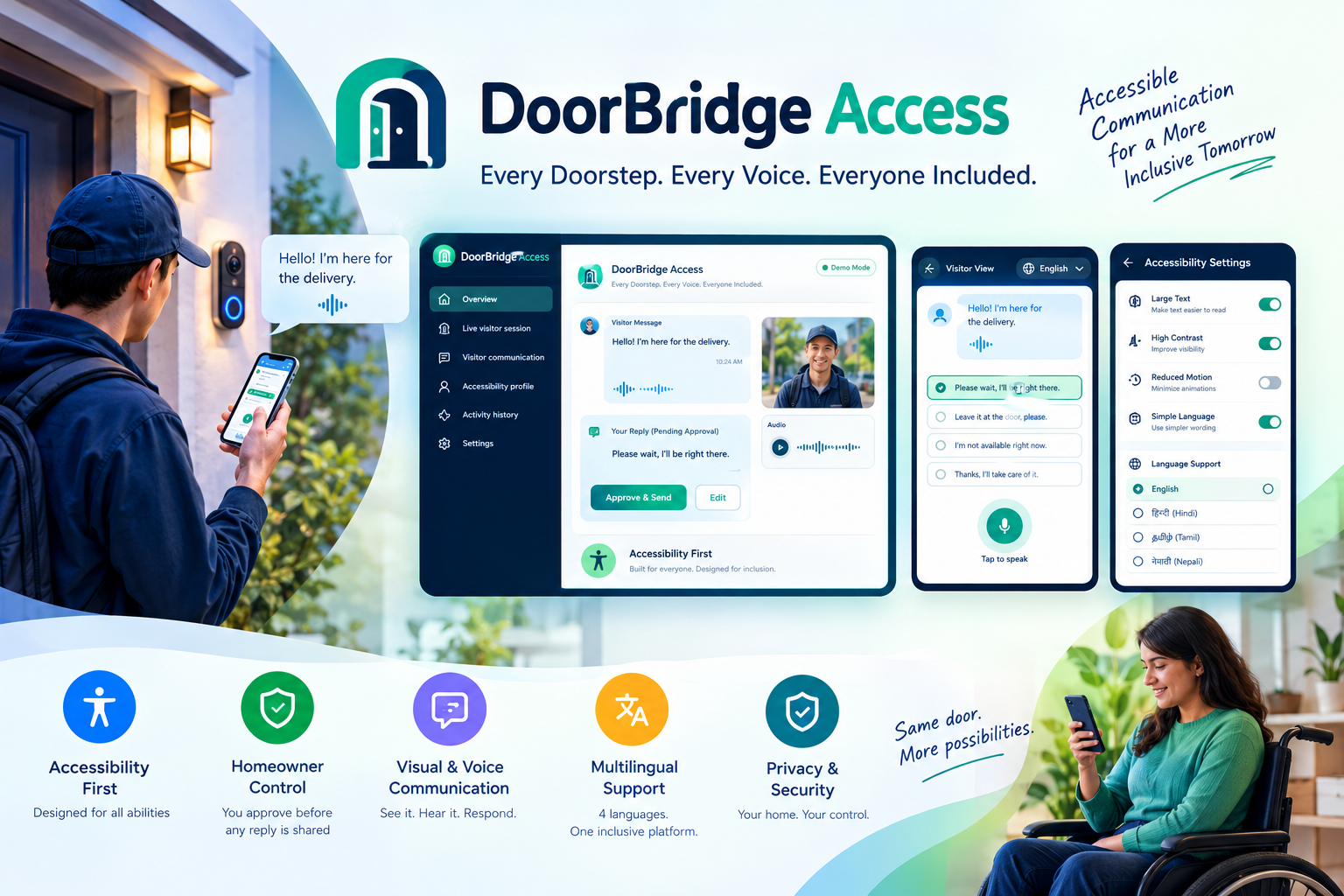
DoorBridge Access demonstrates how visitors and homeowners could communicate through a combination of visual messaging, voice interaction, and explicit homeowner approval.
Key features include:
- Visitor Communication: Simulates visitor messages and displays them in the homeowner dashboard.
- Homeowner-Controlled Replies: Homeowners can draft, edit, and explicitly approve a reply before it appears in the visitor preview.
- Voice Interaction: Supports browser-based speech recognition and spoken replies, depending on browser capabilities and available speech services.
- Multilingual Scenarios: Includes predefined visitor scenarios in English, Hindi, Tamil, and Nepali.
- Accessibility Options: Provides settings such as large text, high contrast, reduced motion, and simple-language preferences.
- Activity History: Helps users review interactions in the local demo.
- Interactive Doorbell Simulation: Demonstrates the proposed experience without requiring physical doorbell hardware.
🛠️ How We Built It
We built DoorBridge Access as a browser-based prototype using React, TypeScript, and Vite.
The interface brings together a simulated smart doorbell, visitor communication, a homeowner response console, and a visitor preview. The application demonstrates the interaction flow locally, allowing us to explore how accessibility and homeowner control can work together in a single experience.
We focused on making the interface clear, interactive, and easy to demonstrate while keeping the implementation lightweight enough for a student hackathon project.
🧩 Challenges We Faced
One of our main challenges was designing a communication flow that is both accessible and controlled by the homeowner. A reply should not be shared with the visitor simply because it has been drafted; the homeowner must explicitly approve it.
We also explored browser-based voice interaction, language selection, persistent demo state, and accessibility preferences. Testing these features helped us identify the importance of browser permissions, installed speech voices, readable interface elements, and honest communication about technical limitations.
📚 What We Learned
Building DoorBridge Access helped us understand that accessibility should be part of the product design from the beginning, not an afterthought.
We learned how to build an interactive React and TypeScript application, connect different interface states, work with browser speech capabilities, test approval-based workflows, and document limitations accurately. We also learned that a working prototype must clearly distinguish simulated functionality from real-world hardware integration.
🔮 What's Next?
Our future goals include exploring compatible doorbell hardware integration, secure communication between separate devices, more robust multilingual support, and stronger privacy and accessibility testing.
These are future development goals, not features currently claimed as implemented.
⚠️ Current Prototype Limitations
DoorBridge Access is a hackathon prototype. The doorbell is simulated in the browser; no physical Ring device or other doorbell hardware is connected. Visitor and homeowner interactions are demonstrated locally rather than through a backend or external messaging service.
Language support uses predefined scenarios and does not automatically translate arbitrary custom messages. Speech recognition and playback depend on browser support, permissions, available voices, and device configuration.
🌍 Our Vision
We believe technology should help make everyday interactions more inclusive.
DoorBridge Access explores a future where every visitor can communicate more easily, every homeowner stays in control, and accessibility is considered at every doorstep.
Built With
- accessibility
- assistive
- css
- design
- development
- frontend
- html
- human-computer
- interaction
- javascript
- react
- recognition
- responsive
- speech
- technology
- text-to-speech
- typescript
- vite
- web

Log in or sign up for Devpost to join the conversation.