-
-
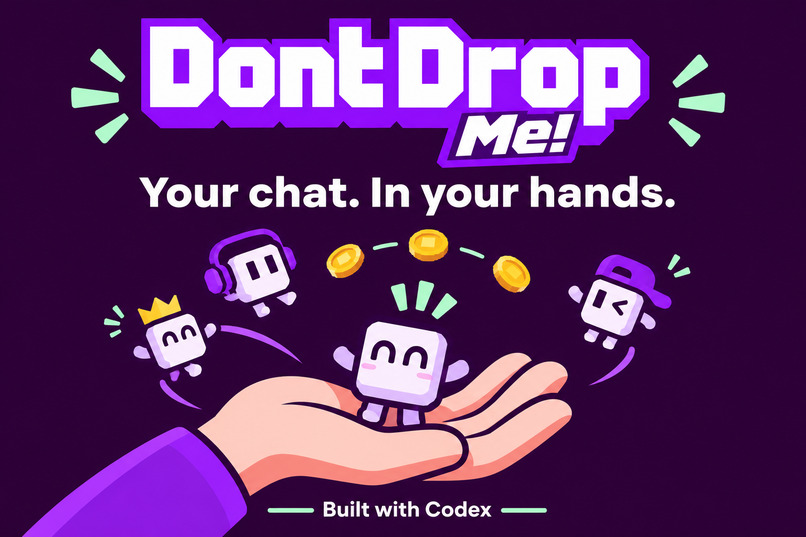
Cover Illustration
-
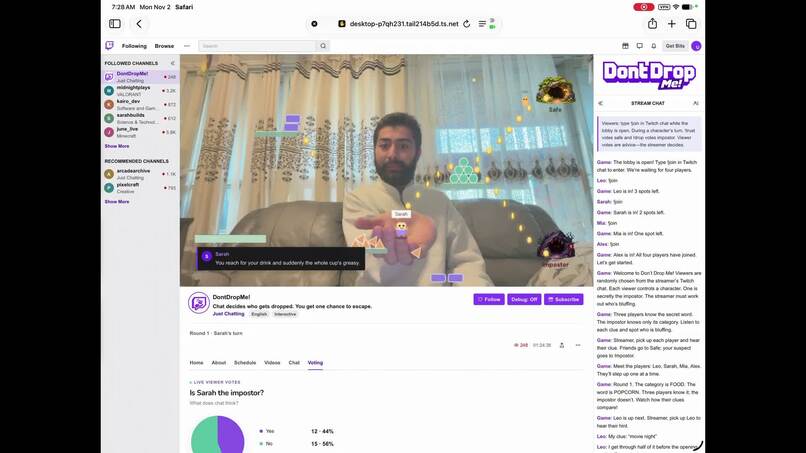
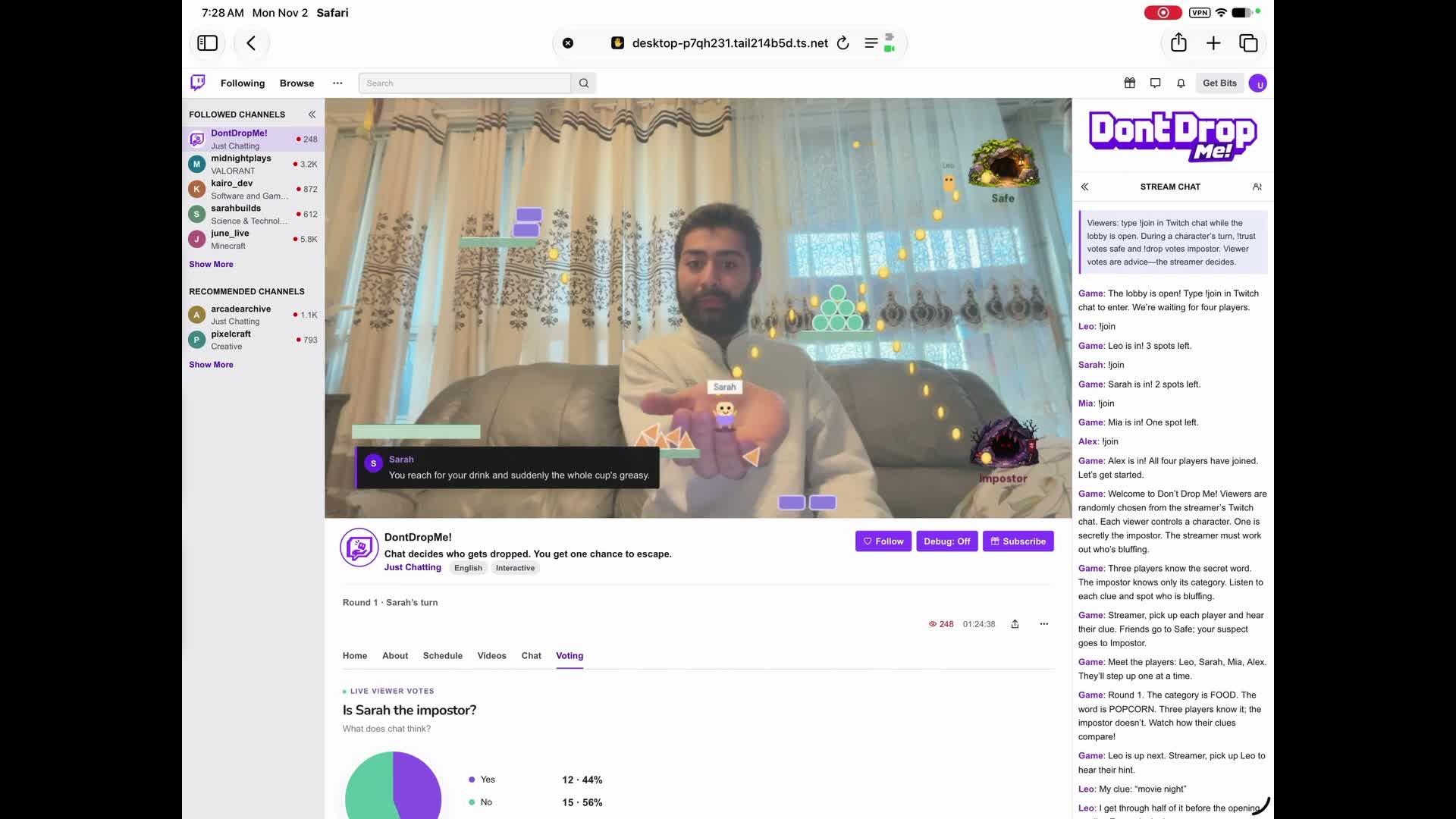
A Streamer Holds a Viewer in Their Palm
-
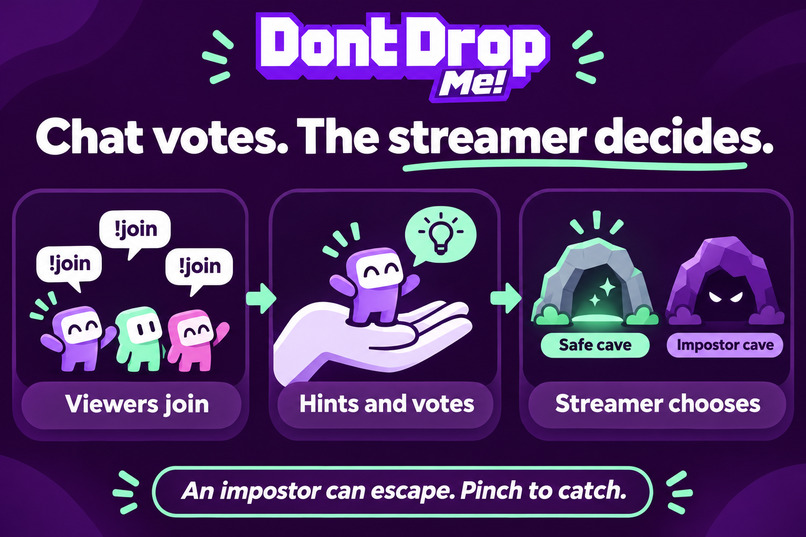
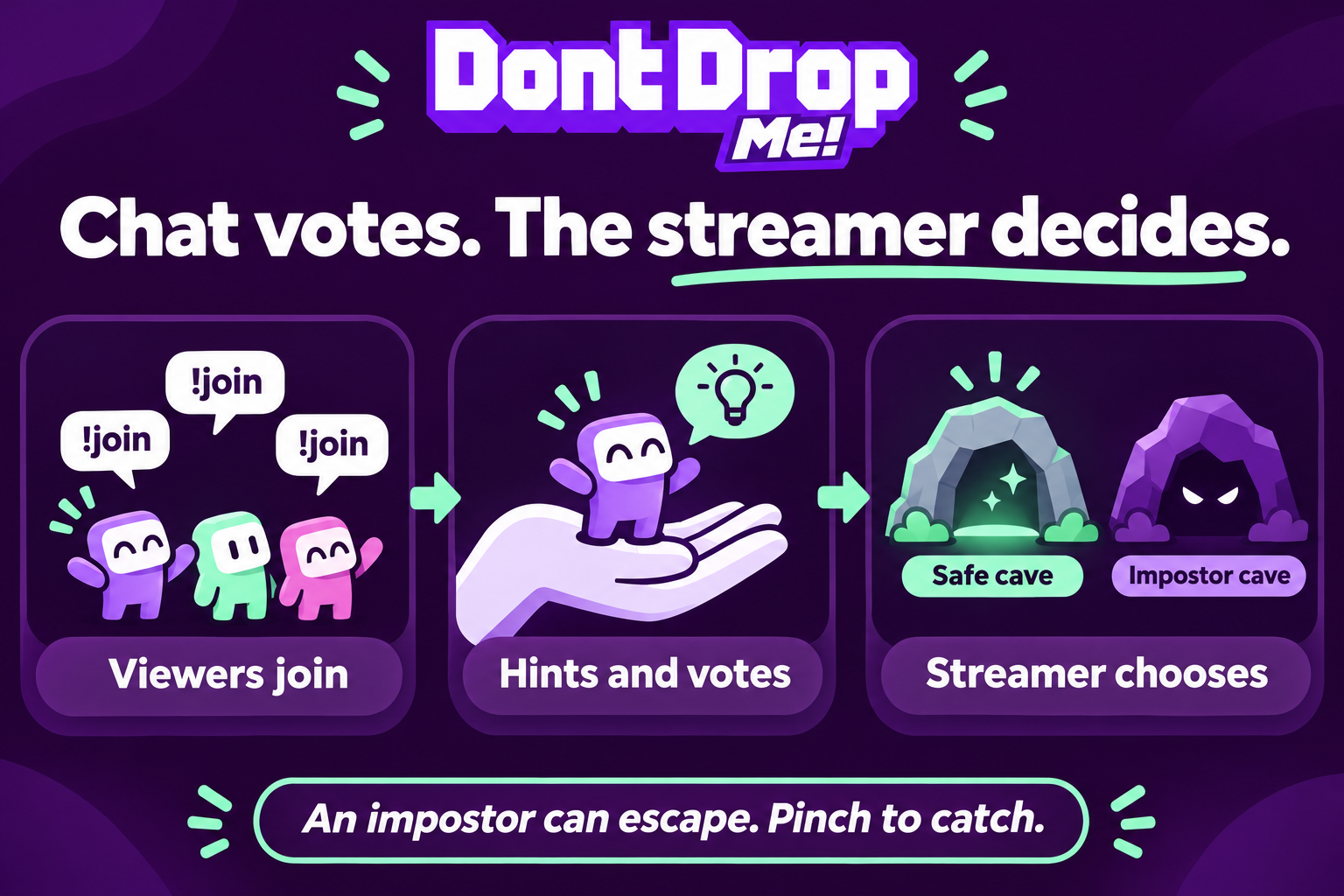
Visual Summary
-
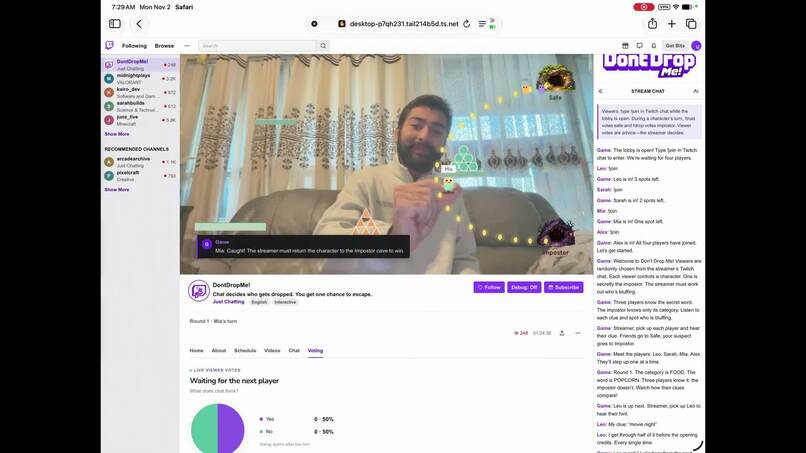
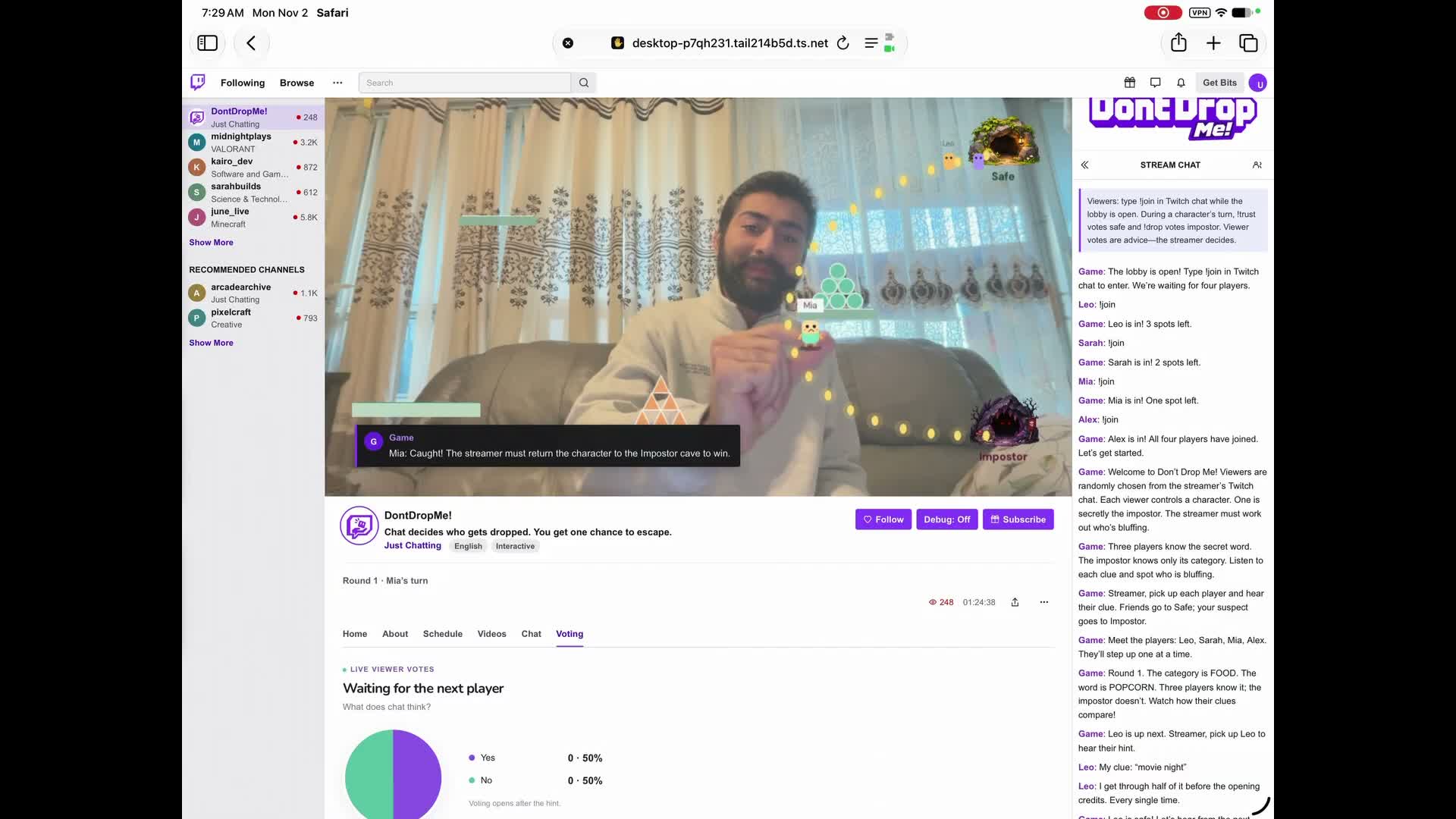
Streamer Captures The Viewer Trying To Escape
-

DontDropMe! Word Logo
-
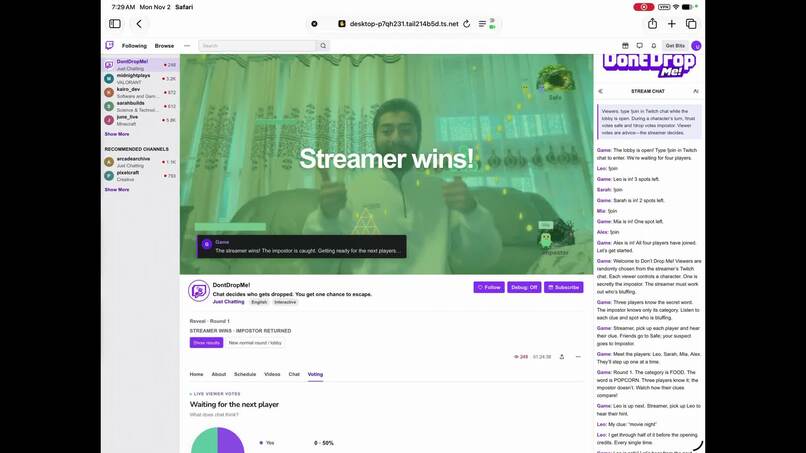
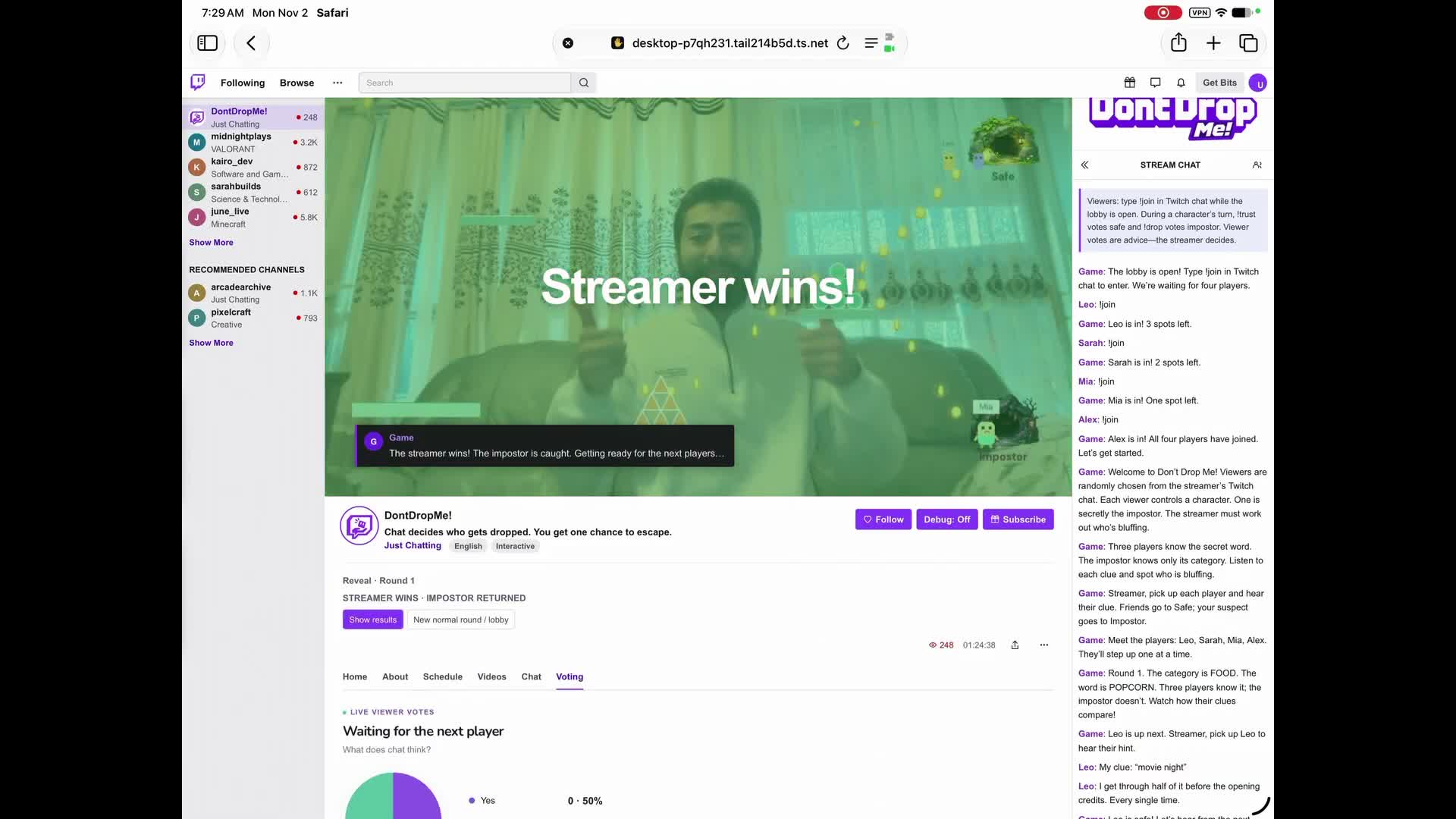
Streamer Wins!
-
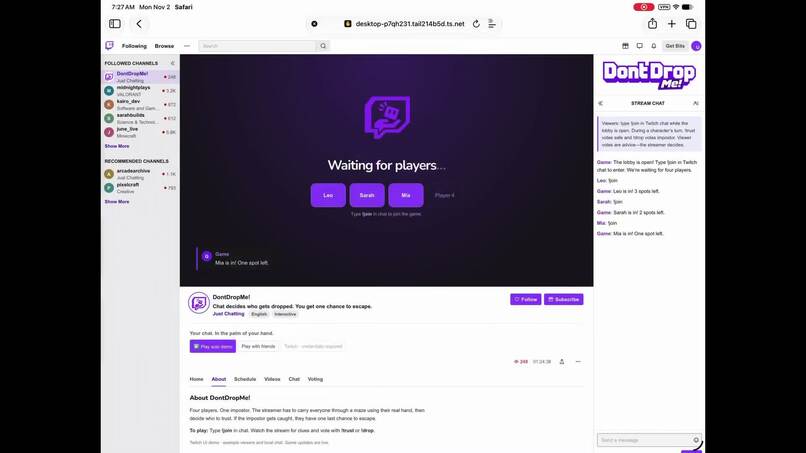
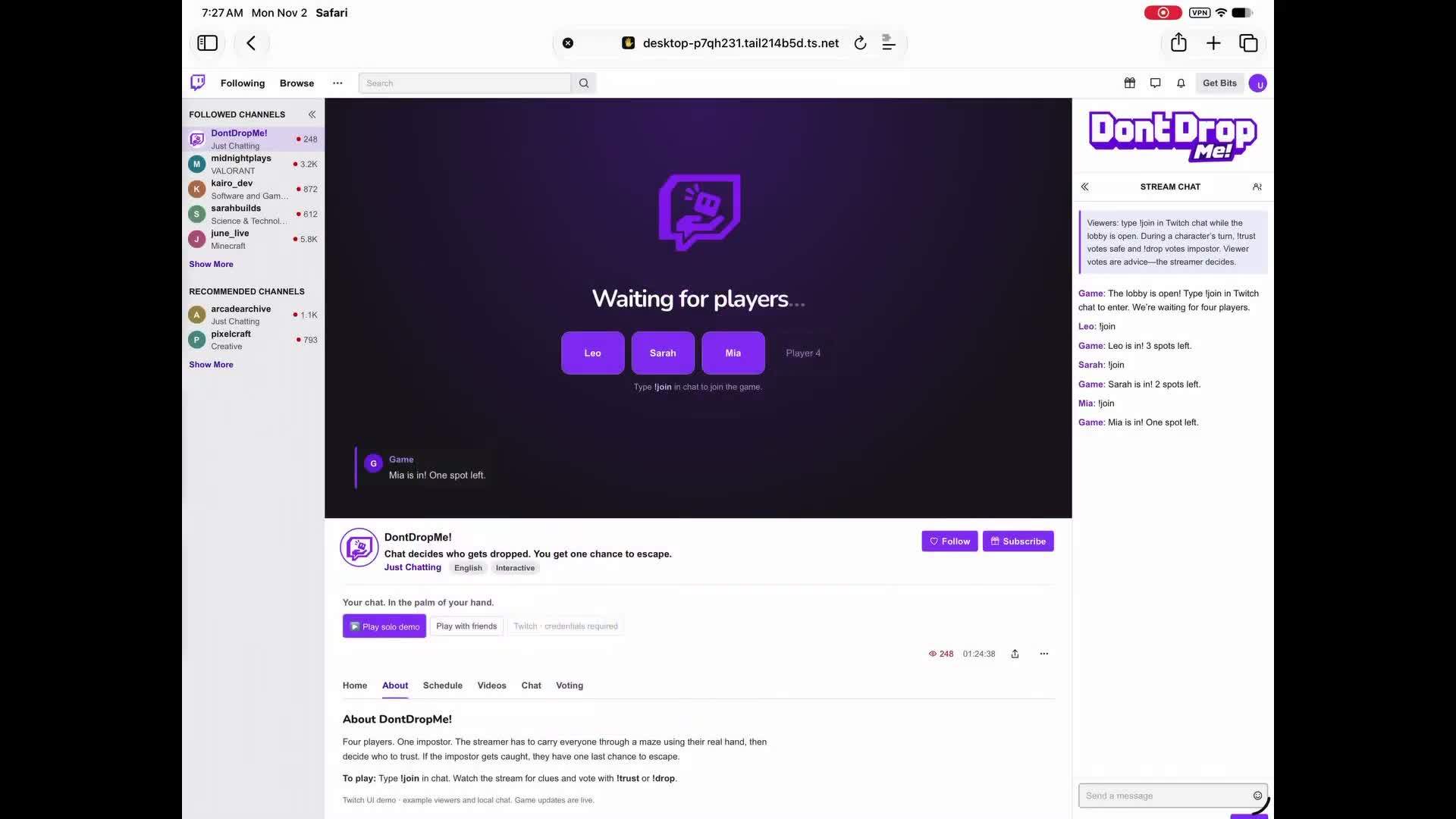
DontDropMe! Lobby

DontDropMe!
Your chat is in your hands. One of them is lying.
Four viewers become tiny characters on a streamer's webcam. Three know a secret word. One is bluffing. The streamer lifts them with a real hand, reads their clues, and carries them toward safety or the Impostor cave while chat argues over whom to trust. Catch the liar, and they may still escape. Now you have to pinch them out of the air.
The streamer is the stage. Viewers are the cast. Chat is the jury.
▶ Watch the demo · Explore the code
Inspiration: what if “trust me” stood on your hand?
I wanted to give the relationship between a streamer and their community a physical form.
Twitch already has the ingredients for great live entertainment: familiar personalities, running jokes, questionable advice, and a crowd ready to challenge every decision. DontDropMe! gives those relationships a body.
A username becomes someone you are carrying. An accusation becomes a destination. Hesitation becomes visible.
The idea grew around a compelling tension: can you read the room while keeping a tiny liar balanced on your palm? Social deduction supplies the uncertainty. Hand-controlled play supplies the physical comedy. Together, they turn a judgment call into something everyone can watch unfold.
What it does: a bluff you can hold
In live Twitch mode, viewers type !join in the connected channel, authenticate on a companion page, and press Ready. Four eligible viewers are randomly selected. Three receive the same secret word; the impostor receives only its category.
Players privately submit clues and answers. The streamer lifts their characters one at a time. Picking someone up reveals their clue and opens voting:
!trust: “I believe them.”!drop: “That’s the impostor.”
Each viewer has one current vote per character and can change their mind. The live vote display shows where the crowd stands. The streamer decides whom to carry to the Safe cave and whom to deliver to the Impostor cave.
The impostor can also win by guessing the secret word. If caught without a successful guess, they can trigger an escape sequence. The streamer must pinch around the fleeing character and return them to the Impostor cave.
Finding the liar is a deduction problem. Keeping them caught is a performance.
The distinctive interaction is a loop: a physical action reveals social information, chat interprets it, and the streamer turns that judgment back into physical action.
Why it belongs on the TwitchCon stage
Imagine a tiny contestant balanced on the streamer's hand. Their clue sounded convincing. Their explanation sounded rehearsed. Chat is divided.
The host hovers between the caves, changes direction, and commits.
The impostor breaks for safety.
Suddenly, a debate becomes a chase. The same hand that delivered the verdict scrambles to enforce it. A triumphant accusation can become a frantic missed pinch in seconds.
Selected viewers get to bluff, persuade, and become characters in the show. Everyone else can take sides and influence the conversation. The streamer’s face, hesitation, and final decision share the same frame.
This is a format built for recurring community rivalries: different players, different suspicions, and another chance for chat to insist it knew all along.
How I built it with OpenAI Codex
I used OpenAI Codex as a development partner across the game mechanics, multiplayer architecture, Twitch integration, and interface.
The project progressed through playable iterations: a hand-controlled foundation, private multiplayer roles, an escape chase, a solo rehearsal cast, interrogation while characters ride the hand, and live Twitch joins and voting. Codex helped implement and refine the coordinate mapping, state transitions, authentication flow, browser interfaces, and automated tests.
The implementation connects four systems around one shared experience:
- Computer vision makes the hand playable. MediaPipe runs in the browser, mapping palm landmarks into the Phaser playfield. Pinch detection measures thumb-to-index distance relative to hand size. Camera frames stay on the device, with GPU-to-CPU fallback and adaptive inference scheduling.
- Twitch gives participation an identity. OAuth and Helix identify broadcasters and players. EventSub WebSockets receive chat commands. Votes use verified Twitch user IDs, while the adapter handles duplicate notifications, reconnections, token refresh, and revocation.
- The server protects the social game. A TypeScript room state machine controls roles, phases, votes, and outcomes. Socket.IO separates public updates, private player information, and host simulation data. The host runs the physical simulation; the server checks delivery and capture conditions.
- Physics makes the journey entertaining. Matter gives toy towers rotation, collisions, and collapse, adding something to disturb and navigate between decisions.
Codex helped build the project. Runtime hand tracking uses MediaPipe, and the solo rehearsal uses scripted players and dialogue. No OpenAI API key is required to play.
I also used ChatGPT’s image-generation tools through Codex to prepare visual assets, including transparent-background cave artwork and branded gallery illustrations. I supplied reference images and the project logo, then directed the visual style and integrated the resulting assets into the game and submission materials.
Challenges: making the illusion hold together
Making the real hand and virtual world agree. Mirroring and cropping a webcam image change where the hand appears. The landmark mapping must match those transformations, and pinch detection must account for hand size. A gesture only feels convincing when the visible result matches the player's intention.
Sharing the spectacle without sharing the secret. Players, the host, and spectators need different information. Separate private and public updates preserve the bluff while keeping the round synchronized.
Keeping participation consistent. Duplicate events, changed votes, and stale actions can distort a social game. Event deduplication, replaceable votes, action IDs, and state-version checks address those cases.
Leaving the streamer free to entertain. The host is talking, reading chat, and making decisions while moving. Tying clue reveals and voting to picking up a character lets the gesture advance the show. Contrasting caves, named characters, and a visible vote chart help spectators follow it.
What I learned and what I’m proud of
The strongest interaction can teach several things at once.
Picking up a character identifies the speaker, reveals their clue, and invites the audience to judge. Carrying them toward a cave communicates a decision before it becomes final. That gives the audience time to understand, anticipate, and react.
I also learned that infrastructure shapes the emotional credibility of a multiplayer experience. Private information protects the bluff. Consistent voting gives participation meaning. Clear physical feedback makes a verdict satisfying to watch.
I’m proudest of making one mechanic carry the whole premise: a real hand holding someone whose story you might not believe.
Try it
The GitHub repository includes the source, assets, and setup instructions.
With Node.js 24 installed, run npm ci and npm run dev, then open http://localhost:5173. Choose Play for the scripted solo rehearsal. Use a webcam for hand control or Mouse Mode to explore.
For live Twitch participation, configure TWITCH_CLIENT_ID, TWITCH_CLIENT_SECRET, PUBLIC_ORIGIN, and PORT, register the matching OAuth callback, and choose Create Twitch Room. The Twitch setup guide covers broadcaster authorization and viewer joining.
Solo rehearsal simulates players and audience activity. Live mode uses actual Twitch joins and votes.
Give chat a body. Give the streamer a dilemma. Let everyone watch what happens when trust slips.
Built With
- audience-participation
- browser-game
- computer-vision
- css3
- express.js
- gesture-recognition
- hand-tracking
- html5
- interactive-streaming
- javascript
- mediapipe
- node.js
- oauth2
- openai-codex
- phaser.js
- social-deduction
- socket.io
- twitch
- twitch-eventsub
- twitch-helix
- typescript
- vite
- vitest
- websocket

