
Inspiration
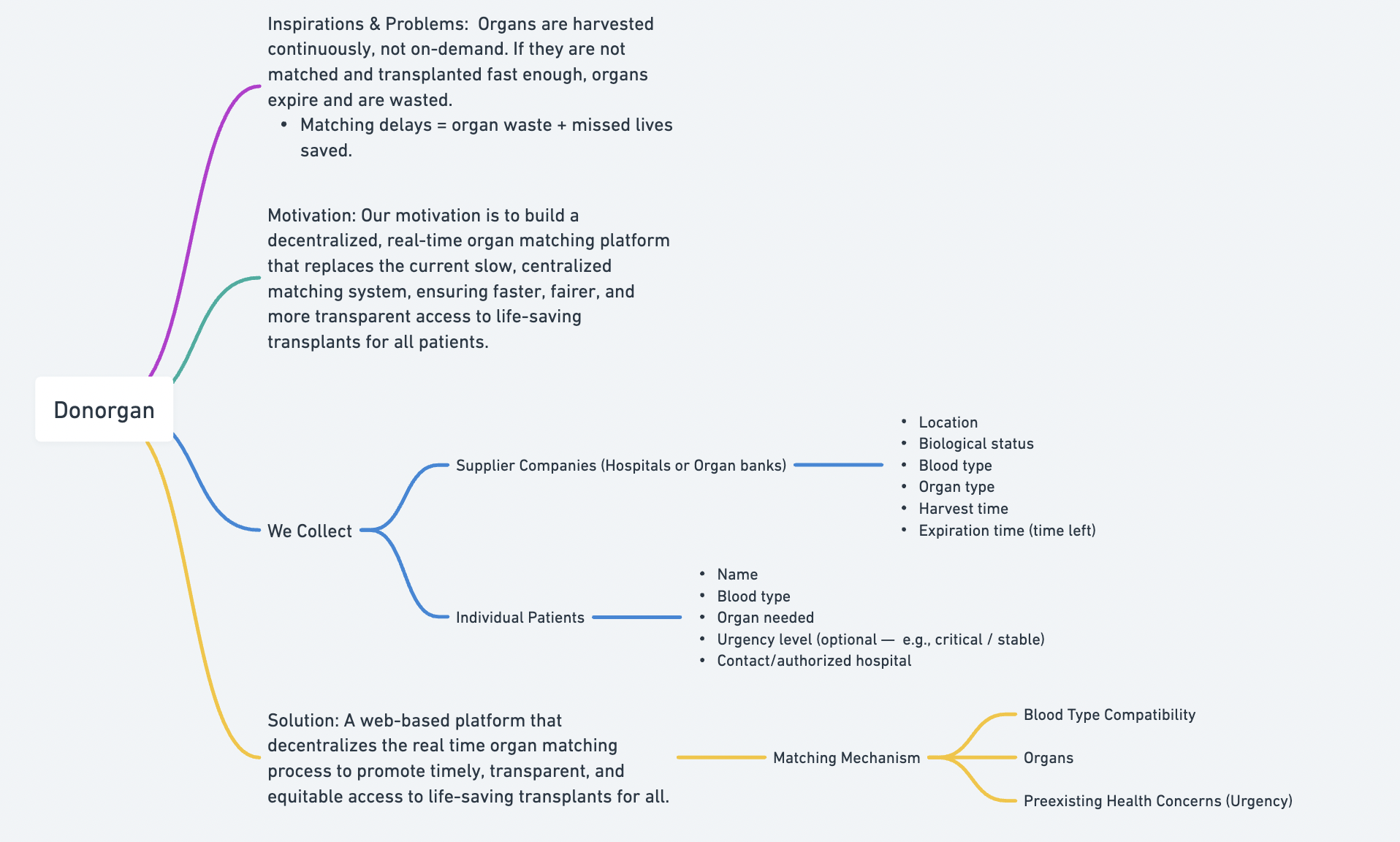
Every year, thousands of life-saving organs go to waste simply because they aren’t matched and used in time. The current organ donation system suffers from information asymmetry, delayed communication, and a lack of urgency visualization. We were inspired to build Donorgan, a real-time organ matching platform that connects organ donor managers with patients in need — faster, smarter, and more transparently.
What it does
The prototype designed to streamline and accelerate the organ matching process. It collects live organ supply information from certified supplier hospitals and companies, while allowing individual patients to register with their medical details such as blood type and organ needs. Using a matching algorithm, Donorgan pairs available organs with suitable patients instantly and displays the remaining organ viability time through live countdowns to emphasize urgency. Once a match is made, the platform immediately notifies both suppliers and patients or hospitals, providing essential contact and location information, while leaving transportation logistics to medical professionals. By focusing on real-time discovery and decision-making, Donorgan aims to significantly reduce organ waste and save more lives.
How we built it
Frontend: Built using Figma for UI mockups and React for web-based interactions. Backend (conceptualized): Node.js/Express backend to handle user registration and matching logic. Database: MongoDB for storing patient and organ data. Matching Logic: Based on blood type compatibility and time remaining until organ expiration. Prototyping: We used Figma to simulate the end-user experience, including the countdown page, registration flows, and organ listing interface.
Challenges we ran into
One of the largest challenges we faced was ensuring that for everyone in the process, from donors, to recipients, and everyone in between, their humanity and dignity was kept intact. When it comes to such a subject, it can be easy to forget that at the end of the day, everyone is human, with their own lives and stories. As such, we wanted to make sure that this wasn't forgotten.
Accomplishments that we're proud of
- Front-end: Created a fully clickable, multi-page prototype in Figma that accurately mimics real-world organ listing, registration, and matching systems, allowing users to experience the full platform journey.
- Backend: Developed a runnable backend that supports the Figma-designed user interface, laying the foundation for live data management, matching logic, and future system integration.
- Built a focused and realistic product scope, tackling one of the most critical bottlenecks in the organ donation pipeline — real-time matching and instant notification — while maintaining simplicity and feasibility for real-world adoption.
What we learned
Throughout this project, we gained deep insights into the complexity of the organ donation system and the critical importance of speed, transparency, and data sharing. We learned how real-world medical systems face challenges not just because of medical limitations, but because of technological and coordination gaps. We also strengthened our skills in translating a real-world healthcare problem into a focused, actionable technology solution — combining front-end design, backend functionality, and user experience thinking. We learned how critical it is to scope projects tightly: solving one high-impact step (matching and notification) can drive real change without getting overwhelmed by the larger ecosystem.
What's next for Donorgan
In the next phase of development, we plan to extend Donorgan beyond real-time matching into a blockchain-enabled organ matching and tracking system. Drawing insights from recent research, including the BOMS (Blockchain-Enabled Organ Matching System) model, we aim to integrate smart contracts to automate and validate the matching process, ensuring that once a match is made, it is immutably recorded on the blockchain to minimize risks of manipulation or data loss. To protect sensitive patient and hospital information, we will adopt a decentralized model where entities interact through blockchain addresses rather than disclosing identifiable data, preserving privacy while maintaining accountability. Additionally, every major event — from organ harvest and listing to match assignment and acceptance — will be securely logged on-chain, enabling authorized users such as hospitals and regulatory bodies to independently verify the full life cycle of each organ
Built With
- figma
- javascript


Log in or sign up for Devpost to join the conversation.