-
-
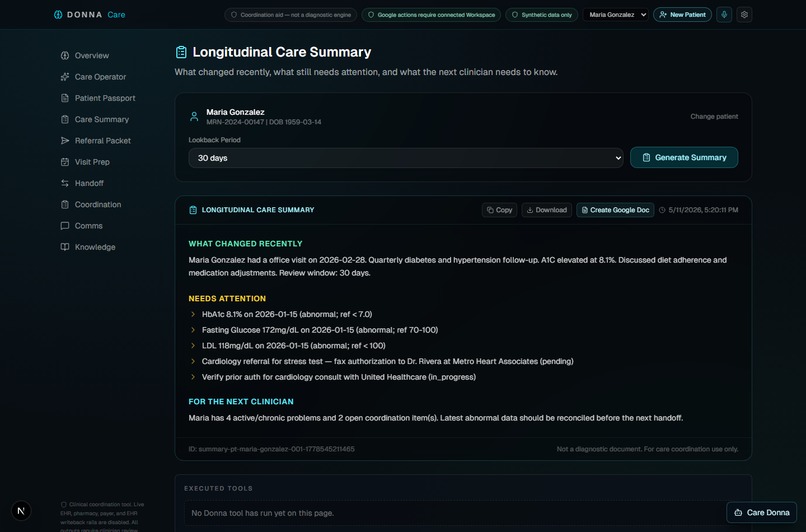
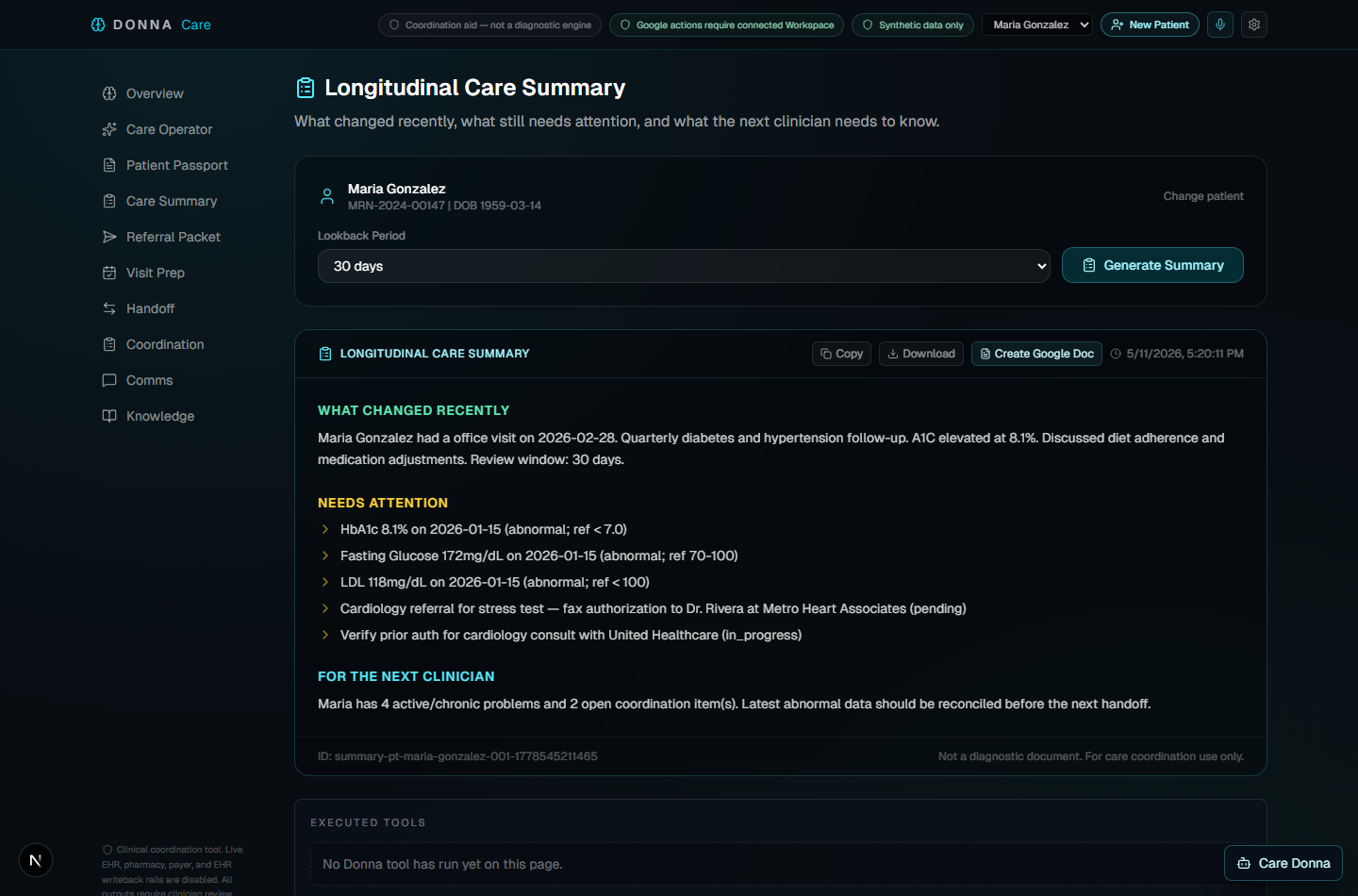
Care Summary: Understand treatment at a glance
-
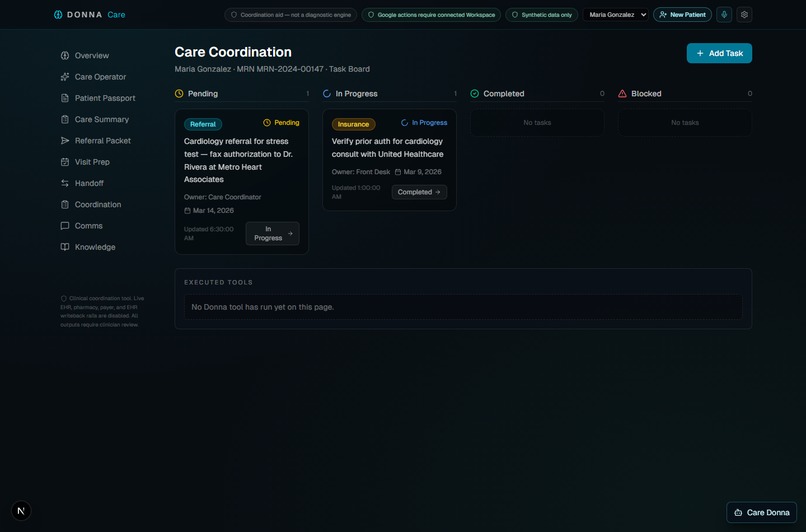
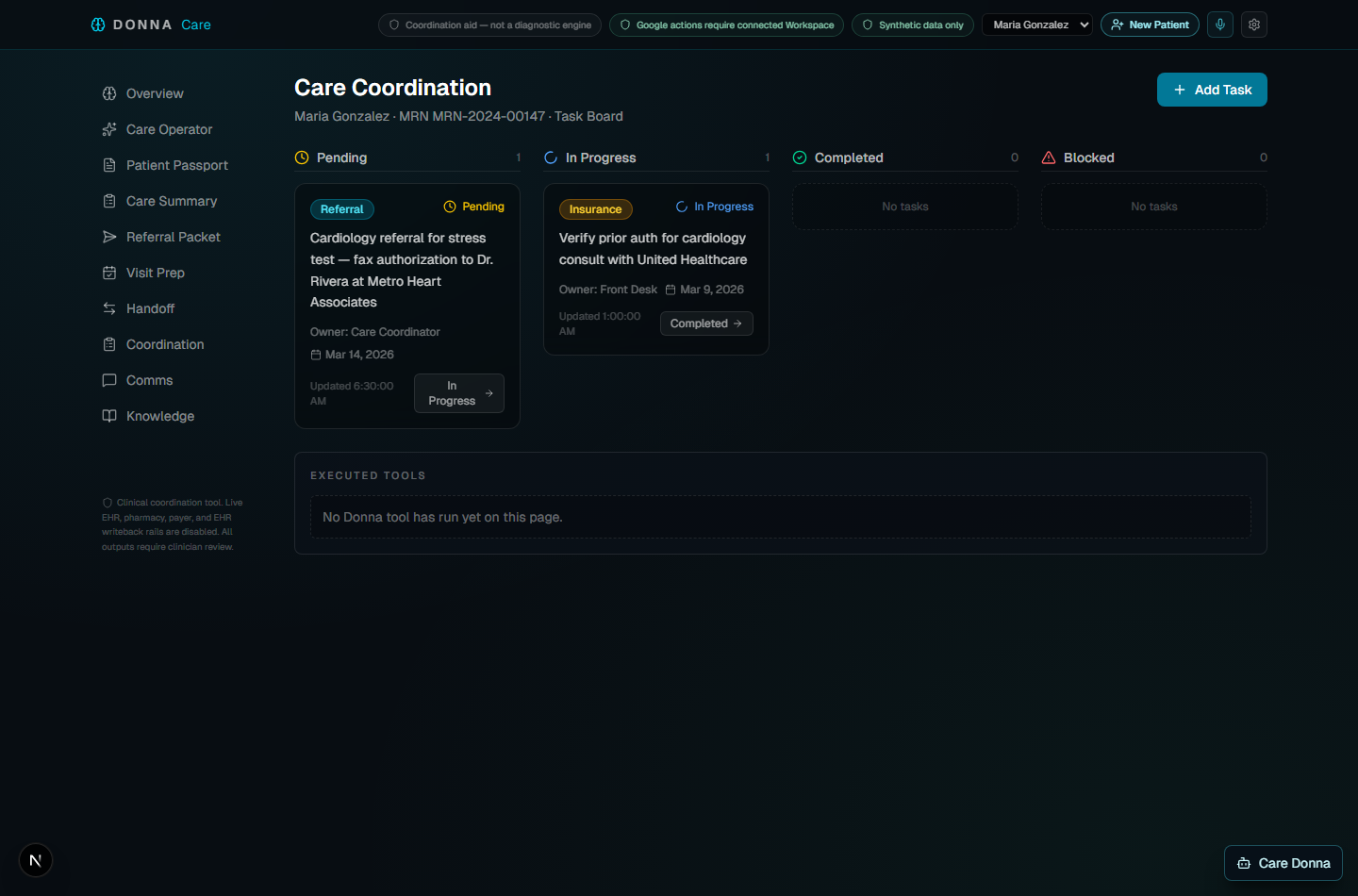
Care Coordination: See necessary tasks to keep the patient ahead of schedule
-
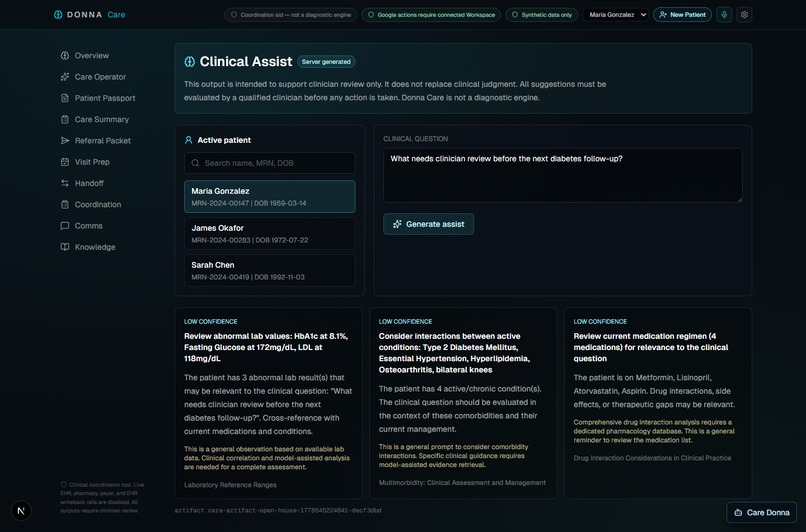
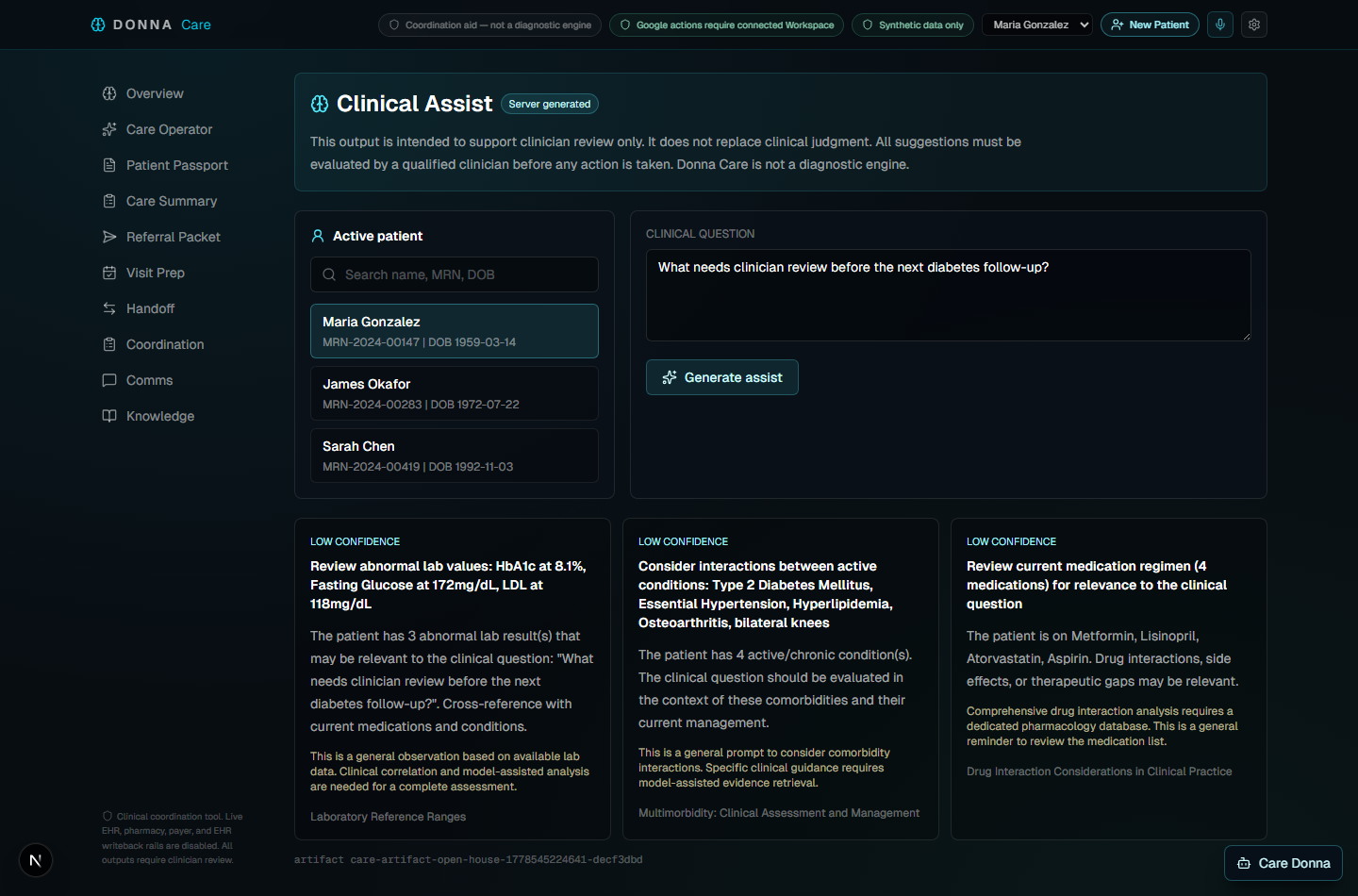
Clinical Assist: Get Donna's input on questions you may have. No replacement for a doctor, but a useful aid to have on hand
-
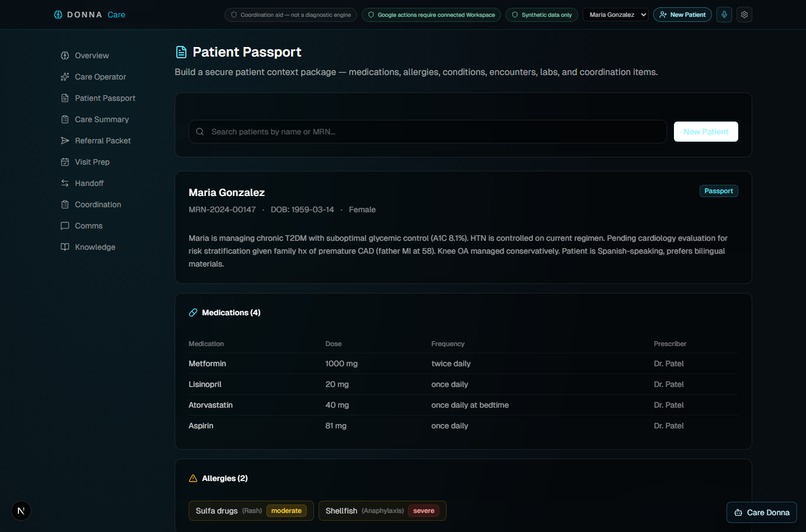
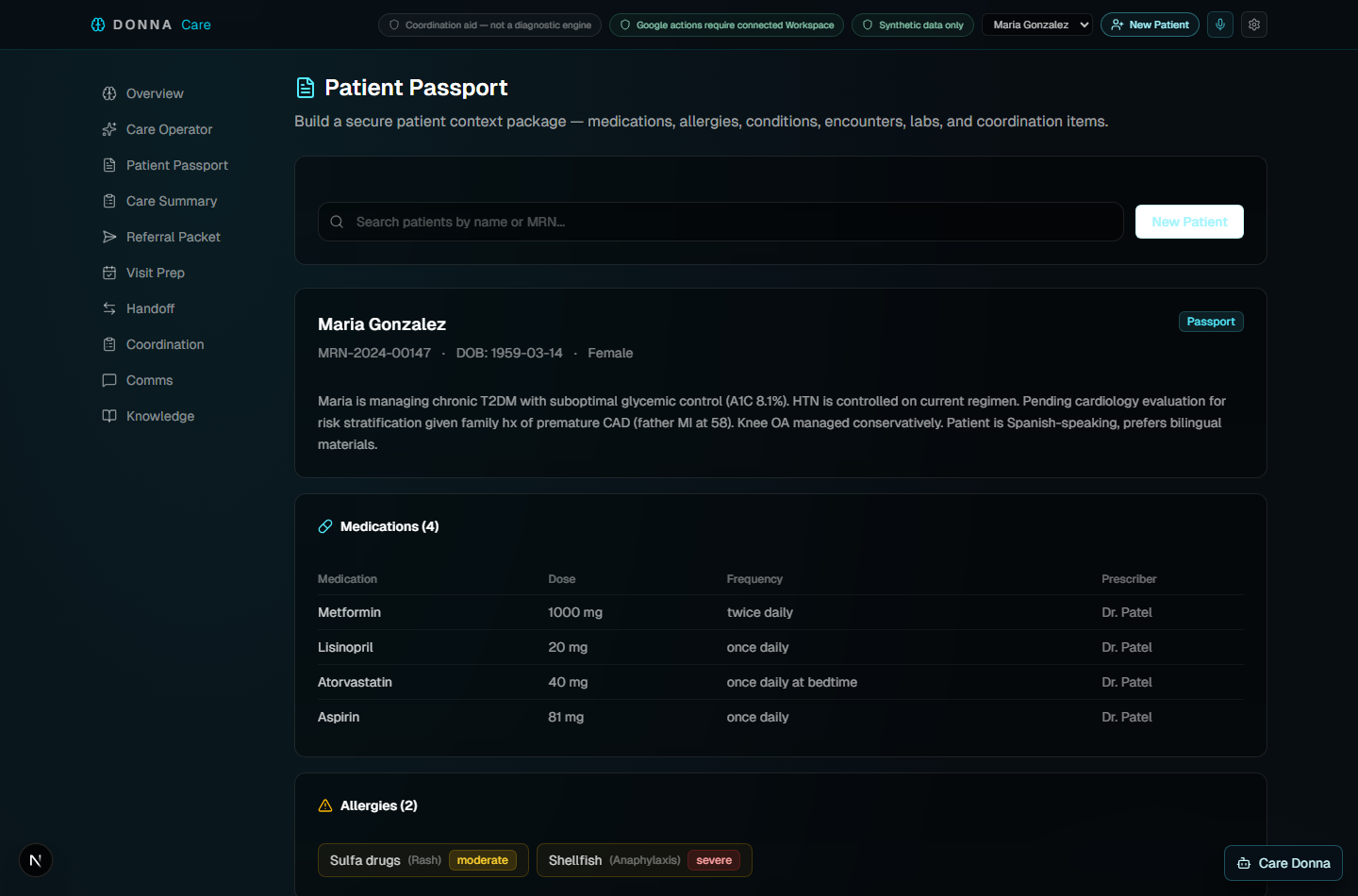
Patient Passport screen: all your vital information in one place
Inspiration
Donna started as an enterprise AI assistant: a system for helping teams manage work across email, documents, tasks, tools, and business operations. The healthcare hackathon gave us a focused question: could that same enterprise workflow foundation be adapted to one of the highest-friction environments in the world: care coordination?
Clinical teams do not usually suffer from a lack of information. They suffer because the right context is scattered across notes, calls, records, labs, referrals, intake forms, scheduling details, and administrative systems. Before anyone can act, someone has to reconstruct the patient story.
Donna Care was built to explore whether an agentic workflow layer could turn that fragmented patient context into reusable, secure, auditable care artifacts.
What It Does
Donna Care organizes patient context into a reusable Patient Passport: a portable package of relevant medications, allergies, conditions, encounters, labs, care-plan context, and coordination items.
From that passport, Donna Care can generate workflow artifacts such as:
- Longitudinal care summaries
- Referral packets
- Visit-prep briefs
- Clinical handoff summaries
- Patient-linked coordination tasks
The goal is not to replace clinicians or act as an autonomous diagnostic engine. Donna Care is designed to support care teams by making context clearer, handoffs cleaner, referrals more complete, and follow-up work harder to drop.
How We Built It
We built Donna Care on top of the existing Donna enterprise platform, then added a healthcare-specific workflow layer. The app uses a Next.js and React frontend, TypeScript APIs, structured patient-context models, MCP-style tool contracts, and database-backed care artifacts.
We focused on making the system feel less like a generic chatbot and more like an operational workspace: patient search, patient passports, structured artifact builders, safety disclaimers, provenance-oriented design, and workflow-specific outputs.
Challenges
The hardest part was scope. Healthcare AI can quickly become too broad or too risky if the product tries to be an “AI doctor.” We intentionally narrowed Donna Care around coordination, documentation support, and context portability.
Another challenge was designing outputs that are useful without pretending to be final clinical truth. Referral packets, handoffs, summaries, and visit-prep briefs all need to be structured, reviewable, and auditable.
What We Learned
The enterprise version of Donna gave us a strong foundation, but healthcare forces a higher bar: clearer boundaries, stronger auditability, safer language, better provenance, and more respect for human review.
We learned that the most useful healthcare agent may not be the one that gives the boldest answer. It may be the one that helps the team understand what matters now, what changed, and what needs to happen next.
What's Next
Next steps include deeper FHIR support, richer patient-context ingestion, stronger provenance tracking, role-aware workflows, secure artifact sharing, and more advanced clinician-facing assistive features with citations and uncertainty handling.
Built With
- amazon-web-services
- aws-cognito
- aws-kms
- fhir/synthea-style-clinical-data
- jest
- lucide-react
- mcp-style-tool-contracts
- next.js
- openai-agents-sdk
- openai-api
- playwright
- postgresql
- radix-ui
- react
- tailwind-css
- typescript

Log in or sign up for Devpost to join the conversation.