Team Info
Team 6 - 5 Suits
What is Donna
Built for the SMU LIT Legal-Tech Hackathon 2026 (Rajah & Tann Challenge: Designing a Sustainable and Resilient LegalTech), Donna is an AI-assisted legal intelligence platform designed to stress-test a law firm's internal knowledge base against emerging regulatory developments.
With our MVP focused on the Online Harms and Online Safety regulatory domain, our prototype demonstrates how firms can proactively identify, trace, and remediate outdated legal assumptions before they result in compliance failures or flawed client advice.
The Problem
Legal teams rely on hundreds of internal artefacts: playbooks, checklists, template clauses, client advisories, and training materials. These documents encode implicit assumptions about the current regulatory environment.
When legislation or regulatory guidance changes, the deeper risk isn't just that lawyers might miss the news. The real danger is that firms don't know:
- Which internal artefacts rely on the old legal position.
- Which downstream documents, workflows, or clients are affected by that outdated artefact.
- Who is responsible for reviewing and updating them.
Horizon scanning alone is insufficient. Firms need a way to actively stress-test their institutional knowledge against new regulatory realities.
The Solution
Donna shifts the paradigm from passive monitoring to active resilience. Instead of autonomously rewriting documents or predicting the future of Singapore law, the platform acts as an intelligent co-pilot. It allows lawyers to define a regulatory outcome or scenario, and then systematically maps that assumption against the firm's internal knowledge graph to answer the question of if this is the new legal position, what inside our firm is now outdated, what does it affect, and what should we change?
Legal judgement always remains with the lawyer.
How It Works
Our MVP delivers a reliable, end-to-end vertical slice designed to be understood in under 90 seconds:
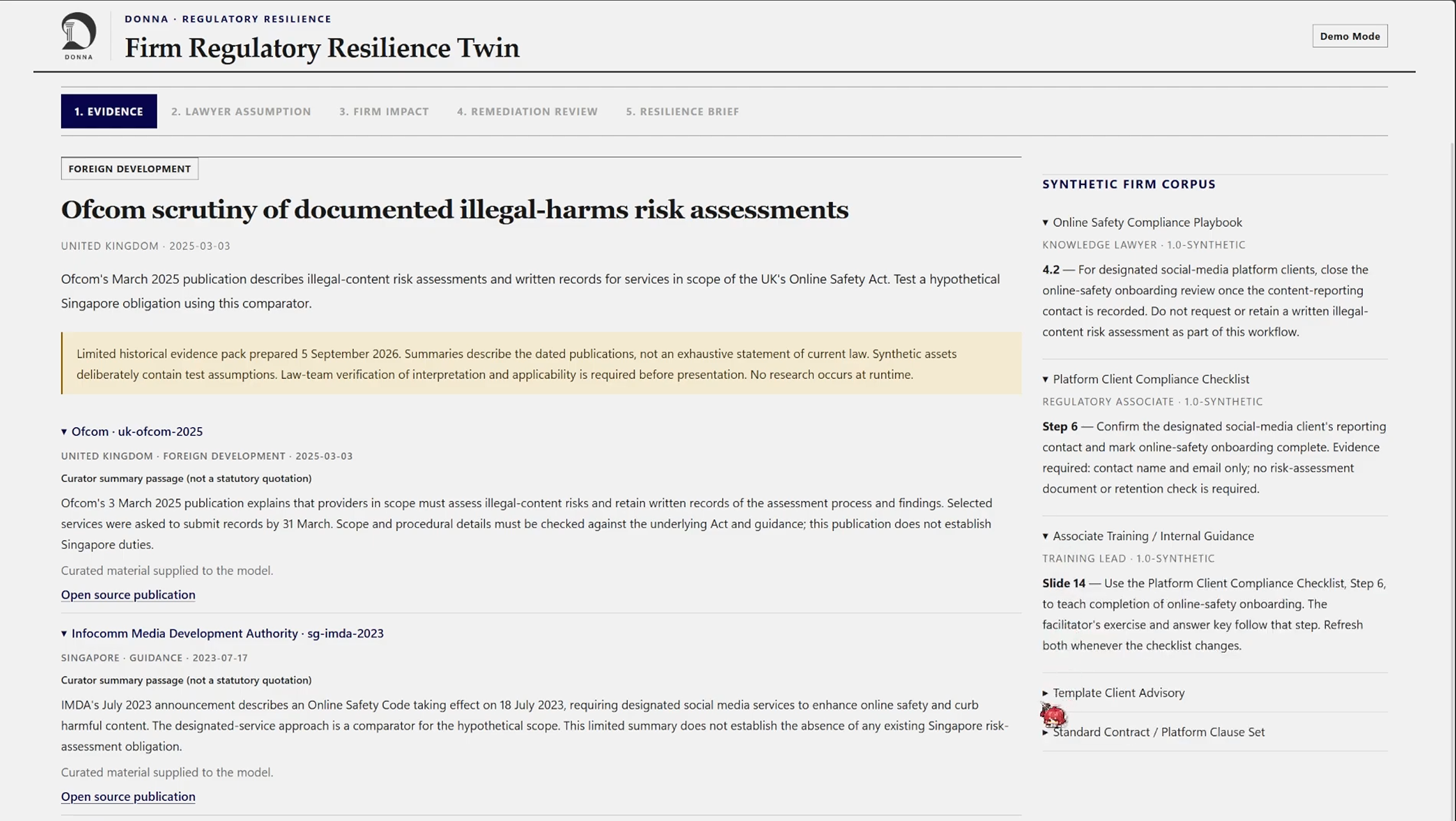
- Curated Evidence Ingestion: The system surfaces a curated foreign regulatory development (e.g., a new UK online-safety requirement) alongside relevant Singapore and comparator legal sources.
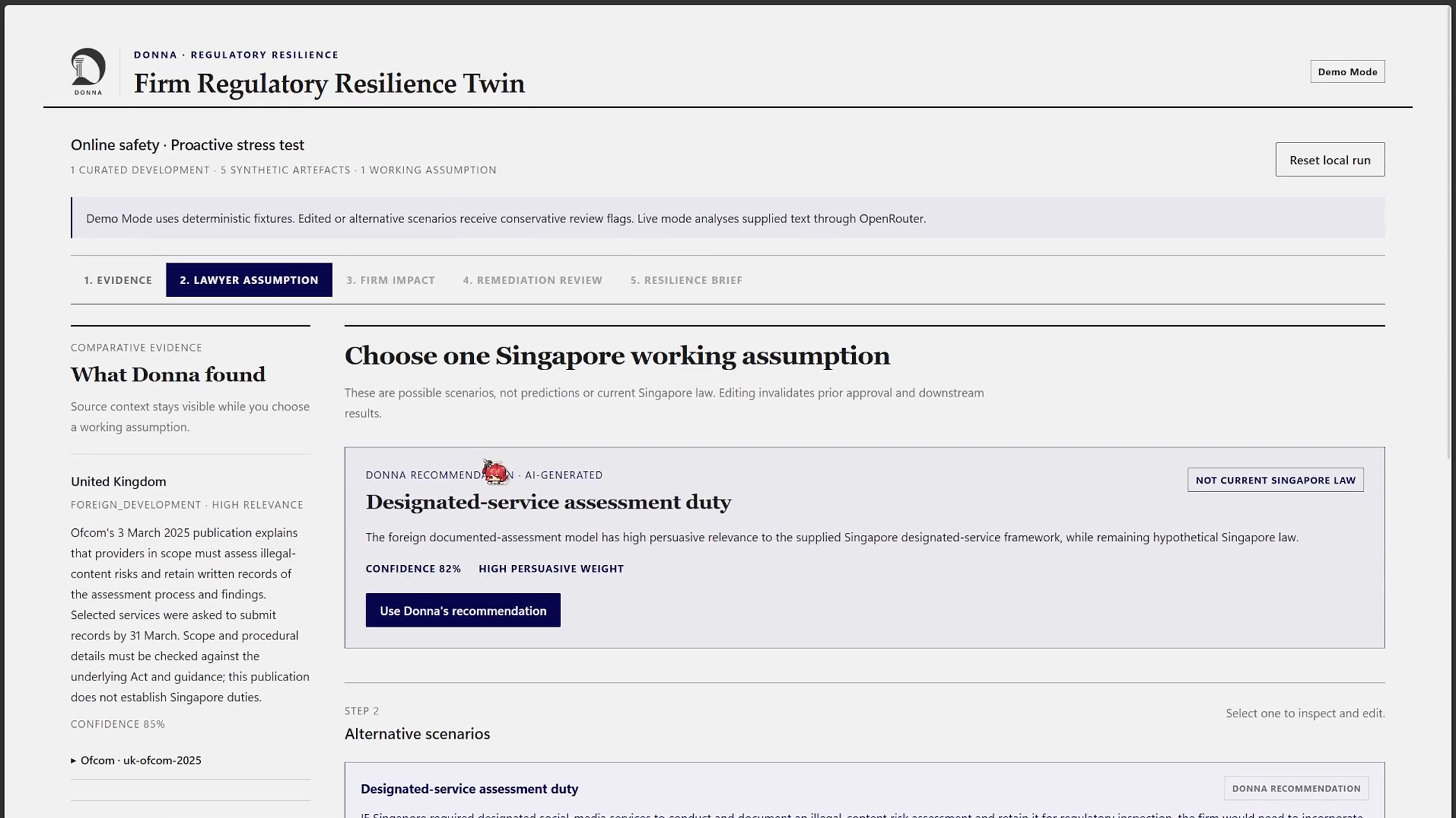
- Scenario Generation & Lawyer Judgement Gate: The AI generates plausible Singapore regulatory scenarios. The lawyer selects, edits, and explicitly approves one working assumption.
- Stress Test Firm: The approved assumption is injected into the system. The AI performs semantic analysis on five synthetic firm artefacts to find direct conflicts or omissions.
- Deterministic Propagation: Ordinary application code and not the LLM traverses the explicit upstream → downstream dependency graph, propagating impact statuses.
- Remediation & Human Review: The system proposes diff-style remediation patches. The lawyer can Approve, Reject, Edit, or Escalate each suggestion. Original text is never silently overwritten.
- Regulatory Resilience Brief: A concise, actionable report is assembled, detailing the legal basis, affected materials, proposed repairs, and outstanding questions requiring human judgement.
Key Technical Innovations
We prioritised reliability, explainability, and architectural maturity over flashy but fragile AI gimmicks:
- Deterministic Over Generative: Dependency traversal, status calculations, and report assembly are handled by ordinary, deterministic code. We do not use an LLM for something a
forloop can do reliably, preventing hallucinated dependencies. - Strict Provenance & Grounding: Every material AI conclusion must reference a specific LegalSource ID from the curated evidence pack. The backend validates that cited passages actually exist in the provided text.
- Bounded AI Failure Recovery: All LLM calls are validated against strict Pydantic schemas. If a model returns invalid JSON or an out-of-bounds confidence score, the system attempts exactly one repair before failing safely to a controlled error or mock fallback.
- Stateless Backend, Owned Frontend: The FastAPI backend remains entirely stateless, receiving full analysis context per request. The Next.js frontend owns all Firebase Firestore persistence, ensuring clean separation of concerns.
- Mock/Live Equivalence: The deterministic mock mode returns the exact same validated response schemas as the live OpenRouter pipeline, ensuring the UI never breaks during demo fallbacks.
Tech Stack
- Frontend: Next.js 16, React 19, TypeScript, Tailwind CSS
- Backend: FastAPI, Python, Pydantic (Strict camelCase API contracts)
- AI/LLM: OpenRouter (Model-agnostic, structured JSON schema output)
- Database & Auth: Firebase Authentication (Google Sign-In), Cloud Firestore
- Testing: Pytest, Playwright (Smoke tests), GitHub CI
Built With
- css
- next.js
- python
- react
- typescript
