-
-
DonDonGo
Inspiration
DonDonGo started from a very simple idea: helping a family-owned farm sell its produce to people living in the city.
When we first built the platform, our goal was straightforward — provide a digital channel for local farms to reach urban customers. But as we started selling, we noticed something unexpected.
Our target users didn’t evaluate food purely as products. They cared deeply about how food affects their body and long-term health.
A simple example made this very clear. If we sold a free-range farm chicken as just “a farm-raised chicken,” we could usually sell about 7 chickens in one batch. However, when we presented the same chicken together with mushrooms and ginkgo nuts — explaining that this combination is traditionally used in Chinese food therapy to nourish the body — sales increased immediately.
By packaging the chicken together with complementary ingredients and a health context, we were able to sell 4–5 additional chickens on top of the original batch.
This experience taught us something important: People don’t just buy food — they buy meaning, intention, and how food fits into their lives.
That insight became the foundation of DonDonGo and ultimately led us to build an AI agent that starts from why someone wants to eat something, translates that intent into what should be ordered, and then places the food order to fulfill their personal needs.
What it does
DonDongo is a group commerce platform powered by an AI agent that turns natural food intentions into executable group orders.
Most food platforms start from products. We start from intent. Users describe what they want to eat in plain language — including preferences, recent eating habits, health goals, or specific dishes. The agent reasons about these inputs, translates them into structured ingredients and meals, matches them with available local merchants, and generates a complete group order.
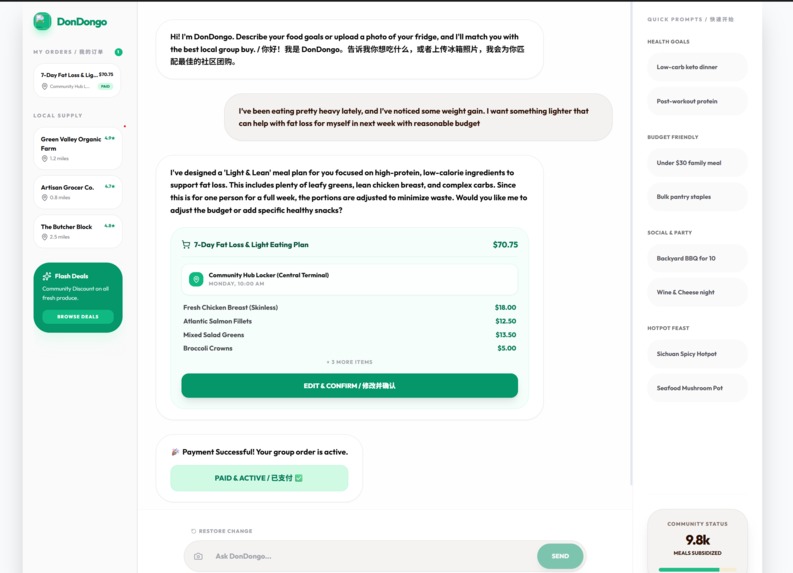
For example, a user might say: “I’ve been eating pretty heavy lately, and I’ve noticed some weight gain. I want something lighter that can help with fat loss.”
Then get the order:
-Fresh Chicken Breast(skinless) -- 1.5 kg -Atlantic Salmon Fillets -- 0.5 kg
-Mixed Salad Greens -- 3 packs
-Greek Yogurt(0% Fat) -- 1 kg
-Rolled Oats -- 0.5 kg
-Assorted Seasonal Berries -- 2 punnets
This order is automatically matched with available local farms and merchants and aggregated into a group-buy flow with a shared cutoff time. After the user confirms the list, price, and pickup location, the agent automatically places the group order.
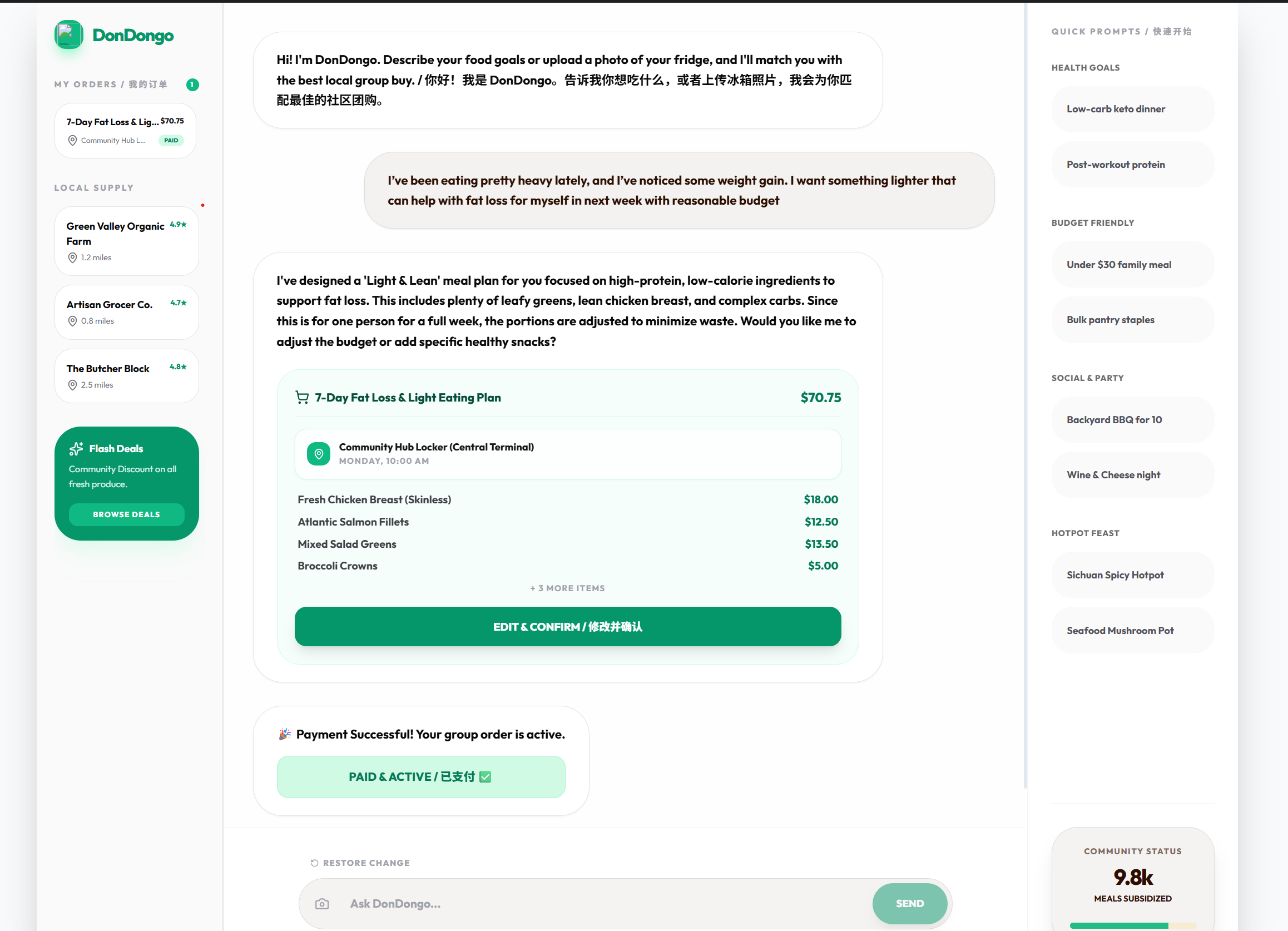
(See the demo image shown above)
Users don’t need to search products, compare vendors, or manually build carts — they simply confirm and wait for the food.
How we built it
DonDonGo was built by starting from real usage scenarios rather than a blank-slate AI demo. We already had an existing group-buying platform and observed how users described food needs in natural language. Based on these real use cases, we integrated Gemini as a core reasoning component within the system.
Gemini plays a central role in DonDonGo by acting as the intent-to-structure engine. User inputs — such as dietary goals, recent eating habits, or dish preferences — are sent to Gemini, where multi-step reasoning is used to interpret why the user wants certain food and translate that intent into what should be ordered.
To ensure reliability, we apply strict system instructions and structured output constraints, requiring Gemini to return data that conforms to a predefined schema. This allows the model’s reasoning to directly drive downstream application logic instead of producing free-form text.
The structured output generated by Gemini is then used to create order lists that fit naturally into a group-buying workflow, including item selection, quantities, and timing. At the current stage, this workflow is validated through a human-in-the-loop setup, ensuring correctness while closely mirroring the intended autonomous agent behavior.
From a system perspective, DonDonGo is designed as an agentic application rather than a chatbot. Gemini handles reasoning and decision-making, while the surrounding application framework focuses on state management, user interaction, and execution flow.
The system is implemented using a lightweight, modular web stack, combining modern React-based UI components with typed data contracts and API-level integration with the Gemini SDK. This separation allows Gemini to remain the intelligence layer, while the rest of the system handles presentation, validation, and future automation.
Challenges we ran into
Preventing the system from stopping at recommendations instead of producing executable orders, which requires making decisions under uncertainty such as missing data, partial inventory, and trade-offs between options.
Resolving conflicts in pickup locations and pickup time windows across different group-buy scenarios, which introduces both technical and operational challenges.
Accomplishments that we're proud of
Built and validated an intent-to-order workflow that converts free-form food requests into editable, executable order lists used in real group-buy scenarios.
Ran the full agent workflow end to end with 103 registered paying users using a human-in-the-loop execution model, manually placing agent-generated orders to verify both business demand and technical feasibility.
Designed the system to operate under real-world constraints — including incomplete user intent, conflicting pickup locations and time windows, and inventory limitations — rather than assuming a clean demo environment.
What we learned
Agency matters more than raw intelligence. We found that “understanding” alone doesn’t deliver value unless the system can also make decisions that lead to an outcome. In practice, users judge usefulness by whether the workflow actually moves forward (from intent → order list → confirmation), not by how fluent the explanation sounds.
Agents only become real when they are built around hard, specific use cases. Large models can handle open-ended conversation, but real deployment requires the agent to understand the user’s concrete scenario: how many people, budget, dietary goals, cooking ability, pickup constraints, and what “lighter” or “healthier” means in context. Once we grounded the agent in these real scenarios, we uncovered requirements that would never appear in a purely prompt-based demo.
Execution forces you to surface and resolve “hidden details.” Turning natural language into an actionable order exposes many edge cases: missing quantities, incompatible ingredient choices, partial inventory, and the need to pick between “closest pickup” vs “best price” vs “health goal fit.” We learned the agent must explicitly break down these details, make trade-offs, and produce structured outputs that the system can validate and execute.
Most of the work happens at the application layer, and it requires iteration. The model can reason, but reliability comes from the surrounding product: schema constraints, state management, undo/edit flows, and clear user confirmation. Each round of testing introduced new corner cases, so we had to iteratively refine both the agent prompts/structure and the UI flow until the output was consistently actionable.
Group commerce is an enabling constraint, not just a business model. Aggregating orders adds complexity (shared cutoff times, pickup windows), but it also reduces uncertainty and makes execution more feasible: merchants can prepare in batches, inventory decisions become clearer, and users get a smoother “confirm once” experience.
What's next for DonDonGo
Integrate the agent with live backend systems. Connect Gemini to real merchant and product SKU data so the agent can reason over actual inventory, pricing, and availability.
Progress toward guardrailed autonomy. Gradually move from human-in-the-loop to constrained autonomous execution, allowing the agent to place orders within predefined safety and confidence thresholds.
Continuously validate under real group-buy constraints. Stress-test agent behavior with real pickup windows, inventory changes, and multi-user aggregation to refine decision quality before broader rollout.
Expand multimodal inputs and long-term memory. Incorporate menus, ingredient images, and situational context, while using persistent agent memory to support consistent decisions across sessions.
Rather than relying on a single large model, we adjust our agent’s use of Gemini models based on concrete business needs across the ordering workflow. Lightweight models handle fast intent parsing and iterative edits to keep interactions responsive and cost-efficient, while more capable models are used selectively for complex reasoning such as resolving group-buy constraints and generating final executable orders. This approach balances user experience, cost, and iteration speed by treating Gemini as a set of complementary tools rather than a single black box.


Log in or sign up for Devpost to join the conversation.