Inspiration
Most people who get hurt by cleaning products aren't careless. They're trying to clean better. The toilet cleaner isn't working, so they add bleach. What they don't know is that many toilet cleaners are acid-based, and acid + bleach releases chlorine gas, in the smallest, least ventilated room in the house.
I checked the bottles at home and found the problem right away: the front says "kills 99.9% of germs", and the chemical names are in tiny print on the back. Nothing on the front tells you which two bottles must never meet. I wanted a tool that answers one question in a few seconds, before you pour: "Is it safe to use these together?"
What it does
Don't Mix is a small web app for anyone who cleans a home, hostel, PG or shop. It's especially for people new to it: students living alone, people helping elderly relatives, new domestic workers.
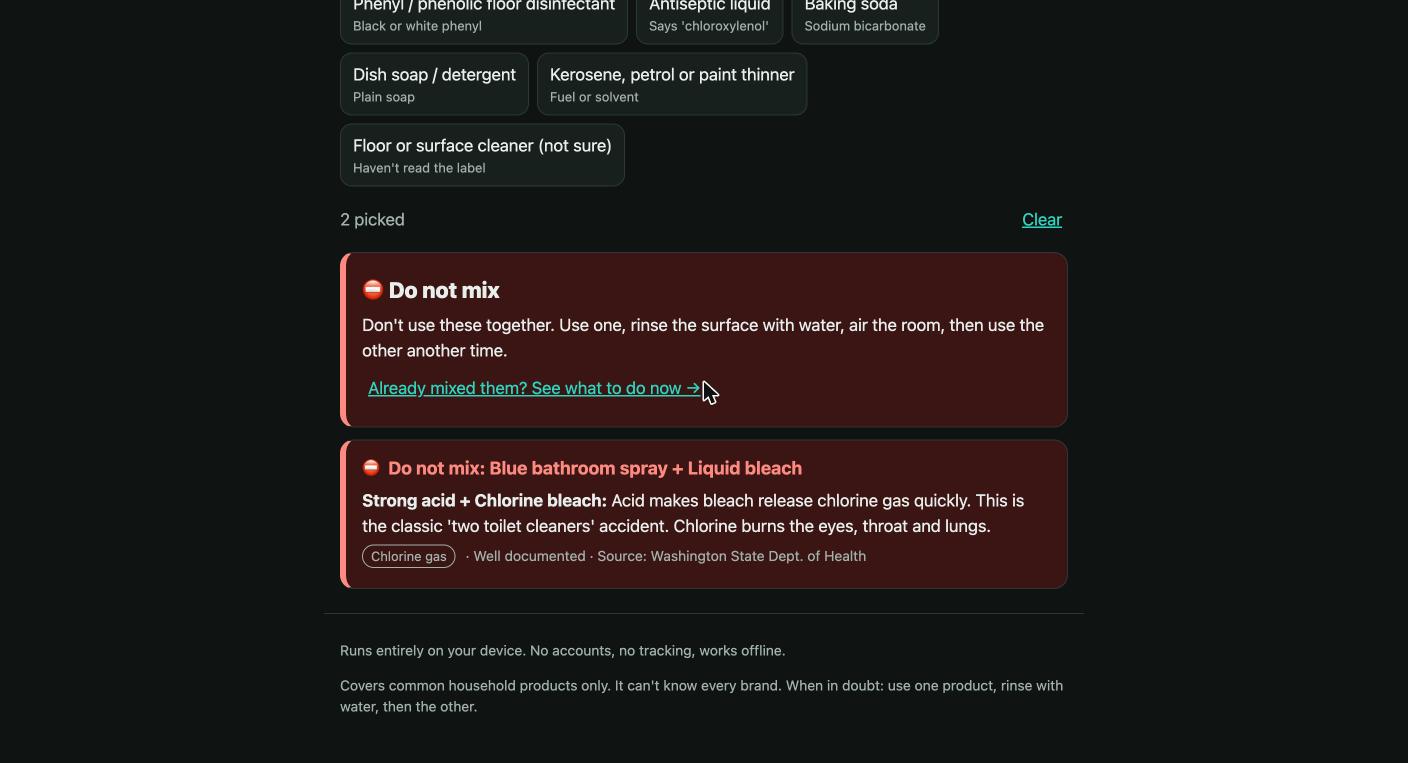
- Check a mix: I pick two or more products and get a clear verdict (⛔ Do not mix / ⚠️ Avoid / ❔ Not sure / ✅ No known dangerous reaction), the gas it would make, why, how well documented it is, and the source.
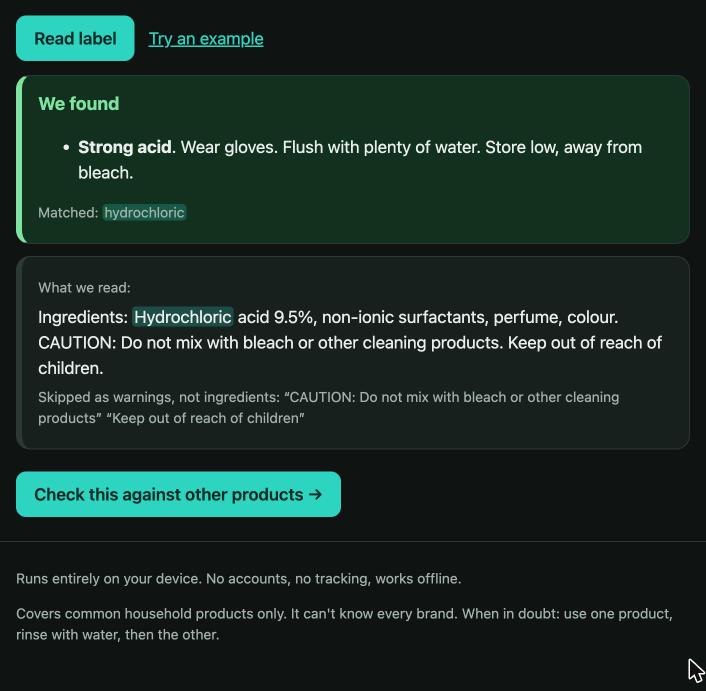
- Read a label: I paste the text from the back of any bottle. The app finds hazardous ingredients and highlights exactly which words it matched. It deliberately skips warning lines like "Do not mix with bleach" so the warning isn't mistaken for an ingredient.
- My cupboard: I list what's under my sink. It tells me which bottles shouldn't share a shelf (a leaking cap can react) and which pairs must never be used back to back without rinsing.
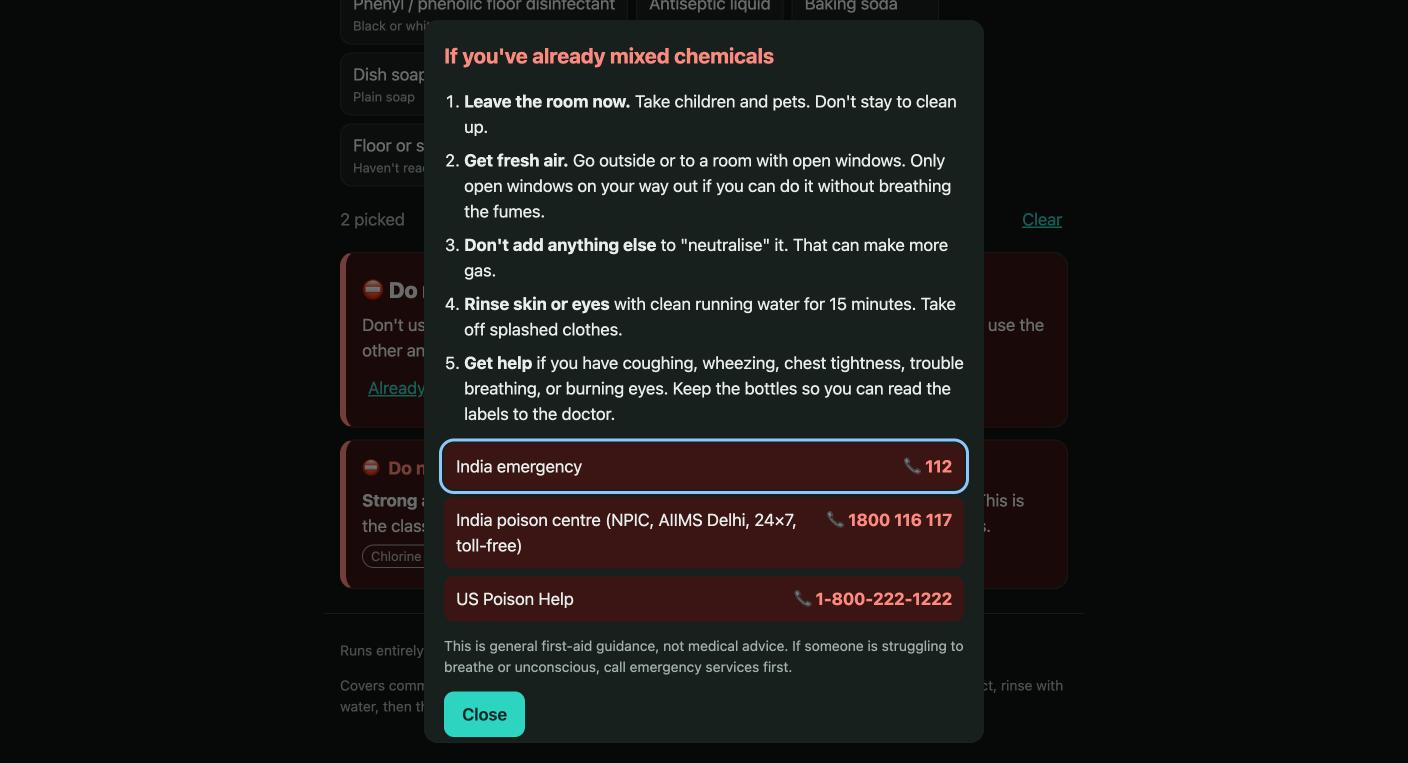
- Already mixed something?: One tap opens first-aid steps and tap-to-call numbers: 112, the AIIMS National Poisons Information Centre (1800 116 117, 24×7), and US Poison Help.
Example of the safer outcome: I paste a label that reads "Hydrochloric acid 9.5%… Do not mix with bleach" and pick liquid bleach. Instead of pouring both into the toilet bowl, I get ⛔ Do not mix: acid makes bleach release chlorine gas quickly. I use one, rinse, air the room, and use the other another day.
How I built it
- Plain HTML, CSS and JavaScript (ES modules). No framework and no build step, so it loads fast on cheap phones.
- A rule table instead of AI. Every product belongs to one or more hazard groups (chlorine bleach, ammonia, strong acid, mild acid, caustic, peroxide, alcohol, phenolic, flammable). Rules describe what happens when two groups meet. If a product is in several groups, the worst pairing wins.
- A label parser that splits text into sentences, drops warning sentences and negations ("bleach-free", "no ammonia"), then matches whole words, longest phrase first.
- A service worker and web app manifest, so it works fully offline and can be installed on a phone.
- Node's built-in test runner: 18 tests cover the reaction rules and the label parser.
- Hosted on GitHub Pages. I used Claude Code (Anthropic) as an AI pair-programmer for code and wording, and I checked every safety rule against the sources below.
Everything was built during the hackathon. The commit history shows the step-by-step build, and no pre-existing code was used.
Challenges I ran into
- Labels mention chemicals they don't contain. Almost every acid cleaner says "Do not mix with bleach". A naive keyword match flags it as bleach, which is exactly backwards. I had to filter out warning sentences and negations before matching.
- Words hiding inside other words. "polyethylene" contains lye, and "phenoxyethanol" contains ethanol. Whole-word matching fixed false alarms.
- Being useful without overclaiming. Some reactions (like bleach + phenolic disinfectants) have less household-scale data. Instead of hiding that, I show a confidence level on every warning and still treat them as unsafe.
- Getting the emergency numbers right. A wrong phone number in a safety app is worse than none, so I checked the poison centre number against AIIMS and Ministry of Health pages.
Accomplishments that I'm proud of
- It never says "safe" when it doesn't know. Unknown products and unrecognised labels return ❔ Not sure, and even ✅ still says to use one product at a time.
- It works with no internet, no account and no tracking. Nothing leaves the device.
- It's accessible: keyboard and screen-reader friendly tabs, results announced as they change, and colour + icon + words for every level, in light and dark mode.
What I learned
- The hardest part of a safety tool is saying "I don't know" clearly and kindly.
- A fixed, readable rule table can be better than AI when the cost of a wrong answer is someone's lungs. It gives the same answer every time, and anyone can check it.
- Small details like "skip the warning sentence" matter more than adding features.
Limitations
- It only knows common product types and ingredient names, not every brand. A label with no chemical names returns Not sure.
- The label reader needs typed or pasted text. There's no camera scanning yet.
- It covers mixing and storage, not every hazard of each product on its own.
- It is not medical advice. In an emergency, call for help first.
What's next for Don't Mix
- Scan a label with the camera using on-device text recognition, so nothing is uploaded.
- Hindi and other Indian languages, since many of the people doing the cleaning don't read English labels.
- A printable cupboard sticker listing "never mix" pairs for shared kitchens and hostel bathrooms.
- More products, reviewed with someone who has a chemistry or toxicology background.
Sources and credits
- Washington State Dept. of Health: Dangers of Mixing Bleach with Cleaners
- AIIMS New Delhi: National Poisons Information Centre (1800 116 117)
- AI assistance: Claude Code by Anthropic
- No third-party libraries, datasets or assets were used.
Built With
- claude-code
- css3
- github
- html5
- javascript
- localstorage
- node.js
- progressive-web-app
- service-worker
