-
-
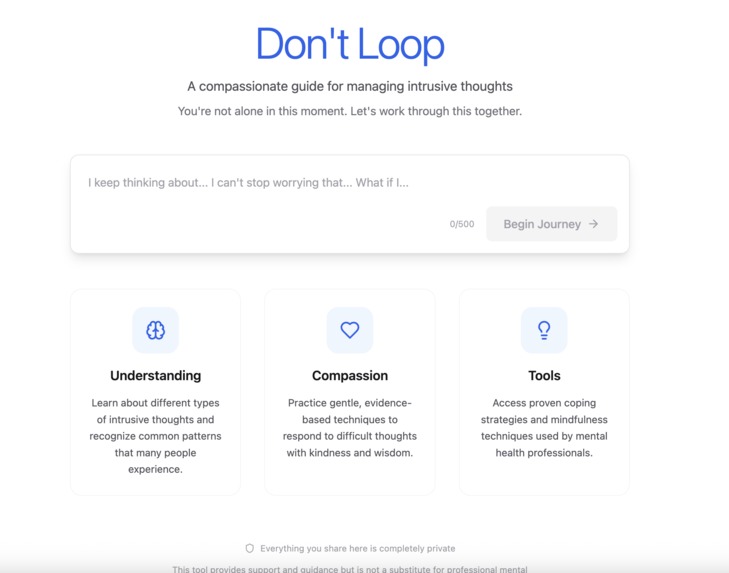
Homepage
-
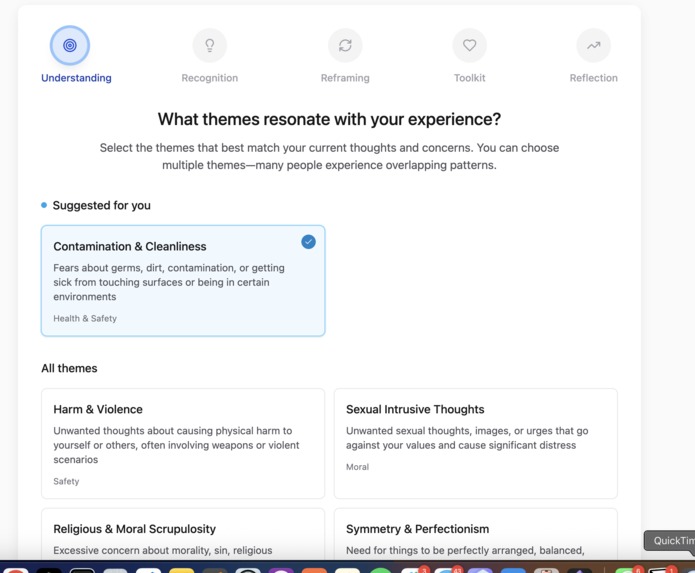
Step 1
Inspiration
As someone who lives with OCD, I’ve often found myself in the middle of an intrusive thought spiral, feeling isolated, confused, and desperate for clarity. Over time, I realized that what helped the most wasn’t just reassurance — it was tools: knowing I wasn’t alone, seeing my thoughts reflected in patterns, and learning to reframe and step out of the loop. But finding those tools in one place was nearly impossible.
That’s what inspired Don’t Loop — a calming, quick-access mental health companion that I wish I had years ago.
What it does
Don’t Loop is a psychological multi-tool designed to guide users through OCD-related thought cycles, phobias, and intrusive thoughts. It works like a gentle wizard:
- You start by writing out what’s on your mind.
- The app identifies relevant OCD themes based on your input.
- You choose the themes that resonate.
- It shows common intrusive thought patterns and ruminations associated with that theme — showing you you’re not alone.
- Then it helps you reframe those thoughts with “anti-thoughts,” grounded in cognitive behavioral therapy (CBT).
How we built it
I used a full JavaScript stack for this project through prompting Bolt. I designed everything to feel intuitive and emotionally safe, avoiding judgmental or clinical vibes. The tone is gentle and human — as if a caring friend were walking you through your anxiety.
Challenges we ran into
The hardest part wasn’t technical — it was content. Curating accurate, empathetic, and non-triggering language around OCD, especially across different subtypes, took hours of research and revision. I didn’t want to overwhelm the user or accidentally reinforce compulsions. Finding the right voice was crucial.
Another challenge was scoping the MVP. There are so many features I’d love to add — AI therapy suggestions, mood tracking, community boards — but I had to stay focused on what actually helps in the moment.
What we learned
Building Don’t Loop deepened both my technical and emotional resilience. It taught me how powerful code can be when paired with compassion. I also gained experience designing around mental health UX, including safety, anonymity, and pacing.
What's next for Don't Loop
I built this tool for myself — but I hope it helps others, too. If even one person uses it during a rough moment and feels less alone, more understood, or a little more in control, it’ll be worth every second. I want to add opportunity to find therapists and smart match on platform.
Built With
- react
- tailwind

Log in or sign up for Devpost to join the conversation.