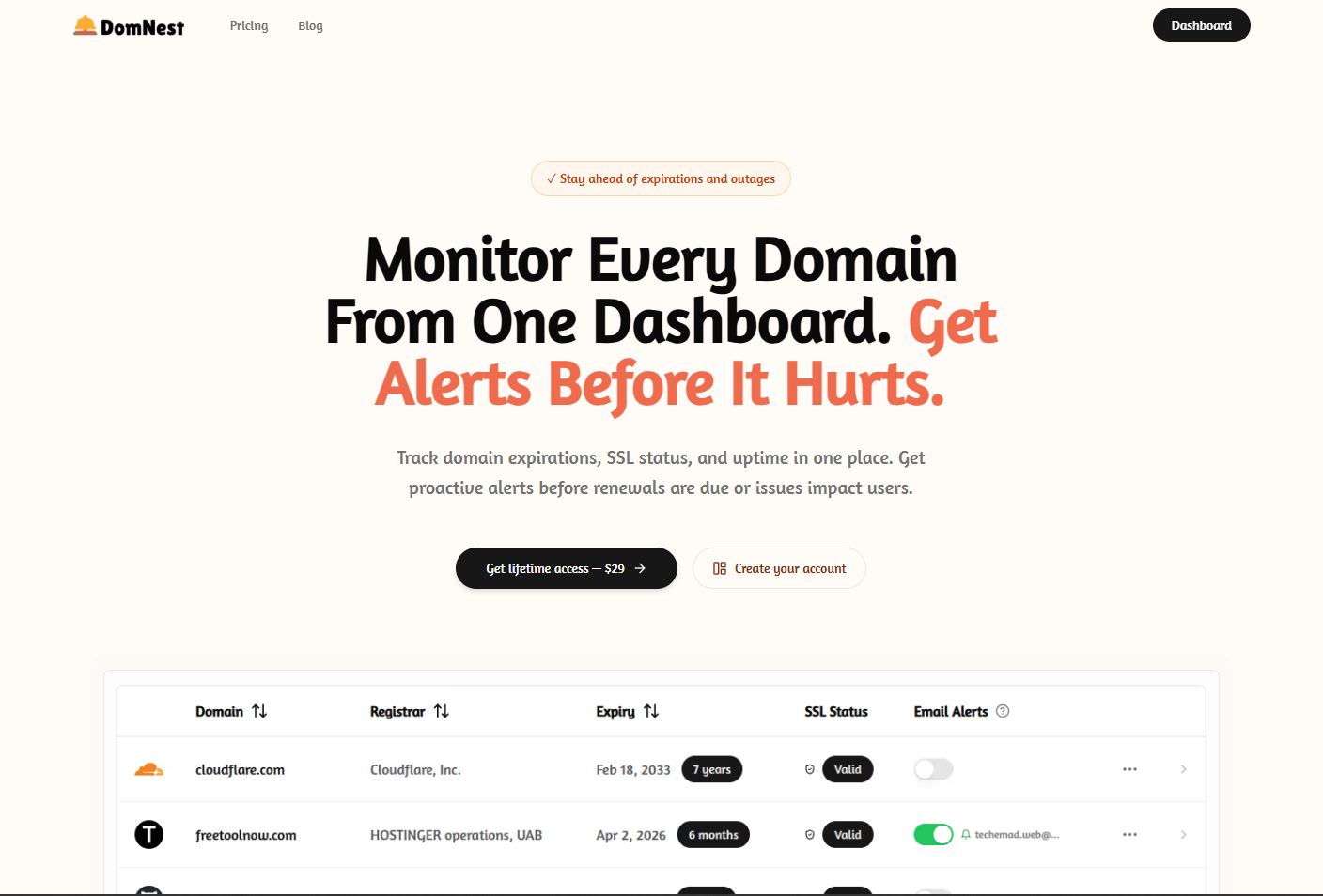
Domains expire. SSL certificates break. Servers go offline.
Most businesses only discover these issues after customers start complaining.
For startups, agencies, and SaaS founders, this is not a small inconvenience. It means lost revenue, SEO damage, broken trust, and emergency fixes. Managing domains across multiple registrars while tracking SSL validity and uptime separately creates unnecessary complexity and risk.
Domnest was built to remove that risk through clarity and automation.
Inspiration
The idea for Domnest came from managing multiple projects and domains across different platforms.
While building and launching several web tools and SaaS products, I constantly needed to check expiry dates manually, verify SSL certificate validity, and monitor uptime using separate services. There was no clean, unified system focused specifically on domain lifecycle visibility for indie founders and small teams.
The workflow felt scattered and fragile.
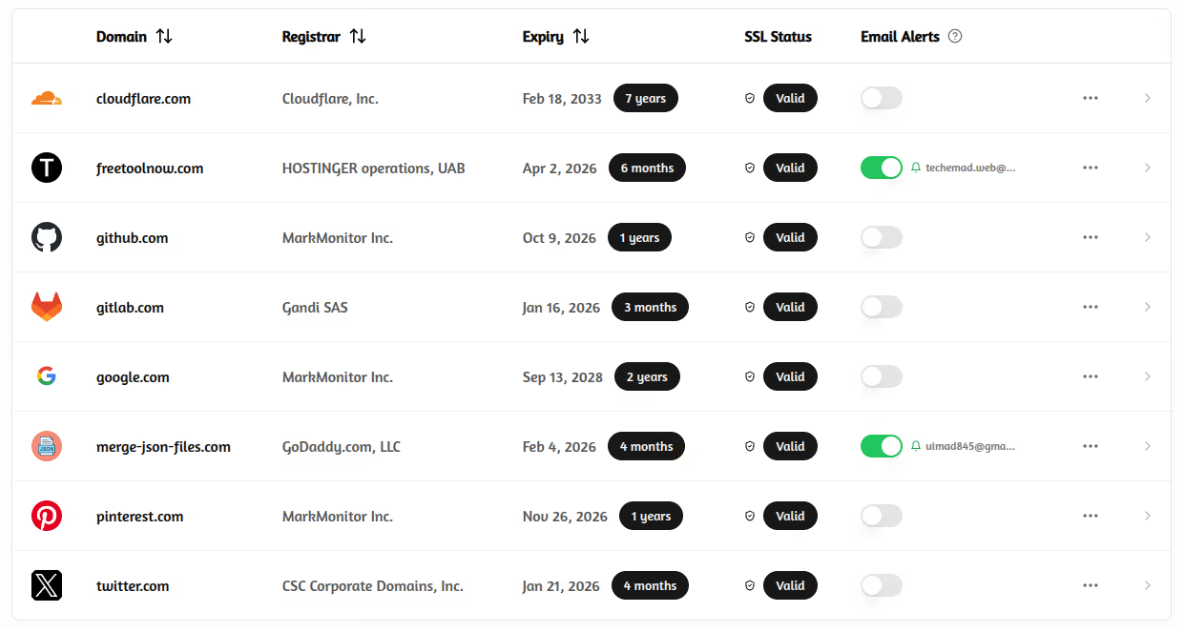
Instead of relying on reminders and disconnected tools, I decided to build a focused dashboard that centralizes domain intelligence into one reliable interface.
How I Built Domnest
Domnest was built as a full stack SaaS dashboard with performance, clarity, and scalability in mind.
Tech Stack
Next.js for full stack development TypeScript for maintainable and safe code MongoDB for structured domain data storage API integrations for WHOIS lookups, SSL validation, and uptime checks A modern dashboard interface designed for clarity and trust
The system separates domain metadata collection, SSL parsing, and uptime monitoring into modular services.
For example, expiry risk is calculated using:
Days Until Expiry = Expiry Date − Current Date
Based on this value, domains are categorized into safe, expiring soon, or critical states. SSL certificates follow a similar classification system.
The goal was not to build another generic monitoring platform. The focus was domain lifecycle intelligence.
What I Learned
Building Domnest taught me how to approach SaaS product development from idea validation to deployment.
I learned how to design dashboards that prioritize signal over noise. I improved my understanding of handling third party API reliability, error states, and data inconsistencies. I also learned that simplicity is a competitive advantage.
A focused product that solves one painful and costly problem clearly is stronger than a platform overloaded with features.
Challenges I Faced
One major challenge was API reliability. WHOIS and SSL data providers sometimes return inconsistent responses or enforce rate limits. Building fallback logic and error handling required careful engineering.
Another challenge was data normalization. Different registrars return expiry data in different formats, which meant parsing and standardizing responses before storing them.
Designing for trust was equally important. Since Domnest monitors critical infrastructure data, the interface needed to feel stable, professional, and reliable.
Finally, resisting feature creep was essential. It was tempting to expand into a full DevOps monitoring suite, but I kept the product focused on domain lifecycle management.
The Vision
Domnest aims to become a proactive risk management system for domain dependent businesses.
Future improvements include portfolio level analytics, smarter alerting systems, renewal insights, and domain health scoring.
The mission is clear. No business should lose customers because of an expired domain or broken SSL certificate.
