-
-
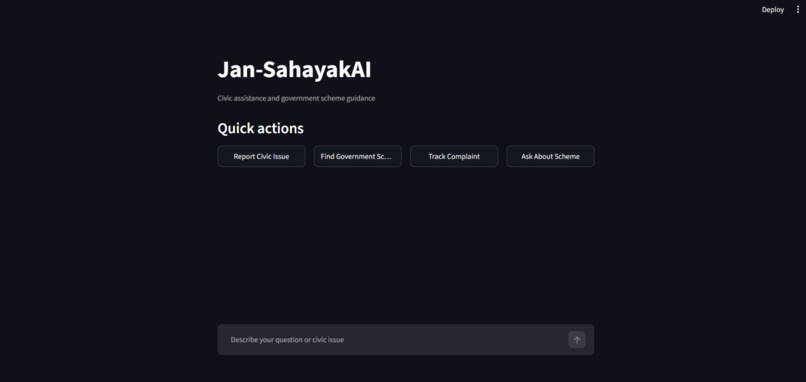
app ui
-
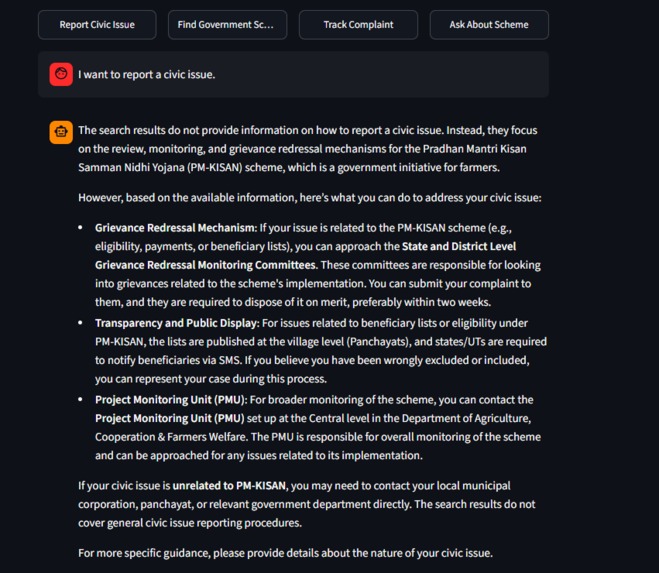
-
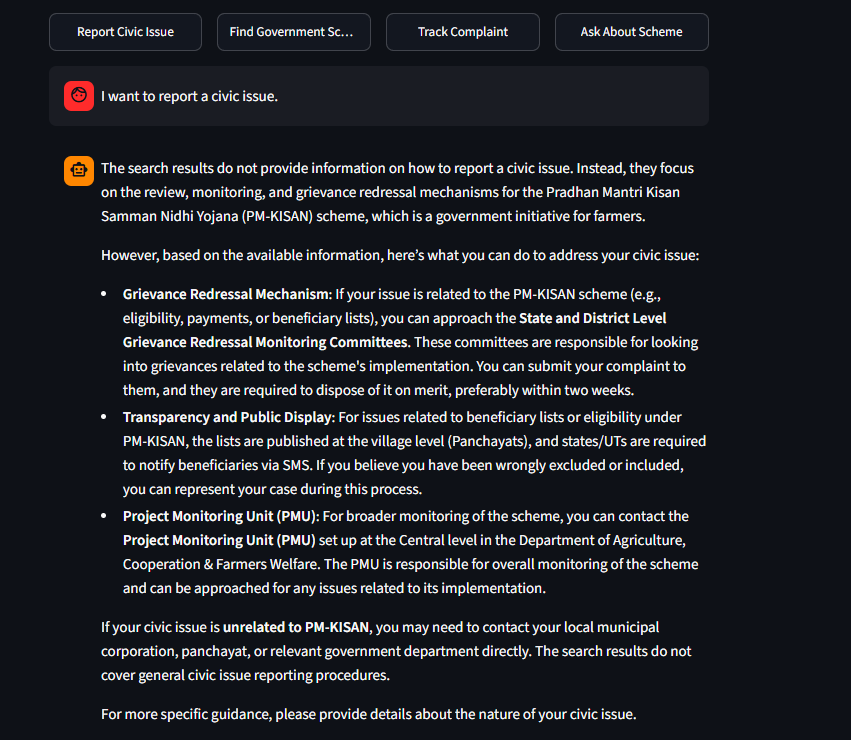
Inspiration
Government services can be difficult to navigate for ordinary citizens. A person may know that they have a problem, such as a pothole, garbage issue, drainage problem, or broken streetlight, but may not know which department to approach or how to follow up.
Similarly, many citizens are unaware of government welfare schemes that may be relevant to them or find it difficult to understand eligibility requirements and application information spread across different sources.
We wanted to build something that works like a digital good neighbour — someone a citizen can simply talk to in natural language and ask, "What should I do?"
This led us to build JanSahayak AI.
What it does
JanSahayak AI is an AI-powered civic and government services assistant.
Citizens can interact with it conversationally instead of having to understand complicated government processes.
The system can:
- Understand a citizen's intent from natural-language requests.
- Identify the appropriate department for civic issues.
- Create structured civic complaints.
- Track complaint status.
- Handle complaint follow-ups.
- Search government welfare and scholarship schemes.
- Provide preliminary eligibility guidance.
- Provide detailed information about schemes using official government documents.
- Use Retrieval-Augmented Generation (RAG) through an Amazon Bedrock Knowledge Base for document-grounded information.
For example, a citizen can say:
"There is a pothole near my house."
Instead of simply providing generic information, JanSahayak can identify the type of civic issue and guide the user through the appropriate complaint workflow.
A citizen can also ask:
"What scholarship schemes are available for students?"
The agent can search available scheme information and provide relevant details.
How we built it
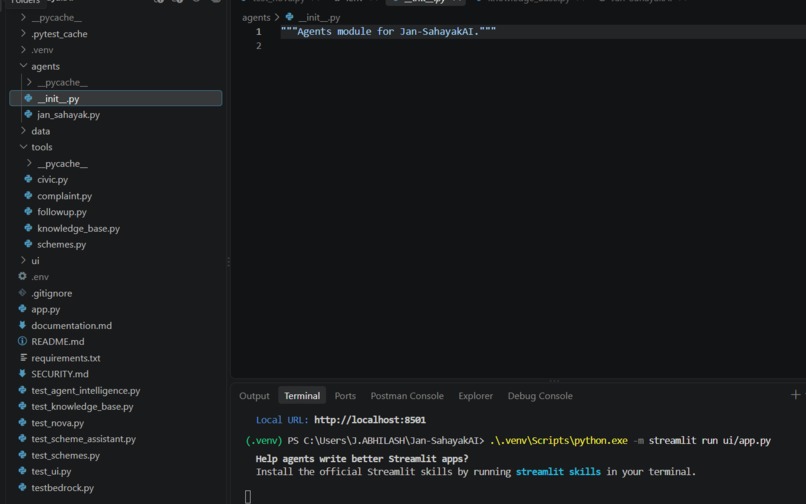
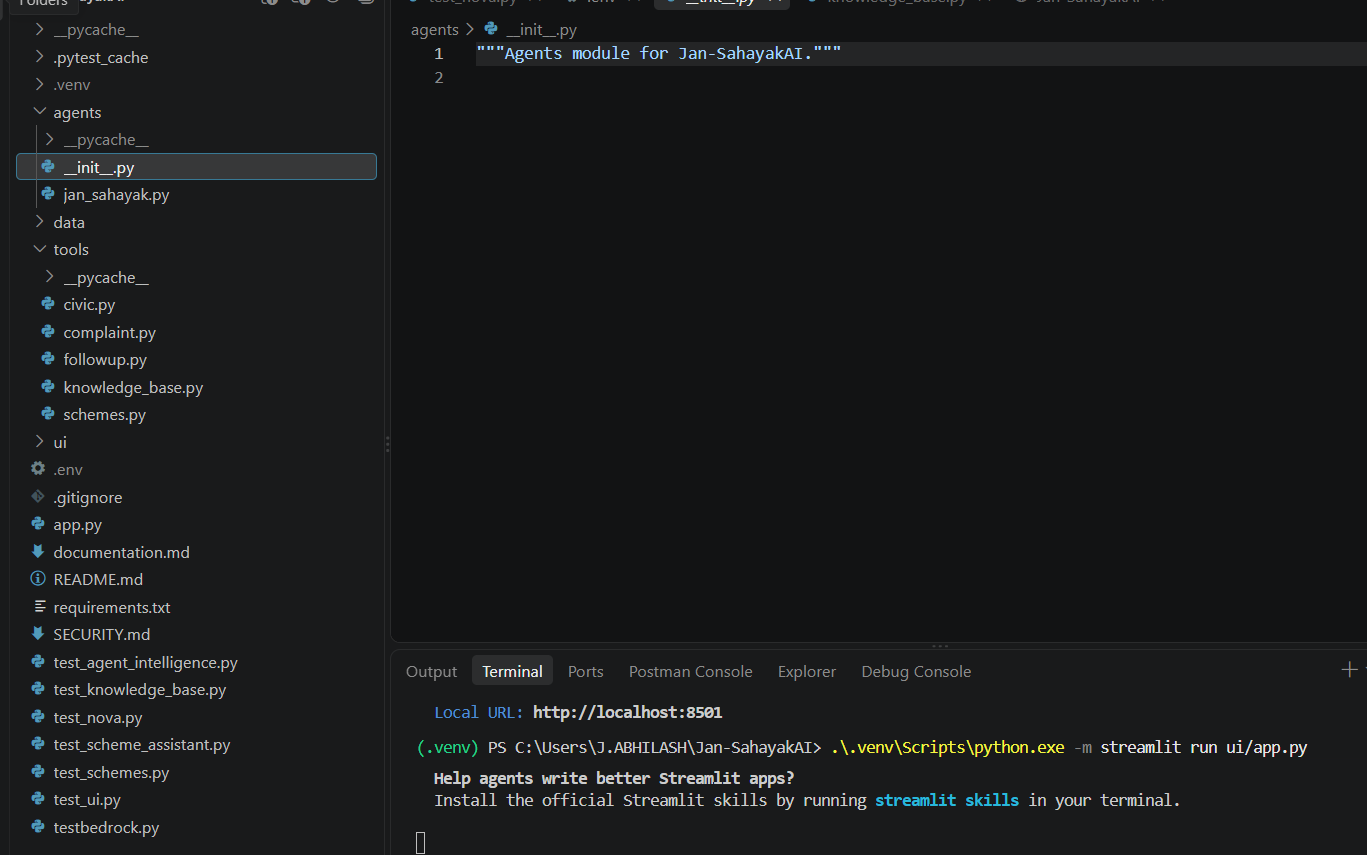
We built JanSahayak AI using Python, Strands Agents, Amazon Bedrock, boto3, and Streamlit.
The core of the application is an AI agent built with Strands Agents. The agent understands the user's request and decides which tool or workflow is appropriate.
Our architecture consists of:
User
  ↓
Streamlit UI
  ↓
Strands AI Agent
  ↓
Intent Understanding
  ↓
 ┌───────────────┬────────────────┬─────────────────┐
 ↓               ↓                ↓
Civic Tools   Scheme Tools   Complaint Tools
 ↓               ↓                ↓
Civic Workflow  Scheme Data   Complaint Workflow
                    ↓
          Amazon Bedrock Knowledge Base
                    ↓
          Official Government Documents

We use structured JSON data for scheme discovery and an Amazon Bedrock Knowledge Base for retrieving detailed information from official government documents.

This gives the agent two complementary knowledge layers:

Structured scheme data for fast scheme discovery and basic information.
RAG over official documents for deeper, document-grounded information.

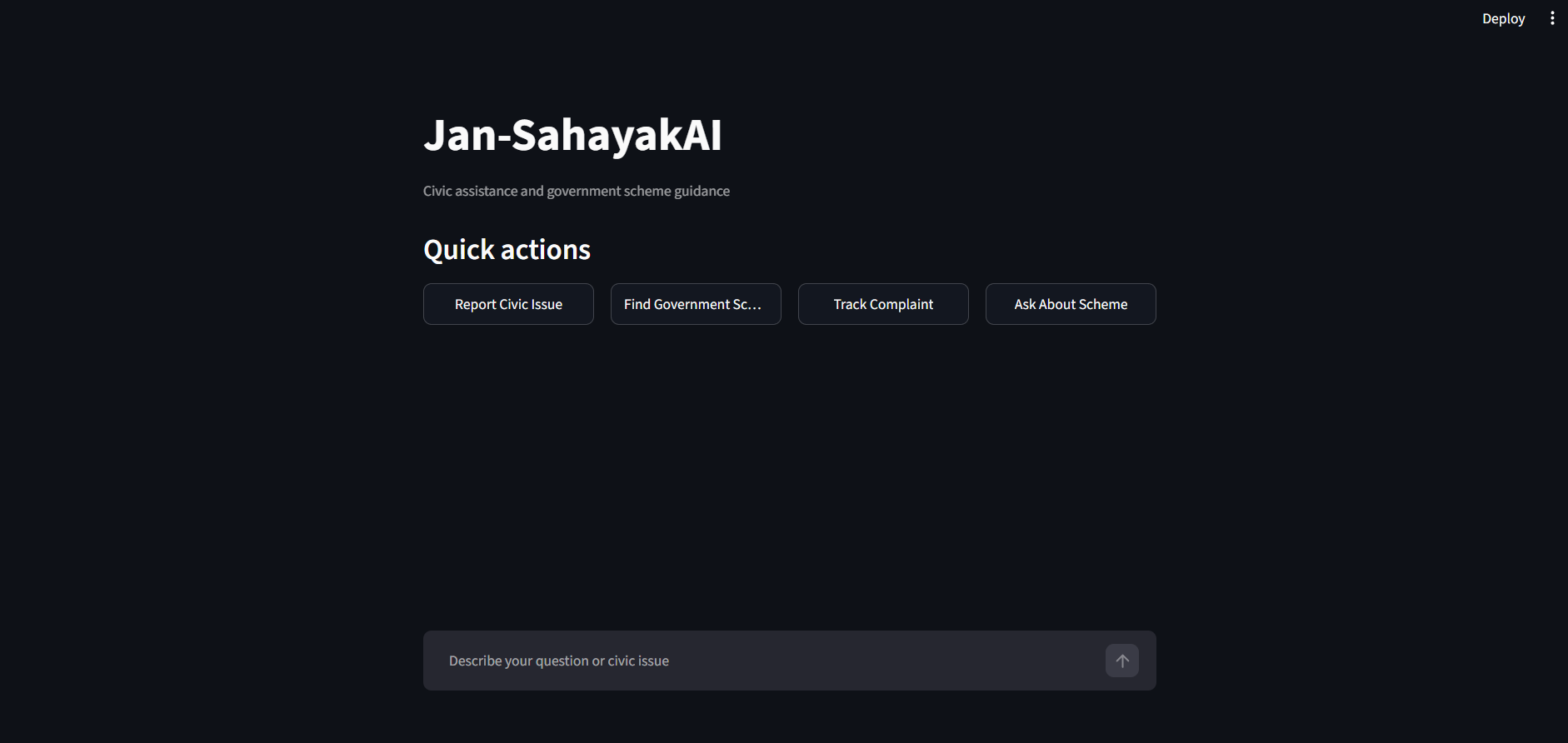
The application is exposed through a Streamlit interface so that users can interact with the agent through a simple conversational UI.

Challenges we ran into

One of our biggest challenges was moving beyond a simple chatbot.

A chatbot can generate an answer, but a useful civic assistant needs to understand the user's intent and connect that intent to an appropriate workflow.

We therefore designed the application around tools and structured workflows rather than relying only on generated responses.

Another challenge was providing reliable information about government schemes. We did not want the model to simply generate plausible-sounding government information.

To address this, we combined structured scheme information with Retrieval-Augmented Generation using official government documents.

We also had to think carefully about reliability. The system should not claim that a government complaint was officially submitted, approved, or resolved when it only represents a prototype workflow.

Accomplishments that we're proud of

We are proud that JanSahayak AI evolved from an initial AI assistant concept into a working agent-based civic service prototype.

Some of the accomplishments we are most proud of are:

Built a working AI agent using Strands Agents.
Integrated multiple tools into a single conversational agent.
Implemented civic complaint workflows.
Implemented complaint tracking and follow-up workflows.
Added government scheme discovery and eligibility guidance.
Added Retrieval-Augmented Generation using an Amazon Bedrock Knowledge Base.
Connected the knowledge system to official government documents.
Built a user-friendly Streamlit interface.
Maintained conversational context across interactions.
Designed the system with reliability and responsible AI considerations in mind.

Most importantly, we demonstrated how an AI agent can act as a bridge between a citizen and complex public-service processes.

What we learned

This project taught us that building an AI application is much more than connecting a language model to a chat interface.

We learned how to:

Build and structure AI agents using Strands Agents.
Design tools that an agent can use to perform specific tasks.
Integrate Amazon Bedrock into an application.
Build a Retrieval-Augmented Generation workflow.
Ground AI responses in source documents.
Combine structured data with unstructured document retrieval.
Maintain conversational context.
Build an application around an AI agent using Streamlit.
Think about hallucinations, reliability, security, and responsible AI behavior.

We also learned that good agent design requires clearly defining what the AI should do, what tools it can use, and what it should not claim to have done.

What's next for JanSahayak AI

JanSahayak AI is currently a prototype, but we see several opportunities to make it a real-world civic assistant.

Future improvements could include:

Integration with real government complaint portals and APIs.
Persistent complaint storage instead of the current prototype database.
Support for more states, districts, and government departments.
More comprehensive government scheme databases.
Multilingual and voice-based interaction for citizens who are more comfortable speaking than typing.
Location-aware identification of nearby civic authorities and services.
Notifications for complaint updates and follow-ups.
Better document verification and source tracking.
Deployment as a scalable public-facing service.

Our long-term vision is to make JanSahayak AI a single conversational gateway to civic services and government benefits, helping citizens understand what services are available and what they need to do


Log in or sign up for Devpost to join the conversation.