-
-

market place
-
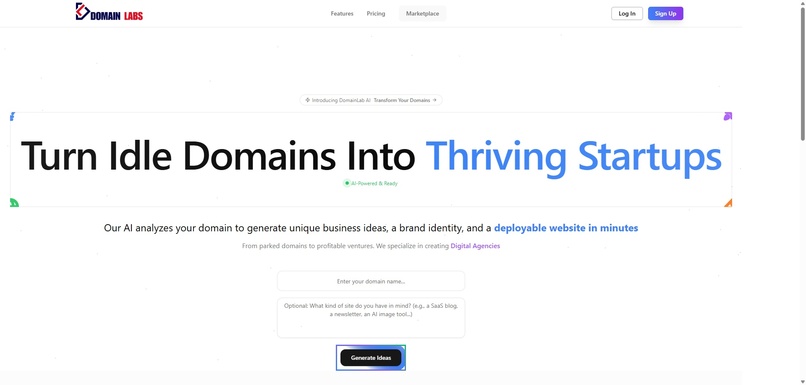
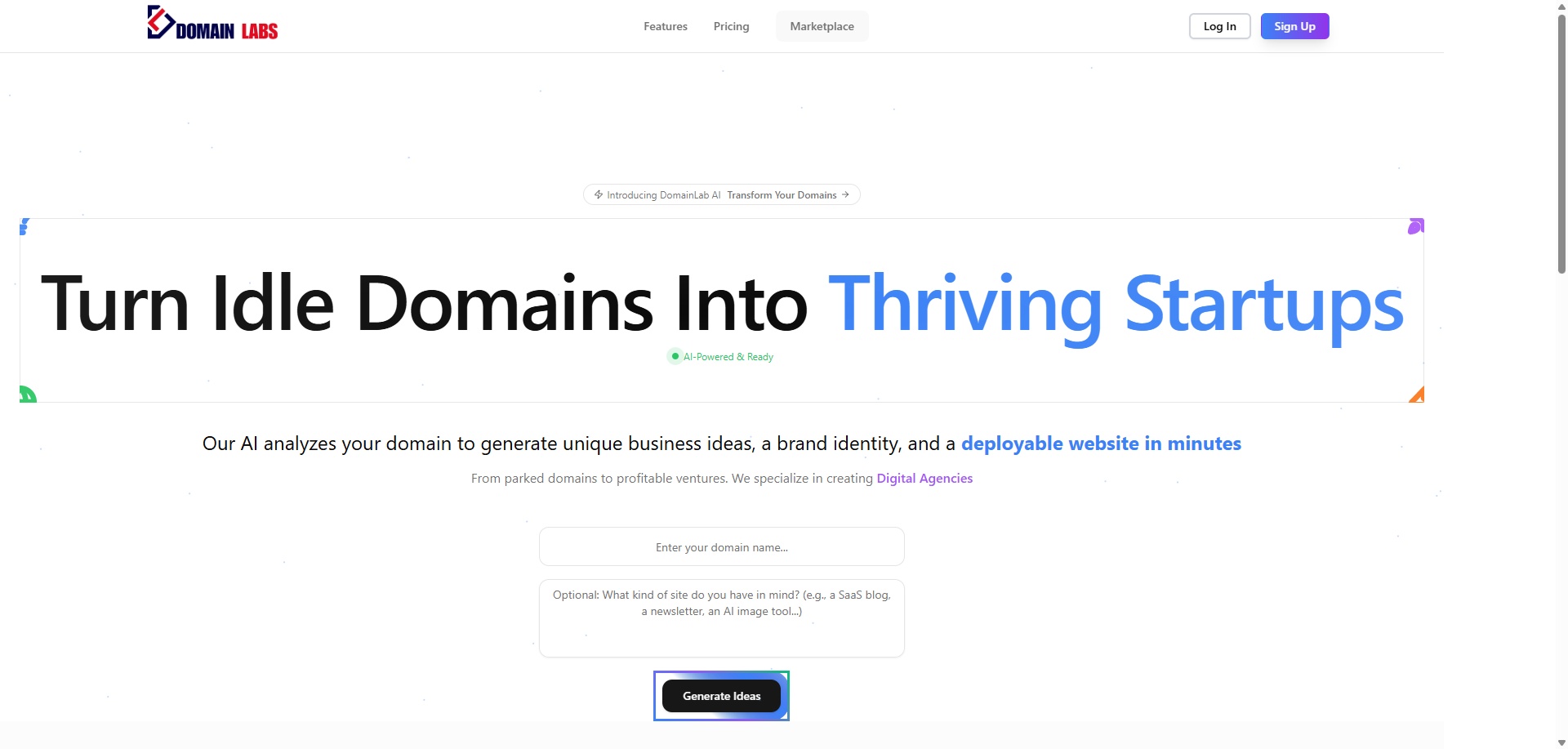
Domain Name
-
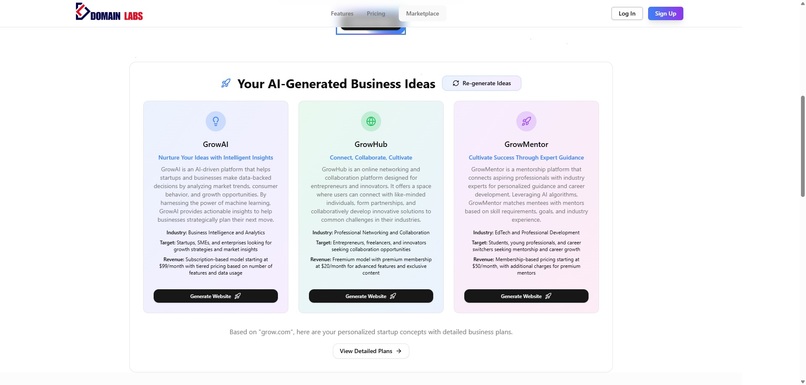
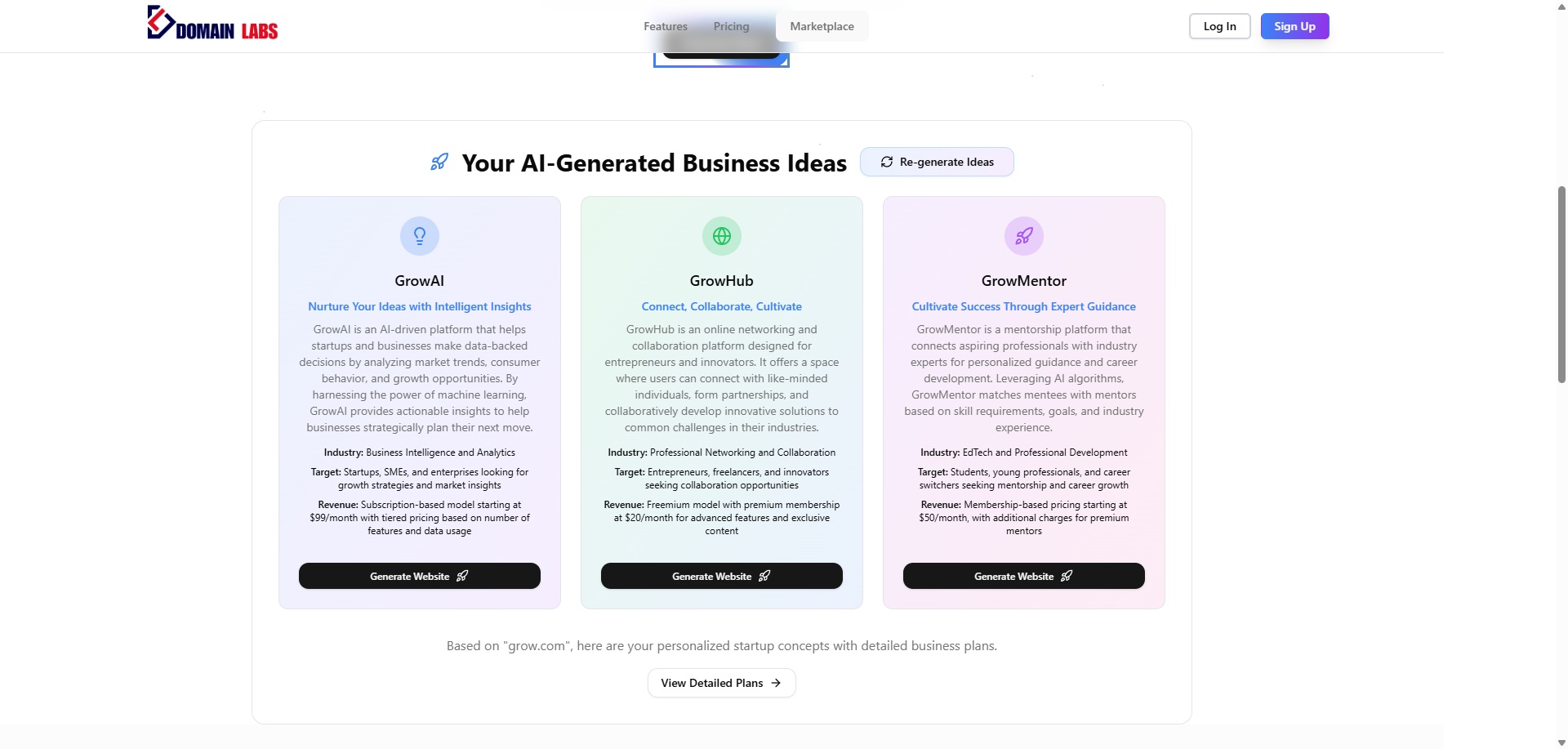
generated ideas

Inspiration
The domain name market is a landscape of immense, untapped potential, but it's plagued by a core paradox: domains are seen as valuable digital real estate, yet they are incredibly difficult to value and sell. This illiquidity means millions of valuable domains sit parked and unused, becoming costly liabilities instead of assets. Our inspiration came from a single, powerful idea referenced in our research: what if we could shift the paradigm from passive monetization (like domain parking) to active value creation? We were inspired to solve the "Domain Investor's Dilemma" by building a platform that could instantly transform a raw, undeveloped domain name into a tangible, market-ready digital product , just as a developer builds a home on an empty plot of land to unlock its true value.
What it does
Domain Labs is a generative platform that breathes life into idle domains. Here's what it does:
AI-Powered Business Conception: A user enters their domain name and can provide an optional suggestion (e.g., "a SaaS for writers"). Our AI then generates three distinct, high-quality, digital-first business concepts, complete with target markets, revenue models, and key features.
Generative Website & Brand Creation: Once a user selects an idea, our "AI Creative Director" generates a complete, unique, multi-page website. This isn't a template; it's a bespoke creation with a unique color palette, font pairing, and rich, relevant content for pages like "About Us" (including fictional team bios) and "Services." It also generates a brand_kit, including a concept for a logo.
Immersive WYSIWYG Editor: The user is immediately taken to a live, interactive preview of their new website. They navigate and edit the site not through a clunky sidebar, but by clicking on the website's own navigation links, creating a seamless and intuitive experience.
Real-Time AI Chat Editor: The platform's most powerful feature. The user can request changes in plain English ("Make the hero text bolder," "Add a testimonial about our great customer service"). The AI understands the request, modifies the website's underlying JSON structure, and thanks to Supabase Realtime, the changes appear on the preview instantly without a page refresh.
Multi-Page Management: Users can expand their site by clicking "Add New Page" and selecting from a library of templates like "Pricing" or "Contact," or even add a blank page to build from scratch with the AI chat.
User Dashboards & Marketplace: The platform includes full user authentication. Logged-in users have a personal dashboard to see all their created projects. They also have the ability to list their finished "Domain + Website" bundle for sale on a public marketplace, turning their once-idle asset into a sellable product.
How we built it
I chose a modern, robust, and integrated stack to bring this ambitious project to life, relying heavily on the tools provided in the hackathon kit.
Frontend: The entire user interface was built in Bolt.new. We used React with TypeScript for type safety and Vite for a fast development experience. The beautiful, responsive UI was crafted with Tailwind CSS and shadcn/ui components.
Backend: We adopted a unified Supabase stack for its power and integration.
Database & Authentication: Supabase Postgres serves as our database, with Row Level Security (RLS) enabled to ensure users can only access their own projects. Supabase Auth handles all user sign-ups and logins.
Backend Logic: All backend tasks are handled by serverless Supabase Edge Functions written in TypeScript. We have dedicated functions for generate-ideas, generate-layout, modify-layout, add-page, and the secure list-project.
Real-time Capabilities: The magic of the instant-updating editor is powered by Supabase Realtime, which pushes database changes to the frontend instantly via WebSockets.
AI Engine: All generative capabilities, from business strategy to copywriting to website design, are powered by OpenAI's GPT-4o model.
Core Architecture: The platform is built on a "Website as JSON" model. The AI generates a detailed JSON object representing the entire site, which is then rendered by a dynamic component in React. This separation of data and presentation is what makes the real-time AI editing possible.
Challenges we ran into
Our biggest challenge was not in the code logic, but in the development environment itself. For days, we battled a persistent and cryptic TypeError: Failed to fetch error.
The Problem: We discovered that the Bolt.new WebContainer, being a secure sandbox, was blocking client-side network requests to the Supabase Functions gateway and, crucially, hiding the true underlying CORS error from the developer tools. This sent us on a long debugging journey where the backend logs showed success, but the frontend showed failure.
The Solution: After exhausting all standard CORS and RLS fixes, we architected a solution. We implemented an "Internal Proxy" using a Supabase Edge Function. The frontend now makes a safe call to this simple proxy function, which then securely invokes the real, complex functions on the backend. This server-to-server communication is not subject to the browser's sandbox rules, which permanently solved the issue. It was a tough lesson in the importance of understanding the specific constraints of a sandboxed development environment.
Accomplishments that we're proud of
Building a Complete End-to-End Platform: We didn't just build a tool; we built a full platform with authentication, user-specific data, a backend, and a complex, interactive frontend.
The Real-Time AI Editor: Creating an experience where a user can "talk" to their website and see it change instantly is a huge accomplishment and feels truly magical to use.
Overcoming a "Nightmare" Bug: The environmental fetch error was a significant obstacle. Systematically diagnosing it and engineering the proxy solution was a major technical achievement we are very proud of.
The Quality of the AI Output: We are incredibly proud of the prompt engineering that went into our functions. The AI doesn't just generate filler text; it creates unique brand identities, detailed business concepts, and rich, multi-page content that provides real value.
What we learned
This hackathon was an intense learning experience.
Architecture Over Brute Force: We learned that fighting a development environment is a losing battle. The correct approach is to understand its limitations and design an architecture (like the internal proxy) that respects them.
The Power of Advanced Prompt Engineering: The quality of our product is directly tied to the quality of our prompts. We learned how to write highly-constrained, role-based prompts that guide the AI to produce reliable, structured, and creative output.
Listen to Your User (Even When It's You): We got stuck in several loops. It was only by stepping back and listening to our own user frustration that we made the right strategic pivots, like simplifying the architecture and focusing on output quality.
What's next for Domains Lab
The vision for Domain Labs is huge, and this hackathon is just the beginning. Our immediate next step is to implement the final piece of the core user journey: deployment.
One-Click Deployment with Entri: Our architecture is ready for it. The next major feature is to build the deploy-site function. Due to the high subscription costs for a service like Entri, we decided to focus on perfecting the core product for the hackathon rather than implementing a feature we couldn't fully test. Post-hackathon, we will integrate the Entri API to provide a seamless, one-click experience for users to connect and deploy their generated websites to their own custom domains. This will complete the "domain-to-deployed" promise.
Full Marketplace Functionality: We will build out the transaction and secure ownership-transfer logic for the marketplace.
Expanded Integrations: We will add the UI and backend proxies for the integrations our research identified, such as Google Analytics, Stripe for payments, and Calendly for booking pages.
Built With
- and
- api
- auth
- bolt.new
- edge-functions
- openai
- react
- realtime)
- shadcn/ui
- supabase-(postgres
- tailwind-css
- the
- typescript
- vite

Log in or sign up for Devpost to join the conversation.