Inspiration
The name.com Domain Roulette track is interesting because the domain is not only a URL. It becomes the creative constraint.
The official discussion clarified that online teams can pick one domain from the public Domain Roulette list. I chose panic.design because it maps to a real problem in AI-era products: users panic when an interface asks them to trust AI output, evidence, payment steps, or public submission buttons without making the human check clear.
What it does
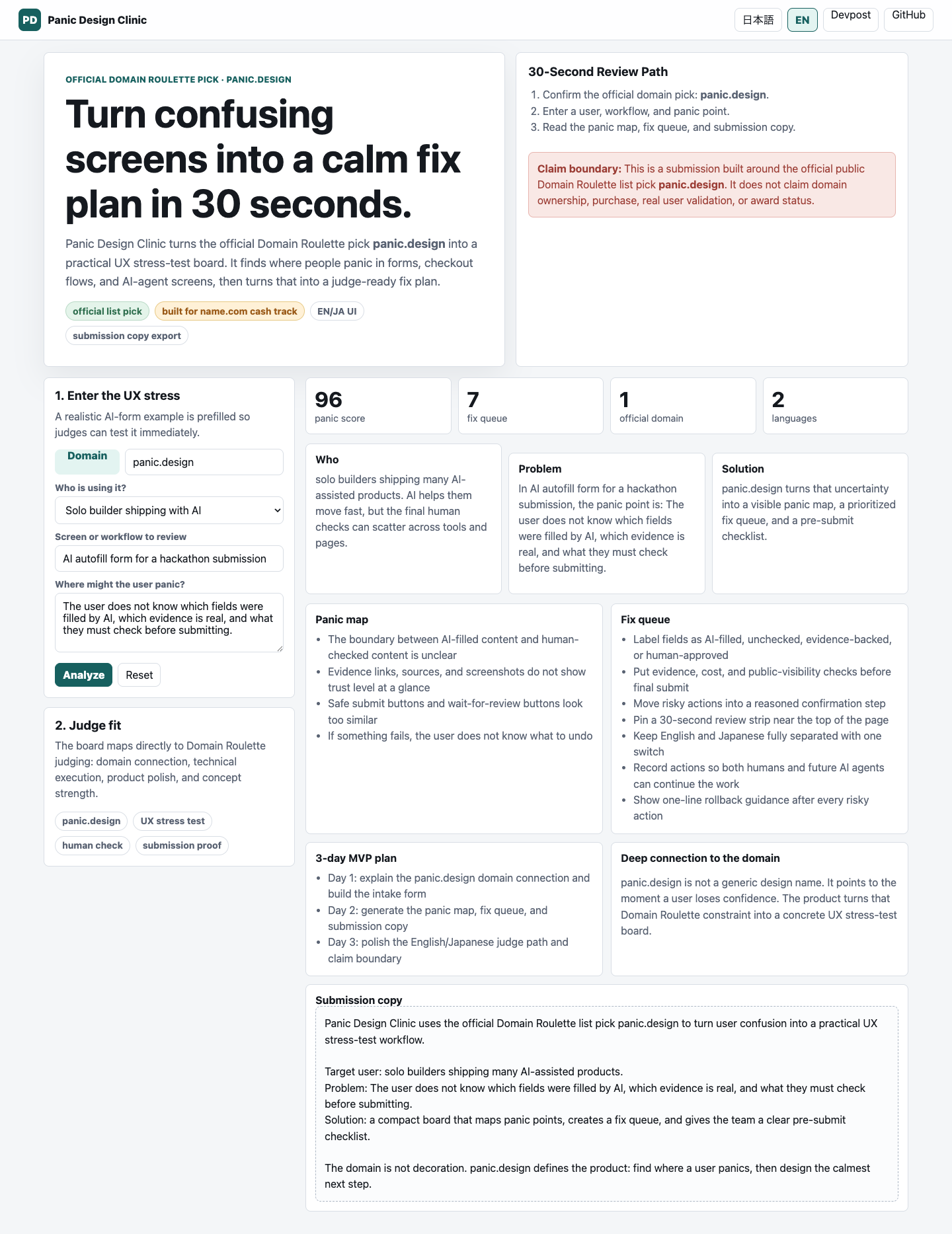
Panic Design Clinic turns panic.design into a compact UX stress-test board. A reviewer enters a user, a workflow, and the point where people may panic. The app then generates:
- who / problem / solution
- a panic score
- a panic map
- a prioritized fix queue
- a three-day MVP plan
- a domain-connection explanation
- copy-ready Devpost submission text
The goal is not to pretend the app is a full UX research platform. The goal is to show a focused product concept around the chosen domain: find the moment the user loses confidence, then design the calmest next step.
How it maps to name.com
- Creative interpretation: panic.design becomes the product behavior, not just the name.
- Technical execution: the stress-test packet runs in one browser app with deterministic generated outputs.
- Product polish: the app includes Japanese/English UI, a 30-second review path, and a visible claim boundary.
- Strength of concept: AI-assisted workflows create real trust panic, and the product turns that into a practical design review.
- Connection to the domain: panic.design directly defines the user problem and the workflow.
How I built it
The product is a static HTML/CSS/JavaScript app published on GitHub Pages. It uses deterministic logic to generate the panic map, fix queue, MVP plan, and submission copy. I also added verification scripts for UI behavior, Japanese support, claim boundaries, no-secrets checks, and regenerated the narrated demo video.
Claim boundary
This app uses panic.design from the official public Domain Roulette list. It does not claim domain ownership, domain purchase, real user validation, revenue, or award status. The generated scores and fix queues are working hypotheses for review, not objective UX research.
What's next
If this were continued beyond the hackathon, I would connect it to screenshot review, form review, and AI-agent action logs so teams can run a real panic.design check before shipping risky workflows.
Built With
- ai-workflow
- claim-boundaries
- css
- github
- html
- japanese-ui
- javascript
- panic-design
- playwright
- ux-stress-test

Log in or sign up for Devpost to join the conversation.