Inspiration
Today, millions of people struggle with stress, anxiety, and mental fatigue. While there are countless mental wellness apps on the market, many of them feel like a chore—just another task on an endless to-do list. We realized that the best way to build a healthy habit is to make it genuinely fun and engaging.
We were inspired by the concept of gamification and cognitive training. What if taking care of your mental health felt like playing a game? We wanted to combine standard mental wellness tracking with active brain exercises, like chess, to create an environment where users actively want to improve themselves daily. That's how Dolphy was born.
What it does
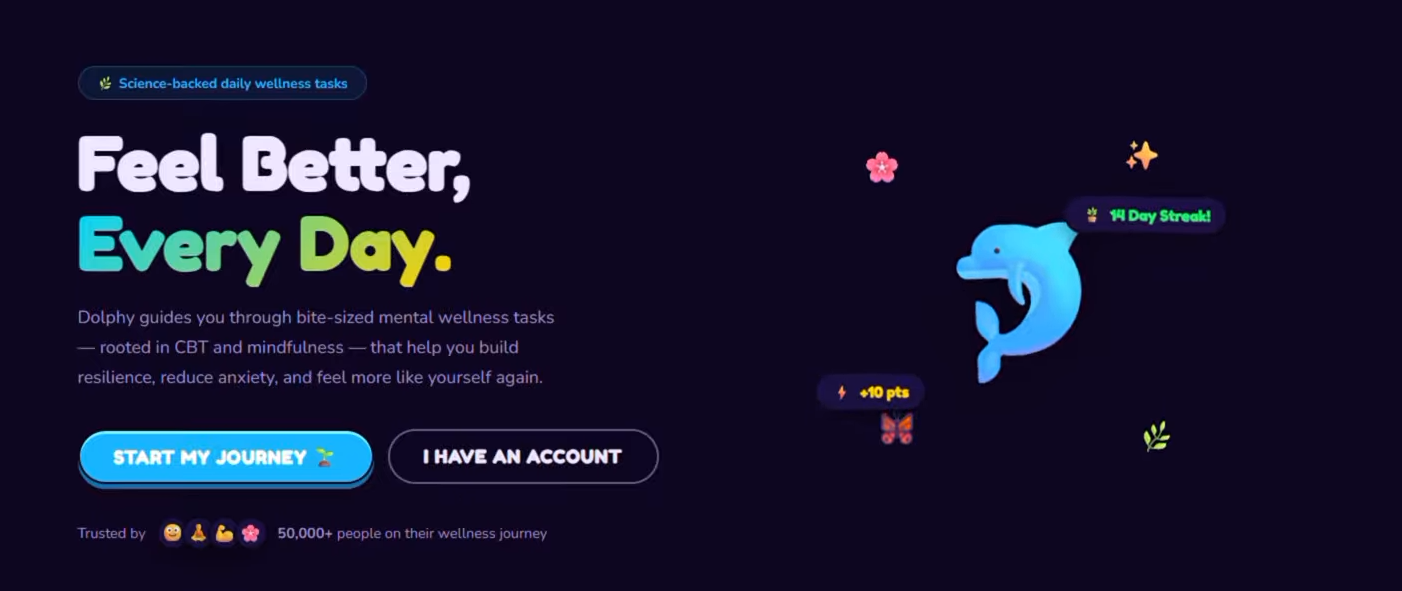
Dolphy is a gamified daily mental wellness and cognitive fitness application. Instead of just meditating or journaling, Dolphy keeps your mind sharp through an engaging progression system.
Users log in to find Daily Quests and Interactive Lessons that teach them about mental health, coping strategies, and cognitive biases. Completing these tasks rewards them with experience points. Furthermore, Dolphy includes an integrated Chess Engine, allowing users to challenge their strategic thinking.
We even designed a conceptual "Cognitive Wellness Score" ($W_{score}$) that tracks a user's overall progress. The score is calculated as a weighted sum of completed quests.
How we built it
We built Dolphy with a focus on speed, simplicity, and performance.
- Backend: We used FastAPI (Python) to create a lightning-fast, asynchronous backend. It handles user authentication, leaderboards, quest tracking, and the logic for the chess engine.
- Frontend: To keep the application incredibly lightweight, we built the frontend using plain HTML, CSS, and Vanilla JavaScript. No heavy frameworks—just pure, optimized web standards.
- Integration: The frontend is served directly by the FastAPI backend using
StaticFiles, meaning the entire application runs seamlessly on a single server without any complex CORS issues.
Challenges we ran into
Building a dynamic, interactive web app without a frontend framework like React or Vue was a fun but significant challenge. Managing state across different pages (like app.html, quest.html, and chess.html) using Vanilla JavaScript required us to be very disciplined with our code structure.
Additionally, integrating the chess engine logic with the frontend UI while keeping the API endpoints secure and fast took a lot of trial and error. We had to ensure that the game state was accurately synchronized between the client and the FastAPI backend to prevent cheating or desyncs.
Accomplishments that we're proud of
We are incredibly proud of how seamless the user experience is. By sticking to Vanilla JS and CSS, we achieved near-instant load times and a very smooth, responsive UI.
We're also proud of successfully blending two completely different concepts—mental wellness tracking and competitive chess—into a single, cohesive gamified experience. Seeing the leaderboard dynamically update as users complete their wellness quests and win matches was a huge validating moment for the team.
What we learned
This project taught us a lot about the power of FastAPI when used not just for APIs, but for serving full-stack monoliths. We also deepened our understanding of gamification mechanics and how small rewards (like points, leaderboards, and leveling up) can drastically improve user retention and motivation in health apps. Finally, we leveled up our Vanilla JavaScript skills, proving that you don't always need a heavy framework to build a rich, interactive application.
What's next for Dolphy
The journey for Dolphy has just begun! Our roadmap for the future includes:
- Chess API Integration: We plan to integrate a robust third-party Chess API (such as the Lichess API or Chess.com API). This will allow users to play real-time multiplayer matches against each other or other players globally, rather than just playing against our local engine.
- Advanced Analytics: Implementing a dashboard with graphs and charts so users can visually track the correlation between their mental wellness quest completion and their cognitive performance (chess win rates) over time.
- More Cognitive Games: Expanding beyond chess to include memory puzzles, logic grids, and spatial reasoning games to provide a full-suite "brain gym."
- Social Features: Adding a friend system so users can form accountability groups to complete daily wellness streaks together.


Log in or sign up for Devpost to join the conversation.