-
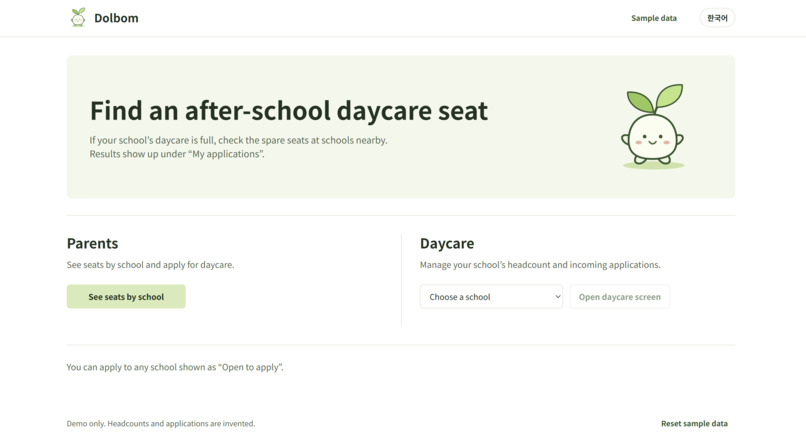
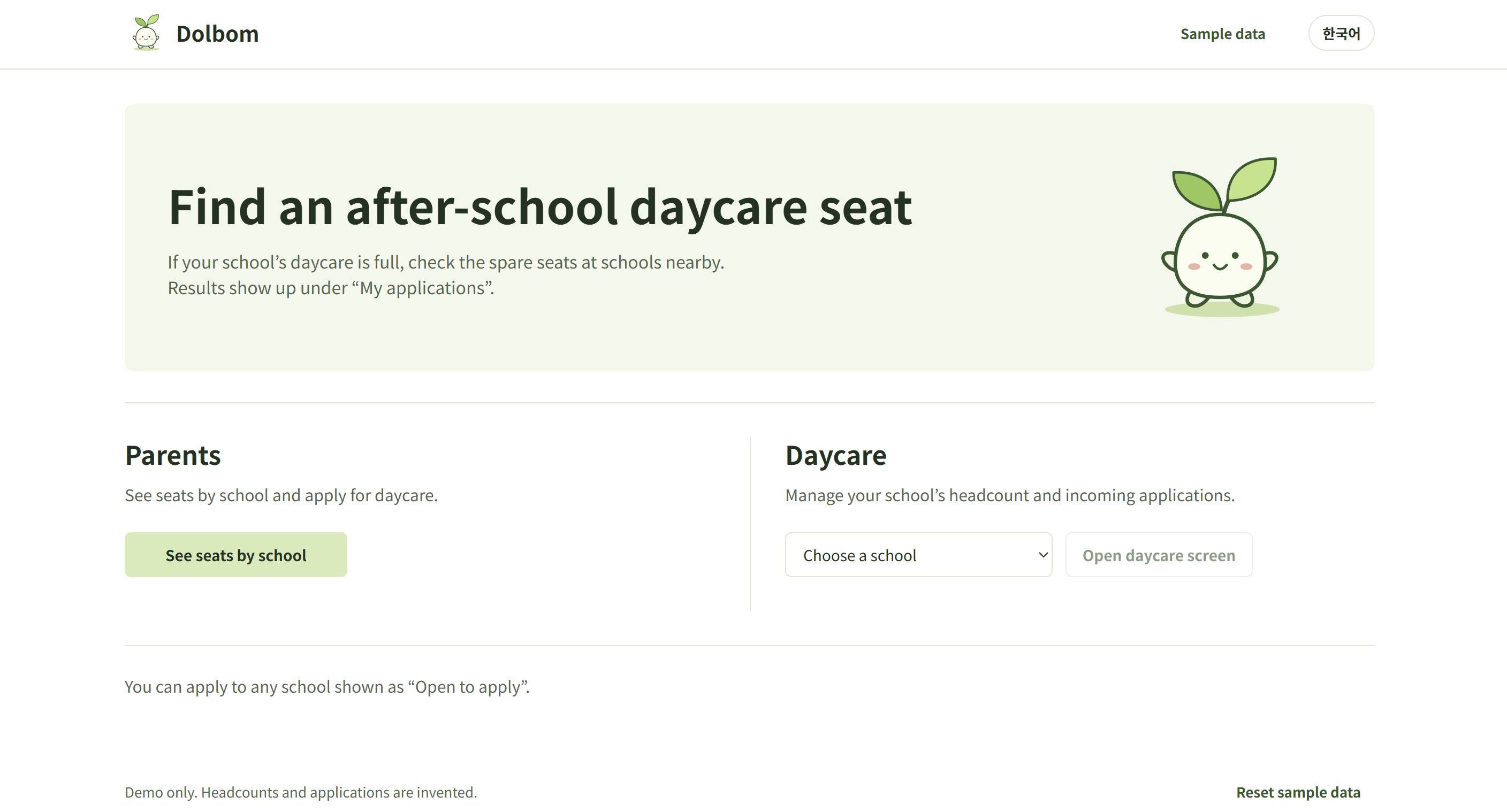
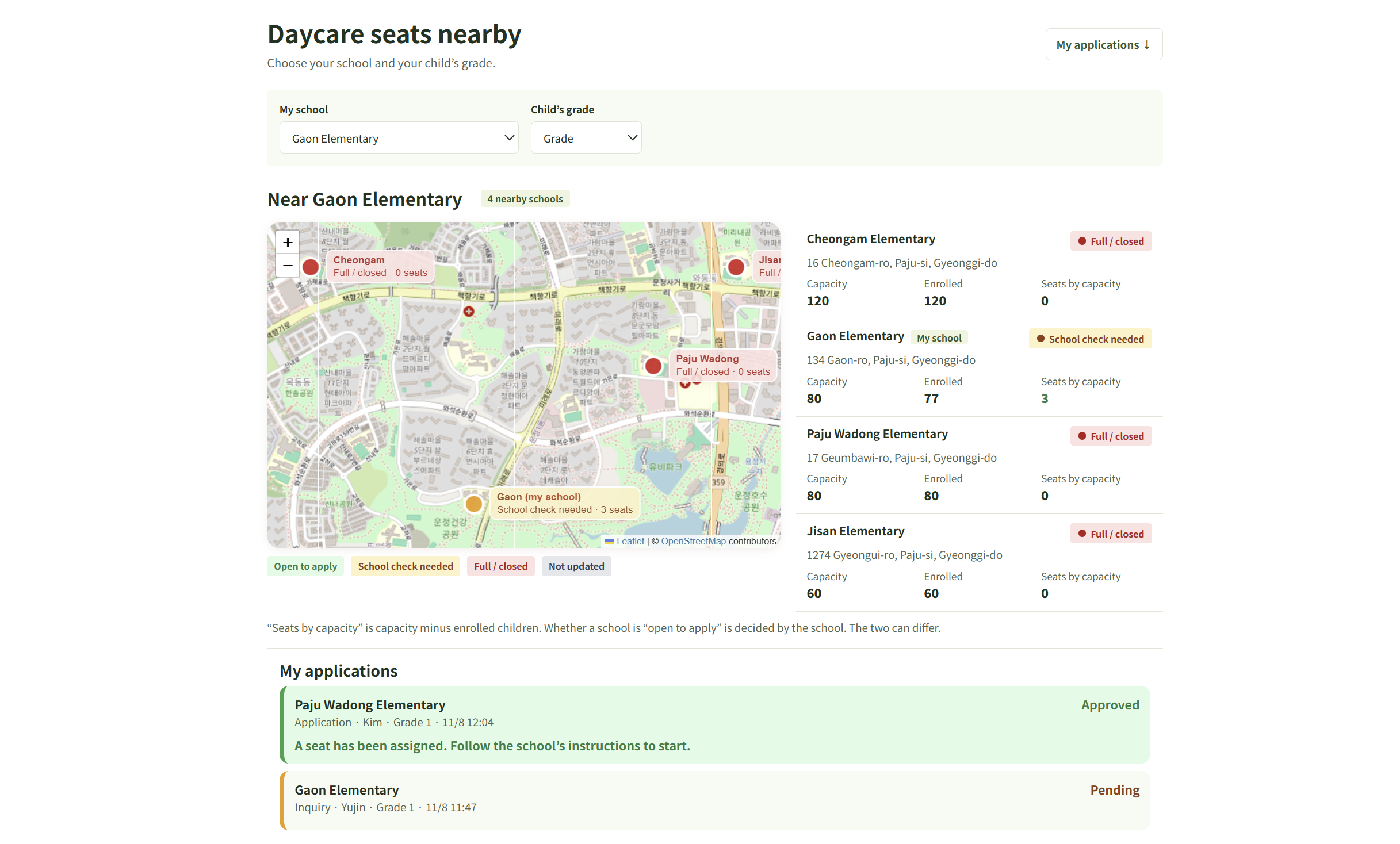
Main page
-
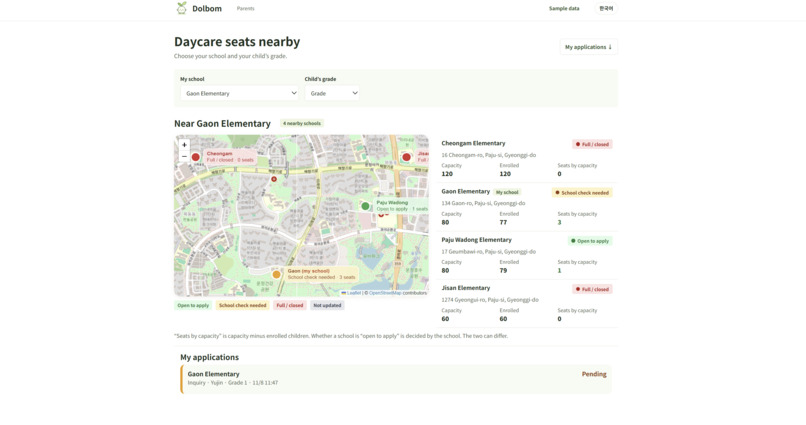
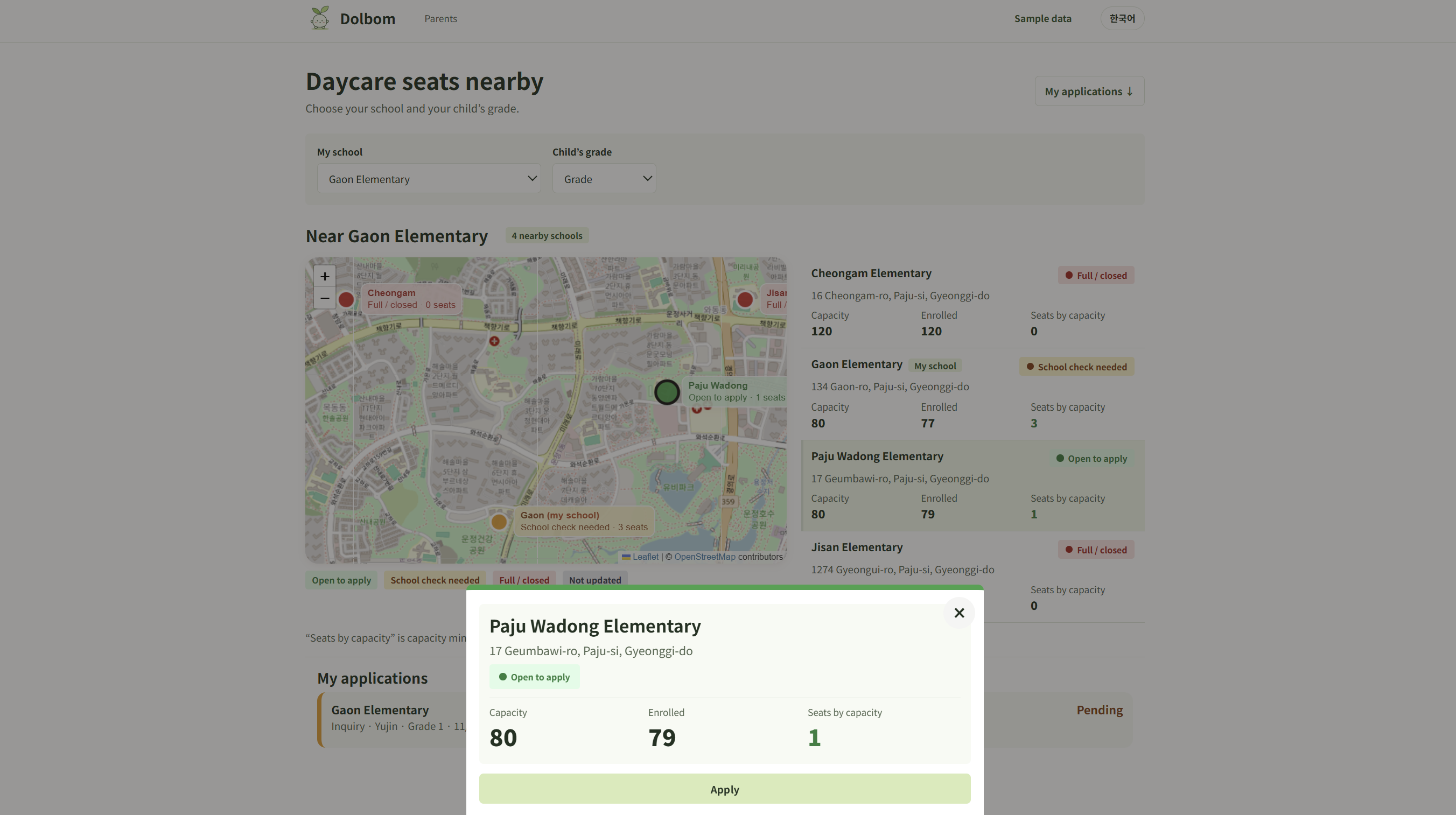
parent page - choose school
-
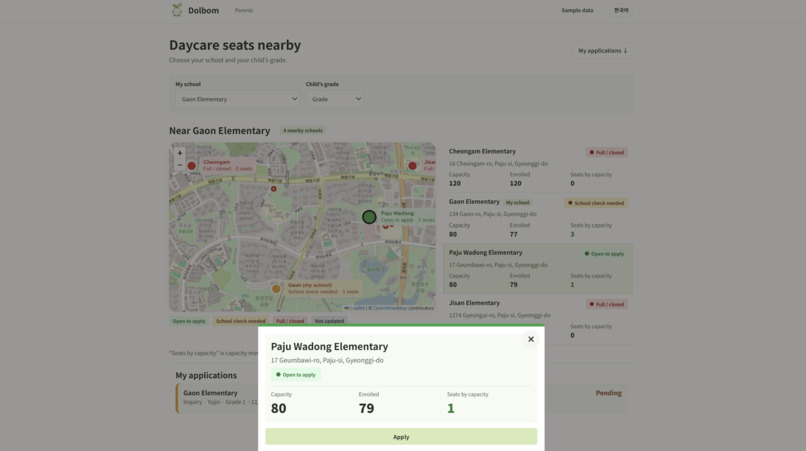
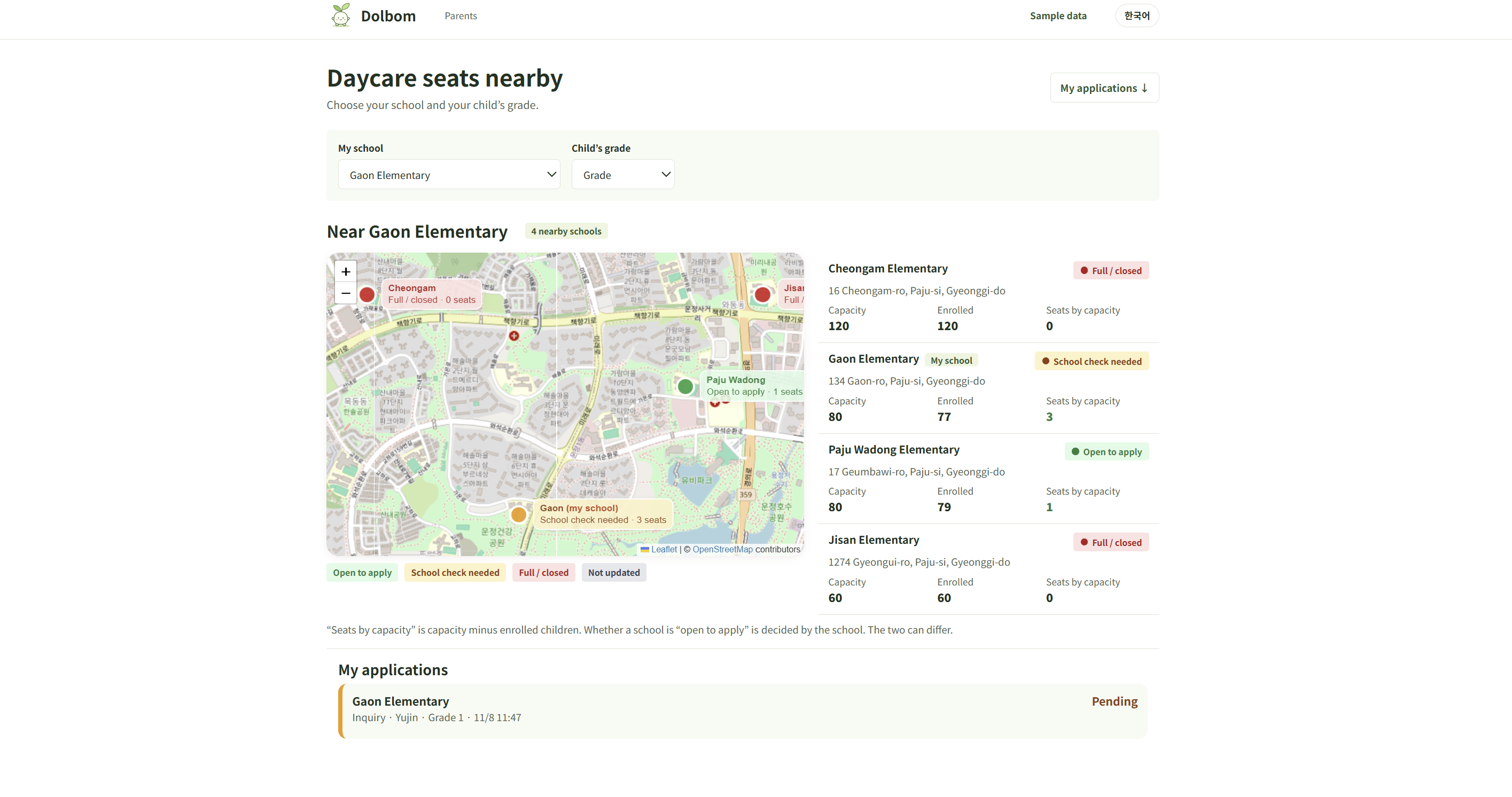
parent page - after clicking school
-
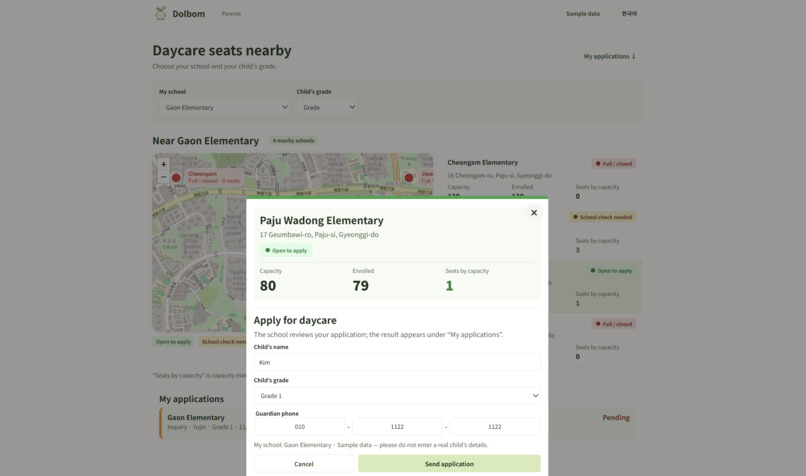
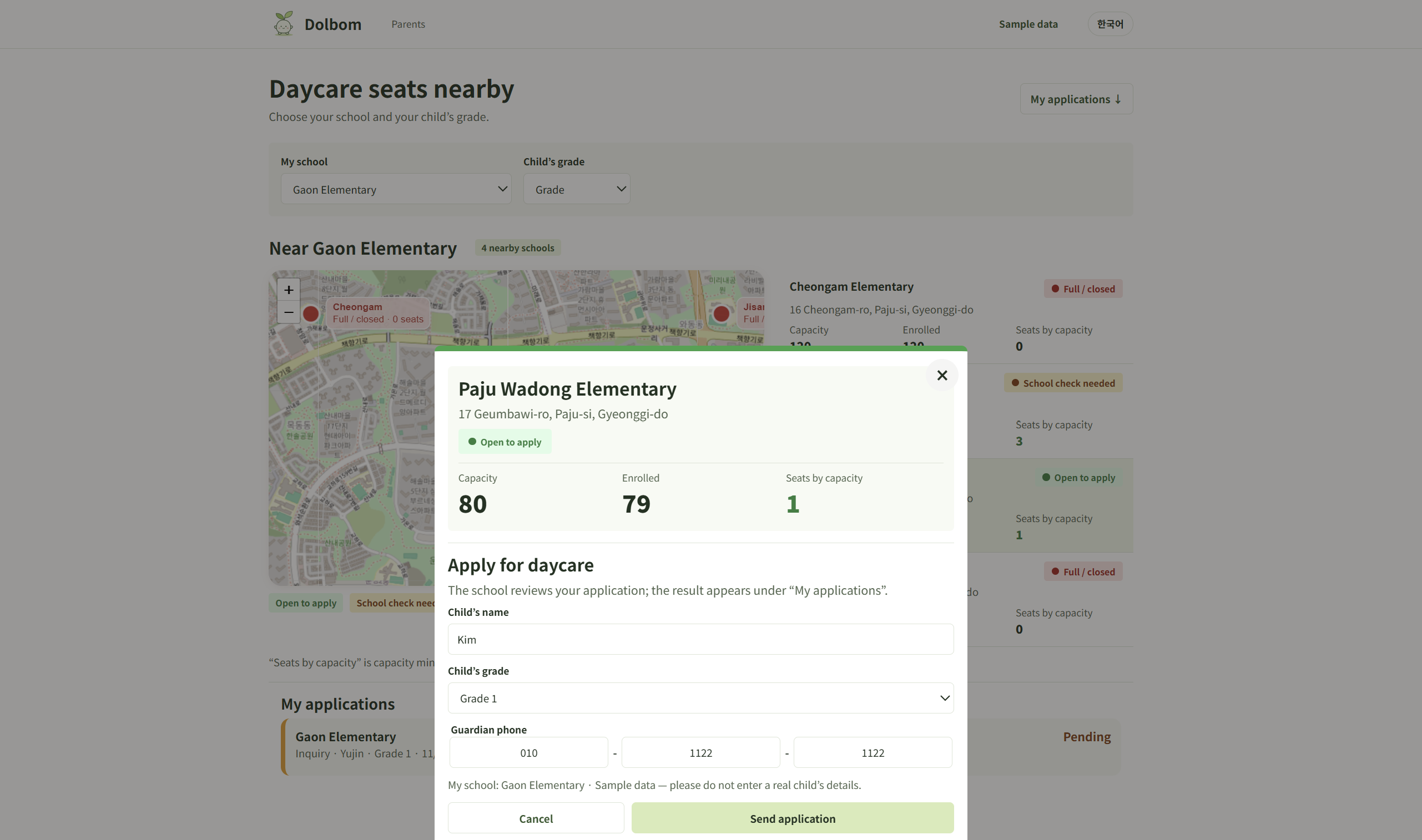
parent page - apply for the left spot
-
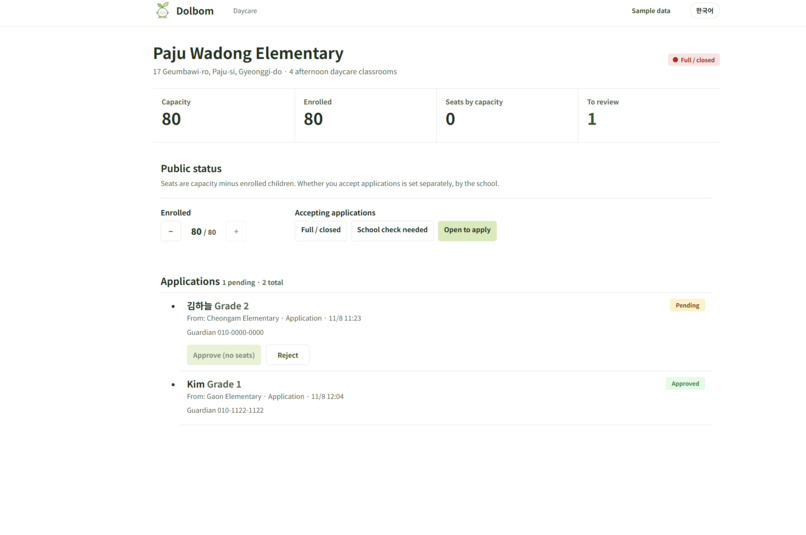
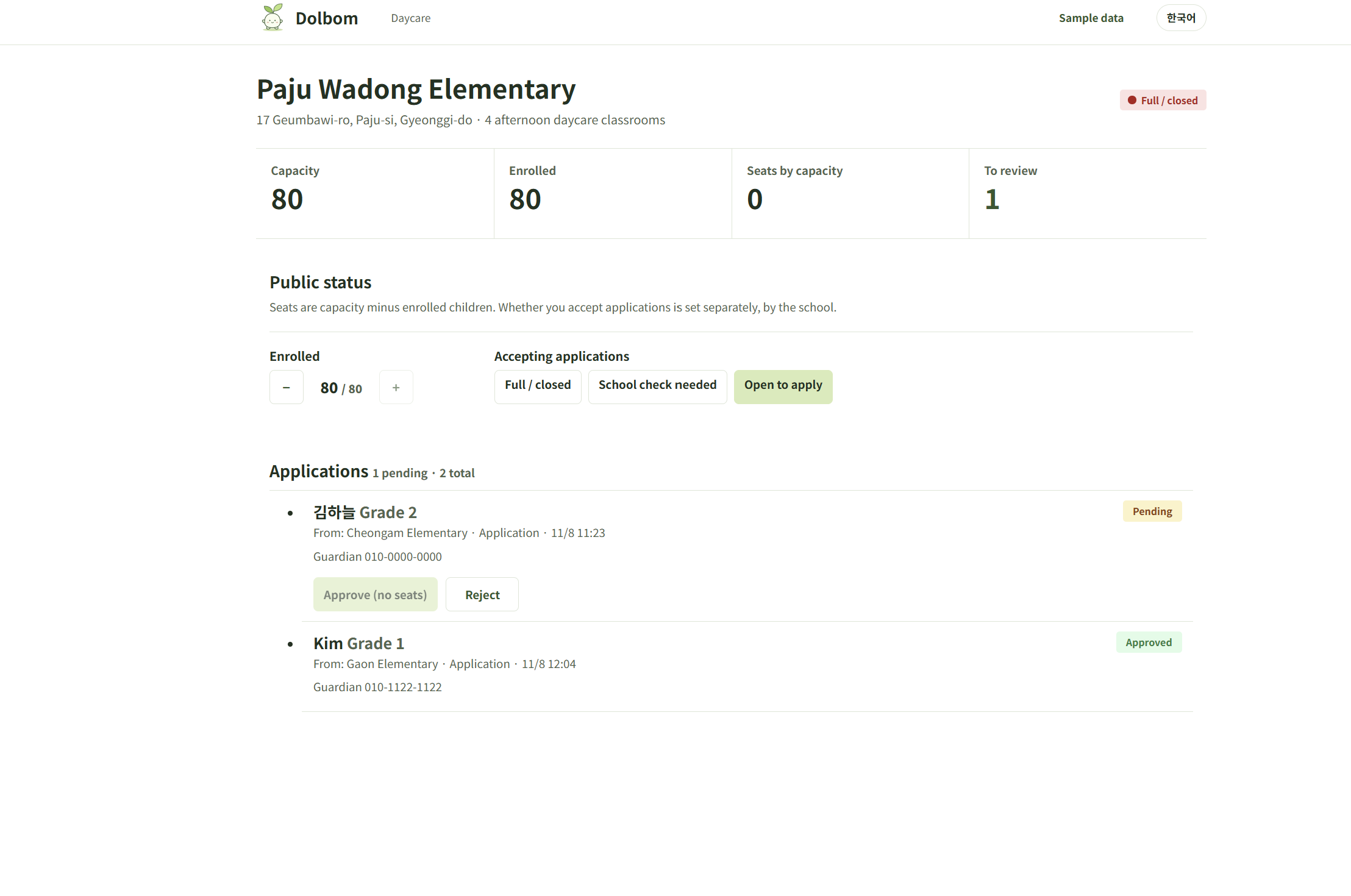
daycare page - approving and stats
-
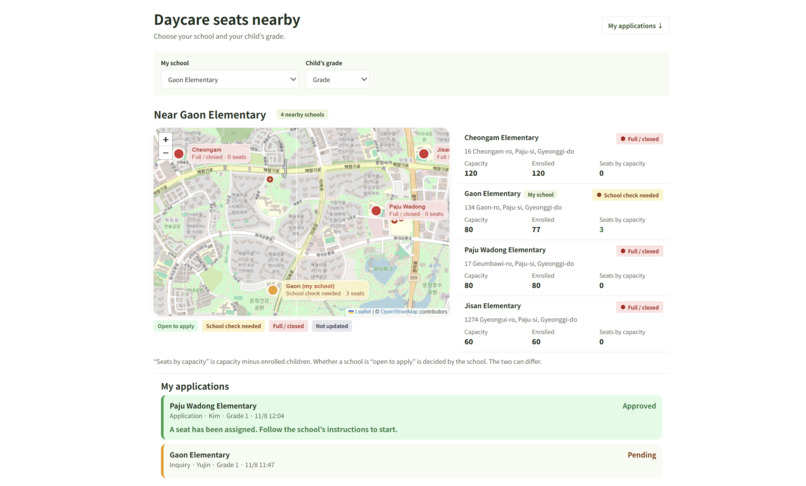
parent page - application approved!
Dolbom (돌봄)
Don't build new after-school care centres - connect the seats that already exist in the school next door.
Inspiration
In Korea, public elementary schools run after-school care classrooms, but a family can only apply to its own school, once a year. When care becomes necessary mid-year, like a parent takes a new job, a grandparent gets sick, and the home school is full, the child has nowhere to go. Meanwhile, a school ten minutes away may have three empty seats that nobody can see, and nobody is allowed to use.
In 2022, 3,786 children were on after-school care waiting lists in Gyeonggi province alone, and 15,108 nationwide (Ministry of Education figures reported by Newsis, 27 Sep 2022). I hypothesize that a meaningful share of those children live within walking distance of a school that had room. I haven't verified that share; a pilot would measure it.
What it does
Dolbom ("care") groups four or five nearby schools into a bundle and shows the whole bundle on one map, live.
- Parents pick their home school and see every school in the bundle with a colour and a label: "full", "school check needed", "open", or "not updated for 24 h". They can apply or ask about availability only inside their bundle.
- School daycare staff see capacity, current headcount, seats by capacity and pending requests. They adjust the headcount, set whether the school is accepting, and approve or reject each request with a written reason.
- Every change is pushed to every screen in real time, so a parent watches "pending" turn into "approved" on their phone the moment the teacher taps approve.
The key design decision: "seats by capacity" and "accepting applications" are different numbers. Seats are computed (capacity − current). Accepting is a decision the school makes. A school with three empty seats still shows "school check needed" until its daycare staff switch it to "open". This keeps schools in control and stops the map from promising what the school hasn't promised.
How I built it
- Shared rules module (TypeScript, pure functions, 29 unit tests): vacancy, the four-step marker priority, bundle filter, approval (headcount +1, refused at capacity), rejection (reason required), duplicate and out-of-bundle refusal. The web app and the server import the same file, so the phone and the API can never disagree about what a status means.
- Server: Node + Express + Socket.IO, JSON-file storage, 19 supertest API tests. Every mutation goes through the rules module and broadcasts an event.
- Web: React + Vite + TypeScript, mobile first, react-leaflet with OpenStreetMap tiles (no API keys). Roles are URLs; there is no login in the demo. English by default with a one-tap "한국어" toggle.
- Data: school names, addresses and classroom counts from the Gyeonggi Office of Education's 2026 온동네 돌봄·교육 자원지도 (Paju). Headcounts, statuses and applications are invented; a banner on every screen says so.
- Built during HackCamp 2026 with an AI coding agent (Claude Code) implementing while the human set the problem, the rules and the demo.
Accomplishments that I'm proud of
- Genuine problem-solving since I really wanted to solve this problem for a year.
Challenges I ran into
- Scope down the problem and how to make the product that can actually help as a service.
What I learned
- The hard part of a community problem is rarely the data; it is who gets to decide. Encoding "the school decides" as a status the school owns changed the product from a seat-grabbing app into a coordination tool.
- An agentic workflow works best with a tight contract: the human writes the rules and the demo script; the agent writes tests first and keeps a decision log.
What's next
- Pilot with a regional education office (교육지원청) on one real bundle of 4-5 schools in Paju, with daycare staff entering real statuses.
- ** Institutionalize short-term bundle use:** today, using another school's care classroom has no formal basis. A pilot should produce a written procedure - eligibility, how long a child may stay, and who is responsible for the walk between schools.
- Authentication and permissions: administrator login, per-school daycare accounts, guardian identity verification.
- Transport safety between schools, the first thing daycare staff will ask about.
- Replace the JSON file with a database and add an audit log of every approval and rejection.
Impact statement
Korean cities are not short of after-school care rooms; they are short of a way to see and share the seats that exist. Dolbom lets a parent whose school is full find an open seat in a neighbouring school within minutes, while leaving every decision with the school that owns the room. If even a fraction of the thousands of children on waiting lists each year live near a school with space - a hypothesis a single district pilot could test in one semester — then the fastest, cheapest expansion of after-school care is not a new building but a shared map and a reason-required approve button.
