-
-
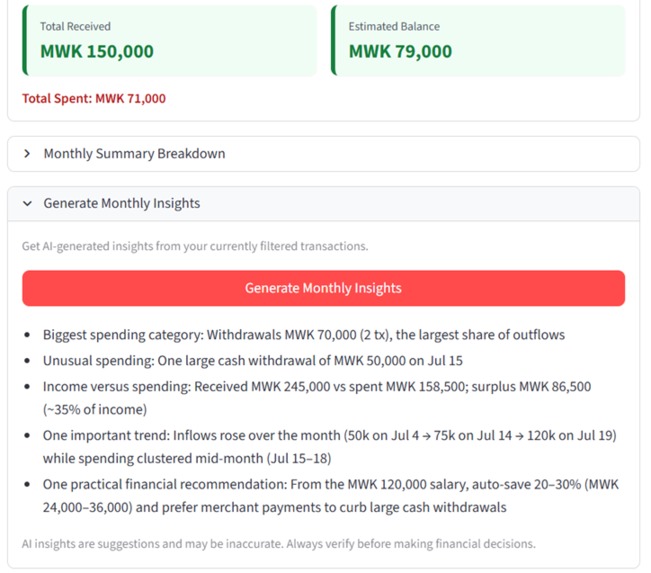
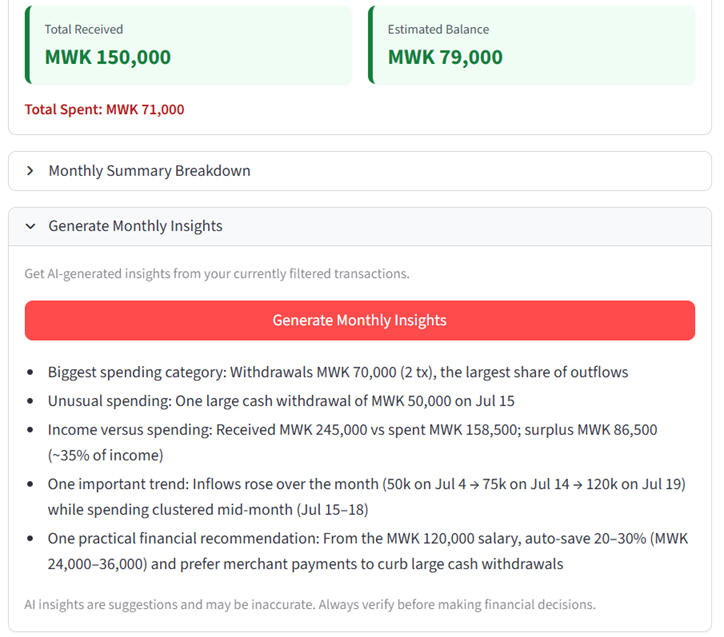
AI Monthly Insights
-
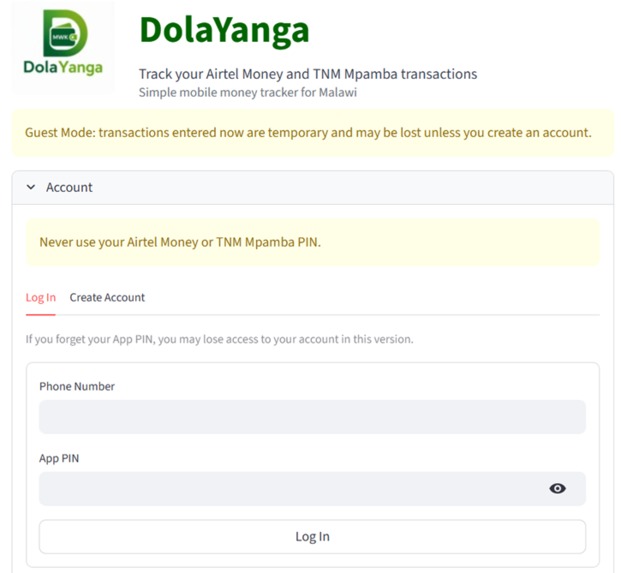
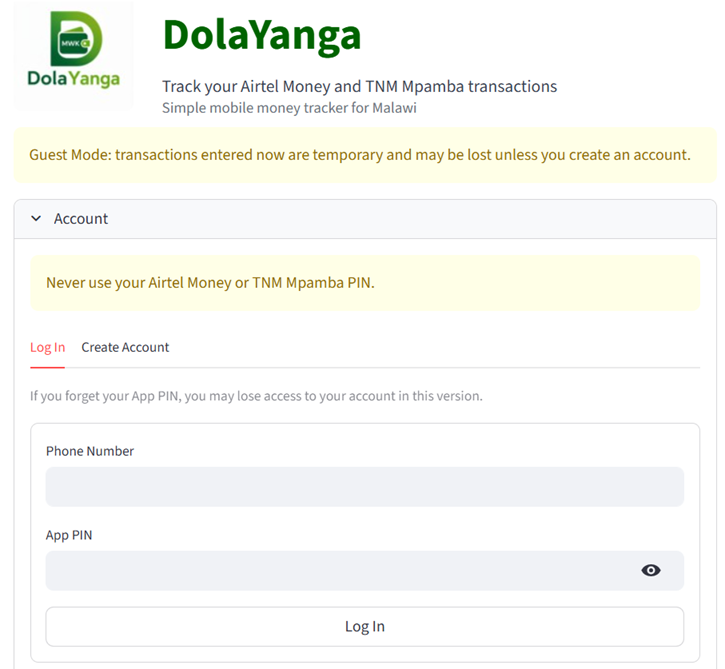
Login/security screenshot
-
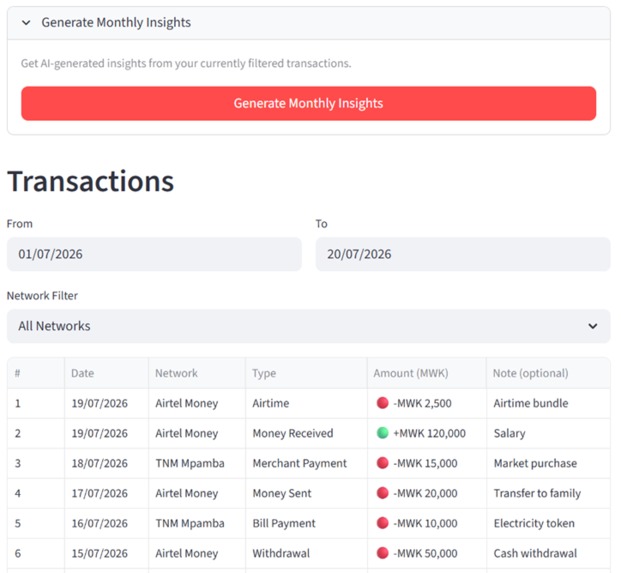
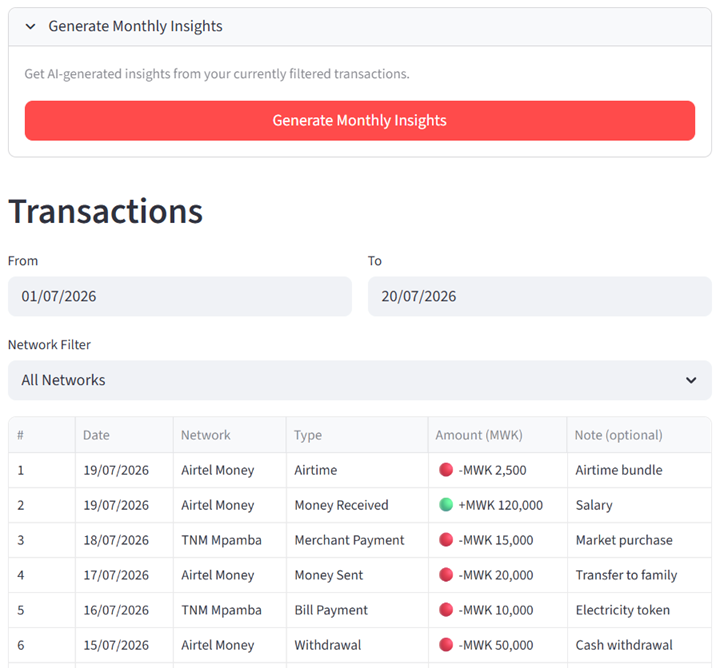
Transactions screenshot
Inspiration
In Malawi, mobile money has become one of the primary ways people send, receive, and manage money. However, while services such as Airtel Money and TNM Mpamba make digital payments accessible, many users still have limited tools to track their spending or better understand their financial habits. I wanted to build a simple, secure application that helps users record their mobile money transactions, monitor their balances, and gain useful insights into their spending. During OpenAI Build Week, I saw an opportunity to make the application even more valuable by extending it with AI-powered financial insights using OpenAI's GPT models.
What it does
DolaYanga is an AI-powered mobile money transaction tracker built specifically for users of Airtel Money and TNM Mpamba in Malawi. Users can: • Securely record mobile money transactions • Track income and expenses • Monitor account balances • View daily and monthly summaries • Export transaction reports • Generate AI-powered Monthly Insights The application supports both English and Chichewa, making it more accessible to users across Malawi. Each user's transaction data is isolated within their authenticated account, and sensitive credentials are managed securely using Streamlit Secrets.
How we built it
The application was built using Python and Streamlit for the user interface, with Supabase providing secure authentication and cloud data storage. During OpenAI Build Week, I used OpenAI Codex as an AI coding assistant to meaningfully extend the project by designing, implementing, debugging, and refining the new AI Monthly Insights feature. Codex also helped accelerate development by assisting with API integration, improving AI response handling, refining bilingual support, resolving mobile interface issues, and polishing the application before deployment. The application uses OpenAI's GPT models through the OpenAI API to analyze a user's own transaction history and generate concise financial observations and practical recommendations in the user's selected language. The project also includes bilingual support, mobile-friendly layouts, interactive summaries, and data visualizations to help users better understand their spending patterns.
Challenges we ran into
The biggest challenge was time. I discovered the OpenAI Build Week competition only a few days before the submission deadline, so I had to rapidly extend an existing project while clearly documenting the new functionality developed during the submission period. There were also several technical challenges, including rebuilding my local Python development environment, resolving deployment issues, fixing a language-switching bug that affected the transaction table on mobile devices, integrating the OpenAI API, improving AI response handling, and testing the application across both desktop and mobile devices. Each challenge improved both the quality of the application and my understanding of modern AI-assisted software development.
Accomplishments that we're proud of
I'm particularly proud of successfully integrating OpenAI's GPT models into a practical application that addresses a real problem for mobile money users in Malawi. Other accomplishments include: • Building a secure user authentication system • Supporting both English and Chichewa throughout the application • Creating a mobile-friendly user experience • Successfully deploying the application online • Meaningfully extending the project using OpenAI Codex during Build Week • Delivering personalized AI-generated financial insights based on users' own transaction data
What we learned
This project demonstrated how AI can enhance existing software rather than simply automate tasks. I gained practical experience working with the OpenAI API, prompt design, Streamlit, Supabase, deployment, and AI-assisted development using OpenAI Codex. Perhaps most importantly, I learned how quickly a useful idea can evolve when combining traditional software development with modern AI tools, while still keeping the developer in control of product decisions and implementation.
What's next for DolaYanga
There are many opportunities to expand DolaYanga in the future. Planned improvements include: • Automatic AI-assisted transaction categorization • Spending forecasts and budgeting tools • Personalized financial goals and savings recommendations • Support for additional local financial services • Offline-first functionality for areas with limited connectivity • Richer dashboards and analytics The long-term vision is to create an intelligent financial companion that helps mobile money users in Malawi better understand and manage their finances while keeping their data secure, private, and accessible in both English and Chichewa.

Log in or sign up for Devpost to join the conversation.