The problem
Every streamer wants to grow their streaming community. One way to do this is to collaborate with other streamers.
Twitch offers many features that support collaboration. However, to use these features, streamers first need someone to stream with.
Small and medium-sized channels in particular often struggle with this first step. In both Japan and English-speaking communities, streamers' own social media posts frequently express concerns such as "I don't have the courage to invite someone to collaborate," "I'm afraid a bigger streamer will think I'm only interested in their numbers," and "I don't have a reason to invite them in the first place." The fewer viewers or less visibility a streamer feels they can offer, the harder it becomes to reach out at all.
Our approach
We envisioned a game system that makes full use of the strengths of three Twitch features—Stream Together, Shared Chat, and raids—to increase collaboration between gaming streamers and make their communities more active.
There are two main ideas.
1. A platform where streamers playing the same game can connect right away
DojoRaid provides both a reason to invite another streamer and a clear idea of what to do together.
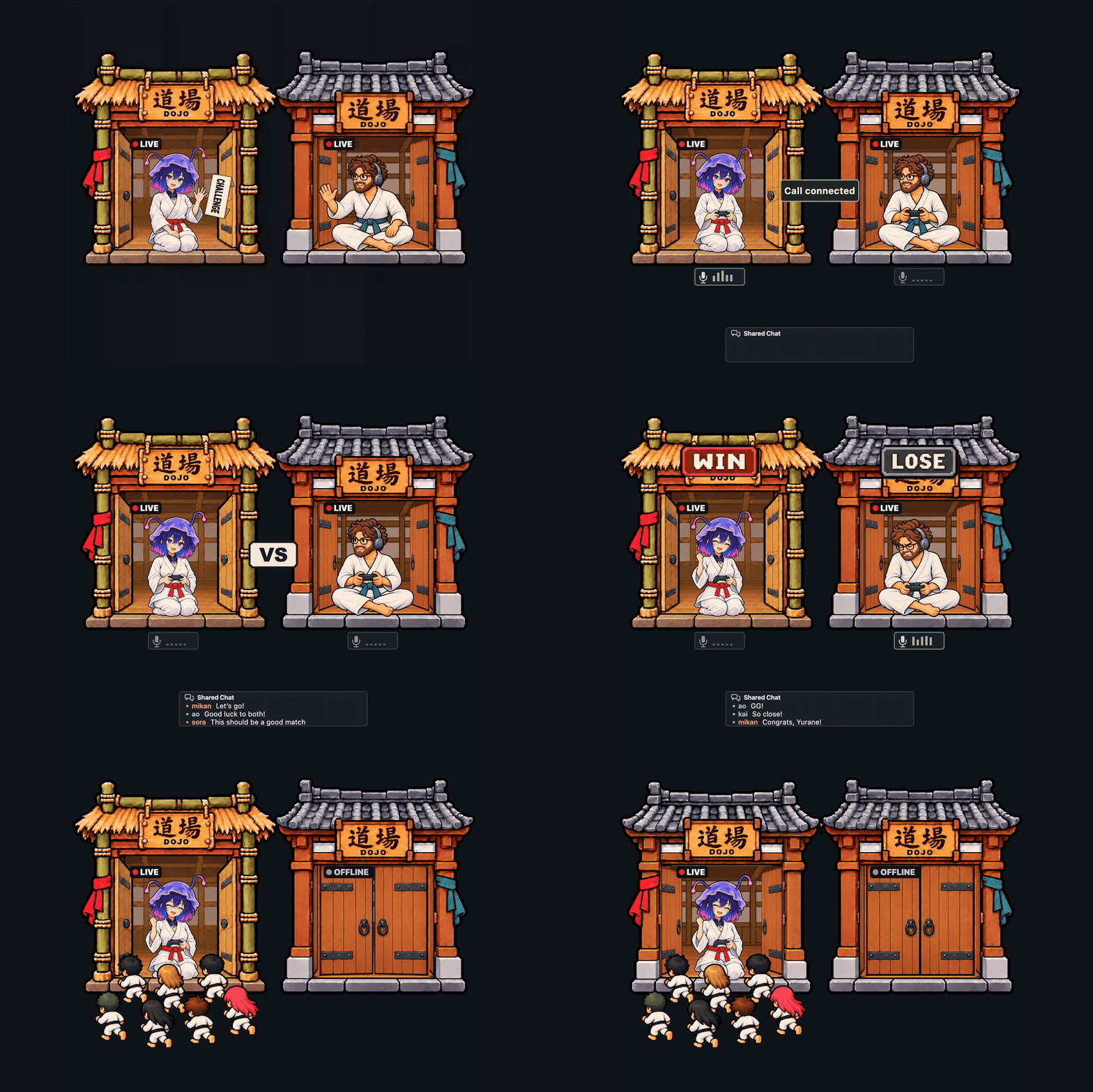
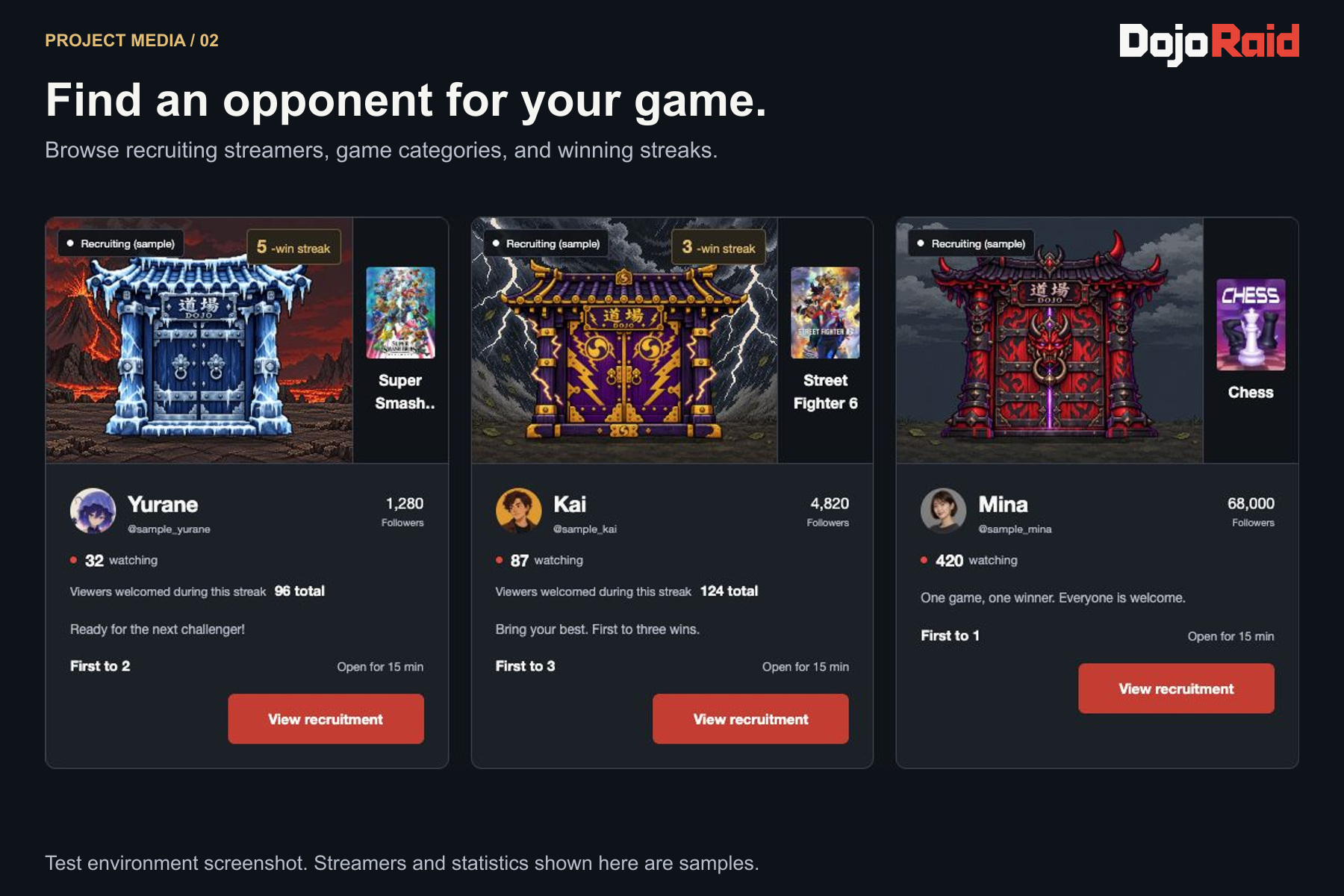
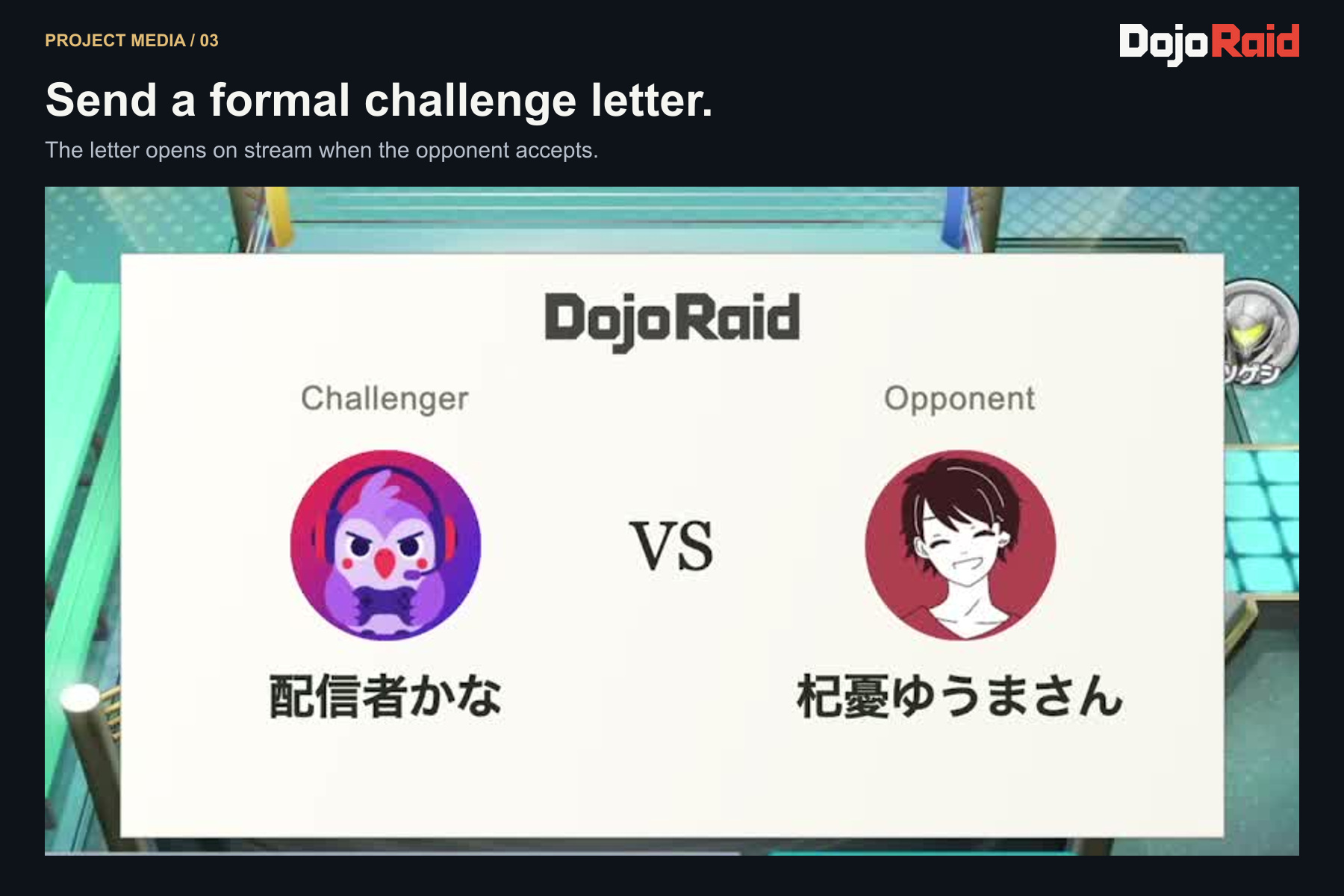
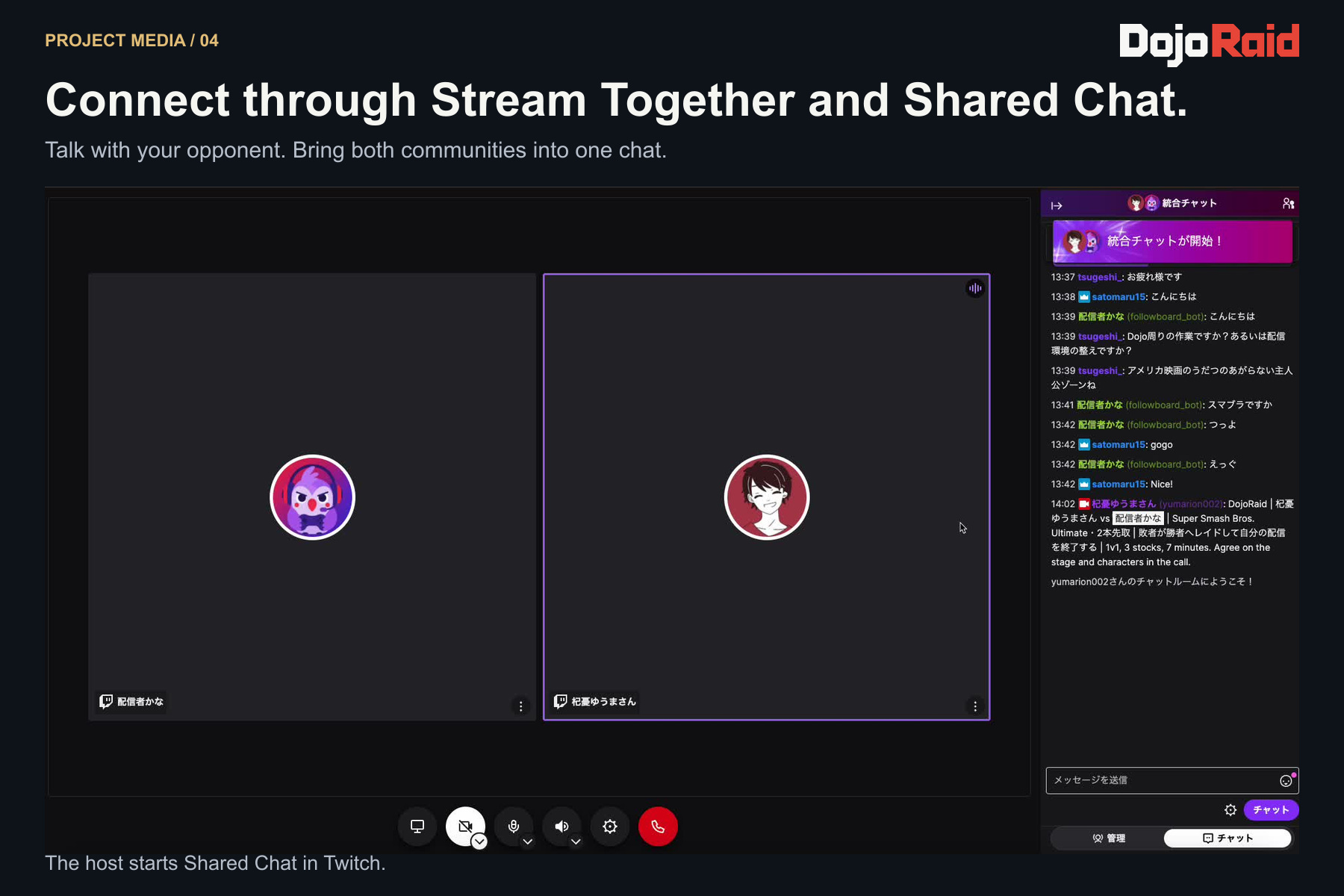
On DojoRaid, streamers can find someone recruiting opponents for the same game in the dojo list and reach out simply by sending a hatashi-jo, a formal challenge letter. If the opponent accepts, they can quickly connect through a Stream Together call, while Shared Chat brings viewers from both streams into one chat. Even without prior discussions or preparation, streamers and viewers can quickly share the feeling of being in the same arena.
2. Game battles with viewers on the line, using raids
The first idea alone makes collaboration possible. However, we felt that this could still end as a one-time interaction, including for the viewers. DojoRaid aims to create collaborations with a compelling hook and the tension of a competitive game, incorporating elements that are possible specifically because of Twitch. We want not only the connection between streamers to continue afterward, but also viewers' experience to go beyond watching once and lead them to follow new streamers. This is why we created game battles with viewers on the line, using raids.
Cultural background
Dojo-yaburi
A dojo is a place where students gather under a martial arts master to train together. Dojo-yaburi, or "dojo breaking," is a traditional Japanese practice in which a martial artist visits another school's dojo and challenges its practitioners to test their skills. It is said that if the challenger won, they would take home the dojo's wooden signboard, a symbol of its pride. In DojoRaid, a channel where viewers gather around a streamer is their dojo. Instead of a signboard, they put their viewers on the line.
Hatashi-jo
A hatashi-jo is a formal letter challenging someone to a contest. Samurai are said to have sent these letters, specifying a time and place, to challenge opponents to duels. In DojoRaid, an invitation to a match is called a hatashi-jo, and the match is agreed upon when the opponent receives and accepts it.
What you can do with DojoRaid
- Recruit an opponent: Sign in with Twitch and choose the game, rules, first-to win target, and recruitment duration to recruit an opponent.
- Send a challenge letter: Choose an opponent playing the same game from the dojo list, review the conditions if you lose, and challenge them.
- Connect: After the opponent accepts, you are invited to a Stream Together call and can join with one button. When the host starts Shared Chat, both communities become one chat.
- Compete: An overlay on both streams displays the score and match status.
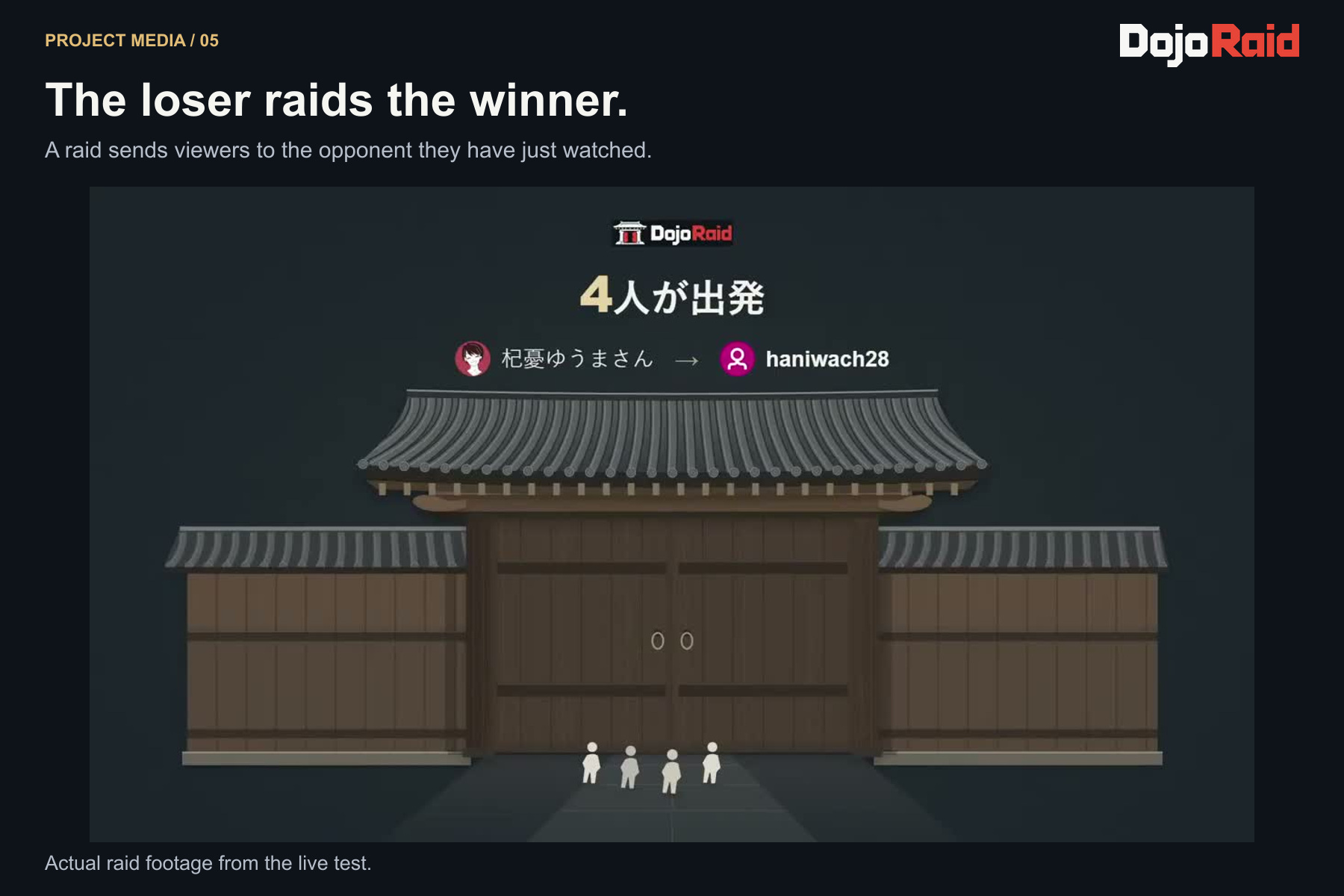
- Raid: Once the result is confirmed, the loser starts a raid to the winner with one action and then ends their own stream.
What makes it different
Stream Together, Shared Chat, and raids are all existing Twitch features. However, using them requires a reason: who to collaborate with and why. Raids have also remained a one-way feature for sending viewers to another channel at the end of a stream.
DojoRaid's originality lies in combining these three features into one game system: a battle with viewers on the line. By turning raids into the risk and reward of a match, it gives streamers a reason to invite each other, while the tension of the contest engages both streamers and viewers. After the result, the raid sends viewers to the opponent they have just competed with, creating new follows and connections rather than ending as a one-time interaction.
Impact on streamers
- Regardless of their size, streamers can easily find rivals and create collaborative events.
- Winners gain new viewers. Losers also connect with the opponent's community through the viewers they send over, expanding their circle of interactions. The desire to win next time also motivates them to improve their skills.
- No money changes hands. The stakes are pride and viewers alone.
Impact on viewers
- Viewers can become participants in the contest rather than simply watching it. They can also take part by predicting who will win through optional Channel Points predictions.
- Shared Chat brings viewers from two communities into one chat. They can cheer each other on, sometimes enjoy a rivalry, and share the same moment with viewers they would not normally meet.
- Through a raid, viewers discover a new streamer's community through a moment of shared excitement rather than through a random move.
Ease of use
DojoRaid is designed to let streamers concentrate on the match in front of them without being distracted by setup and controls.
To assess usability, five streamers with Twitch accounts helped us test the service in actual broadcasts. We confirmed that even first-time DojoRaid users could proceed through recruitment, accepting a challenge letter, connecting the call, playing the match, and raiding without getting lost.
Getting started
- Sign in with a Twitch account. No installation is required.
- Copy and paste the URL automatically issued by the system into an OBS browser source to use all the visual effects. An illustrated guide explains the additional steps.
During a match
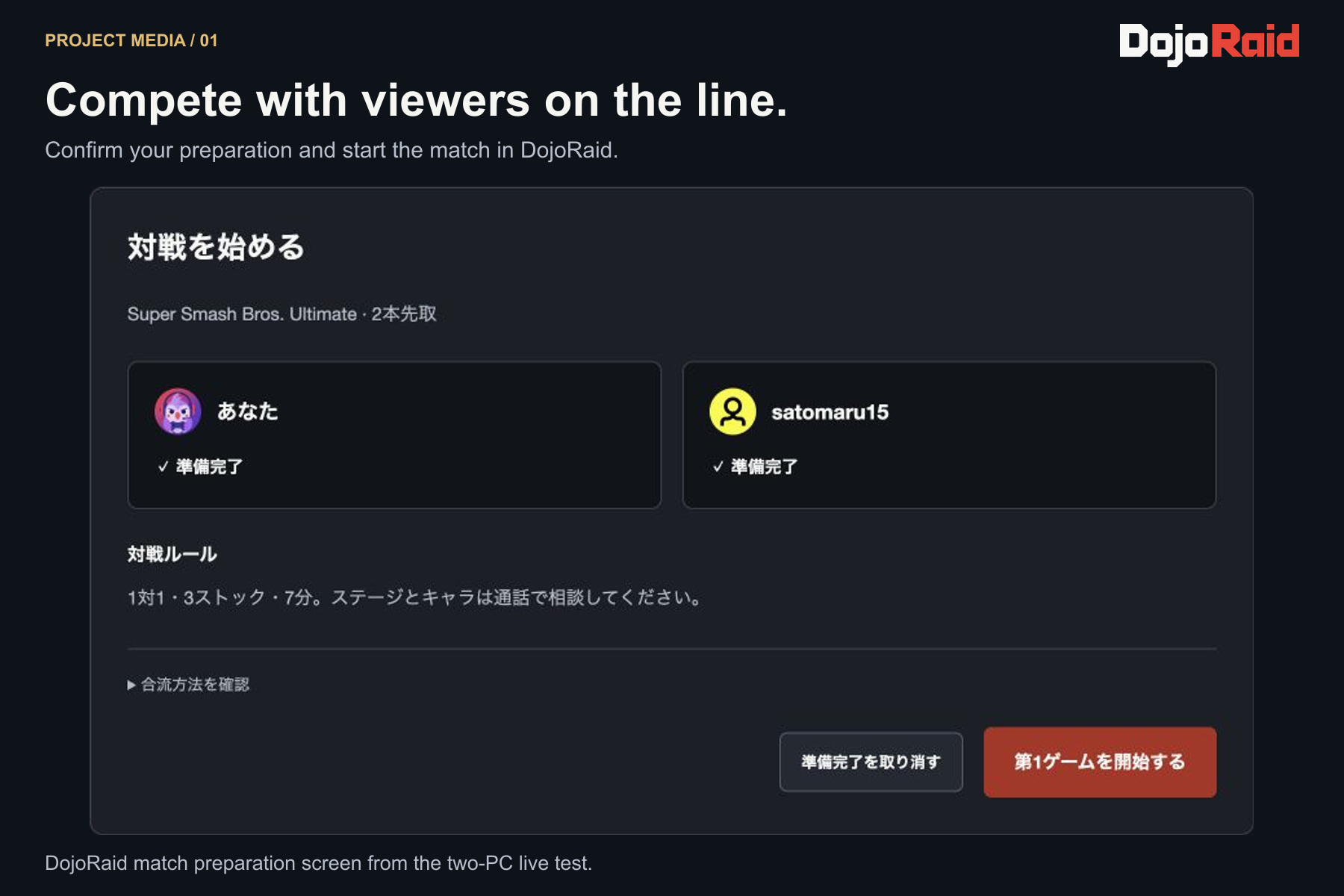
- When the opponent accepts a challenge letter, a Stream Together invitation is sent automatically, and the opponent can join with one button.
- Stream titles and tags are updated, and match rules are pinned in chat automatically. These changes are restored after the match.
- Notification sounds alert streamers when a response is needed, such as when a challenge arrives or the opponent takes an action.
After the result
- Once the result is confirmed, the loser can start a raid to the winner with one action. When the raid arrives, the winner's channel automatically gives the loser a shoutout.
Concerns and our response
1. Will the losing streamer's viewers leave immediately after the raid?
The Stream Together call can continue after the raid, so the losing streamer's voice remains in the winner's broadcast. Moving through a raid on the Twitch app is also very seamless, allowing viewers to move naturally to the next stream. In addition, the interaction between streamers immediately after a match offers both communities a scene they would not normally see. For these reasons, we believe viewers are less likely to leave immediately.
2. Could smaller streamers repeatedly challenge larger streamers at an unexpected frequency just to gain viewers?
We plan to introduce an original rating system based on each streamer's Twitch follower count and winning streak on DojoRaid. By preventing challenges to streamers with a higher rating, matches would generally take place between streamers of a similar size. Larger streamers with higher ratings would have more freedom to choose their opponents. Smaller streamers, meanwhile, could earn the right to challenge larger streamers by steadily building winning streaks and raising their ratings.
Twitch integration
Twitch features are connected into one flow, from recruitment to the match and the raid.
- Twitch authentication and stream information: Sign-in, game category, stream status, viewer count, and follower count.
- Stream Together: Guest Star APIs prepare the session and send invitations. Streamers join the call through a DojoRaid button.
- Shared Chat: The host starts it in Twitch, and DojoRaid checks the connection status.
- Raids: Following the loser's start action, DojoRaid executes the Raids API. EventSub confirms arrival and displays a welcome effect in OBS.
- Supporting features: Optional predictions and clip creation, pinned match conditions, title and tag updates, stream markers, and post-raid shoutouts.
The required permissions are authorized during initial setup. We also protect existing pinned messages and content edited by streamers themselves. Joining the call, starting Shared Chat, starting the raid, and ending the broadcast in OBS are actions performed by the streamers themselves.
How we used Codex
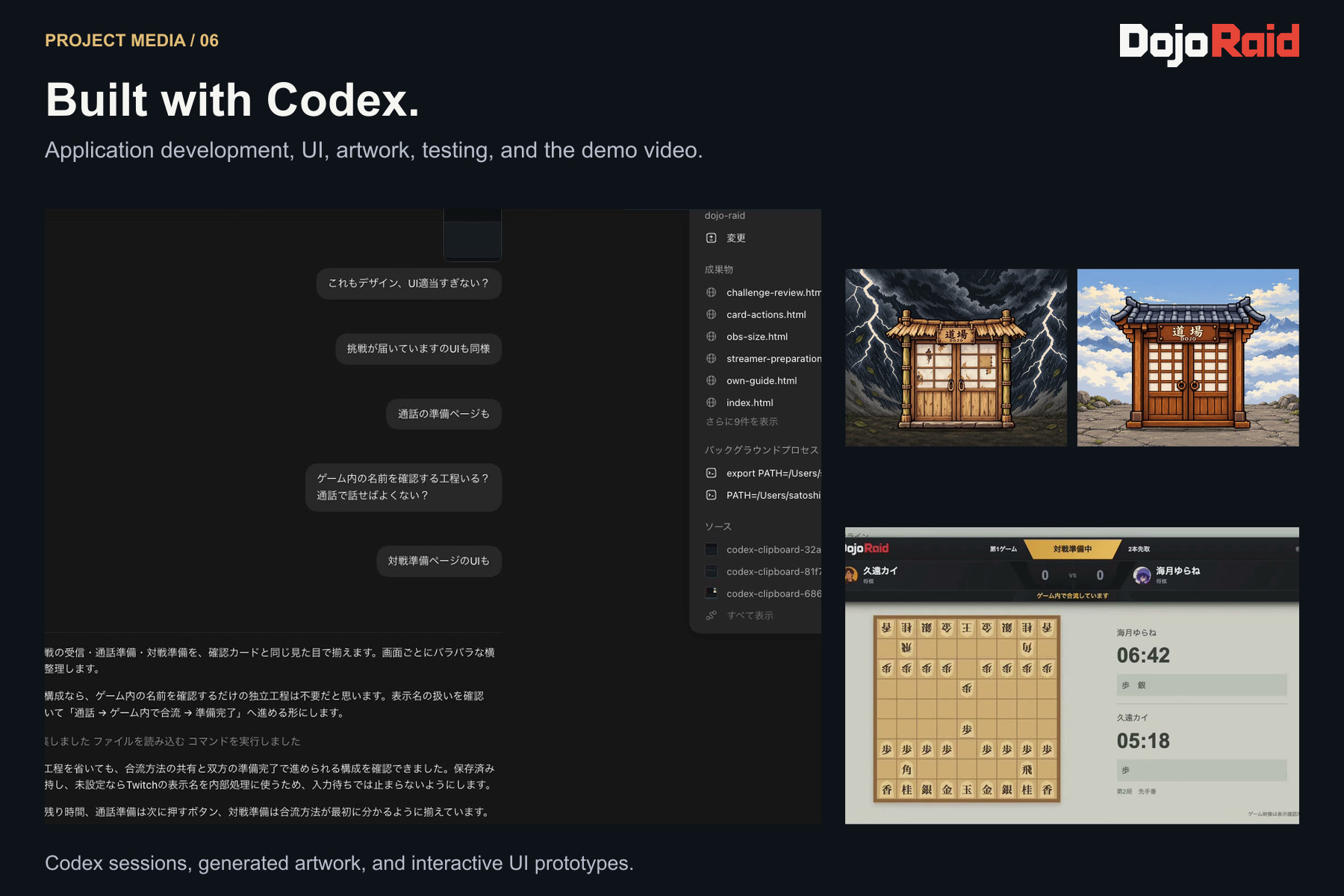
Humans handled the concept and decisions about what to adopt. We used Codex for everything from application implementation, design, and testing to producing the submission demo video.
- Development: Implemented the screens, backend, database, Twitch integration, and deployment.
- UI: Created interactive prototypes and improved them based on feedback from actual use.
- Assets: Used built-in image generation to create eight backgrounds and two additional gates. Signboards were added to ten gates created in another session, followed by revisions. The logo and introductory video were also produced.
- Testing: Developed more than 600 automated tests. Codex operated the Mac while a human operated Windows to verify calls, Shared Chat, clips, and raids in actual broadcasts.
- Submission video: The hackathon submission demo video was also produced using Codex.
Assets created in other sessions were handed over to the main session together with production records and integrated into the application.
Submission session ID: 01a171e3-997e-7673-a096-20c2d7d1f391
Work developed during the hackathon
Development began on October 25, 2026. We implemented the flow from recruitment, challenges, call participation, joining the game, and result confirmation through to raids. We also produced the OBS overlay, gates and winning-streak backgrounds, Japanese and English support, and the user guide.
Existing FollowBoard characters and icons, along with the original gate designs created in another Codex session, were used as supplied assets.
Technology stack
React, TypeScript, and Vite / Hono and Cloudflare Workers / Supabase Auth, PostgreSQL, and Realtime / Twitch Helix API and EventSub.
The overlay is added to OBS as a browser source. The introductory video uses image assets and Canvas and WebGL animation.
Try it
- Judging site (fixed submission): submission.dojoraid.com
- Production site: dojoraid.com
- User guide (Japanese): Streamer guide
- Submitted source code (fixed tag): GitHub
- Demo video: English demo on YouTube
The judging site and linked Git tag preserve the submitted version. Development may continue on the production site and the repository's main branch. Please use the judging site and fixed tag for evaluation.
The landing page and public dojo list do not require sign-in.
To test the entire match flow, use two Twitch accounts and streaming setups. Sign in through Chrome, complete the stream setup, and add the overlay to OBS at a width of 1920 and height of 1080. Once both participants have started streaming, one recruits an opponent and the other sends a challenge. Predictions and clips can remain off.
Built With
- cloudflare
- react
- supabase
- twitch
- typescript
