A safer, faster path from “I’d love to help” to a real dog walk — and a way for every completed walk to make the next one better.
Inspiration: we followed one willing walker
Dogs Canberra connects community volunteers with rescue dogs for exercise, socialisation and rehabilitation. A walk can give a dog confidence, stimulation and a better chance to show who they really are. For the person holding the lead, it can mean fresh air, movement, companionship and the quiet joy of being useful to an animal who needs them.
That is a lovely exchange. Reaching it, however, involved rather less lovely things: inbox searches, attachments, spreadsheets and waiting.
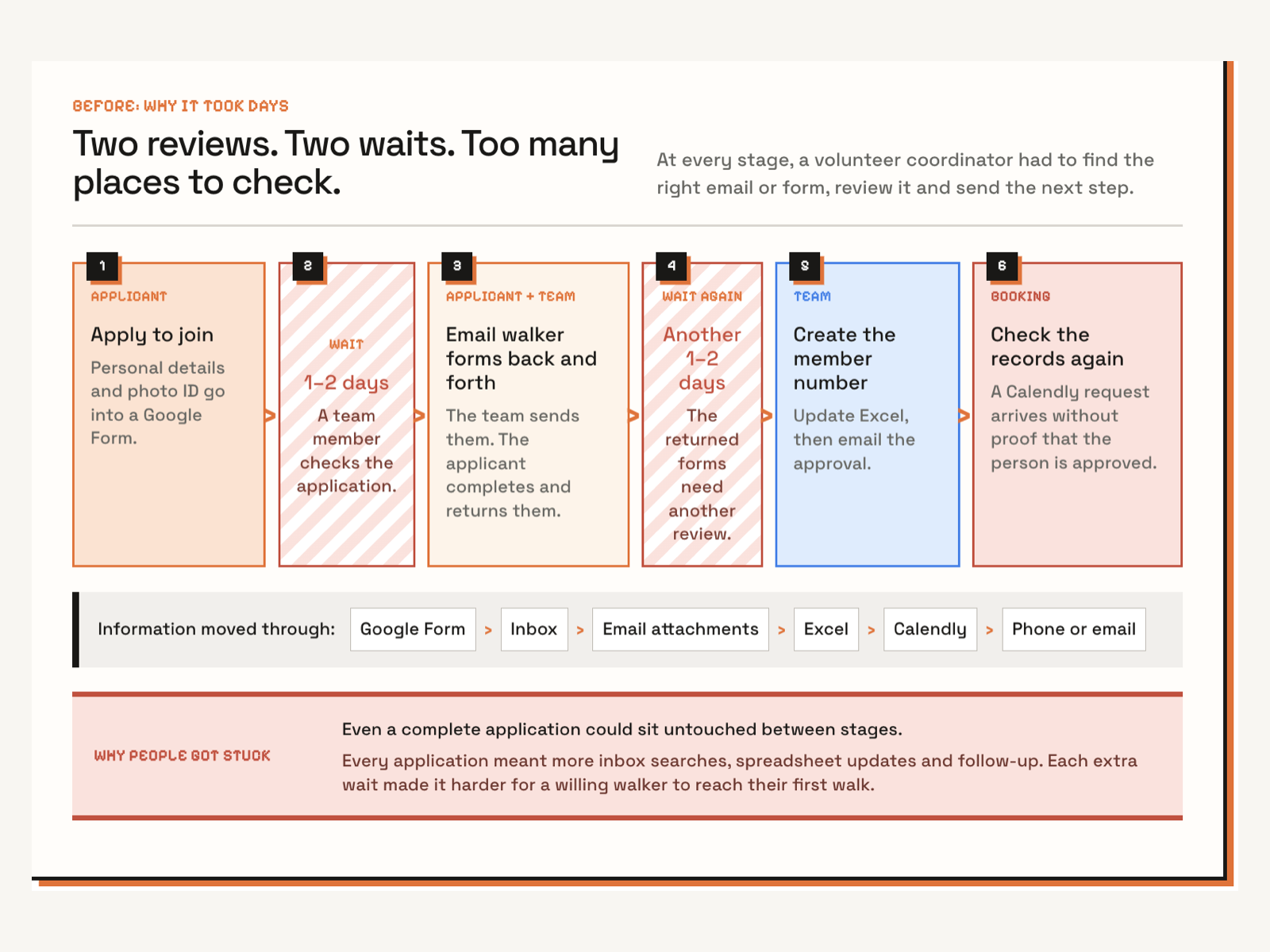
We began by following the existing volunteer journey from start to finish. A prospective walker moved from the Dogs Canberra website to a Google Form, then into email, induction and OHS documents, more email, Excel, Calendly and finally phone or email coordination.
None of those tools was terrible on its own. The problem was that none of them knew what the others knew.
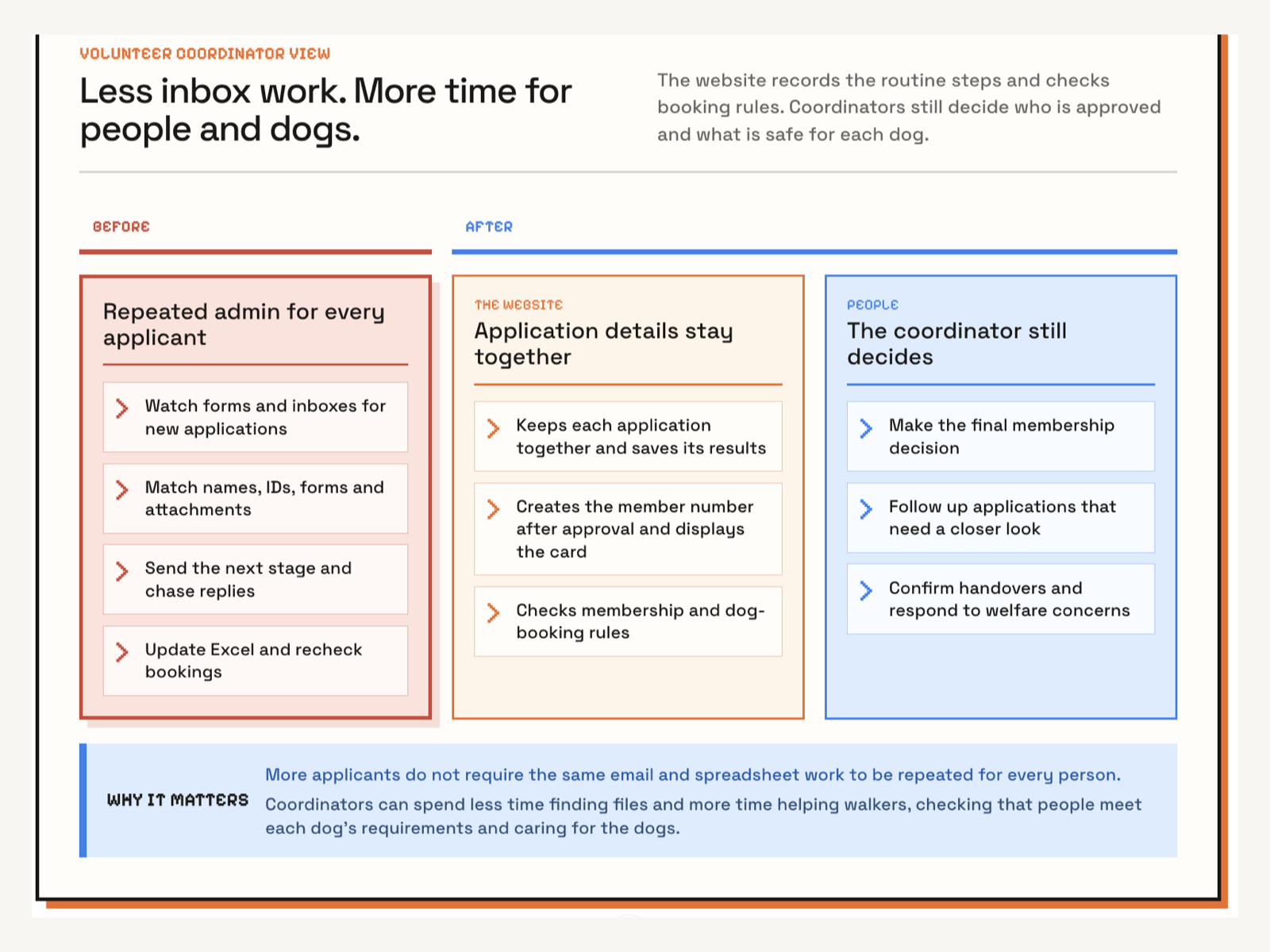
A coordinator had to find each application, send the next step, wait for it to return, match the right documents to the right person, review the record again, create a member number and later repeat many of those checks when a booking arrived. The coordinator had quietly become the integration layer — essentially a human API with an inbox.
A complete application could wait 1–2 days at each review point, even when the applicant had done everything correctly. Meanwhile, a willing volunteer was losing momentum and a rescue dog still needed exercise, attention and time away from the everyday pressures of care.
That led us to the question behind DogsCBR Walks:
How might we remove the waiting created by fragmented administration without removing the human judgement that keeps people and dogs safe?
Mapping out the tangled leads
What we built: one journey instead of a relay race
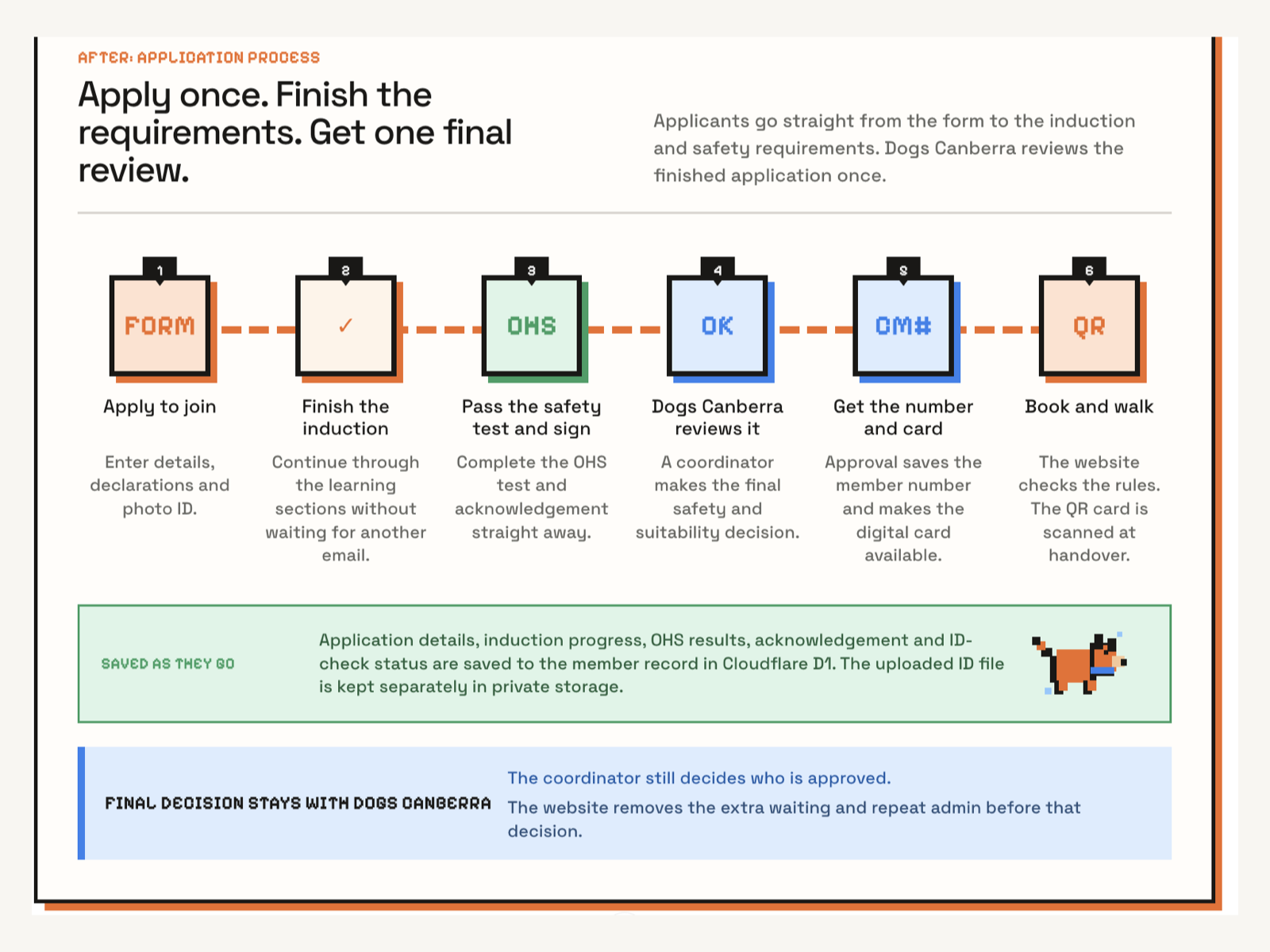
DogsCBR Walks brings the volunteer journey into one connected web application.
A new member can:
- submit the existing application details and declarations;
- continue directly into the induction;
- complete the OHS test and acknowledgement;
- send one complete record for coordinator review;
- receive a member number and digital card after approval; and
- book a dog only when the relevant membership and handling rules are satisfied.
The important word is after. The system does not automatically approve people. A Dogs Canberra coordinator still sights identification, reviews the completed application, assigns the appropriate experience level and makes the final decision.
We automated the movement of information — not the safeguarding judgement.
One connected record makes the system useful
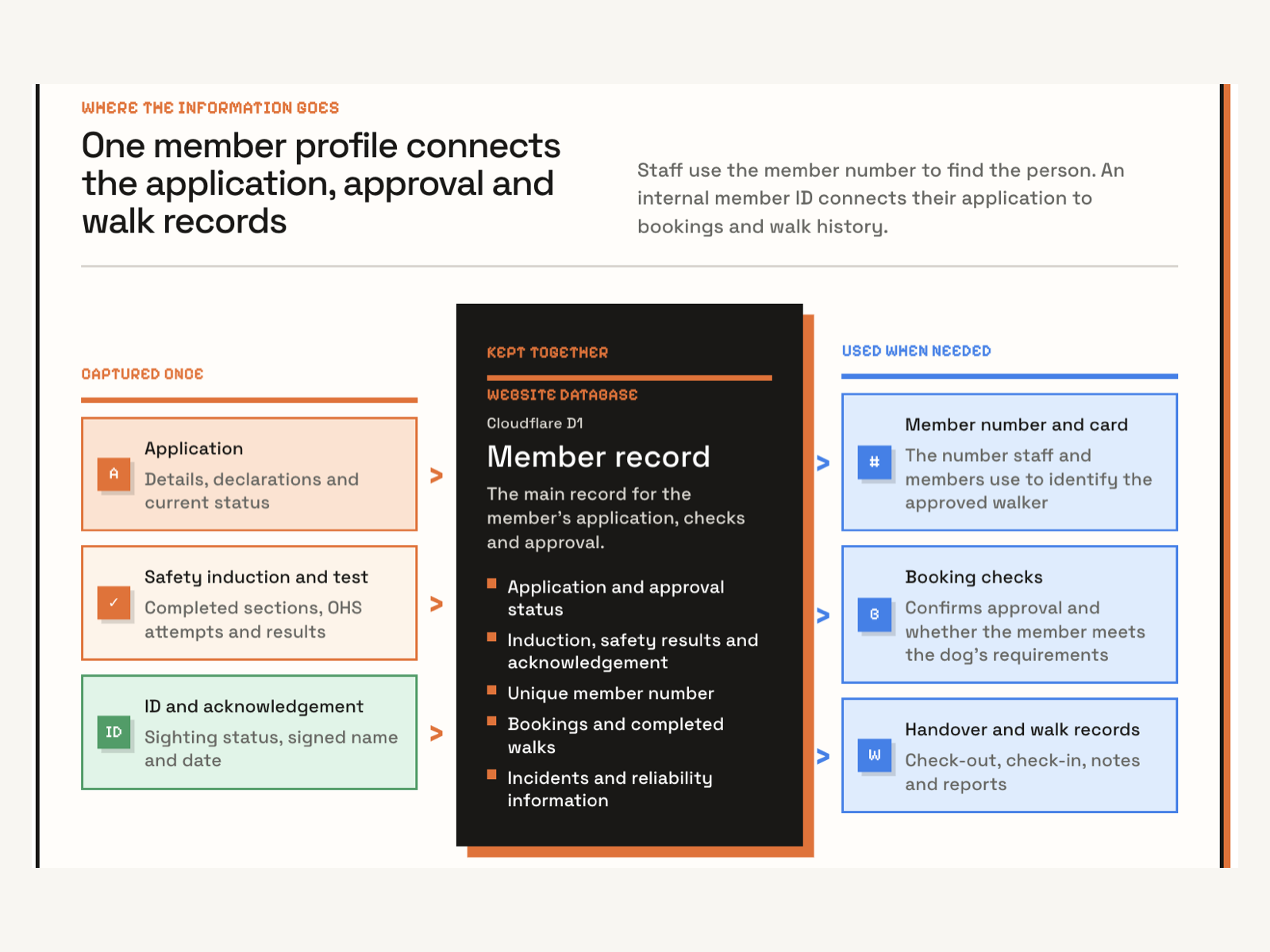
When an application begins, DogsCBR Walks creates one member record in Cloudflare D1. That record connects application status, induction progress, OHS results, acknowledgement, ID-sighting status, approval, membership level, bookings, walks, reports, incidents and reliability information.
That connection matters more than simply replacing a spreadsheet with a database.
The application can now answer operational questions at the moment they matter:
- Is this membership approved right now?
- Has the person completed the required safety steps?
- Does their experience level meet this dog’s requirements?
- Is this their first walk with this dog, meaning supervision is required?
- Is there a current booking that matches this handover?
Approved members receive a digital card with a signed QR reference. The code does not contain their name, phone number or email address; it lets an authorised user retrieve the current member record. An old screenshot therefore cannot make a cancelled booking or suspended membership look current.
In short, the database stopped being a cupboard where information was stored and became part of the safety system.
Safety does not stop when the booking is made
The old calendar could tell the team that somebody wanted a time slot. It could not inherently tell them whether that person was approved, whether they met a particular dog’s requirements or whether a first walk needed supervision. Calendars are less gifted at safeguarding.
DogsCBR Walks applies known eligibility rules before the booking is accepted. When the situation needs context or judgement, the coordinator remains responsible.
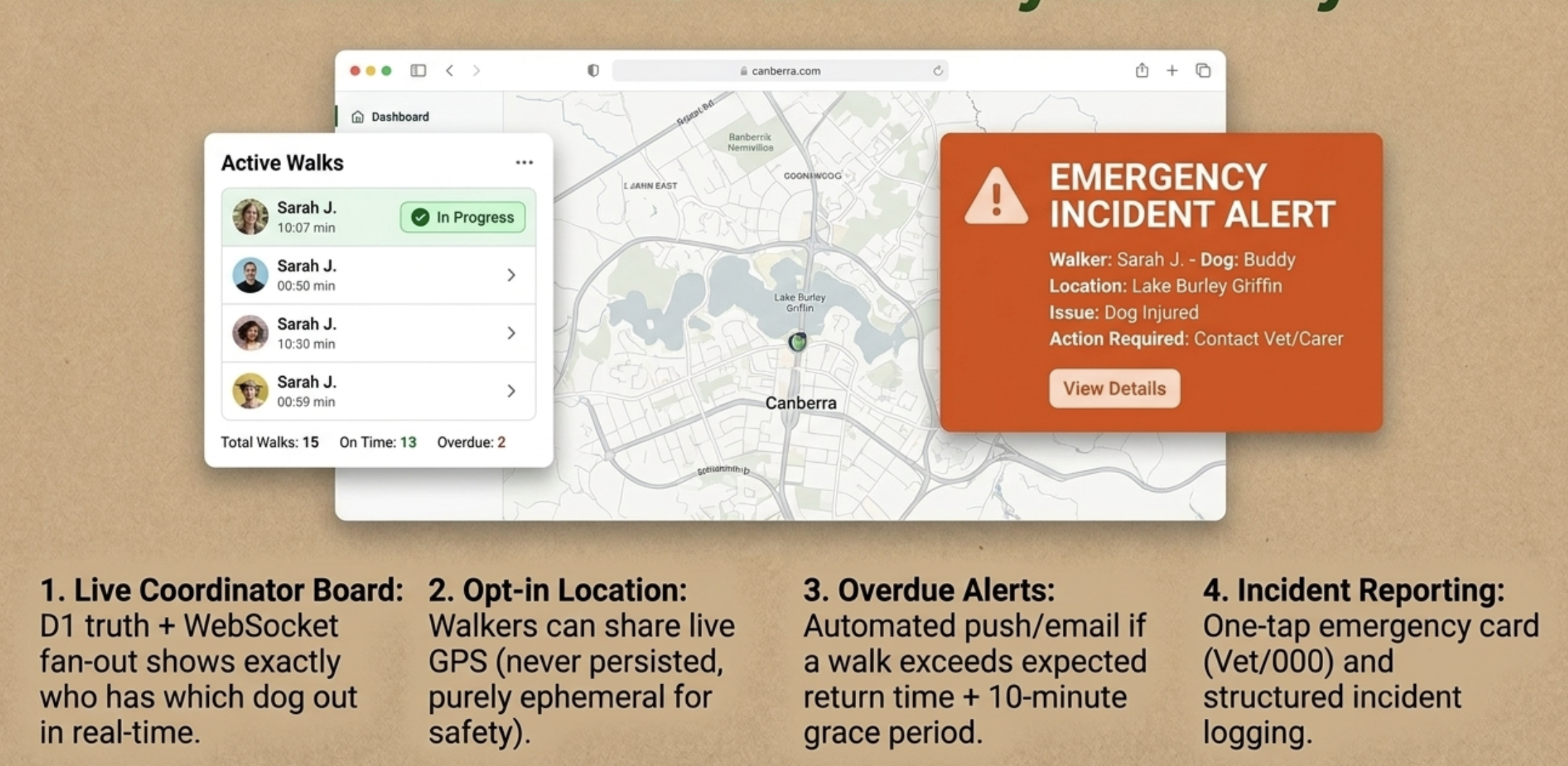
On walk day, the app supports:
- two-sided handover confirmation between walker and carer;
- check-out, expected return and check-in status;
- emergency information and incident reporting;
- overdue alerts; and
- opt-in live location during the active walk.
The location data is deliberately temporary. It helps the team during the walk but is not added to the permanent member history. Useful for safety, useless for building an accidental surveillance archive — exactly as intended.
Every walk can leave something useful behind
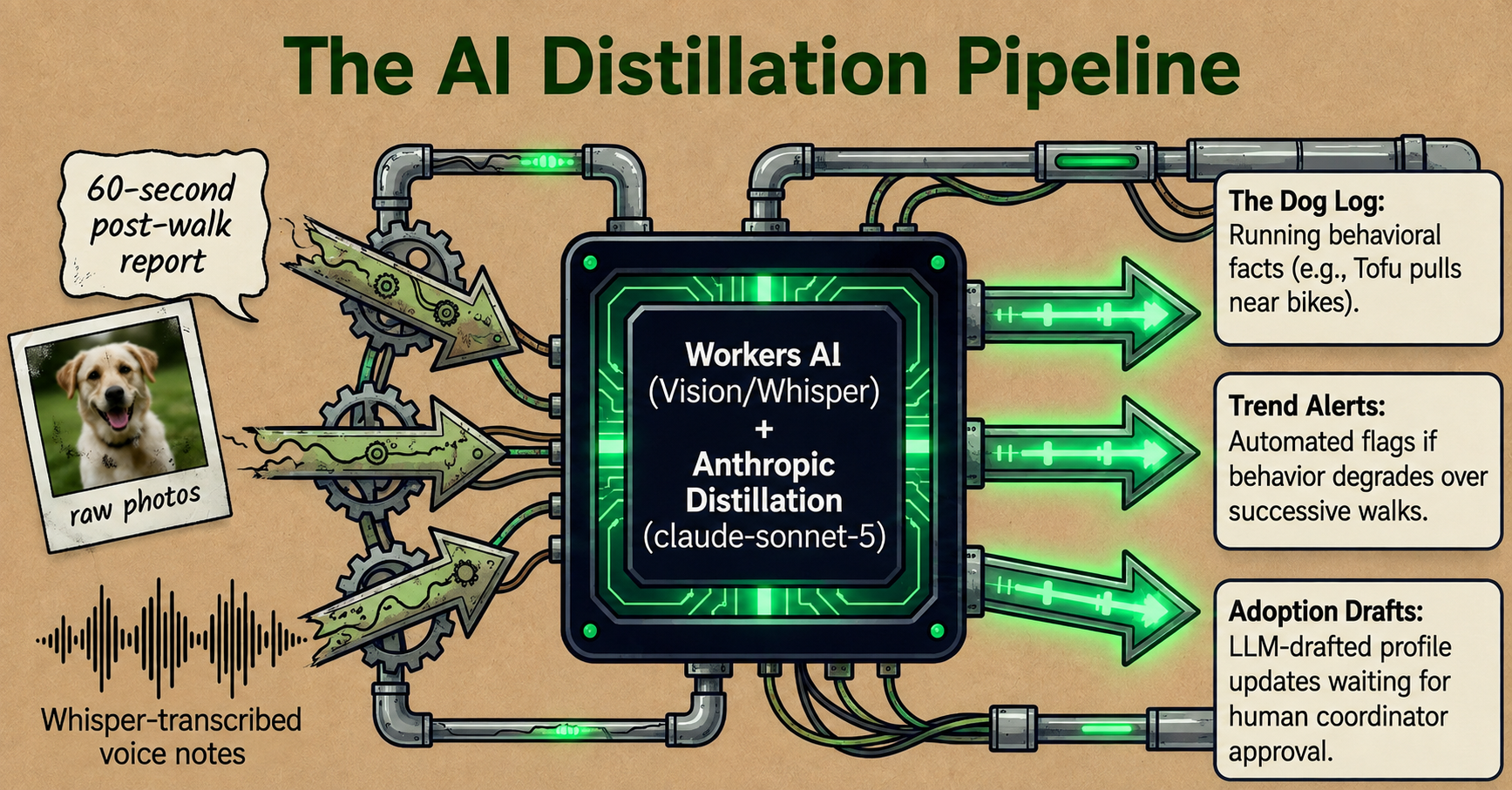
When a dog comes home, the walker can complete a short report with structured ratings, behaviour observations, notes, photos and an optional voice note. Foster-carer notes can be included too.
Those reports build a dated dog log across different walkers. One comment about pulling near bicycles may be a one-off. The same observation across several walks may be a pattern worth reviewing. That history can help refine handling advice, prepare future walkers and support richer adoption conversations.
This is where AI helps — carefully.
- Workers AI can caption walk photos and transcribe voice notes.
- Anthropic, accessed through the application’s distillation workflow, can turn the report and existing dog history into concise factual entries and draft possible trends, fit hints or adoption-profile wording.
- Dogs Canberra reviews the interpretive output. Draft insights can be edited, approved or rejected; they are not automatically published.
We deliberately separated observation from judgement. AI can organise evidence. It does not approve walkers, override handling rules or decide what is publicly true about a dog.
How we built it
DogsCBR Walks is a working prototype built with Solid 2 and TanStack Solid Start on Cloudflare Workers.
We based the workflow on Dogs Canberra’s real expression-of-interest form, induction, OHS material and dog-walking procedures, then tested the connected route from application through approval, booking, handover, return and reporting.
| Layer | Technology | What it does |
|---|---|---|
| Experience | Solid 2 + TanStack Solid Start | Mobile-friendly member, carer and coordinator journeys |
| System of record | Cloudflare D1 + Drizzle | Members, dogs, bookings, reports, incidents and audit history |
| Durable processes | Cloudflare Workflows | Onboarding, booking and post-walk tasks that can safely wait for human action |
| Live walk state | Durable Objects | Handover prompts, presence and temporary location during an active walk |
| Private files | R2 + Cloudflare Images | Photo ID, dog photos and walk media |
| Multimodal processing | Workers AI | Image captions and voice-note transcription |
| Evidence distillation | Anthropic via TanStack AI | Human-reviewable dog-log entries and insight drafts |
| Communication and outputs | Email, web push and Browser Rendering | Reminders, alerts, printable cards and reports |
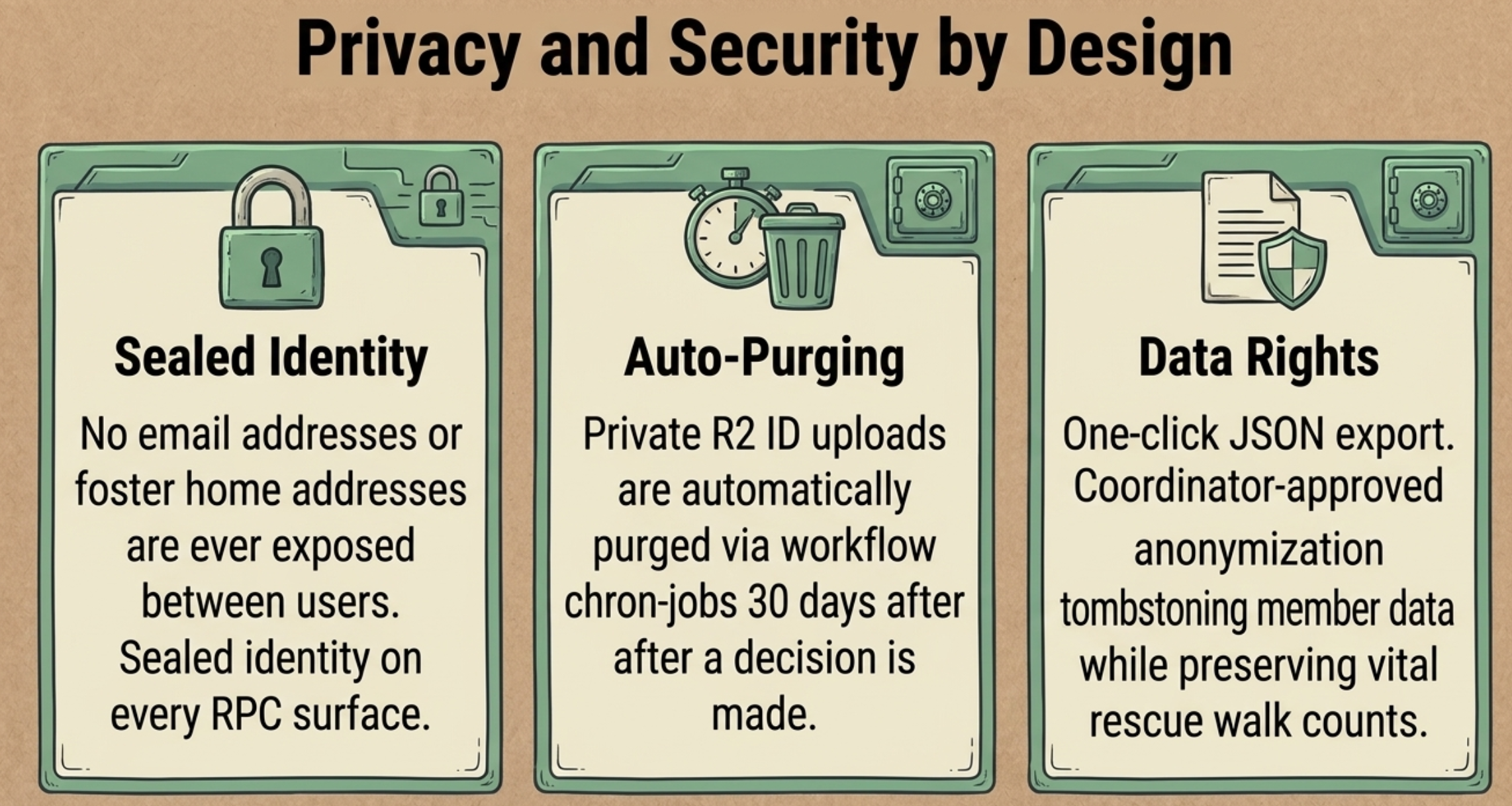
We chose this architecture because a volunteer-run charity needs software that can grow without requiring its own infrastructure team. Durable information lives in D1. Sensitive files have their own retention rules. Temporary walk-session data stays temporary. Long-running workflows can pause for a real person instead of pretending every decision should happen instantly.
The hardest challenges
1. Deciding what not to automate
At first, every manual step looked like an automation opportunity. It was not.
Some manual work existed because disconnected systems forced a volunteer to copy information around. That was waste. Other steps existed because somebody genuinely needed to make a membership, safety or animal-welfare decision. That was responsibility.
Learning to separate those two changed the whole design.
2. Giving different information different lifetimes
Bookings, approvals and incident facts need durable history. A raw identity document does not need to live forever. Live location is useful during a walk but should not become a permanent movement record.
Designing separate lifecycles for these data types was harder — and more important — than simply choosing where to store them.
3. Connecting the digital flow to a physical handover
Software can make a booking look beautifully tidy while the real-world handover remains ambiguous. We had to model both sides confirming check-out and return, along with practical fallbacks when scanning or connectivity is unavailable.
The system needed to support the people at the gate, not just look impressive in a database diagram.
4. Keeping AI useful without making it the authority
An “AI-powered matching engine” might have sounded flashier. It also would have put probabilistic software in the wrong place.
Known eligibility rules belong in code. Safeguarding and welfare decisions belong with people. AI belongs where messy evidence needs to be organised into something a person can review.
That boundary became one of the most important parts of the build.
What we learned
The biggest lesson was that good automation does not remove people from the process. It removes the repetitive work around the moments when people are most needed.
We also learned that “centralise the data” is not enough. The value comes from relationships: a member linked to an approval, linked to a booking, linked to a dog, linked to a completed walk and its report. Those relationships let the system make routine checks consistently while keeping the original evidence available to the humans responsible for the decision.
Finally, we learned that a walk can count twice.
It counts once because a rescue dog receives exercise, socialisation and individual attention while a community member gets outside and contributes to something meaningful.
It counts again because the experience can strengthen the dog’s history and help make the next walk, handling plan or adoption conversation better informed.
The outcome
DogsCBR Walks gives applicants a clearer route into the program and gives coordinators one complete record to review. It checks booking rules consistently, supports accountable handovers and turns completed walks into useful dog knowledge.
The coordinator is still the person making the important decisions. They simply get to spend less time hunting through inboxes and spreadsheets — and more time helping walkers, carers and dogs.
Make it easier to help. Keep every walk accountable. Capture what happened. Let AI organise the evidence. Keep people responsible for what it means. Make the next decision better than the last.
Built With
- anthropic
- app
- claude
- d1
- drizzle
- human-in-the-loop
- orm
- r2
- solidjs
- speech-to-text
- sqlite
- tanstack
- typescript
- whisper
- workflows


