Inspiration
We always wanted to do something with kebab. And we already did: a wonderful heatmap of kebab prices. It was not cherished (shame). So here is our next iteration to bring more kebab into this world, since the real thing seems to grow in price like GPUs: an idle game featuring our favourite, most nutritious food.
What it does
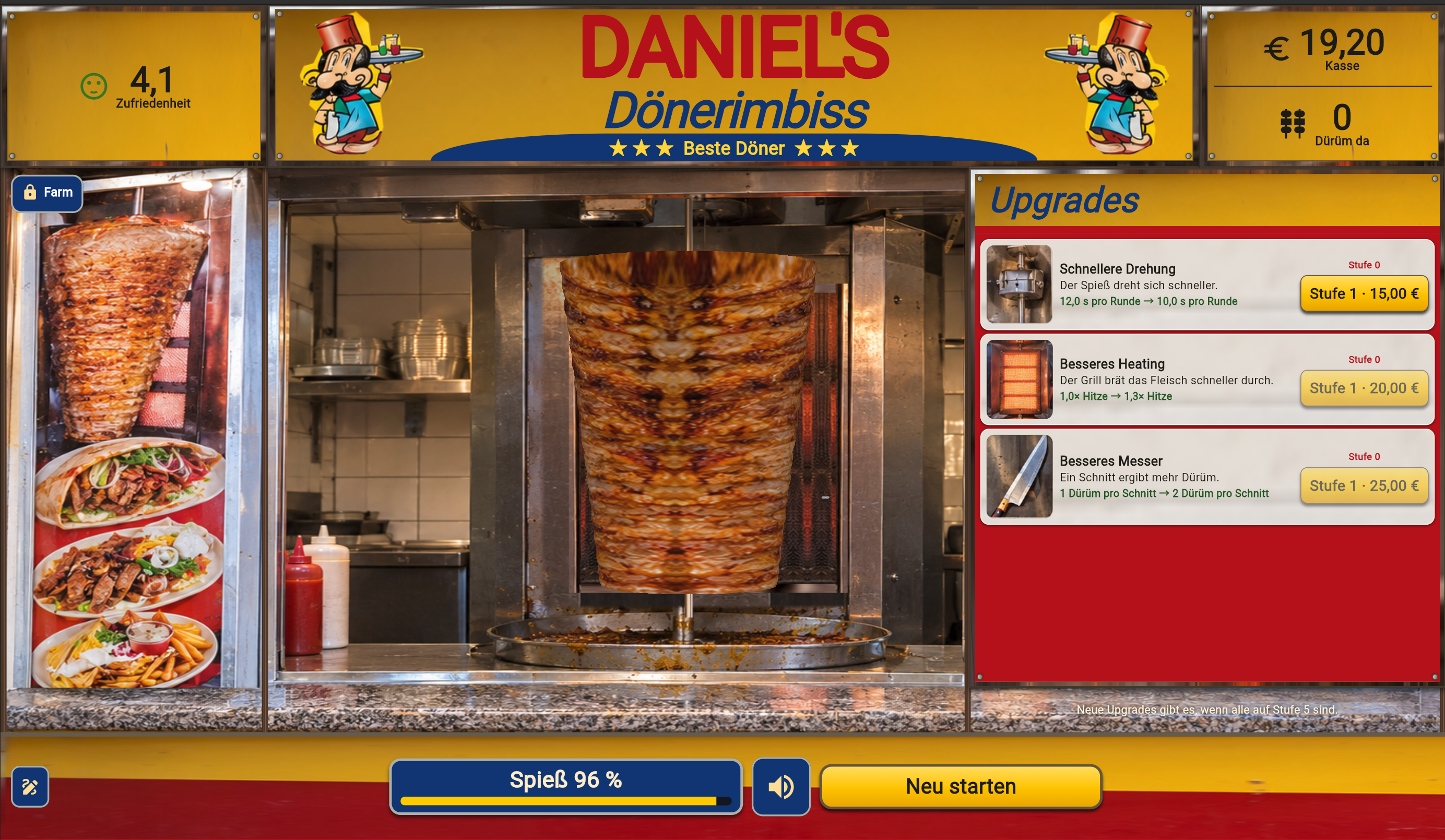
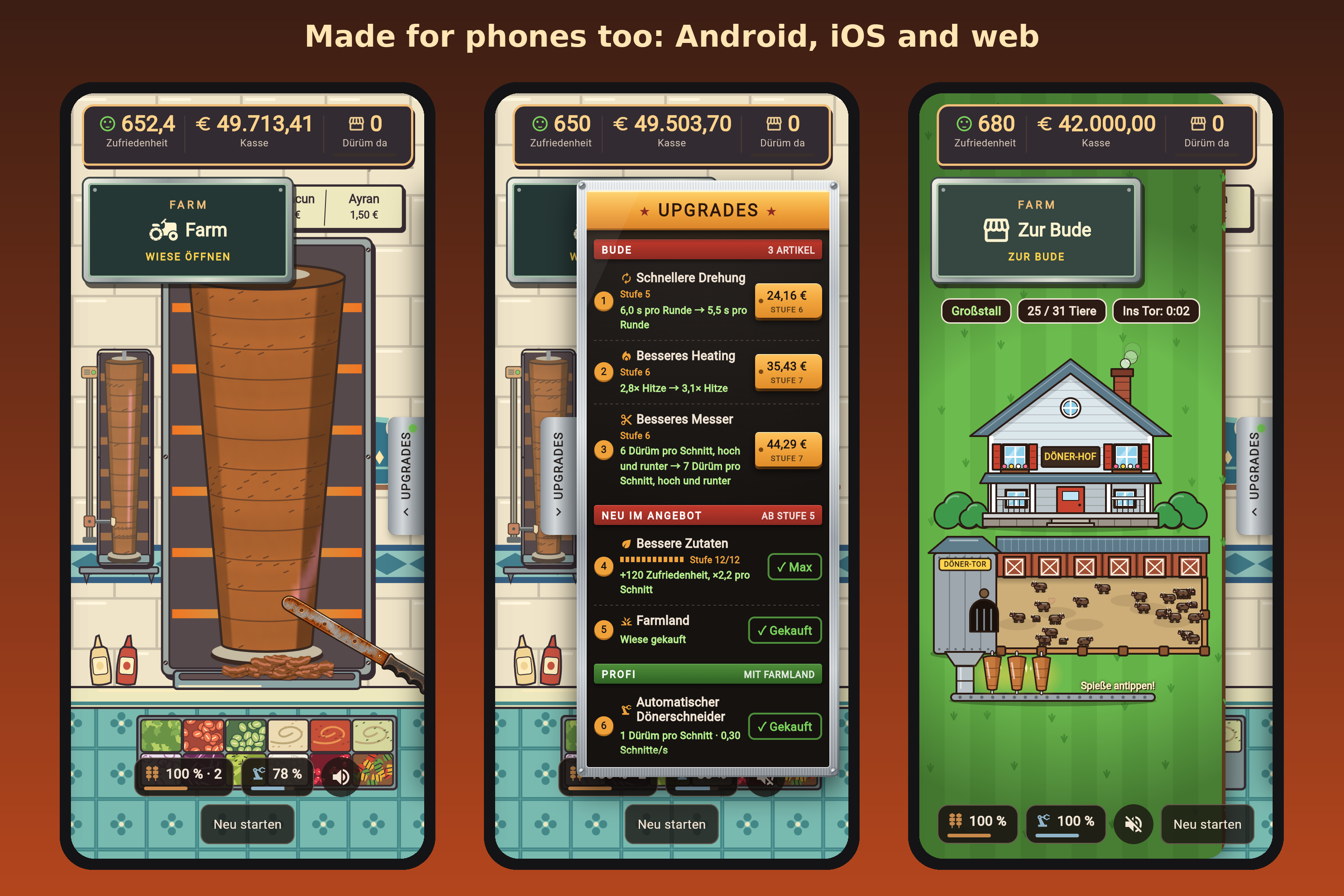
Dönerklicker is a clicker / idle game about a rotating döner spit. You start in a slightly grimy kebab shop with one spit, one knife and zero happy customers, and you end up running a genetically optimised meat empire with franchise branches all over town.
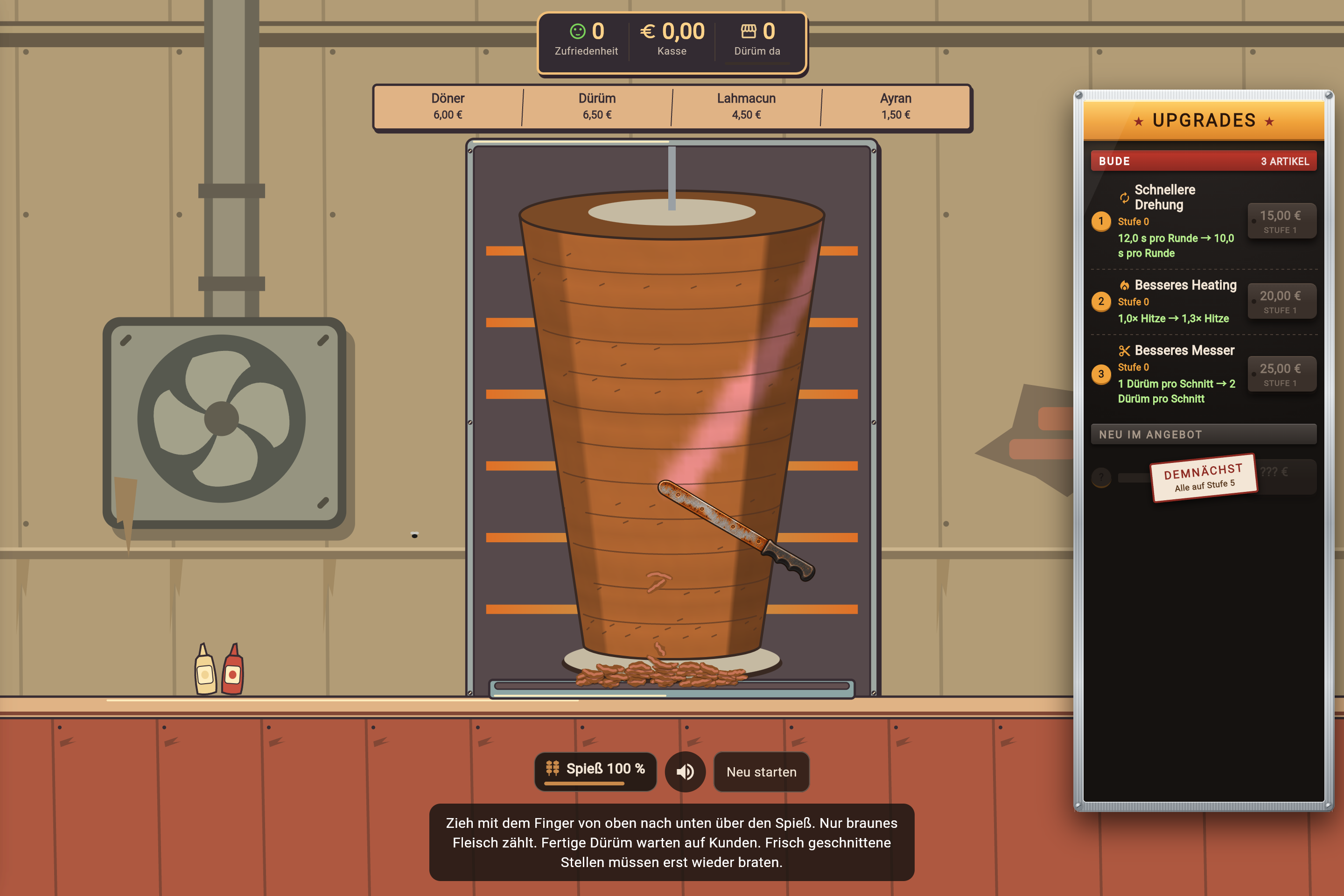
- Cut the spit. The spit turns in front of the grill. Swipe down over the meat to slice it. Only properly browned meat counts, and the spot you just cut is raw again and has to roast back. Cut too short and you get "Longer!", cut raw meat and you get "Too raw!". Every good slice becomes a dürüm that flies onto the counter.
- Satisfaction is the economy. Customer satisfaction starts at 0 and has no ceiling. Long, well-roasted cuts raise it, raw or stingy cuts lower it. It drives both the price and how fast customers come: $$\text{price} = 3\,€ + 0.0225\,€ \cdot \text{satisfaction}$$ At 0 a customer shows up every 2 seconds, at 200 four per second.
- The spit wears down. It gets thinner with every cut, and a new one costs money, unless your own farm delivers spits for free.
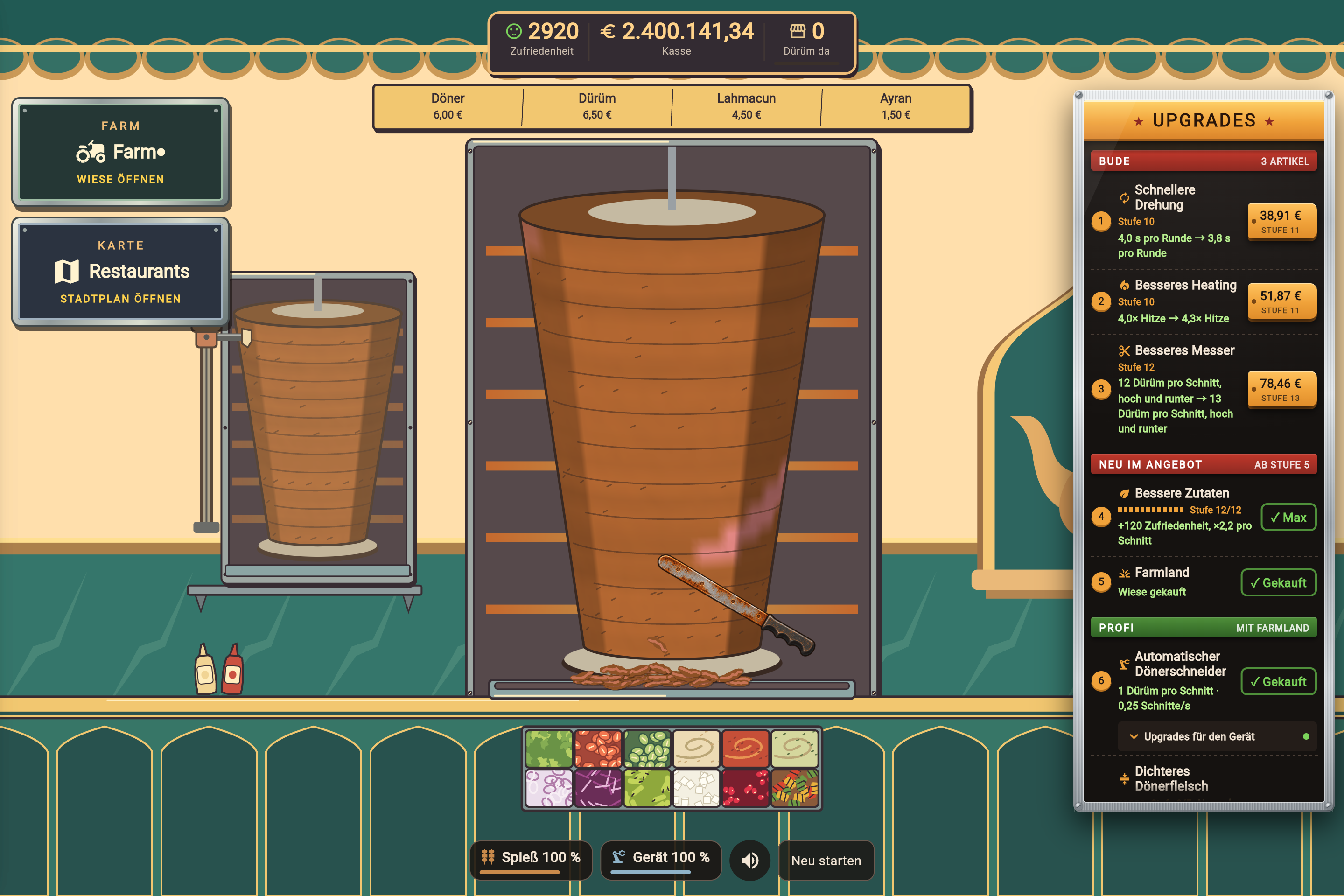
- Upgrades on an aluminium menu board. All upgrades live on a fast-food style menu board with a brushed aluminium frame: faster rotation, better heating, a better knife (level 6 turns golden and cuts in both directions), and once everything hits level 5, better ingredients: twelve toppings from lettuce to pomegranate syrup that appear one by one on the counter.
- Der Gerät. A professional automatic kebab cutter with its own smaller spit on a wall console in the back. It rolls dice for raw, too little, normal or lots of meat, wears down its own spit and has its own upgrades. A buyer can restock both spits for you.
- Renovate the shop in five steps from grimy booth to Döner Palace, each with its own background.
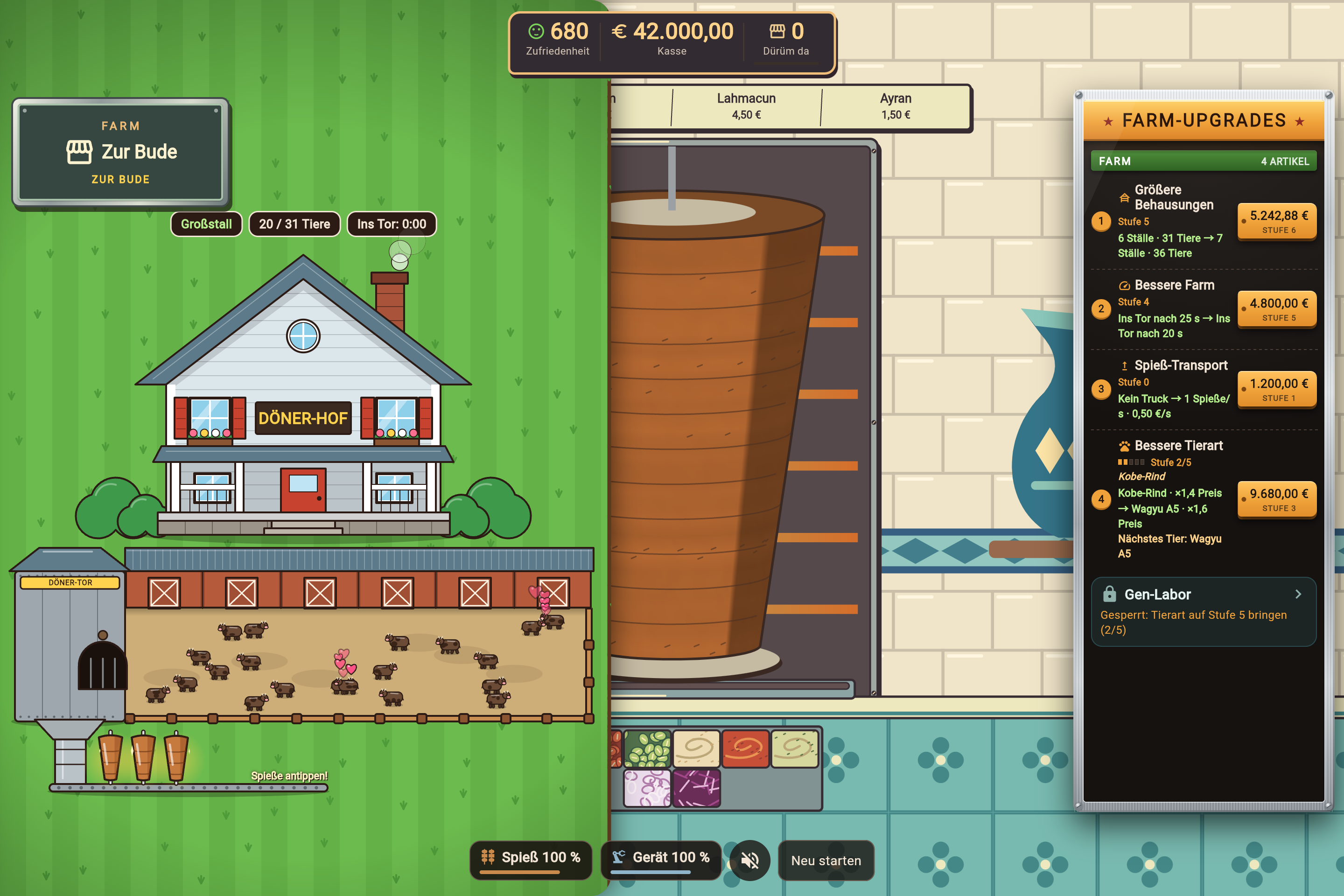
- The farm. Buy farmland and a meadow slides in from the left: a big comic farmhouse, a stable with one box per housing upgrade and an enclosure full of animals wandering around. They are attracted to each other, and when two adults collide they may fall in love: hearts rise, eyes turn into hearts and 2 to 3 babies are born. Every grown animal eventually walks into the Döner Gate on its own, and a fresh spit slides down the chute for you to tap and store. The more productive the farm, the more industrial it looks, from a cosy farmstead to a smoking meat factory.
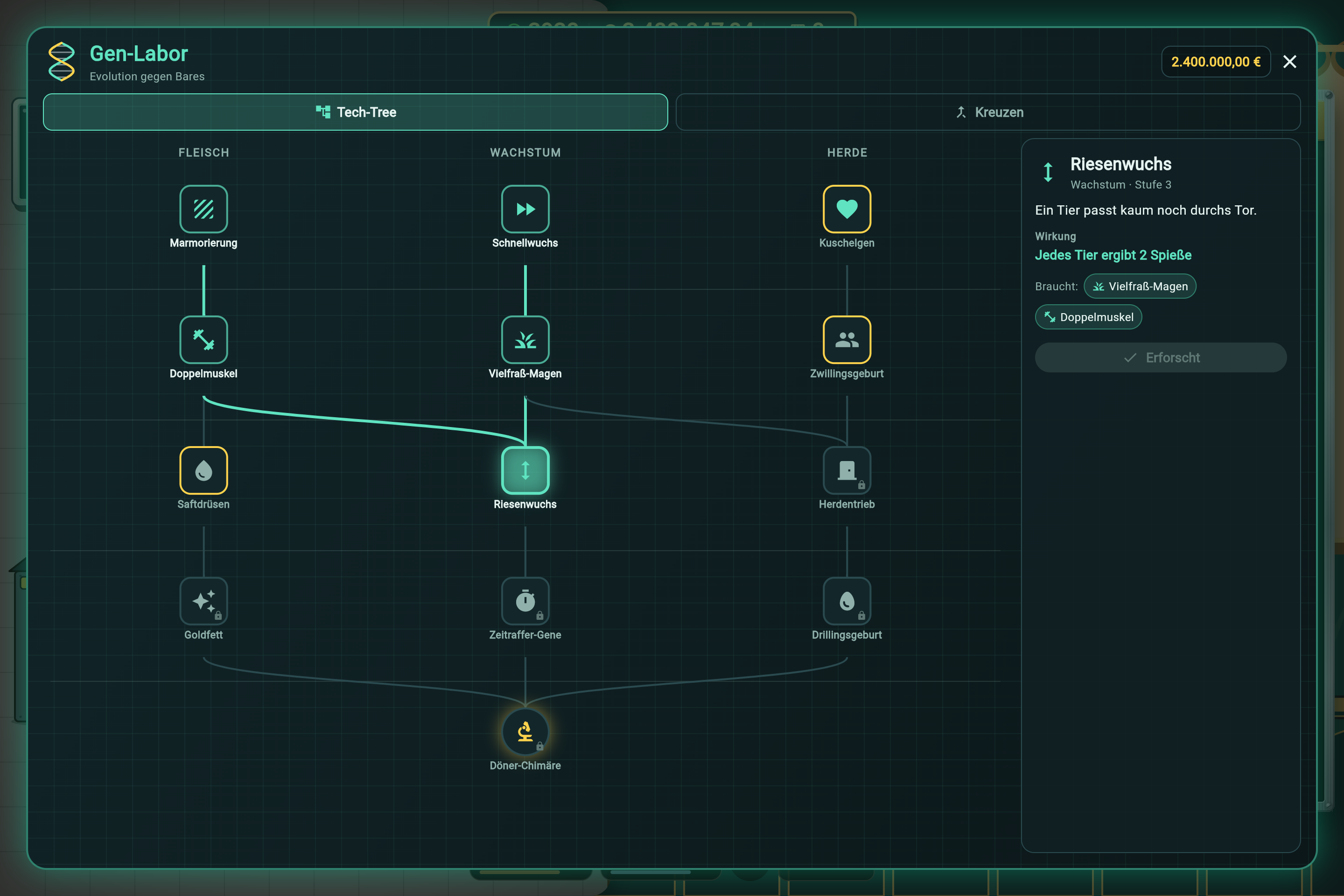
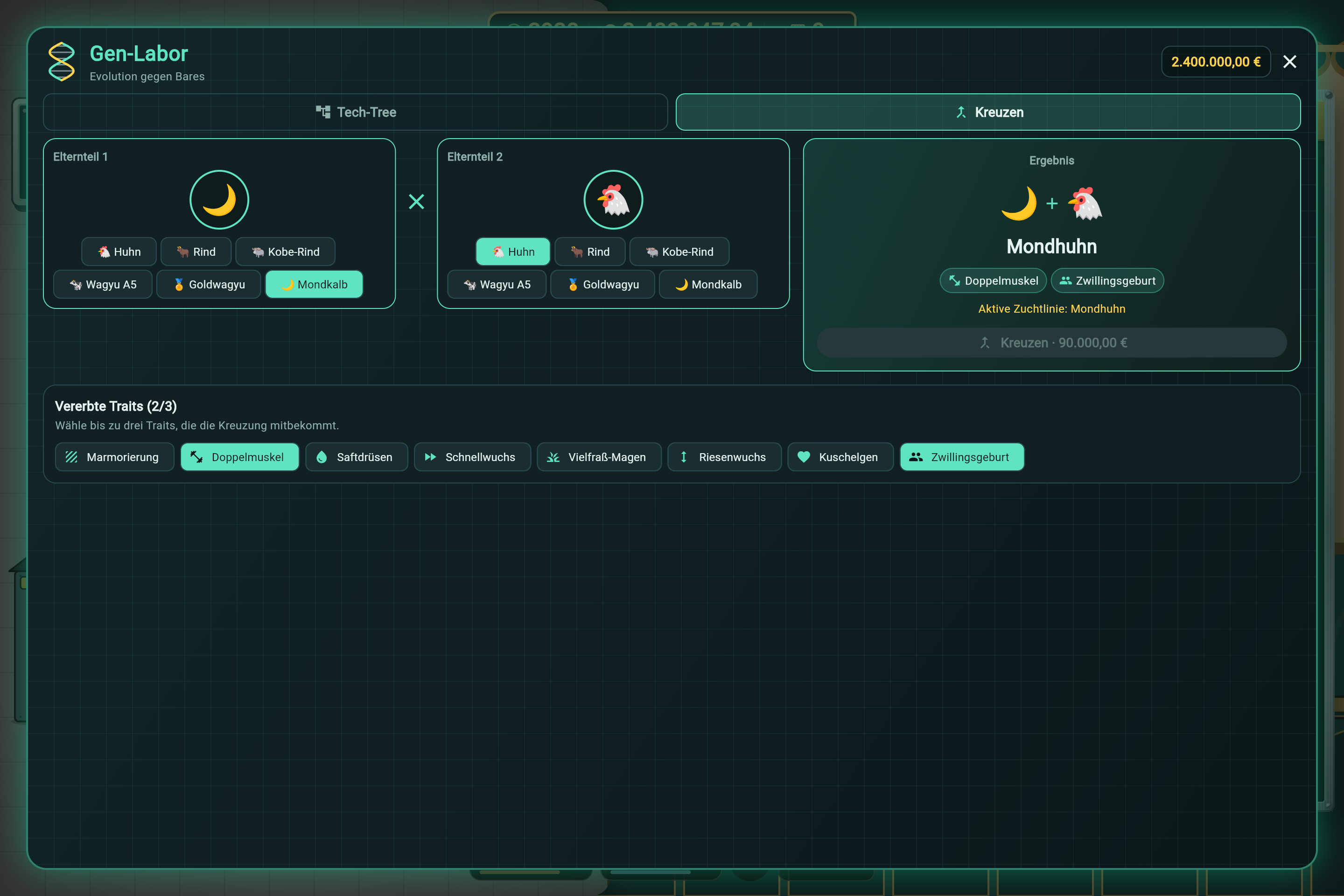
- Animal species and the gene lab. Meat quality only improves through better animals: chicken, beef, Kobe, Wagyu A5, Gold Wagyu and finally the Moon Calf. At Moon Calf the gene lab opens: research 13 traits in a tech tree (Marbling, Double Muscle, Twin Births, Herd Instinct, ...) and crossbreed species into things like the Rinderhuhn (beef-chicken) or the Sternenochse (star ox). The crown is the Döner Chimera, which doubles every other trait.
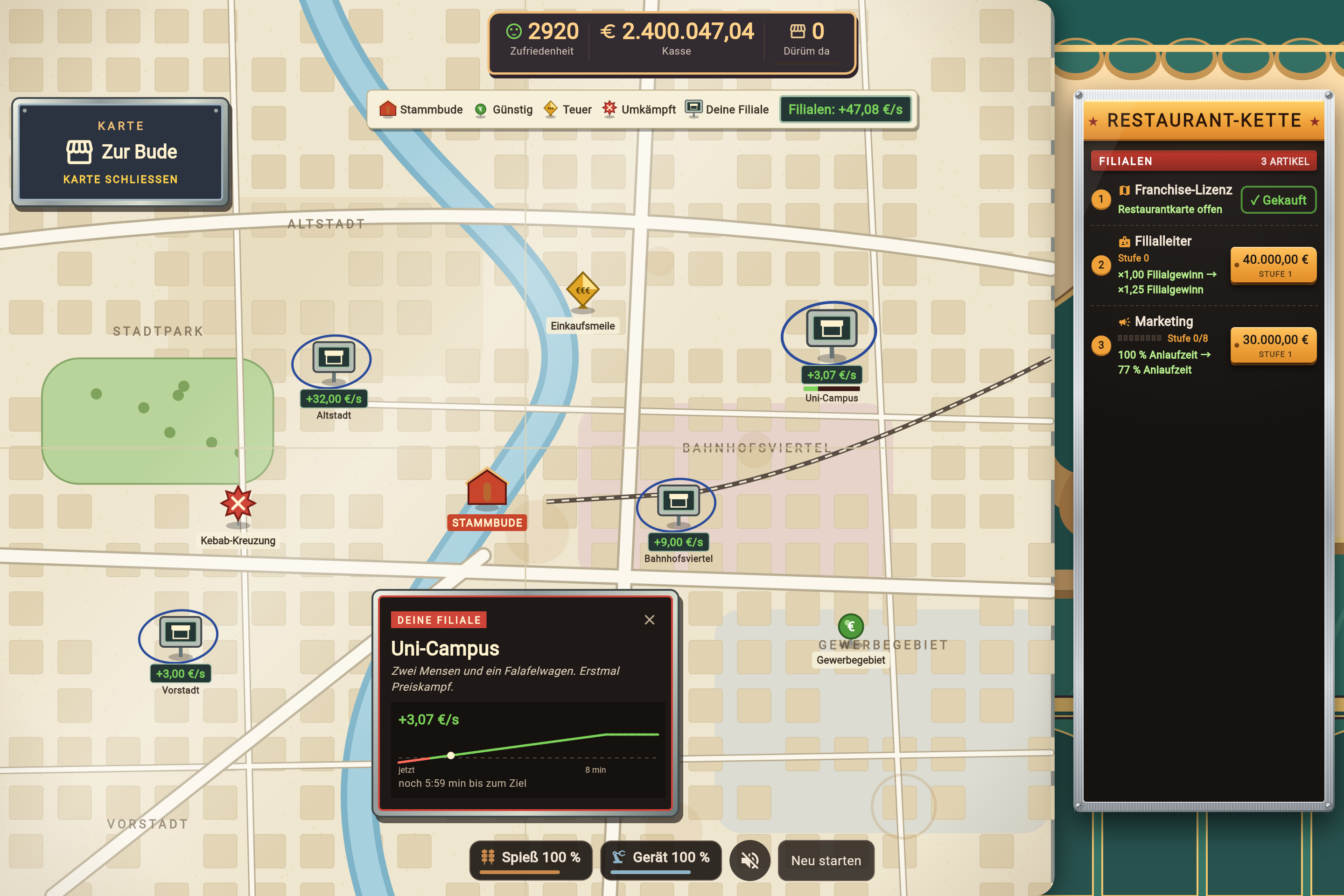
- The restaurant map. Once your shop is a palace, buy a franchise licence and open branches on a laminated city map: cheap spots with small profit, expensive ones with big profit, and contested ones that lose money at first and pay best once they are established.
The game saves locally and runs on Android, iOS and the web.
How we built it
- Flutter and Dart for one codebase on web, Android and iOS. We chose Flutter on purpose because there is a HarmonyOS SDK for it, so the same code can go straight to HarmonyOS devices as well. The whole scene is drawn in code with
CustomPainter: the spit, meat shavings, the shop, the farm, the animals, the menu board and the city map. The only image asset is the knife sprite. - Game logic without widgets.
GameStatehandles roasting, cutting, wear, satisfaction and the economy; the herd simulation (walking, attraction, collisions, births) is plain Dart and unit tested. Every number lives in a config file per upgrade group, so balancing is a one-line change. - Synthesised sound. Grill sizzle, a passing fly and the cash register are generated as WAV files by a Dart script before every build. No licensed recordings.
- A concept paper first. We kept a living definition paper with every rule and value, and wrote each new idea into it before it went into code. That paper is the spec, the balancing sheet and the changelog at once.
- Claude Code as a team member. We built the game together with Claude (Claude Code): HTML mockups and prototypes for new features first, then the Flutter implementation, each feature on its own branch and pull request, with CI running tests,
flutter analyzeand a web build.
Challenges we ran into
- Making cutting feel good. Deciding which meat counts as browned, how wide a cut is, what happens when the knife changes direction mid-swipe, and keeping that responsive with mouse, touch and pen took many iterations.
- Parallel features, one game screen. Farm, gene lab, menu board, restaurant map and the second spit were built in parallel and all touch the same state and screen, so merging them without breaking each other was a real puzzle.
- Clean comic graphics without assets. Drawing a farmhouse, a stable and a fence purely in code so that edges line up on whole pixels and outlines stay the same width everywhere is harder than it looks. We ended up writing a test for the farm layout.
- Balancing an idle game in a weekend. Exponential prices, open-ended satisfaction and money from many sources need to stay fun from the first cut to the Döner Chimera.
Accomplishments that we're proud of
- A complete progression loop from one dirty spit to an industrial farm, a gene lab and a franchise chain, built during the hackathon.
- Animals that fall in love on collision. Watching the hearts pop never gets old.
- Over 60 commits, more than 100 tests and every single value of the game documented in the concept paper.
- Everything, including the sounds, is generated by code.
What we learned
- Writing ideas down in a concept paper first makes working with an AI agent much smoother: the paper is the shared source of truth for humans and Claude.
- Quick HTML mockups are a great way to agree on a look before spending time on Flutter painters.
- Keeping game logic out of the widgets and every number in config makes balancing and testing fast.
- Idle games are mostly maths, and kebab maths is the best kind.
What's next for Doenerklicker
- The Gammelspieß (rotten spit), already prototyped: if you can't pay full price for a new spit, the supplier takes all your cash and hands you olive-grey meat with mould spots, flies and stink lines that costs satisfaction on every slice. "Green counts as a vegetable."
- Branches that need spits from the farm, so the restaurant map and the farm feed into each other.
- Upgrades per branch and competitors trying to win back contested spots.
- More gene lab content, more species and more crossbreeds.
- Balancing the late game, then publishing on the web, Google Play, the App Store and HarmonyOS via the Flutter HarmonyOS SDK.
Built with (Devpost-Tags)
flutter, dart, claude, claude-code, anthropic, custompainter, shared-preferences, android, ios, harmonyos, web, html, javascript, github, github-actions
