-
-
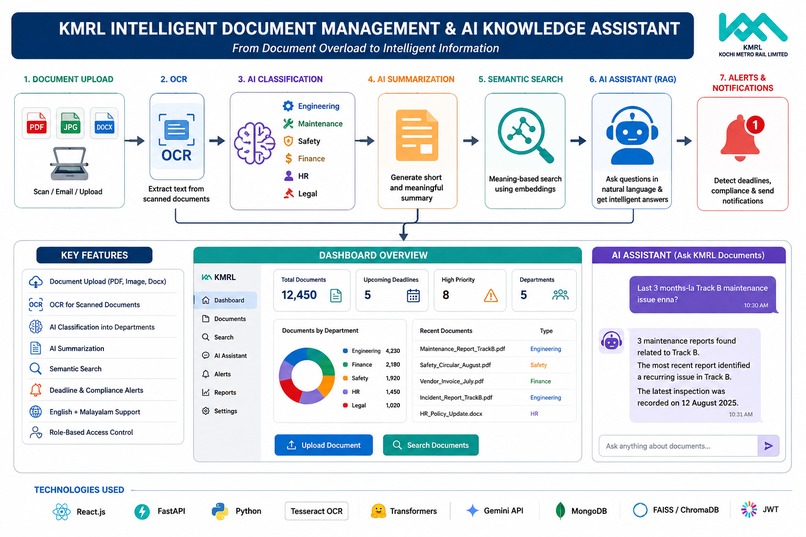
KMRL document overloading
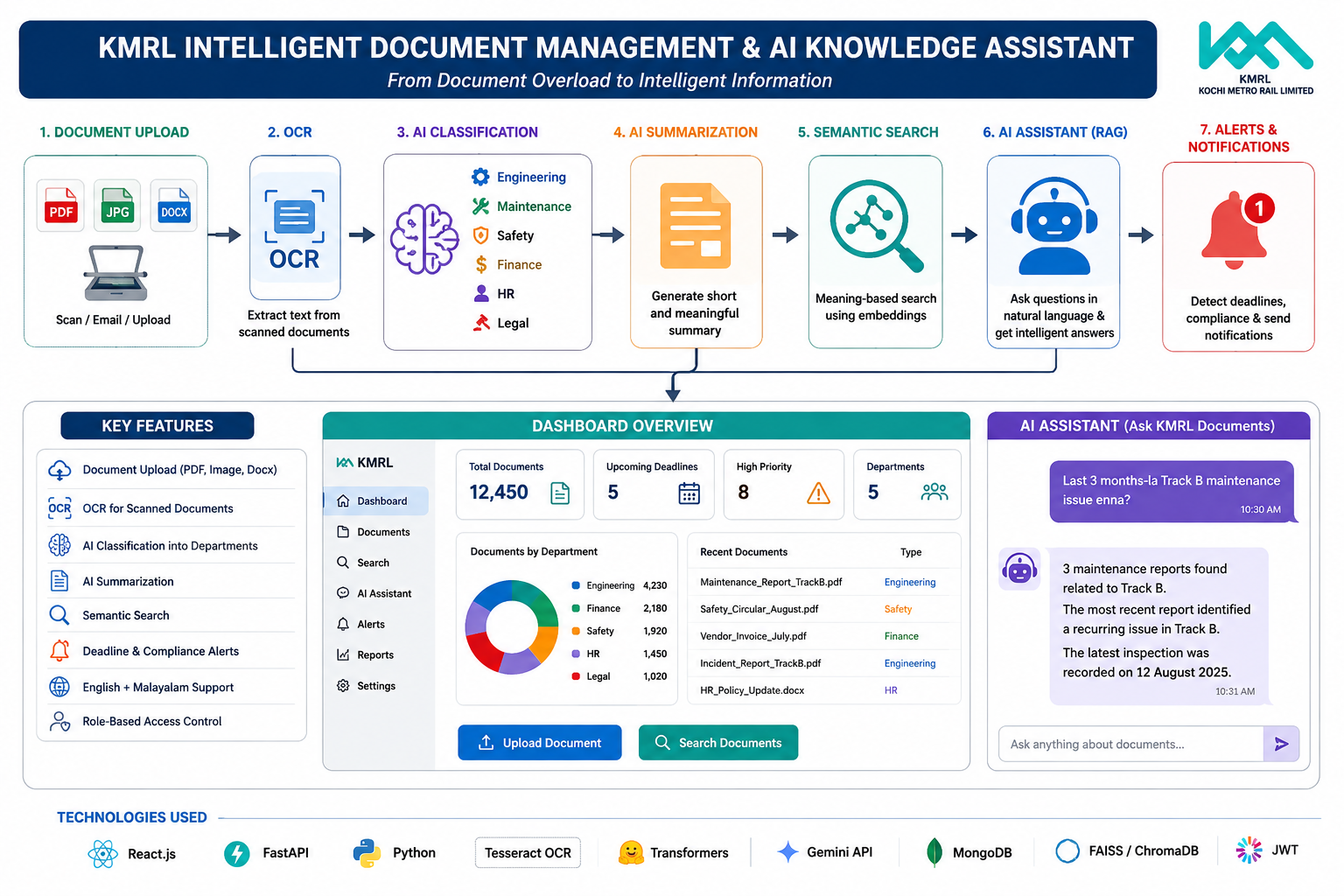
Inspiration
Kochi Metro Rail Limited (KMRL) handles a large number of documents such as maintenance reports, engineering documents, safety reports, invoices, HR documents, and legal records. These documents can come from different sources and formats, making it difficult and time-consuming for employees to find the right information.
This inspired us to build an AI-powered Intelligent Document Management System that can transform document overload into easily accessible and meaningful information.
What We Built
Our solution automates the complete document management process:
Document Upload → OCR → Text Extraction → AI Classification → Summarization → Embeddings → Semantic Search → RAG-based AI Assistant → Alerts
The system can process digital and scanned documents, automatically classify them into departments, generate summaries, detect important deadlines, and retrieve relevant information using semantic search.
We also designed an “Ask KMRL Documents” AI Assistant, allowing users to ask questions in natural language and receive answers based on the organization's documents.
How We Built It
We used React.js for the frontend and Python FastAPI for the backend. OCR is used to extract text from scanned documents, while NLP and AI models are used for classification and summarization.
For intelligent retrieval, we use embeddings and vector search with technologies such as FAISS/ChromaDB. A RAG-based approach allows the AI assistant to retrieve relevant documents before generating answers. MongoDB is used for document and application data, with JWT-based authentication for secure access.
Challenges We Faced
One of our major challenges was handling different document formats, especially scanned documents that require OCR before processing.
Another challenge was making search more intelligent than traditional keyword-based search. We addressed this by using semantic search, which focuses on the meaning and context of the user's query.
Handling multilingual documents, extracting important dates, maintaining secure role-based access, and providing accurate AI-generated answers were also important challenges.
What We Learned
Through this project, we learned how OCR, Natural Language Processing, embeddings, vector databases, semantic search, and Retrieval-Augmented Generation (RAG) can work together to solve a real-world organizational problem.
Most importantly, we learned how to convert a real-world problem into a practical AI-powered automation solution.
Built With
- api
- chromadb
- faiss
- fastapi
- gemini
- jwt
- mongodb
- natural-language-processing
- ocr
- python
- rag
- react.js
- rest
- search
- semantic
- tesseract
- transformers


Log in or sign up for Devpost to join the conversation.