Documatey
Inspiration
Documentation often sits unused or becomes complex more and more. We wanted to create a way to make documentations more actionable along with a goal or a desired outcome of using the documentation.
What it does
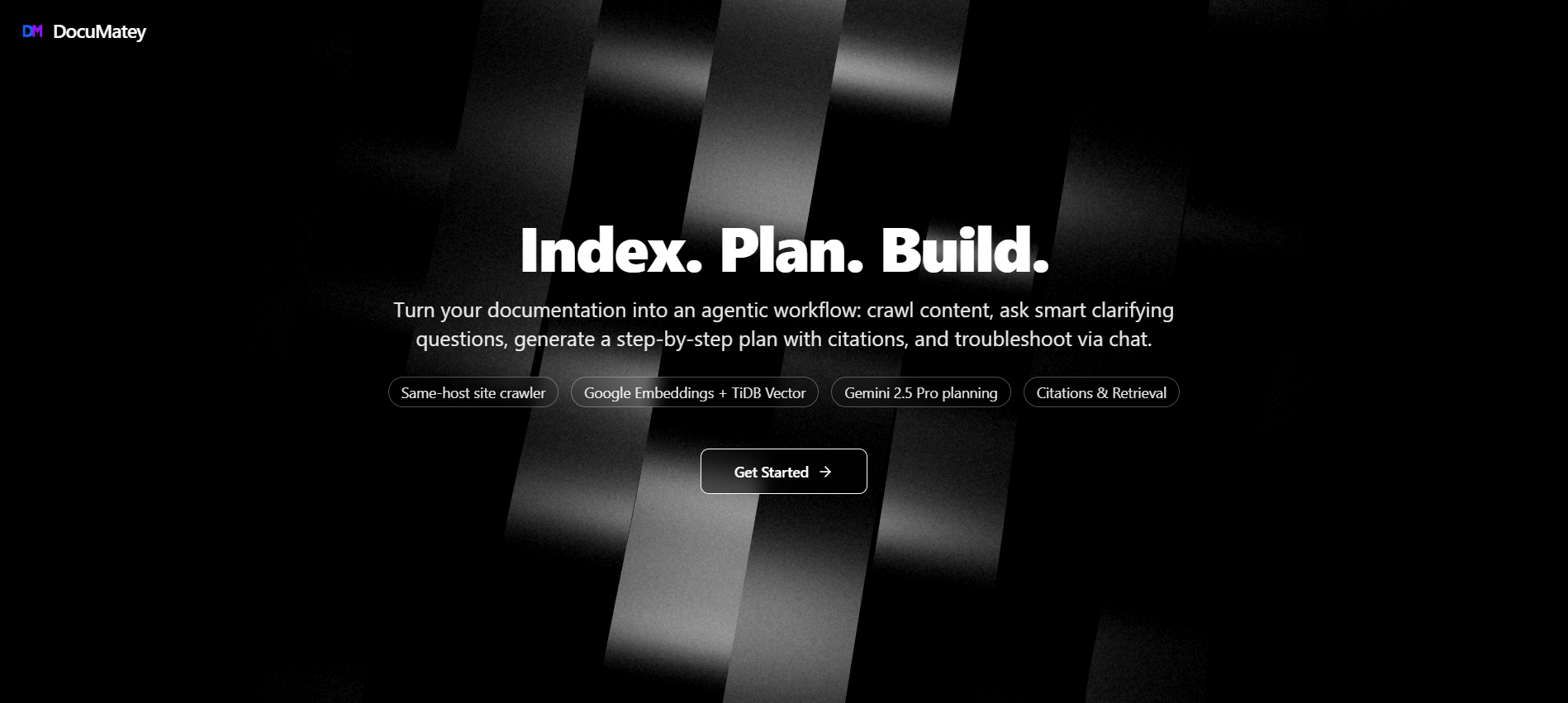
Documatey transforms raw documentation into structured, actionable plans along with the user's goal of using the documentation.
How we built it
- Frontend: Built with Next.js + shadcn UI for a clean, responsive interface.
- Backend: Next.js inbuilt API to handle requests between the AI agent and the database.
- AI Agent: Implements an agentic pipeline using Gemini for LLM to generate relevant follow-up questions in order to clarify the goal and, for the steps in-context chat.
- Database: TiDB Serverless with vector search for indexing, semantic search, and retrieving relevant documentation snippets.
- Integration: The system chains LLM calls and queries the TiDB vector index to generate step-by-step, goal-aligned plans.
Features and functionality
DocuMatey turns documentation into an agentic workflow:
- Index docs (crawl or paste text) into a vector store.
- Ask clarifying questions to firm up requirements.
- Generate a step by step plan with citations.
- Chat with retrieval grounded to the selected plan step.
Challenges we ran into
- Over-broad retrieval: Unconstrained vector search often pulled in off‑domain snippets, degrading plan quality.
- System prompts and strict JSON: Getting Gemini to return strictly valid JSON was inconsistent.
What we learned
- How to effectively combine AI agents with vector databases for real world productivity tools.
- The importance of data indexing and embeddings in making search and retrieval reliable.
What's next for Documatey
- Response robustness and schema validation: Strictly validate LLM JSON against zod schemas
- Multi-model support and fallbacks: Allow model routing for LLMs with per-task prompts.
Additional submission details
- TiDB Cloud account Email associated with the Project : [email protected]
- Run Instructions : Please refer the README.md file on the public GitHub repo
- Live demo : A testable demo has been deployed to vercel
Built With
- nextjs
- tidb
- typescript

Log in or sign up for Devpost to join the conversation.