-
-
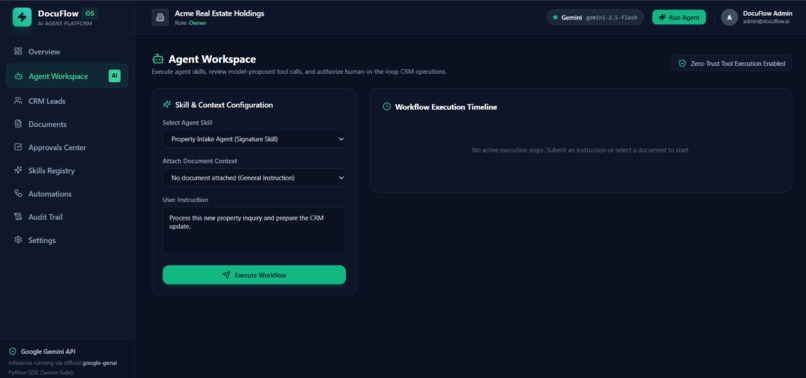
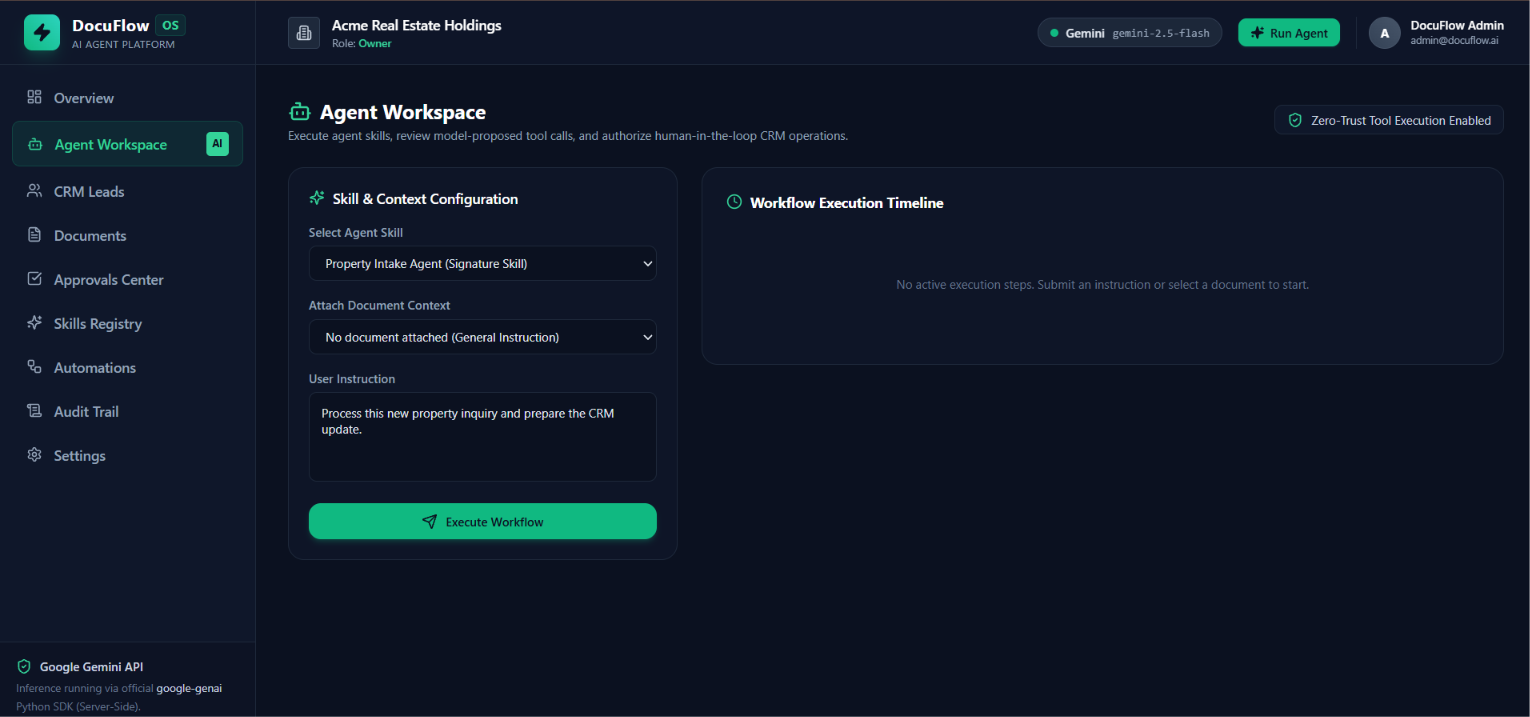
DocuFlow AI Agent OS dashboard showcasing intelligent document workflows, CRM automation, and AI-powered business operations.
Inspiration
Businesses handle large volumes of documents, customer inquiries, property details, and repetitive administrative tasks. Important information is often scattered across PDFs, forms, emails, and CRM systems, making business operations slow and error-prone.
We built DocuFlow AI Agent OS with a vision to transform business documents into meaningful, actionable workflows. Starting with real estate, we aim to help businesses move beyond manual data entry toward intelligent, secure, and human-supervised automation.
What it does
DocuFlow AI Agent OS is an AI-powered document intelligence and CRM automation platform. It is designed to extract information from business documents, organize customer inquiries, connect information with CRM records, and help agents propose or perform authorized actions.
Our initial use case is a Property Intake Agent, which supports:
- Document intake and information extraction.
- Structured data review with source evidence.
- CRM lead matching and organization.
- Suggested next actions and approval workflows.
- Permission-controlled execution and audit trails.
The platform is designed to support expansion into other business workflows and industries.
How we built it
We built the platform using Next.js for the frontend and FastAPI for the backend, with Google Gemini for AI inference through a server-side integration.
The system brings together document processing, structured information extraction, CRM workflows, agent orchestration, approval controls, and activity tracking. Our architecture emphasizes modularity, secure API integration, tenant isolation, and human oversight for consequential actions.
Challenges we faced
One of our biggest challenges was connecting AI-generated information with reliable business operations. Extracted data must be validated, uncertain information must be reviewable, and proposed actions must not be executed without appropriate permissions.
We also worked through frontend-backend integration, API configuration, dashboard metrics reliability, data consistency, and deployment considerations. Designing a clear distinction between real business records and synthetic demonstration data was another important part of building a trustworthy prototype.
What we learned
We learned that building useful AI agents requires much more than connecting an LLM to an interface. Reliable agents need structured tools, validation, permission checks, human approvals, persistence, error handling, and auditability.
This project strengthened our understanding of full-stack development, AI integration, workflow automation, and designing AI systems around real business needs.
What's next
Our next steps are to improve document processing accuracy, strengthen evaluation and monitoring, expand CRM integrations, improve workflow reliability, and bring more industry-specific agents into the platform.
DocuFlow AI Agent OS — From Business Documents to Business Actions.
Built With
- ai-agents
- crm
- fastapi
- google-gemini-api
- next.js
- ocr
- postgresql
- python
- react
- rest-api
- supabase
- tailwind-css
- typescript
- workflow


Log in or sign up for Devpost to join the conversation.