-
-
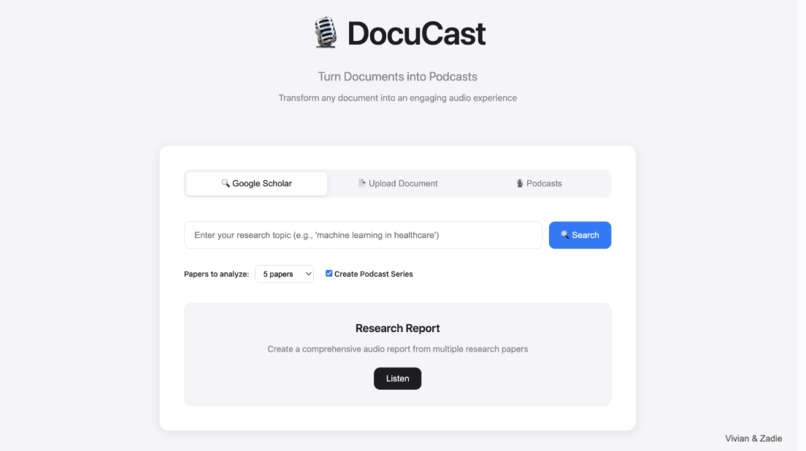
DocuCast homepage
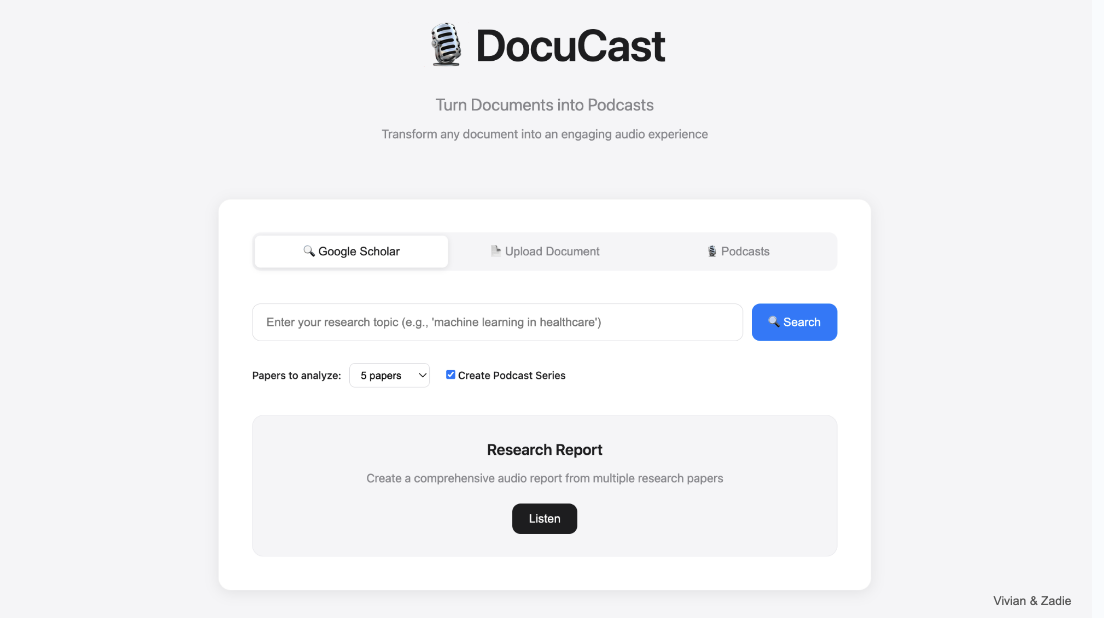
Inspiration
The inspiration came from a common frustration in academic research: the overwhelming volume of papers published daily makes it nearly impossible for researchers to stay current. While the problem statement focused on "security-first" research discovery, the real challenge was accessibility - transforming dense academic content into digestible, portable formats. The core insight: What if we could transform the tedious process of paper screening into a podcast-like experience?
What it does
SecureScholar automates the research consumption process through a complete pipeline: users can either search for academic papers on any topic or upload PDF documents directly. The system uses AI to generate structured 3-point summaries focusing on Method, Novelty, and Key Results, with importance scoring from 0-10. Each summary is converted to audio using text-to-speech technology, creating podcast-style content with professional intros and outros. The system serves these audio files through a web interface, transforming hours of paper reading into minutes of audio consumption.
How we built it
Backend: Node.js/Express server with comprehensive error handling and environment-based configuration AI Integration: OpenAI GPT-3.5-turbo for structured summarization Fallback to rule-based summaries when APIs unavailable Vector embedding preparation for future semantic search Audio Processing: Gladia TTS API integration with fallback to local audio generation WAV/MP3 file creation and static serving Podcast-style content structuring (intro/segments/outro)
Data Pipeline: PDF text extraction using pdf-parse Redis integration for caching and metadata storage File upload handling with validation
Challenges we ran into
Audio Format Compatibility: Initially generated MP3 files using dummy data that browsers couldn't decode, requiring a switch to properly formatted WAV files with valid audio headers. API Reliability: Multiple external services (OpenAI, Gladia TTS, Redis Cloud) failed intermittently, forcing us to implement comprehensive fallback systems for every API call.
Accomplishments that we're proud of
Complete End-to-End Pipeline: Successfully built a system that takes raw research queries and produces playable audio files through multiple AI processing steps. Structured Data Processing: Implemented consistent summarization format that extracts actionable insights from academic papers in a standardized Method/Novelty/Results structure. Production-Ready Error Handling: Built comprehensive error catching, logging, and graceful degradation throughout the entire pipeline. Modular Design: Created a maintainable codebase where each component (orchestration, summarization, audio generation) can be independently updated and tested
What we learned
API Integration Complexity: Integrating multiple AI services (OpenAI, Gladia TTS, Redis Cloud) taught us the critical importance of fallback systems. Real-world APIs fail, rate-limit, and change - robust applications must handle these gracefully. Audio Generation Pipeline: Converting text to audio involves more than just TTS - we learned about audio format compatibility, browser playback requirements, and the difference between generating files vs. creating playable content. Modular Architecture Benefits: Breaking the system into discrete services (orchestrator.js, summarizer.js, tts.js, etc.) made debugging and iteration much faster than a monolithic approach.
What's next for DocuCast
Enhanced Audio Experience: Implement voice variety, speed control, and professional audio editing to create truly engaging podcast content rather than basic TTS output.
Built With
- amazon-web-services
- apify
- brightdata
- express.js
- gladia
- horizon3.ai
- javascript
- node.js
- redis

Log in or sign up for Devpost to join the conversation.