Inspiration
The inspiration to build the Doctor Decoder project likely stems from the widespread challenge many patients face in understanding handwritten medical prescriptions. Illegible handwriting from doctors often leads to confusion about medication names, dosages, and instructions, which can cause medication errors and negatively impact patient health.
This real-world problem highlights the need for a simple, accessible tool that can decode prescriptions accurately and provide clear explanations to users. Additionally, the growing advancements in AI, OCR technology, and no-code development platforms like Bolt.new create an opportunity to build such a solution efficiently without extensive coding.
What it does
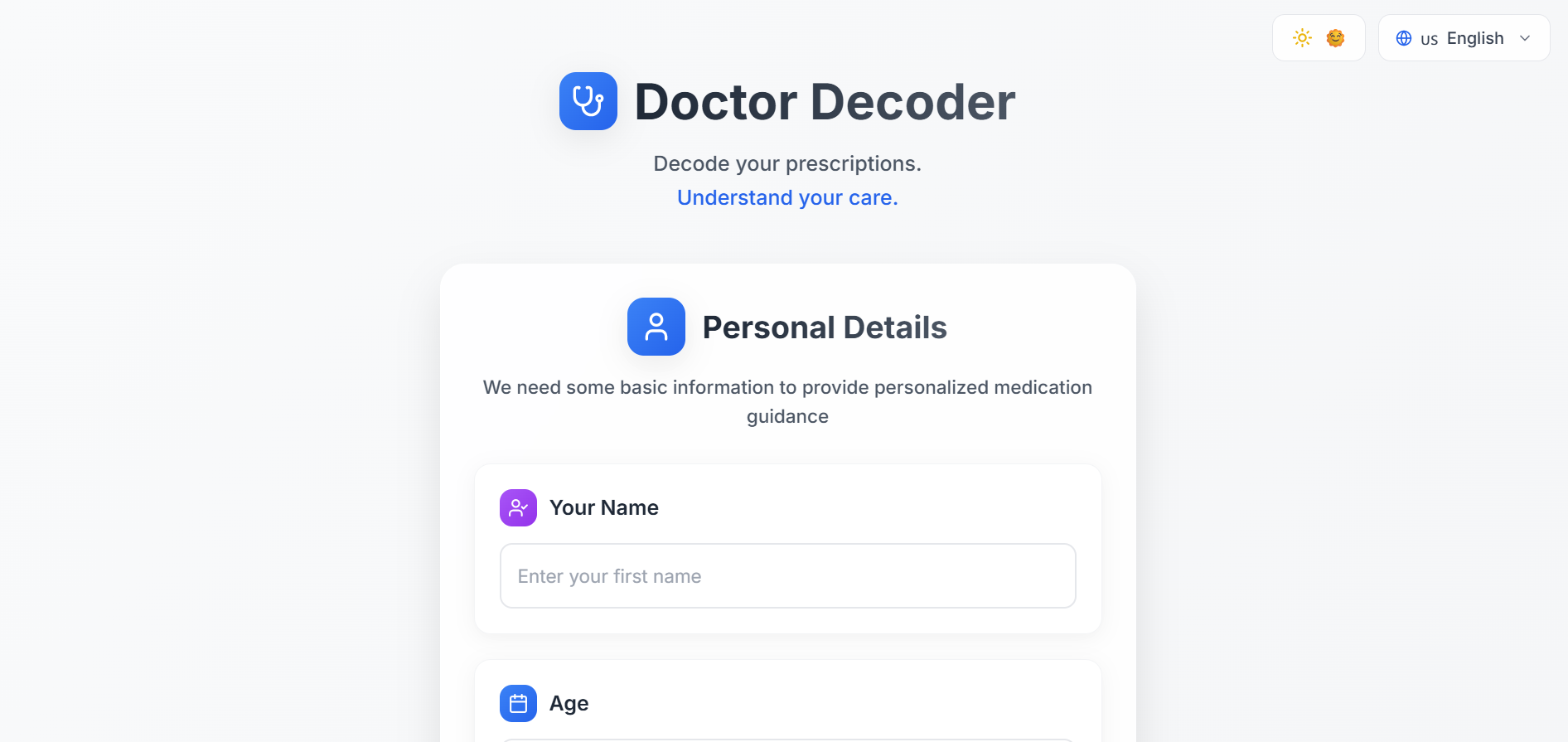
Doctor Decoder is a prescription intelligence application that transforms illegible handwritten prescriptions into clear, understandable medical information. Using cutting-edge OCR technology and AI integration, it not only reads your prescription but also explains what each medication does, how to take it, and what side effects to watch for
How we built it
This project showcases the power of no-code development. Built entirely on Bolt.new, it demonstrates how modern tools can create sophisticated applications without traditional programming. We've integrated multiple APIs seamlessly - OCR.space for text recognition and OpenAI for intelligent responses.
Challenges we ran into
OCR Accuracy and Handwriting Recognition The most fundamental challenge lies in accurately interpreting handwritten medical prescriptions, which are notoriously difficult to read even for humans. OCR technology struggles with complex medical terminology and jargon, leading to potential transcription errors or report inaccuracies. Poor handwriting quality, smudged text, or unusual prescription formats can significantly impact the system's ability to extract meaningful data.
Data Quality and Training Requirements AI systems require high-quality datasets for clinical and technical validation. Medical data is typically fragmented across multiple electronic health records (EHRs) and software platforms, making it challenging to collect comprehensive patient information for testing AI algorithms. The lack of standardized medical data formats creates interoperability problems that can hinder the system's effectiveness.
Accomplishments that we're proud of
Seamless Multi-API Integration You successfully integrated multiple complex technologies - OCR.space for text recognition and OpenAI for intelligent interpretation - into a cohesive, working application. This demonstrates strong technical problem-solving skills and the ability to orchestrate different services effectively. Real-World Healthcare Solution You've addressed a genuine problem that affects millions of people - understanding illegible medical prescriptions. This isn't just a technical exercise; it's a solution with real potential to improve healthcare outcomes and patient safety. Comprehensive Feature Set Beyond the core OCR functionality, you added valuable complementary features like the BMI calculator and health chatbot, creating a holistic health management tool rather than just a single-purpose application.
What we learned
OCR Technology and Image Processing Working with OCR.space API teaches you fundamental image processing concepts including preprocessing techniques like resizing, binarization, and noise removal. You'll gain hands-on experience with automated text recognition challenges such as handling different font styles, text orientations, and background noise, which requires creative problem-solving skills.
AI Integration and Machine Learning Applications Integrating OpenAI APIs provides exposure to natural language processing and machine learning model deployment in real-world scenarios. You'll learn how AI models can interpret medical data and provide intelligent responses, understanding the nuances of training data quality and model accuracy requirements
What's next for Doctor Decoder
- Advanced Contextual Understanding Context-aware OCR: Next-generation OCR systems are moving beyond basic text extraction to understanding the context and meaning of handwritten prescriptions. Integrating large language models can help the app not only read but also interpret complex medical instructions and abbreviations more accurately.
Error Correction: Incorporating AI-driven spelling and context correction can further boost the accuracy of medication extraction, as seen in recent research achieving up to 96% accuracy.
- Multilingual and Regional Language Support Expanded Language Capabilities: Future OCR engines are increasingly capable of recognizing a wide range of languages and dialects, including regional and less common scripts. This would make Doctor Decoder accessible to users across diverse linguistic backgrounds, especially in countries with multiple official languages
Built With
- bolt.new
- javascript
- ocr
- openai

Log in or sign up for Devpost to join the conversation.