Doctor AI – An AI-Powered Personal Health Conversation Assistant
Inspiration
The idea for Doctor AI came from a simple observation: many people want to better understand their health and lifestyle habits, but traditional health assessments often feel overwhelming, repetitive, and impersonal. Most existing solutions rely on long questionnaires that do not adapt to the individual.
I wanted to create a more natural experience where people could simply have a conversation about their health. The goal was not to replace medical professionals, but to build an intelligent companion that encourages users to reflect on areas such as sleep, nutrition, exercise, stress, and overall wellbeing.
What I Built
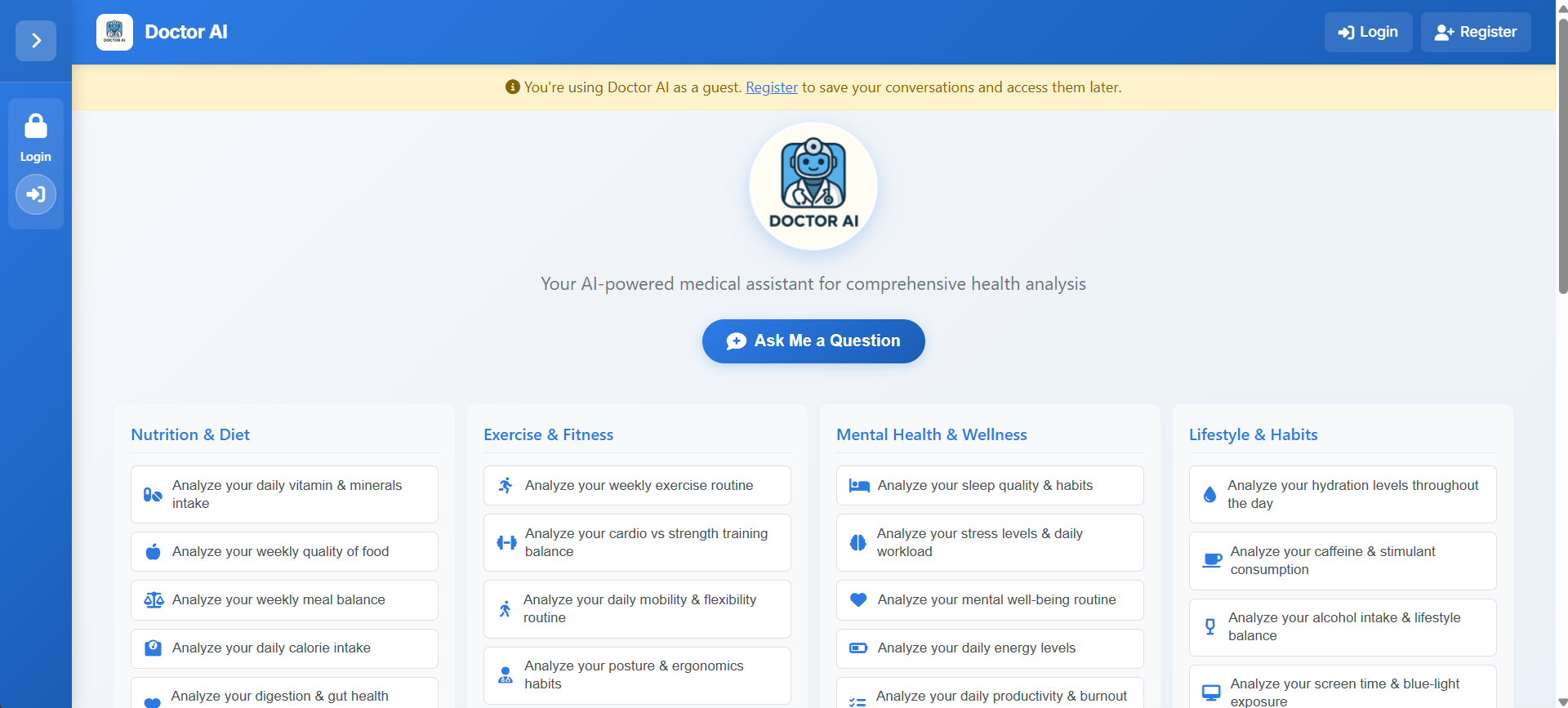
Doctor AI is a web-based AI health assistant that provides personalized conversations and health analyses.
Users can create an account, access a personal dashboard, choose different health analysis categories, and start an interactive conversation with the AI. The assistant asks follow-up questions based on the user's responses, creating a more personalized experience than a traditional static form.
The platform includes:
- User registration and authentication
- Personalized AI health conversations
- Multiple health analysis categories
- Conversation history and session management
- A personal dashboard with previous analyses
- Real-time AI responses powered by Google Gemini
- User interaction insights through Novus AI
How I Built It
Doctor AI was built as a full-stack web application using:
- Backend: Python and Django
- Frontend: HTML, CSS, JavaScript, and Django Templates
- AI Model: Google Gemini API
- Database: SQLite during development with production-ready deployment preparation
- Analytics: Novus AI (Pendo) for understanding user behavior and product insights
- Version Control: Git and GitHub
- Deployment: Railway
The biggest focus during development was creating a smooth conversational experience. I implemented a system for handling chat sessions, storing conversation history, and maintaining context between messages so users can return to previous discussions and continue where they left off.
Challenges I Faced
One of the biggest challenges was designing the conversation flow and making AI interactions feel natural. Unlike a standard chatbot, Doctor AI needed to remember previous messages, understand the context of different health topics, and provide relevant follow-up questions.
Another major challenge was managing user sessions and chat history. I had to build a reliable system that handled both authenticated users with persistent database storage and guest users with temporary sessions.
Integrating third-party services also provided valuable learning experiences. Setting up the Google Gemini API, handling API limits and billing, and integrating Novus AI analytics required troubleshooting and multiple iterations.
Finally, preparing the application for production involved learning about environment variables, security practices, version control workflows, and deploying a full-stack Django application to the cloud.
What I Learned
Building Doctor AI taught me that shipping a product is much more than writing code. It involves understanding the user problem, designing intuitive experiences, integrating multiple technologies, testing with real users, and continuously improving based on feedback.
I learned how to build and deploy a complete AI-powered product from the ground up, including backend development, frontend design, AI integration, authentication systems, analytics, and cloud deployment.
One of the most valuable lessons was seeing how quickly an idea can evolve into a real product when combining modern AI tools with traditional software engineering.
Future Vision
Doctor AI is just the beginning. In the future, I would like to expand the platform with more advanced health insights, improved personalization, long-term habit tracking, and richer analytics to better understand how users interact with the product.
The long-term vision is to make health reflection more accessible, conversational, and personalized for everyone.
Built With
- css3
- django
- djangotemplates
- github
- google-gemini-api
- google-generative-ai-sdk
- html5
- javascript
- json
- novusai
- postgresql
- python
- railway
- rest-apis

Log in or sign up for Devpost to join the conversation.