-
-
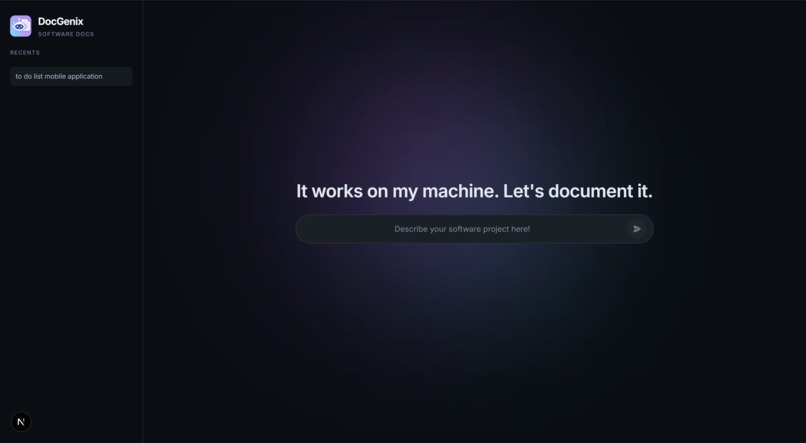
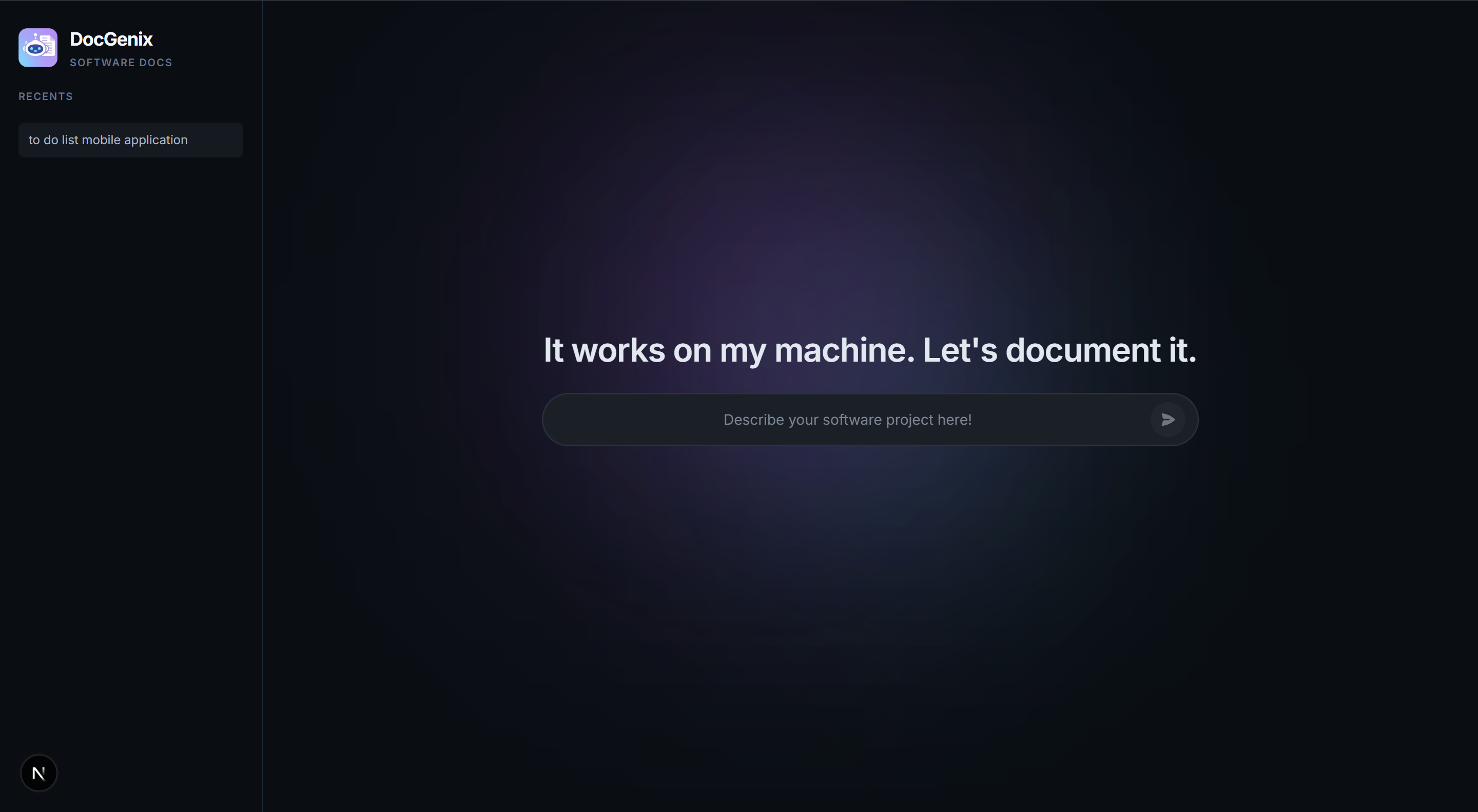
DocGenix Landing Page
-
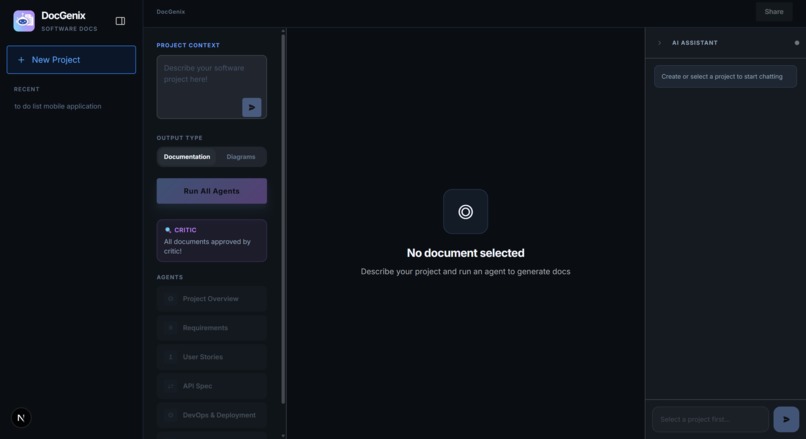
Project Context, Agents, etc
-
Inspiration
Building software projects often starts with a blank page. There's no structure, no direction, and hours lost just figuring out what to document. We wanted to eliminate that friction by creating a tool that takes a raw idea and instantly scaffolds everything a team needs to start building with confidence.
What it does
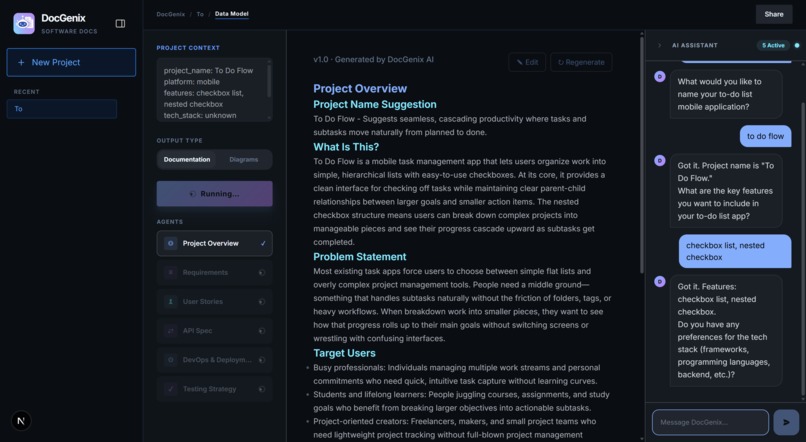
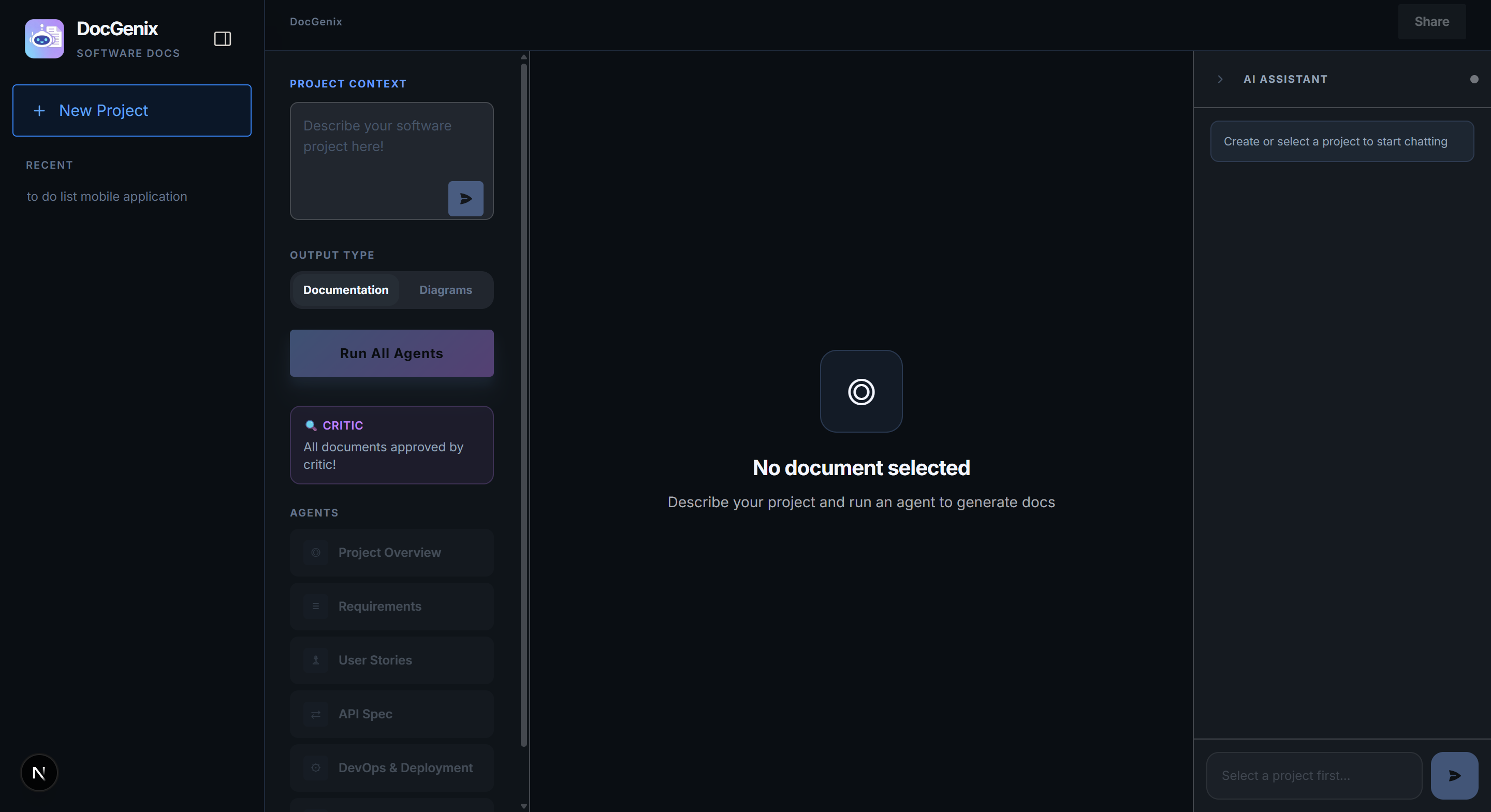
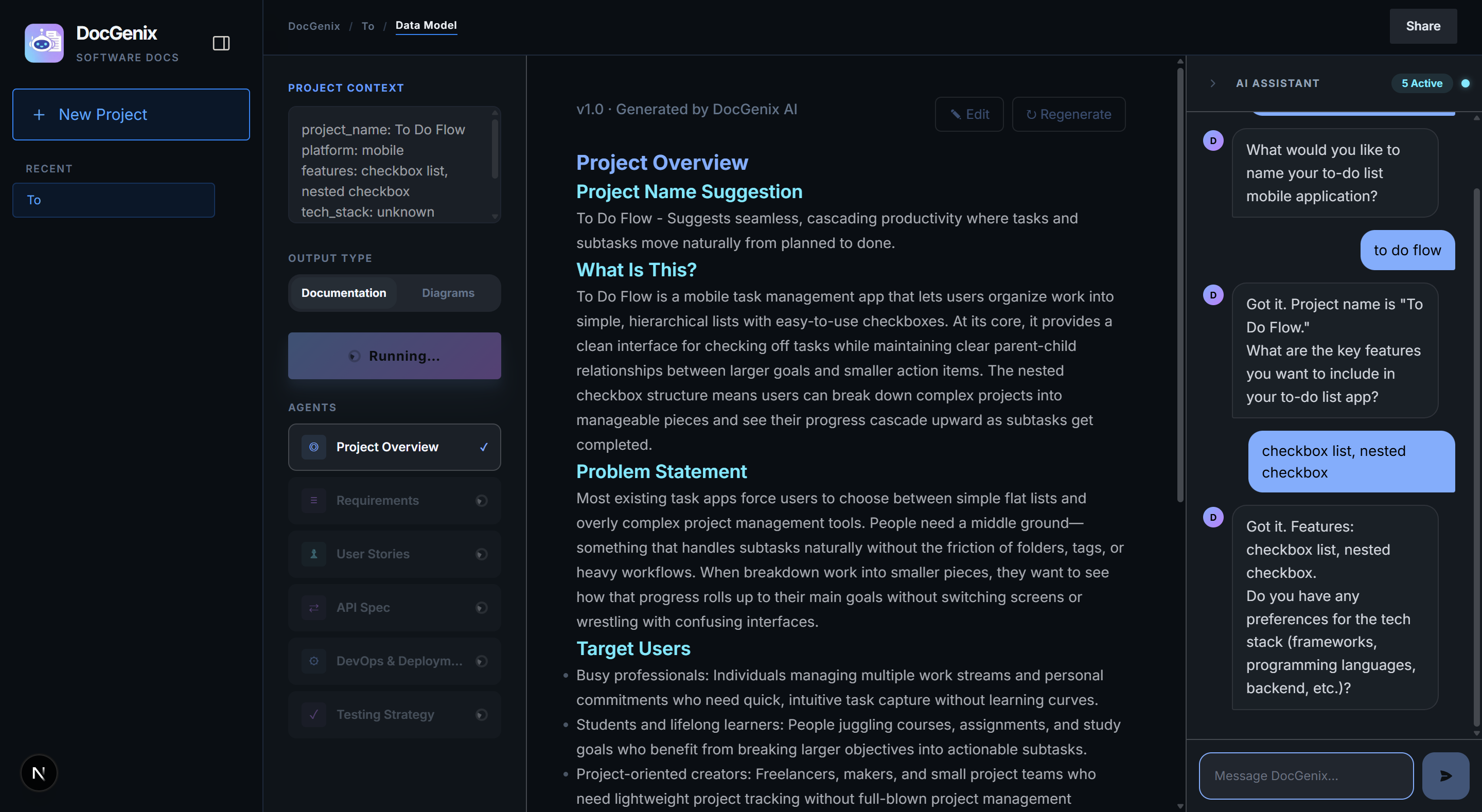
DocGenix inquiries you about your project idea through a conversational AI agent, then launches 8 specialist agents in parallel to generate a complete documentation suite: project overview, requirements, user stories, system architecture, API spec, data model, DevOps pipeline, and testing strategy. A critic agent reviews every document and refines them before you see the results. You can also generate React + Tailwind UI starter components, view interactive 3D architecture and ER diagrams, edit documents inline, and export everything as a ZIP.
How we built it
The backend is a Python FastAPI server orchestrating LangGraph ReAct agents powered by the ASI:One API, with results streamed to the frontend via Server-Sent Events. The frontend is built in Next.js 16 with React 19, using react-force-graph-3d for the 3D architecture diagram and ReactFlow for the ER diagram. UI generation uses Google Gemini via a custom stitch tool. Agent coordination is handled through Fetch.ai Agentverse, and all project data is persisted in SQLite.
Challenges we ran into
Coordinating 8 parallel agents and ensuring the critic loop produced consistent, high-quality revisions without runaway re-generation cycles was tricky. Parsing the architecture and data model outputs into clean node/edge JSON for the live diagrams, without extra LLM calls, required careful prompt engineering. Streaming partial results over SSE while maintaining a responsive UI added another layer of complexity.
Accomplishments that we're proud of
We built a full multi-agent pipeline with a critic review loop in a hackathon timeframe. The live 3D force graph and ReactFlow ER diagram rendering directly from agent output (with no manual parsing step) is something we're especially proud of. The end-to-end flow from idea to downloadable ZIP of production-ready docs genuinely works.
What we learned
Designing multi-agent systems requires thinking carefully about failure modes; what happens when one agent stalls, produces malformed output, or the critic loop disagrees. We also learned a lot about prompt design for structured document generation, and how much the quality of the interview step upstream shapes everything downstream.
What's next for DocsGenix
We'd like to add support for more LLM backends, richer diagram types (sequence diagrams, deployment diagrams), GitHub integration to commit generated docs directly to a repo, and a collaborative mode so teams can work on the same project simultaneously. Long-term, we want DocGenix to stay in sync with a codebase as it evolves, not just generate docs once, but keep them current.
Built With
- css
- fastapi
- next.js
- python
- react
- tailwind
- typescript
- uvicorn

Log in or sign up for Devpost to join the conversation.