-
-
DocRoute AI — AI-Powered Document Intelligence for Vietnamese Government Agencies
Inspiration
Public sector organizations across Vietnam and Southeast Asia still rely heavily on manual, multi-step workflows to classify, route, review, and respond to administrative documents. This process averages 5-7 days per document, with limited visibility into document status and inefficient coordination across departments. Documents pass through 6 manual steps — intake, registration, distribution, review, consultation, and response — creating bottlenecks, misrouting risks, and duplicated effort.
We asked ourselves: How might we leverage AI to transform this broken workflow while respecting strict security and confidentiality requirements across 4 classification levels (Unclassified → Top Secret)?
What it does
DocRoute AI is an AI-powered document intelligence platform that automates the entire 6-step administrative document workflow:
- Automated Ingestion: Processes both physical (scanned) and digital documents using OCR and intelligent parsing
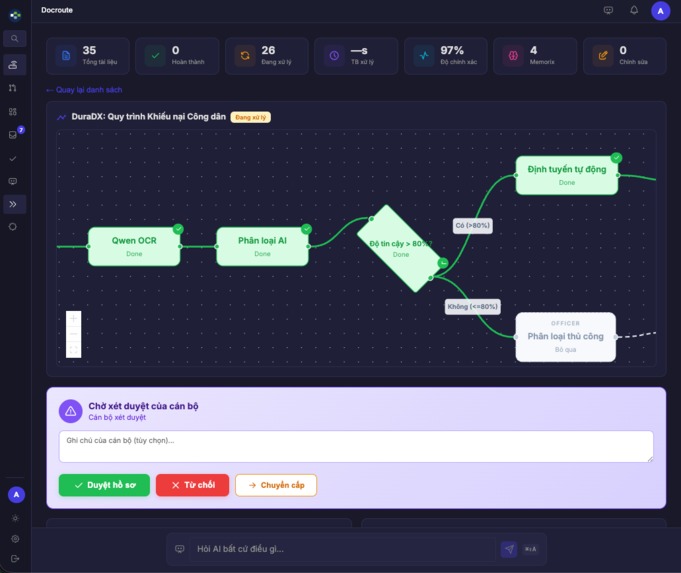
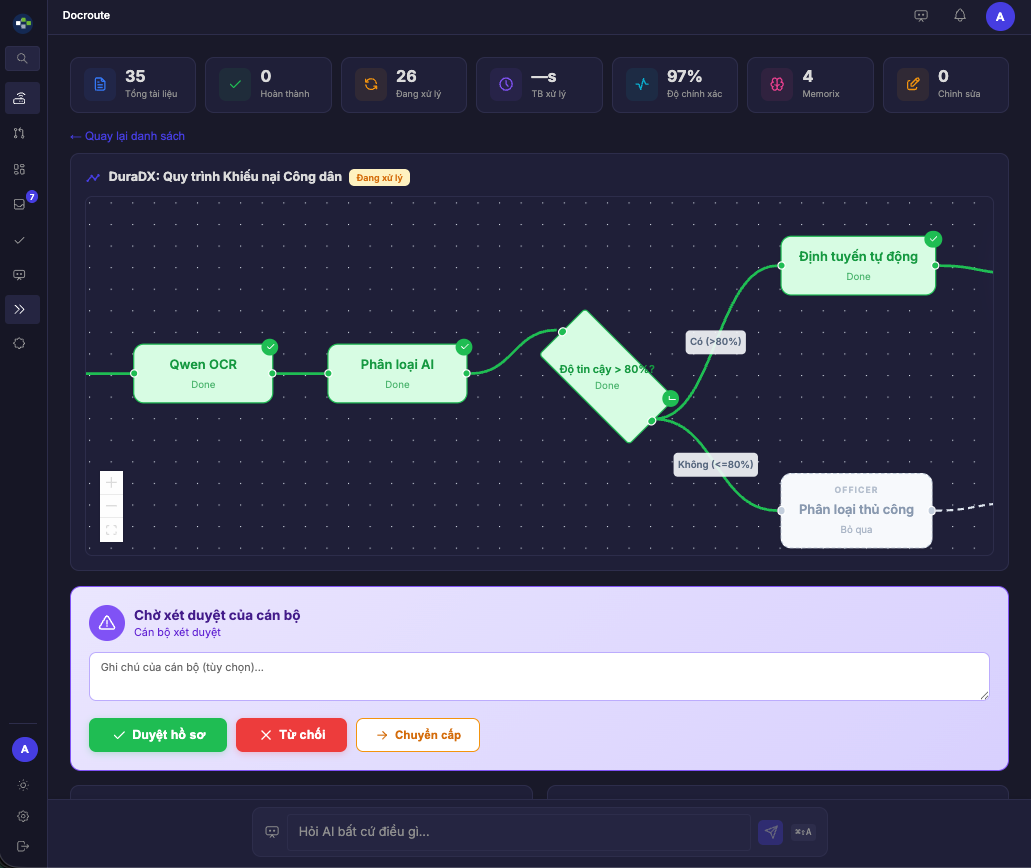
- Intelligent Classification: Qwen AI automatically detects document type, subject matter, and security classification level
- Smart Routing: AI-driven department identification and automatic routing to the correct processing unit
- AI Summarization: Extracts key information, generates concise summaries, and identifies action items
- Cross-Department Collaboration: Structured workflow enabling parallel review instead of sequential processing
- Real-time Tracking: Full lifecycle visibility with status dashboards and audit logging
- Multi-level Security: Role-based access control across Unclassified, Confidential, Secret, and Top Secret levels
How we built it
We built DocRoute AI on a production-grade BPM (Business Process Management) platform enhanced with Qwen AI at its core:
- Qwen AI Integration: Used Qwen models for document classification, Vietnamese language NLP, summarization, and entity extraction
- OCR Pipeline: Integrated OCR for processing scanned physical documents with varying quality levels
- Workflow Engine: Built automated routing rules that map document types to departments based on AI classification output
- Security Layer: Implemented role-based access control with 4 classification levels and comprehensive audit logging
- Dashboard: Real-time tracking interface showing document lifecycle status across all departments
Challenges we ran into
- Handling variable quality scanned documents required robust pre-processing before OCR and AI analysis
- Vietnamese language document processing required careful prompt engineering with Qwen to handle administrative terminology
- Balancing automation speed with security constraints — ensuring classified documents never bypass access controls
- Designing a system that works in hybrid paper-digital environments where document ID numbers are not fully standardized
- Cross-department workflow coordination with multiple disconnected legacy storage systems
Accomplishments that we're proud of
- Reduced document processing time from 5-7 days to minutes for standard documents
- Built a working prototype that handles all 6 steps of the administrative workflow automatically
- Achieved accurate Vietnamese language document classification and summarization using Qwen AI
- Implemented proper multi-level security with audit trails suitable for government use
- Created a system that bridges the gap between physical and digital document workflows
What we learned
- Qwen AI excels at multilingual document understanding, especially with Vietnamese administrative text
- Government document workflows have universal pain points that are highly automatable with the right AI approach
- Security and accessibility must be designed in from day one, not bolted on later
- The biggest efficiency gains come from eliminating duplicated cross-department review, not just speeding up individual steps
What's next for DocRoute AI
- Pilot deployment with Vietnamese government agencies for real-world validation
- Expand language support for other Southeast Asian administrative contexts
- Add predictive analytics for document processing time estimation and workload balancing
- Integrate with existing government e-document systems and digital signature platforms
- Scale the platform to handle higher document volumes with enterprise-grade infrastructure

Log in or sign up for Devpost to join the conversation.