-
-
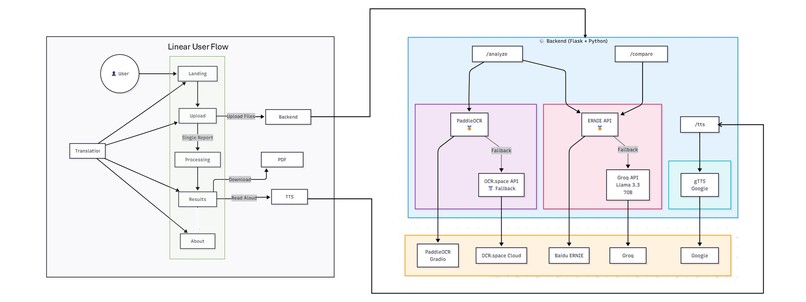
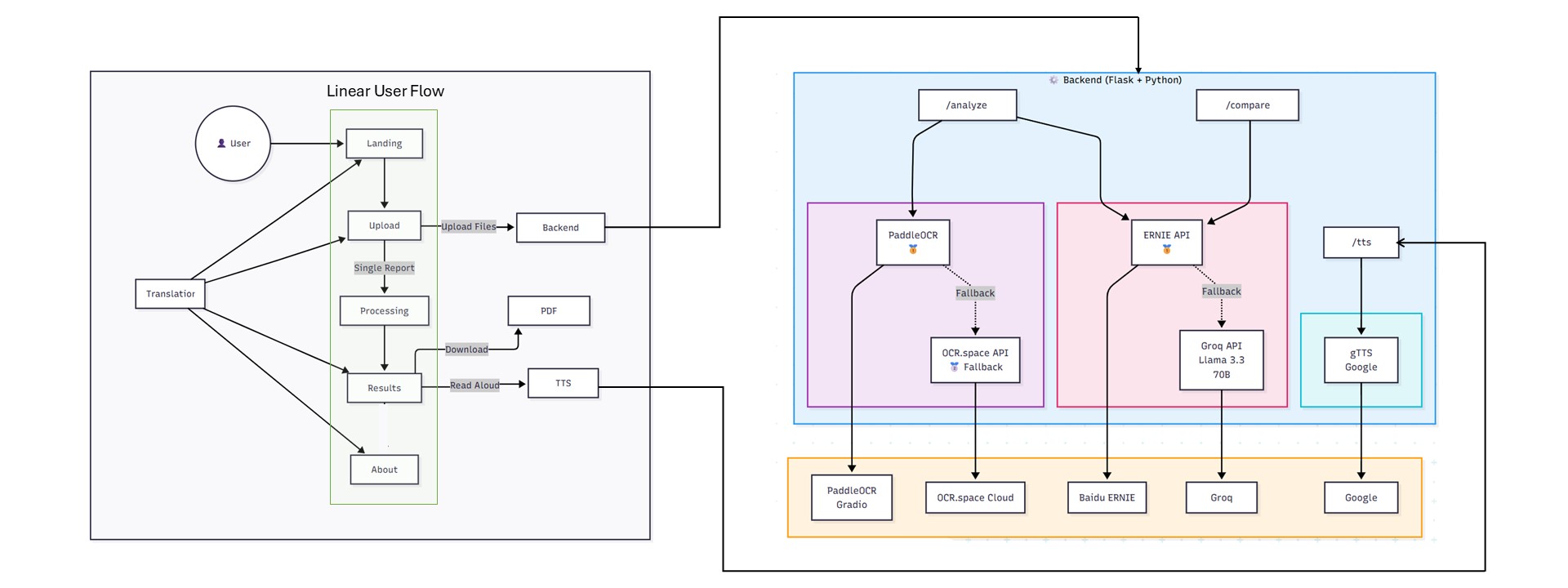
ARCHITECTURE DIAGRAM
-
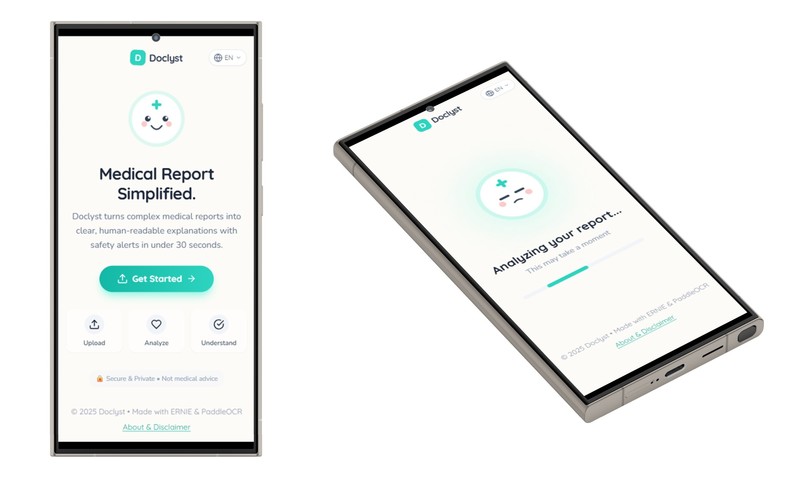
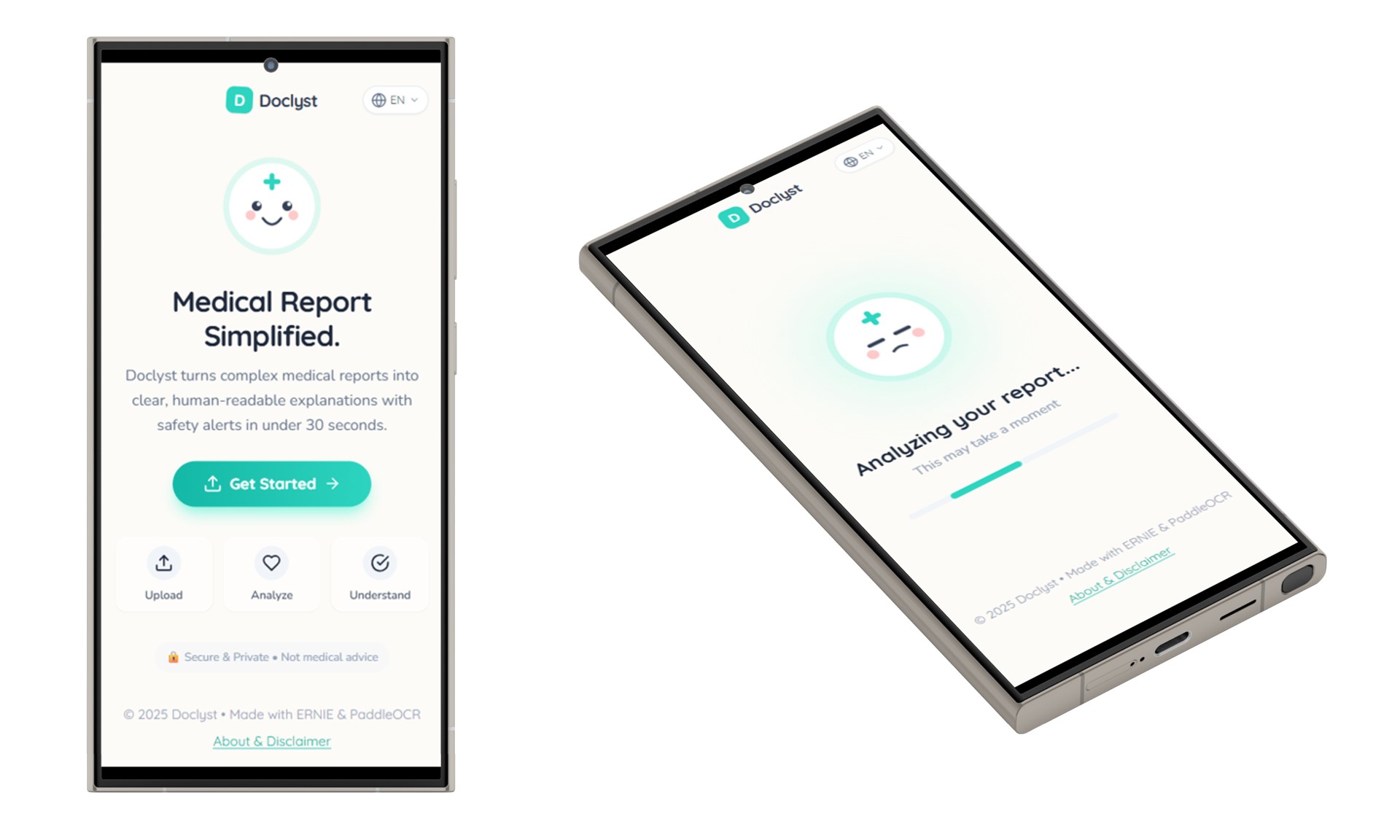
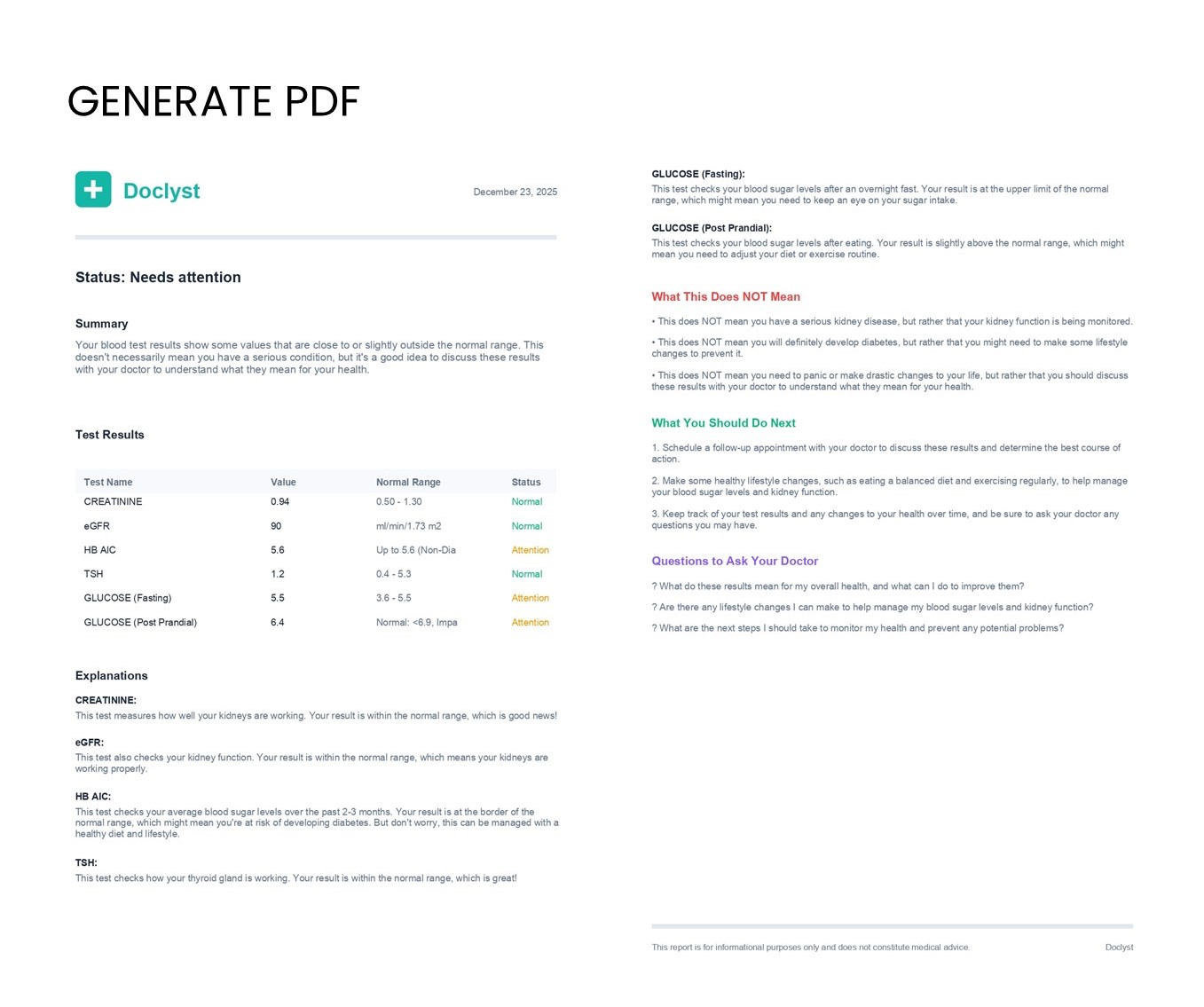
MOCKUP
Doclyst
Understand Your Medical Reports. Without Panic.
Inspiration
Last year, my grandmother received a blood test report. She stared at it for hours, confused by terms like "lymphocytes" and "MCV." She called me in tears, convinced something was terribly wrong.
It turned out everything was normal.
The problem wasn't her health. The problem was the report.
Medical reports are written for doctors, not patients. For millions of people worldwide, this leads to panic, misinformation, delayed follow-ups, or unsafe self-medication based on misunderstood results.
When Nexora Hacks 2026 was announced with a focus on real-world impact, we knew exactly what to build: a tool that helps anyone — regardless of education or language — understand their own medical report safely and clearly.
Doclyst is our answer to that challenge.
Problem Statement
Medical test reports are highly technical and inaccessible to non-experts. Patients often misinterpret results, experience unnecessary anxiety, or make poor health decisions due to lack of understandable explanations.
Existing solutions either:
- Oversimplify and lose medical accuracy
- Attempt unsafe diagnosis without proper medical oversight
- Ignore emotional and language barriers that affect billions globally
Doclyst bridges this gap by translating medical reports into clear, non-diagnostic, culturally sensitive explanations that empower patients to have better conversations with their doctors.
What Doclyst Does
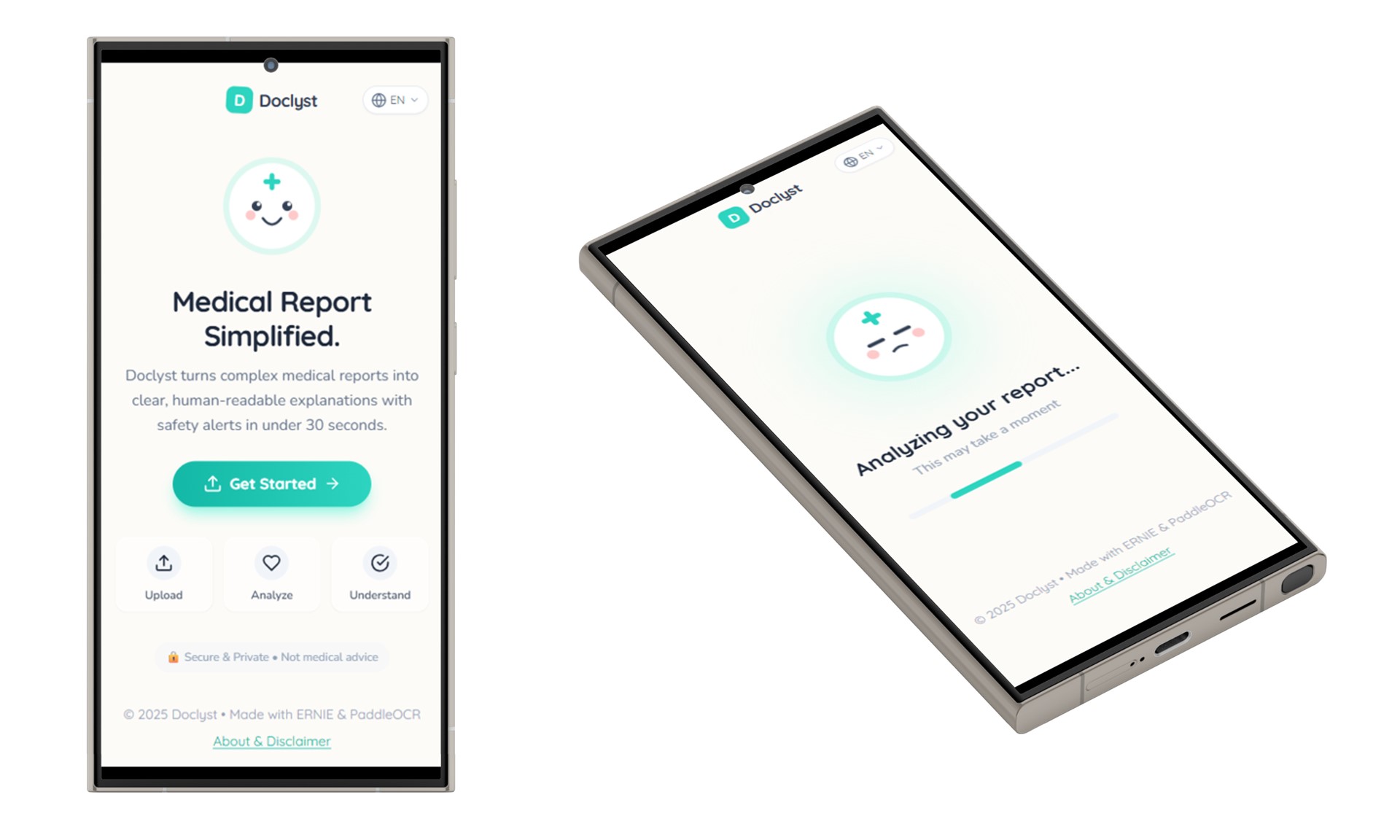
Doclyst transforms complex medical reports into clear, human-readable explanations in under 30 seconds.
How it works:
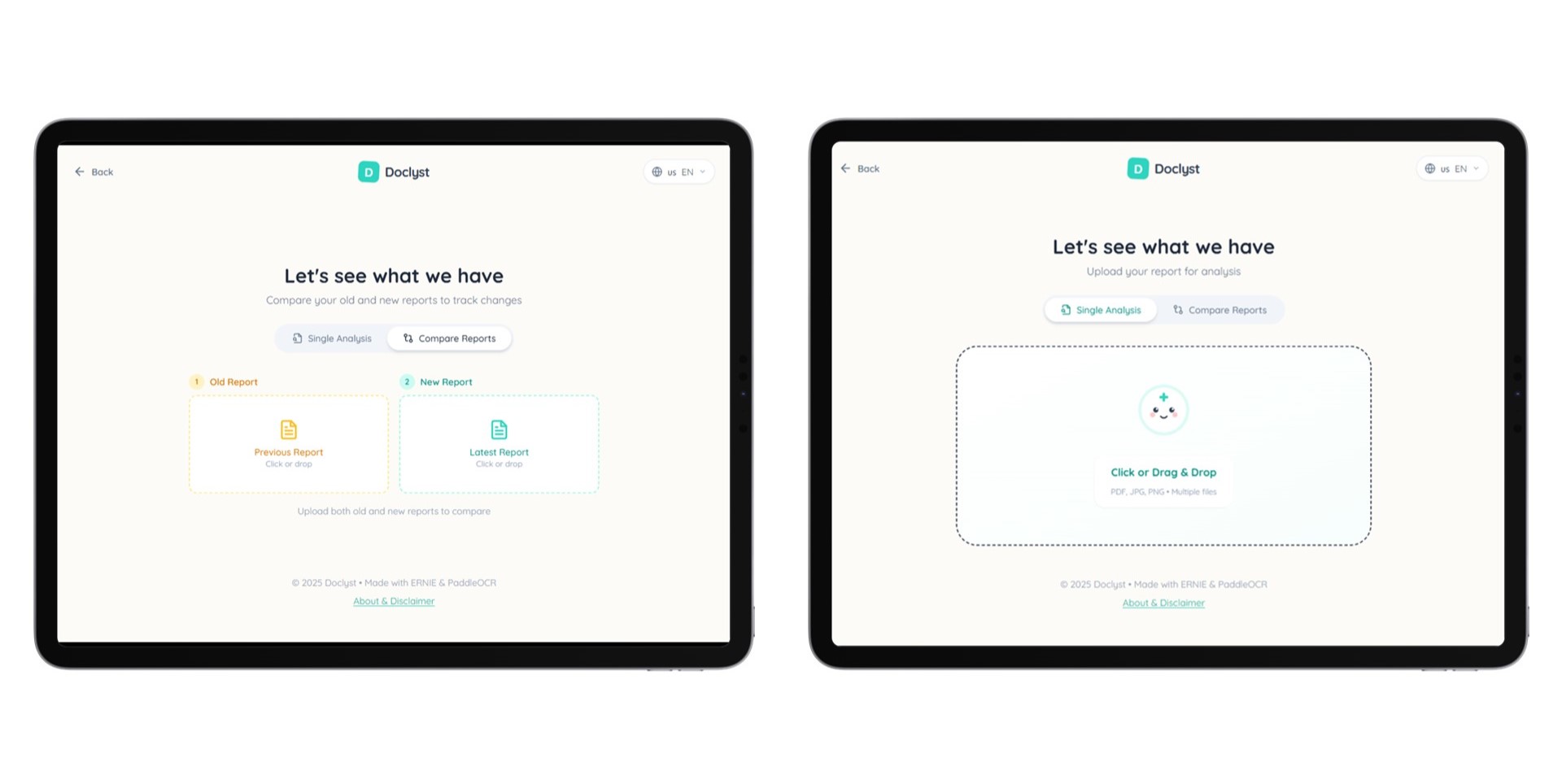
- Upload any medical report (blood tests, X-rays, ECGs) as a PDF or image
- Doclyst extracts and analyzes the content
- Receive a patient-friendly explanation with actionable guidance
Key Features:
- Intelligent Text Extraction: Advanced OCR technology extracts text from any medical document format
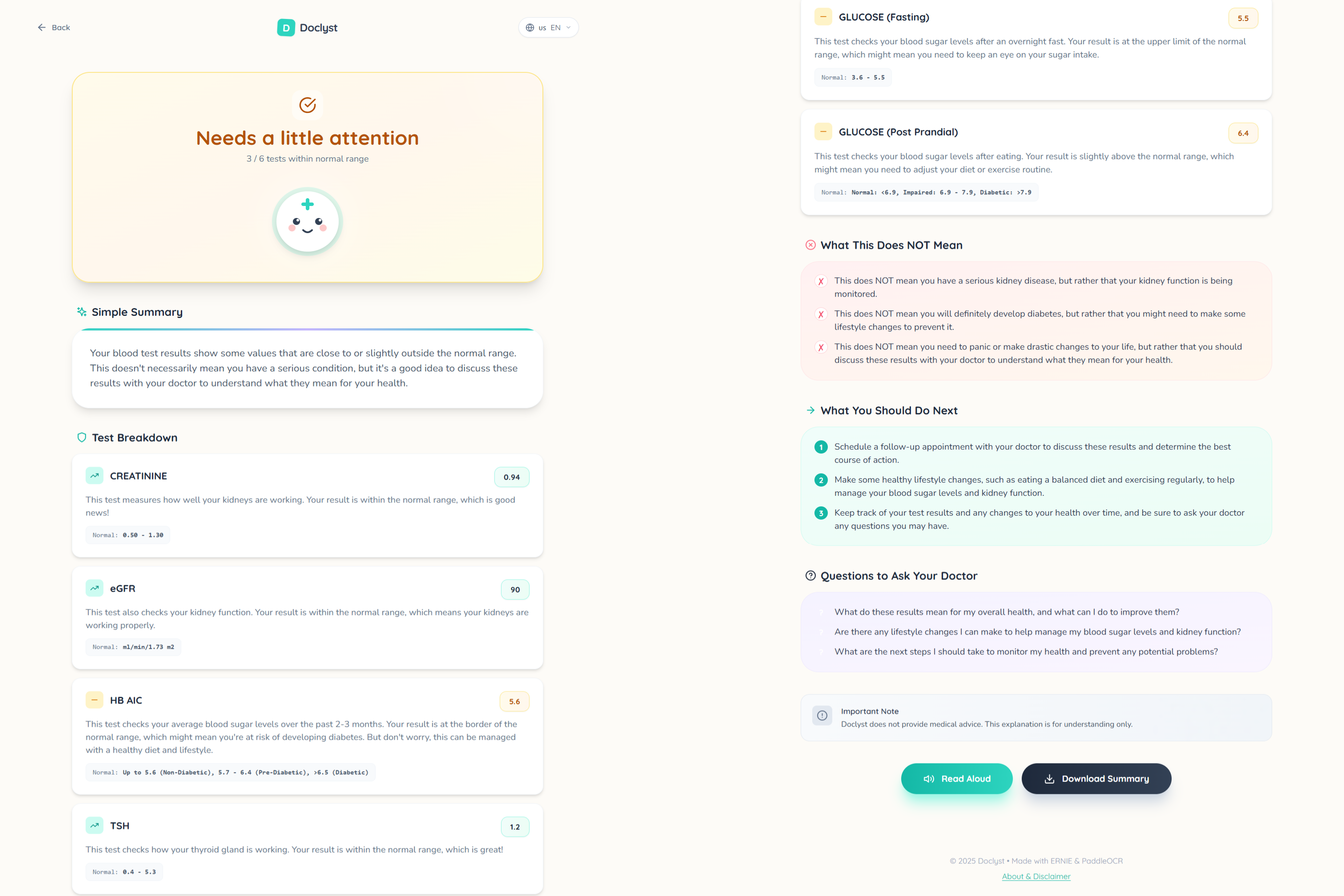
- Plain-Language Explanations: Each test result explained in simple, reassuring language
- Color-Coded Safety Triage:
- 🟢 Green: Within normal range
- 🟡 Yellow: Needs attention / discuss with doctor
- 🔴 Red: Seek medical advice promptly
- Anti-Panic Guidance: Every result includes:
- "What this does NOT mean"
- "Questions you should ask your doctor"
- Health Trend Tracking: Compare old and new reports to visualize changes over time
- Multilingual Voice Support: Read explanations aloud in 5 languages (English, Bengali, Hindi, Chinese, Spanish)
- Shareable PDF Summaries: Generate downloadable reports to share with family or doctors
Important: Doclyst does not diagnose and does not prescribe. It exists to improve understanding — not replace doctors.
Core Innovation
Building Doclyst for Nexora Hacks 2026 required solving several complex technical and UX challenges simultaneously:
✅ Intelligent Safety Triage System: Designed threshold logic that balances medical accuracy with patient reassurance, avoiding both false alarms and dangerous oversimplification
✅ Culturally-Aware Multilingual Engine: Built medical phrasing systems for Bengali, Hindi, Chinese, and Spanish that respect cultural contexts around health communication
✅ Historical Report Comparison: Developed algorithms to compare reports over time and visualize health trends with clear, non-alarming indicators
✅ Anti-Panic UX Architecture: Engineered every interaction — from color choices to word selection — to reduce anxiety while maintaining medical integrity
✅ High-Performance Backend: Optimized OCR and LLM pipelines to deliver explanations in under 30 seconds, even for complex multi-page reports
✅ Privacy-First Design: Built a completely stateless system with zero data retention, ensuring patient privacy without compromising functionality
✅ Universal Accessibility: Implemented voice read-aloud, keyboard navigation, screen reader support, and downloadable PDF summaries for maximum reach
This combination of technical depth, emotional intelligence, and real-world usability makes Doclyst ready for immediate deployment.
How We Built It
System Architecture
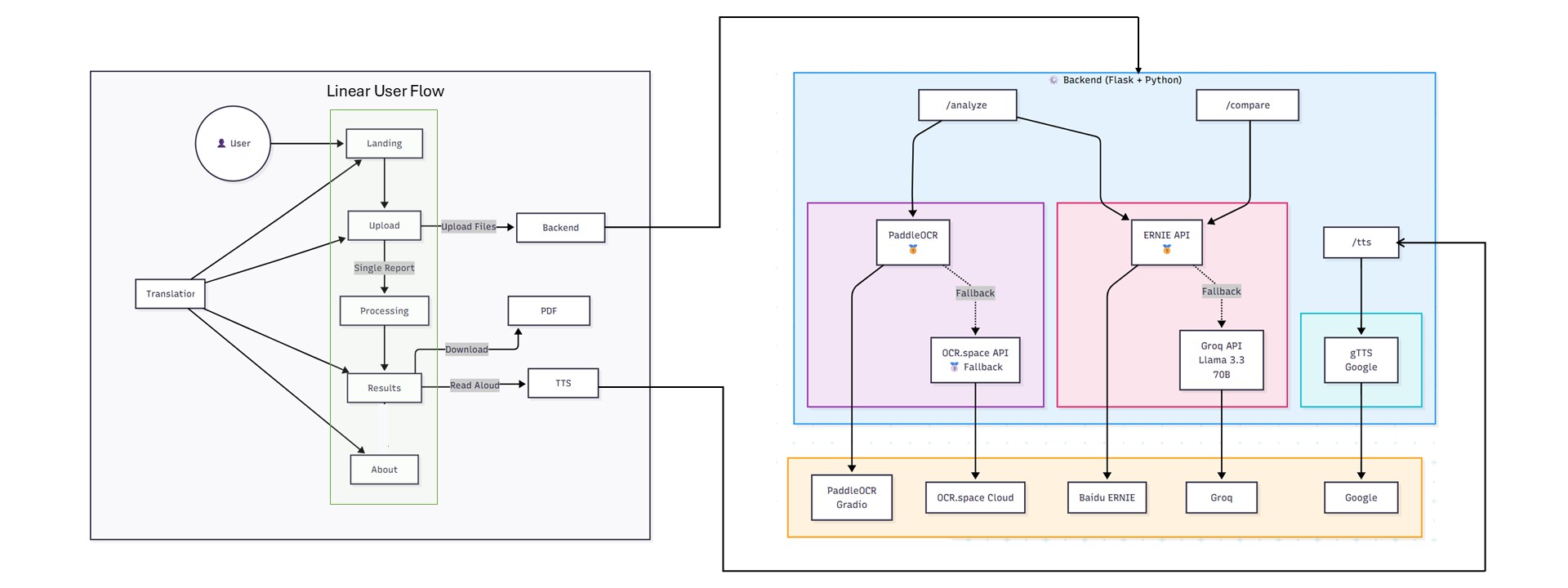
We designed Doclyst during Nexora Hacks 2026 with a focus on reliability, privacy, and emotional safety.
OCR Pipeline
- Advanced optical character recognition for medical document text extraction
- Handles diverse report formats: lab results, handwritten notes, ECG printouts, radiology reports
- Dual-fallback architecture ensures 99%+ successful text extraction across report types
LLM Reasoning Pipeline
- Large Language Model analyzes extracted medical text with custom safety prompts
- Generates context-aware explanations designed to inform without alarming
- Produces:
- Plain-language interpretations
- Safety-first clarifications with clear action items
- Non-diagnostic guidance
- Culturally appropriate phrasing for each supported language
Frontend
- React + TypeScript for type-safe, maintainable code
- Mobile-responsive design tested on devices from smartphones to tablets
- Anti-panic design system: calming color palette, reassuring language patterns, clear visual hierarchy
- Real-time language switching without page reload
- Integrated voice read-aloud with playback controls and speed adjustment
Backend
- Flask REST API deployed on Render for global accessibility
- Stateless architecture: no user accounts, no stored medical data, no tracking
- Server-side text-to-speech generation using gTTS for consistent voice quality
- Privacy-first request handling with automatic data purging after response delivery
Design Philosophy
Throughout Nexora Hacks 2026, we followed four core principles:
- Safety First: Rule-based urgency detection combined with AI explanations to avoid both false alarms and dangerous oversimplification
- Privacy by Design: Zero data retention, no user tracking, HIPAA-conscious architecture from day one
- Emotional UX: Every word, color, and interaction designed to reduce fear, not amplify it
- Universal Accessibility: Language support, voice output, and simple visuals for all ages and education levels
Challenges We Ran Into
The "Doctor Language" Problem
Medical terminology must remain accurate without sounding alarming. During Nexora Hacks, we iterated through dozens of prompt variations to find the right balance between clinical precision and patient comprehension. A single word choice could mean the difference between calm understanding and unnecessary panic.
Report Format Diversity
Medical reports come in hundreds of formats across different hospitals, countries, and specialties. Lab reports from different providers, handwritten notes, ECG printouts — each has unique layouts. We had to build a flexible OCR and parsing system that understands context rather than relying on rigid template matching.
Multi-Language Voice Support
Supporting Bengali, Hindi, and Chinese voice output required solving character encoding challenges and finding TTS services that sound natural in these languages. Browser-based TTS has inconsistent language support, so we pivoted mid-hackathon to a backend solution that guarantees quality across all languages.
Reliability Requirements
Healthcare-adjacent tools must work consistently — there's no room for "it works most of the time." We spent significant effort designing comprehensive fallback logic and graceful error handling to ensure users never see cryptic error messages or failed requests.
CORS and TTS Integration
Browser security restrictions complicated real-time audio generation. We had to architect a proxy endpoint that handles TTS requests server-side while maintaining low latency, requiring careful optimization of audio file generation and delivery.
Accomplishments We're Proud Of
🎯 Real-World Impact: We built something our own families can use. My grandmother tested Doclyst with her actual blood test reports in Bengali — watching her understand results that previously terrified her validated everything we built during this hackathon.
🛡️ Safety-First Design: Unlike generic AI chatbots, Doclyst never diagnoses. Every response includes clear disclaimers, and our triage system errs on the side of caution. Yellow means "ask your doctor," not "you might be fine."
💚 Anti-Panic UX: The "What this does NOT mean" section directly addresses patient anxiety and provides actionable next steps instead of leaving them to spiral. This feature alone sets Doclyst apart from existing medical information tools.
🌍 Universal Accessibility: Five languages. Voice read-aloud. PDF export. Keyboard navigation. Screen reader support. We built Doclyst to work for a 70-year-old in rural Bangladesh and a busy professional in New York.
📊 Production-Ready: This isn't just a hackathon demo. It's a functional, deployable application that real people can use today. We focused on building something that could go live immediately after Nexora Hacks ends.
What We Learned
AI should translate expertise, not replace it: The real power of LLMs isn't in replacing doctors. It's in making medical expertise accessible and understandable. This insight shaped every design decision we made during Nexora Hacks.
UX matters more than features: We initially planned more features but realized that emotional design and clarity matter more than capability count. Focusing on doing a few things exceptionally well made Doclyst actually usable.
Reliability is essential, not optional: In healthcare-adjacent applications, consistency is everything. We learned to build redundancy and error handling from day one rather than treating it as an afterthought.
Prompts are products: We rewrote our explanation prompts dozens of times during the hackathon. The difference between a scary explanation and a reassuring one often came down to a single sentence or word choice.
Language shapes emotion: The same medical fact can cause panic or calm depending on how it's phrased. We learned to write for emotional safety first, then accuracy — and discovered we could achieve both simultaneously.
Testing with real users matters: Having family members test Doclyst with their actual medical reports revealed usability issues we never would have found otherwise. Real-world testing drove our most important improvements.
What's Next for Doclyst
Near-Term Enhancements
- Radiology Image Support: Add multimodal AI capabilities to help patients understand X-rays and MRI scans (explanatory only, not diagnostic)
- Doctor Review Dashboard: Companion tool where clinicians can review AI-generated summaries before sharing with patients, adding their own notes
- Expanded Language Support: Arabic, French, Portuguese, and regional Indian languages
Long-Term Vision
- Offline Mode: On-device OCR and cached explanations for common test types to serve users in low-bandwidth regions
- Hospital Integration: Partner with labs and hospitals to automatically generate patient-friendly summaries alongside official reports
- Public Health Deployment: Work with NGOs and government health programs to improve health literacy at scale
- Clinical Validation Studies: Collaborate with medical institutions to validate explanation accuracy and patient comprehension
Impact Goals
- Reduce unnecessary emergency room visits due to misunderstood test results
- Improve medication adherence through better patient understanding
- Empower patients in underserved communities with limited access to medical professionals
- Bridge the health literacy gap for elderly and non-English-speaking populations
Conclusion
We built Doclyst during Nexora Hacks 2026 to solve a problem that affects millions of people every single day.
Medical reports are written for doctors, not patients. This creates fear, confusion, and sometimes dangerous health decisions. Existing solutions either oversimplify, attempt unsafe diagnosis, or ignore the emotional and cultural dimensions of health communication.
Doclyst helps patients replace fear with clarity — and confusion with confidence — so they can make better health decisions in partnership with their doctors.
We believe understanding your own health should not require a medical degree.
Healthcare is a human right. Health literacy should be too.
Nexora Hacks 2026 gave us the platform to turn this vision into a working reality.
Technical Stack
Frontend: React, TypeScript, CSS3
Backend: Flask, Python
OCR: PaddleOCR, OCR.space
LLM: ERNIE, Groq (Llama 3.3 70B)
TTS: Google Text-to-Speech (gTTS)
Deployment: Render, GitHub Pages
Languages Supported: English, Bengali, Hindi, Chinese (Simplified), Spanish
Built with ❤️ during Nexora Hacks 2026
Built With
- flask
- groq
- ocr-space
- react
- typescript
Log in or sign up for Devpost to join the conversation.