Inspiration
Legal research inside a law firm is not just a chatbot problem. An institutional system has to route work to the right specialist, use verifiable authority, preserve state and provenance, fail safely, and keep a human in control of consequential decisions.
Docketive is infrastructure for that workflow.
What it does
Docketive is a verifiable multi-agent legal-research MVP built around a synthetic U.S. federal copyright workflow.
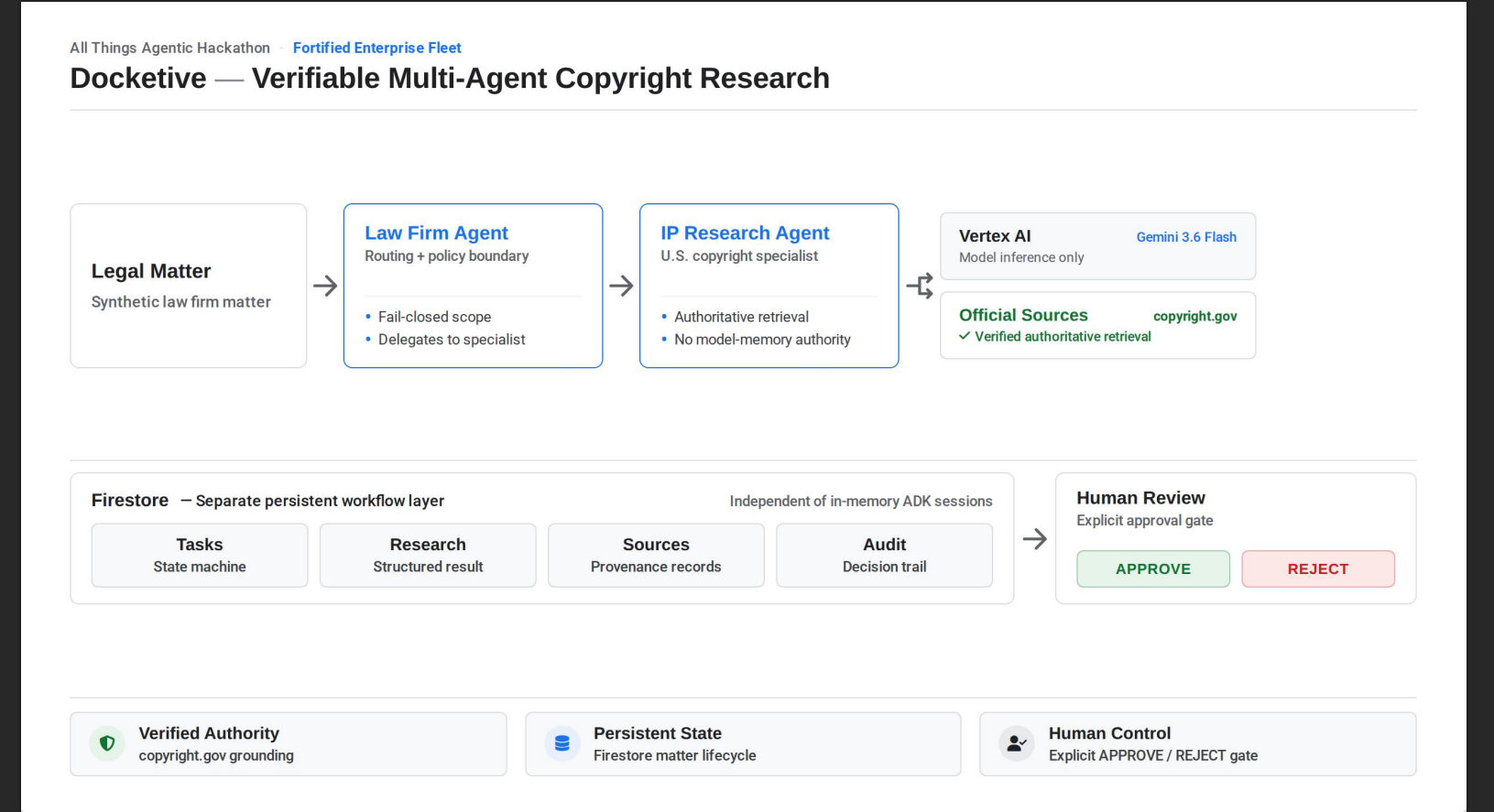
A Law Firm Agent owns the routing and policy boundary. Supported IP matters are deterministically delegated to an IP Research Agent, while unsupported domains fail closed instead of being routed to the wrong specialist.
The IP Research Agent performs source-grounded copyright research using allowlisted official copyright.gov sources. The model cannot invent arbitrary authority URLs, and retrieved sources preserve provenance including official URL, retrieval timestamp, source metadata, and SHA-256.
A separate persistent workflow in Google Firestore stores matter state, research, sources, approval state, and audit events. Research cannot complete the workflow by itself: it enters an explicit human-review gate, where a human reviewer must approve or reject the result.
How we built it
Docketive uses Google ADK for multi-agent orchestration and Gemini 3.6 Flash through Vertex AI for the deployed model runtime.
The backend runs on Google Cloud Run using FastAPI. The legal matter lifecycle is persisted separately in Firestore.
The architecture deliberately separates responsibilities:
- Law Firm Agent: routing and policy enforcement
- IP Research Agent: specialist copyright research
- authoritative-source tools: verified legal authority and provenance
- Firestore workflow: persistent state, failure handling, approval, and audit
- human reviewer: final control over consequential legal decisions
Routing is enforced in code rather than left to an unconstrained model decision. Gemini calls use bounded retries, unsupported domains fail closed, authoritative-source retrieval fails closed, and workflow failures can return research to a retryable pending state with a RESEARCH_FAILED audit event.
Challenges
One of the main challenges was discovering that fluent model behavior is not the same as reliable institutional behavior.
An early version relied more heavily on model-controlled routing. Live testing exposed nondeterministic specialist transfer, so we replaced it with a deterministic routing boundary.
Provider availability also affected development. The final submission runtime uses Gemini 3.6 Flash after verified live execution proved more reliable for the submission path.
Another important design challenge was separating conversational agent state from legal matter state. ADK serving sessions currently default to in-memory state, while the legal matter lifecycle is persisted independently in Firestore.
What we learned
The hardest part was not making Gemini answer a copyright question. It was making the system refuse to pretend when routing, verified authority, provider availability, or human approval was missing.
For legal AI, provenance, failure semantics, scope enforcement, and human governance are part of the product architecture—not optional metadata around the answer.
What we are proud of
The current MVP demonstrates:
- strict separation between orchestration and specialist research
- deterministic specialist routing
- official-source legal research with provenance
- persistent legal workflow state
- retryable failure handling
- explicit human approval and rejection
- auditable human decisions
- a deployed Google Cloud backend with live multi-agent execution
The deterministic verification baseline is 18 passed, 5 deselected — VERIFY PASS.
Current scope
The verified substantive research scope is intentionally narrow: supported U.S. federal copyright law using official copyright.gov sources.
Docketive does not currently claim verified case-law retrieval, broad jurisdiction coverage, redundant specialist failover, production-grade agent-to-agent identity/authorization, or autonomous legal decision-making.
The live Cloud Run agent execution and the Firestore persistent workflow are demonstrated as separate current MVP paths; the deployed /run_sse request itself is not claimed to create the displayed Firestore workflow documents.
What's next
After the hackathon, the architecture can expand toward additional legal specialists and jurisdictions, stronger production identity and authorization controls, and broader authoritative legal-research infrastructure while preserving the same core principle: verified authority and human control before consequential legal action.
Built With
- a2a
- fastapi
- gemini-3.6-flash
- google-adk
- google-cloud
- google-cloud-run
- google-firestore
- iam
- python
- vertex-ai


Log in or sign up for Devpost to join the conversation.