Inspiration
Law students deal with a large amount of information for every case — facts, legal issues, judgments, timelines, evidence, and details that they need to remember for exams. In practice, this information is often scattered across PDFs, personal notes, documents, and different study tools.
We saw an opportunity to bring this entire workflow into one focused platform.
The idea behind Docket came from a simple question:
What if a law student's case file could also become their study workspace?
Instead of spending hours manually converting case information into notes, flashcards, timelines, and revision material, we wanted students to have one place where they could organize their cases and use AI to make the learning process faster and more interactive.
This led us to build Docket, an AI-powered legal learning and case management platform designed specifically for law students.
What it does
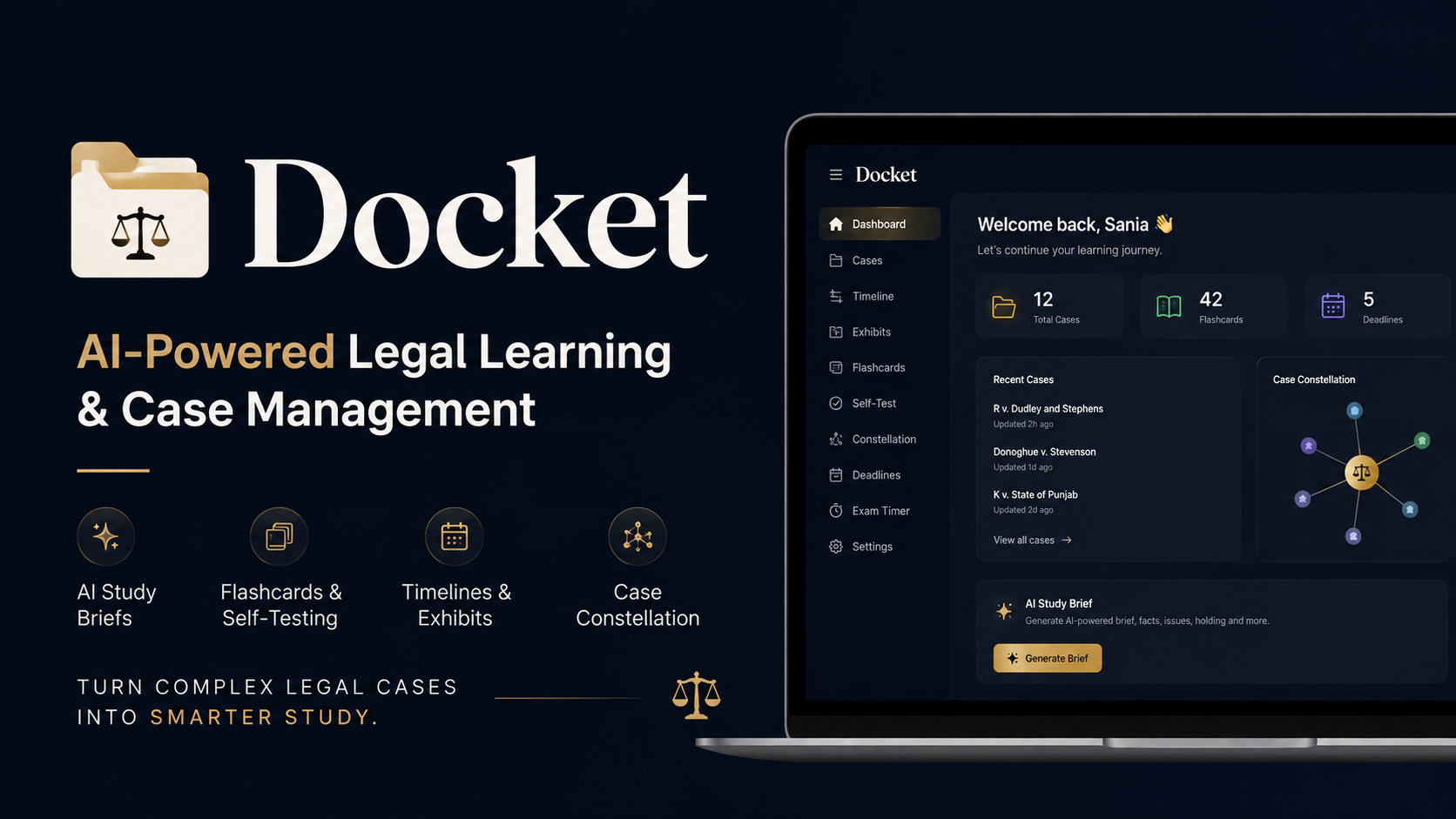
Docket provides law students with a centralized workspace for managing, understanding, and studying legal cases.
Students can create and organize cases, store important information, attach supporting exhibits, build timelines, connect related cases, and prepare for exams without constantly switching between different applications.
Docket's AI functionality is powered by Google Gemini. Students can use their case information to generate structured study material, including:
- AI Study Briefs
- Case Facts
- Legal Issues
- Case Holdings
- Case Chronology
- AI-generated Flashcards
- Self-Test Questions
- Revision Material
Docket also includes practical tools that support the complete study process:
- Case Management for organizing legal cases
- Case Search for quickly finding information
- Case Timelines for understanding the sequence of events
- Exhibits for organizing images, videos, and PDFs
- Case Tags and Case Constellation for discovering relationships between cases
- Study Streaks for maintaining consistent study habits
- Exam Timer for practicing under exam conditions
- Deadline Tracking for managing important dates
- Revision Sheet Export for creating downloadable study material
The overall workflow is:
Case Information → AI-Powered Understanding → Interactive Revision → Exam Preparation
Rather than making AI a separate chatbot, Docket integrates it directly into the student's existing learning workflow.
How we built it
Docket was built as a full-stack web application using a combination of modern web technologies and AI services.
The frontend was developed with React and Vite, with a responsive interface designed around the needs of law students.
The backend was built using Node.js and Express.js, providing REST APIs for case management, authentication, study resources, timelines, exhibits, and other application functionality.
For persistent data, we use MongoDB with Mongoose.
For AI-powered functionality, we integrated the Google Gemini API. Gemini is used to analyze case information and generate structured learning resources such as study briefs, flashcards, and self-testing material.
For storing uploaded exhibits such as images, videos, and PDFs, we use Cloudinary.
Authentication is implemented using JWT, while passwords are securely hashed using bcrypt. Protected API routes ensure that user data and case information remain associated with the correct account.
We also implemented automated testing and GitHub Actions CI to improve reliability and catch issues during development.
The application was developed with a focus on making the different components work together as one continuous workflow rather than as a collection of unrelated features.
Challenges we ran into
One of our biggest challenges was making AI-generated content genuinely useful.
A generic AI response is not enough for an educational application. We needed the output to be structured and useful for other parts of the platform. This required careful prompt design, response handling, and integration between the AI service and the application's features.
Another challenge was integrating several different technologies into one reliable application. Docket combines a React frontend, Node.js backend, MongoDB database, Gemini AI, authentication, and cloud storage. Making these components communicate reliably required continuous testing and debugging.
Handling uploaded exhibits was another challenge because users may work with different types of case materials, including images, videos, and PDFs. We needed to make these materials easy to upload, store, and access without making the interface complicated.
We also faced the challenge of designing an application that was powerful without becoming overwhelming. Legal case management can quickly become complicated, so we focused on organizing features around the actual workflow of a student.
One important lesson was that not everything needs to be powered by AI. AI is most valuable when it helps reduce repetitive work or transform information into something useful for learning. Features such as timelines, tags, dashboards, exhibits, and exam tools provide the structure that makes the AI functionality more useful.
Accomplishments that we're proud of
We are proud that Docket became a complete working application rather than simply an AI prototype.
We built an end-to-end workflow where information entered into a case can become structured learning material and then be used for active revision.
One of the workflows we are most proud of is:
Case → AI Study Brief → Facts & Issues → Chronology → Flashcards → Self-Test → Revision
This demonstrates how AI can be integrated into an actual educational workflow instead of simply providing a conversational interface.
We are also proud of building supporting functionality around the AI, including case management, timelines, exhibits, Case Constellation, study tracking, exam tools, authentication, cloud file storage, and revision sheet generation.
From a technical perspective, we are proud of bringing together the frontend, backend, database, AI integration, authentication, storage, and testing into a single deployable product.
Most importantly, Docket was built around a real problem faced by students. We didn't want to create an AI feature simply because AI was popular; we wanted to use it where it could make a student's existing workflow more efficient.
What we learned
Building Docket taught us that developing an AI application is about much more than connecting an API to a frontend.
We learned how to identify where AI can provide meaningful value and how to integrate AI-generated information into features that users can actually interact with.
Throughout the project, we gained practical experience with:
- Full-stack web development
- React and Vite
- Node.js and Express.js
- MongoDB and Mongoose
- REST API development
- Google Gemini API integration
- Authentication and authorization
- Cloudinary file storage
- Automated testing
- GitHub Actions and CI
- Responsive UI/UX design
We also learned about the importance of designing AI outputs for reliability and usability. A response that looks impressive in a chat window is not necessarily useful inside a real application.
The biggest lesson we took away is:
AI becomes much more powerful when it is integrated into a complete workflow instead of being treated as an isolated chatbot.
What's next for Docket
Our next goal is to continue developing Docket as a focused learning platform for law students.
We want to improve the reliability and usefulness of AI-generated educational content while continuing to make legal study more organized, interactive, and accessible.
We also want to learn from how students actually use Docket and use that feedback to improve the existing experience rather than adding unnecessary complexity.
In the longer term, Docket could evolve into a more comprehensive intelligent learning environment where students can manage their legal knowledge, understand complex cases, actively test their understanding, and prepare for exams from one place.
However, the core philosophy will remain the same:
AI should make learning easier — not make learning more complicated.
Docket — Turn complex legal cases into smarter study. ⚖️🧠
Built With
- actions
- api
- cloudinary
- express.js
- gemini
- github
- javascript
- jwt
- mongodb
- mongoose
- node.js
- react
- rest
- vercel
- vite

Log in or sign up for Devpost to join the conversation.