-
-
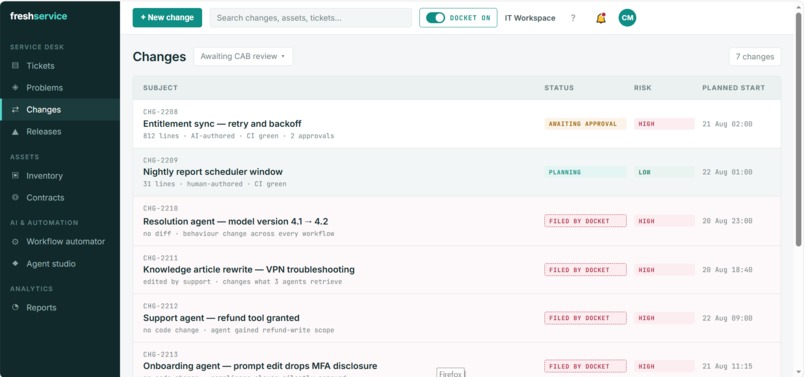
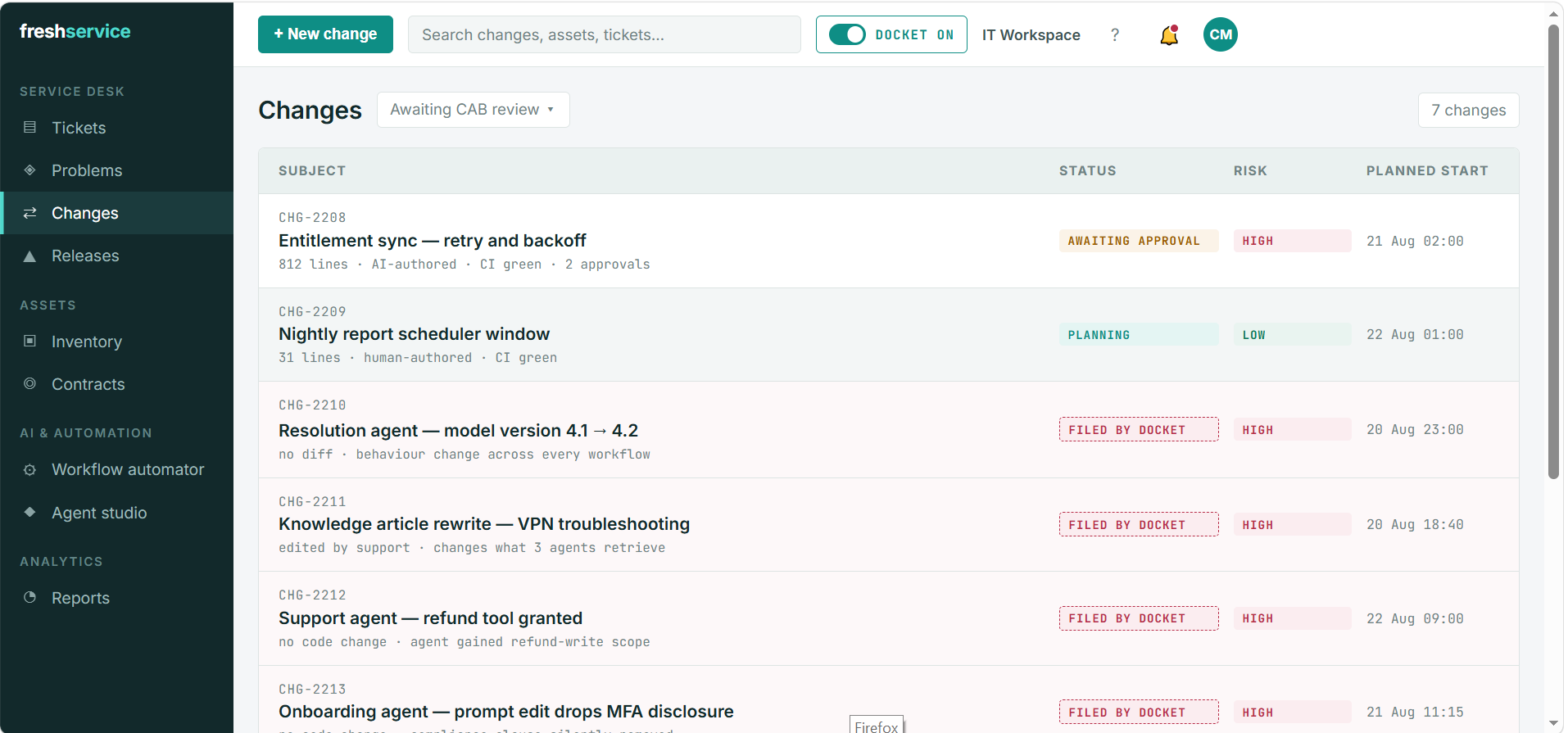
Docket-enabled Freshservice dashboard showing AI-related changes, their approval status, and assessed risk levels for CAB review.
-
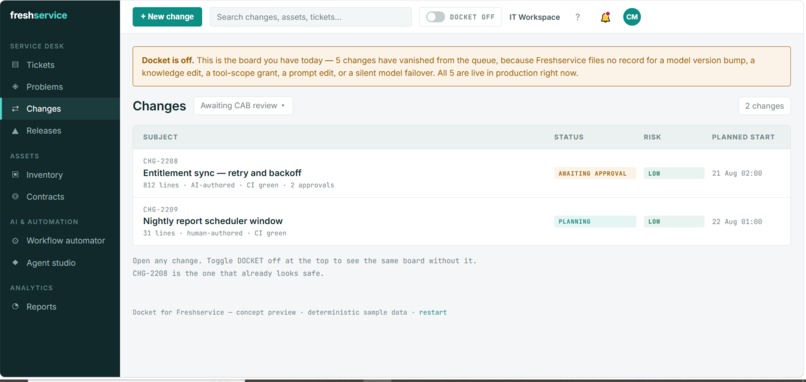
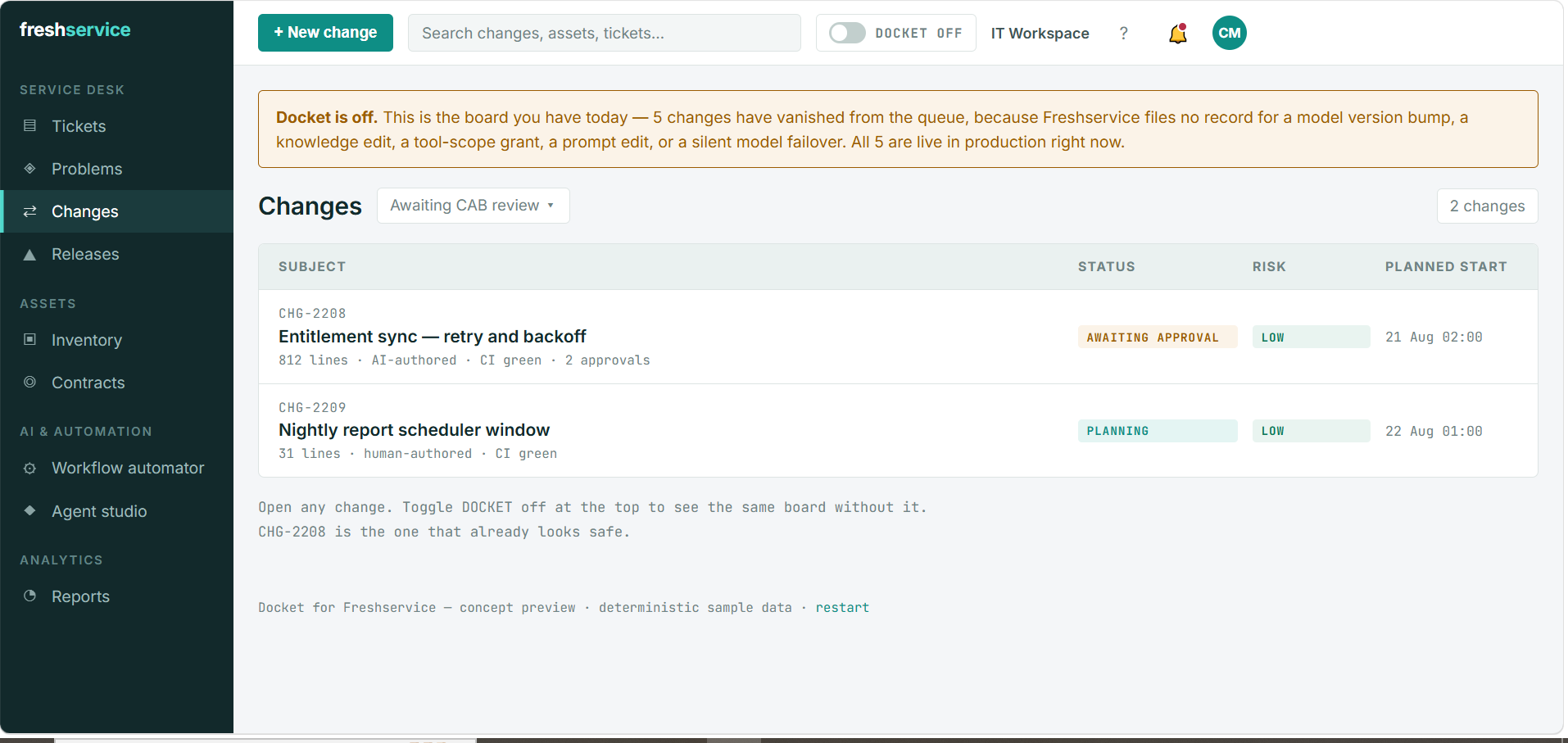
Docket — Freshservice Change Management Dashboard(When Docket is off)
-
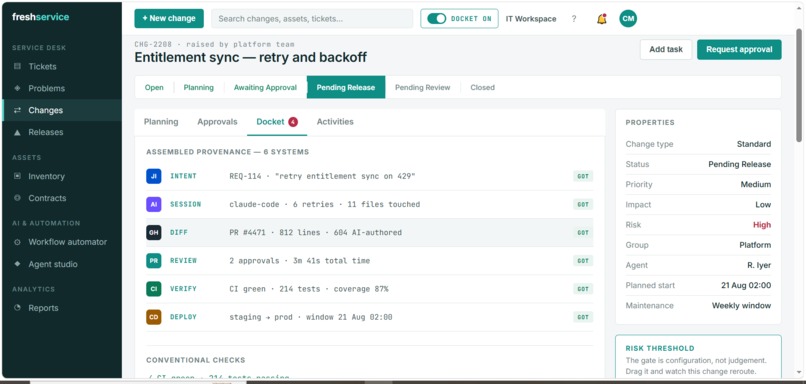
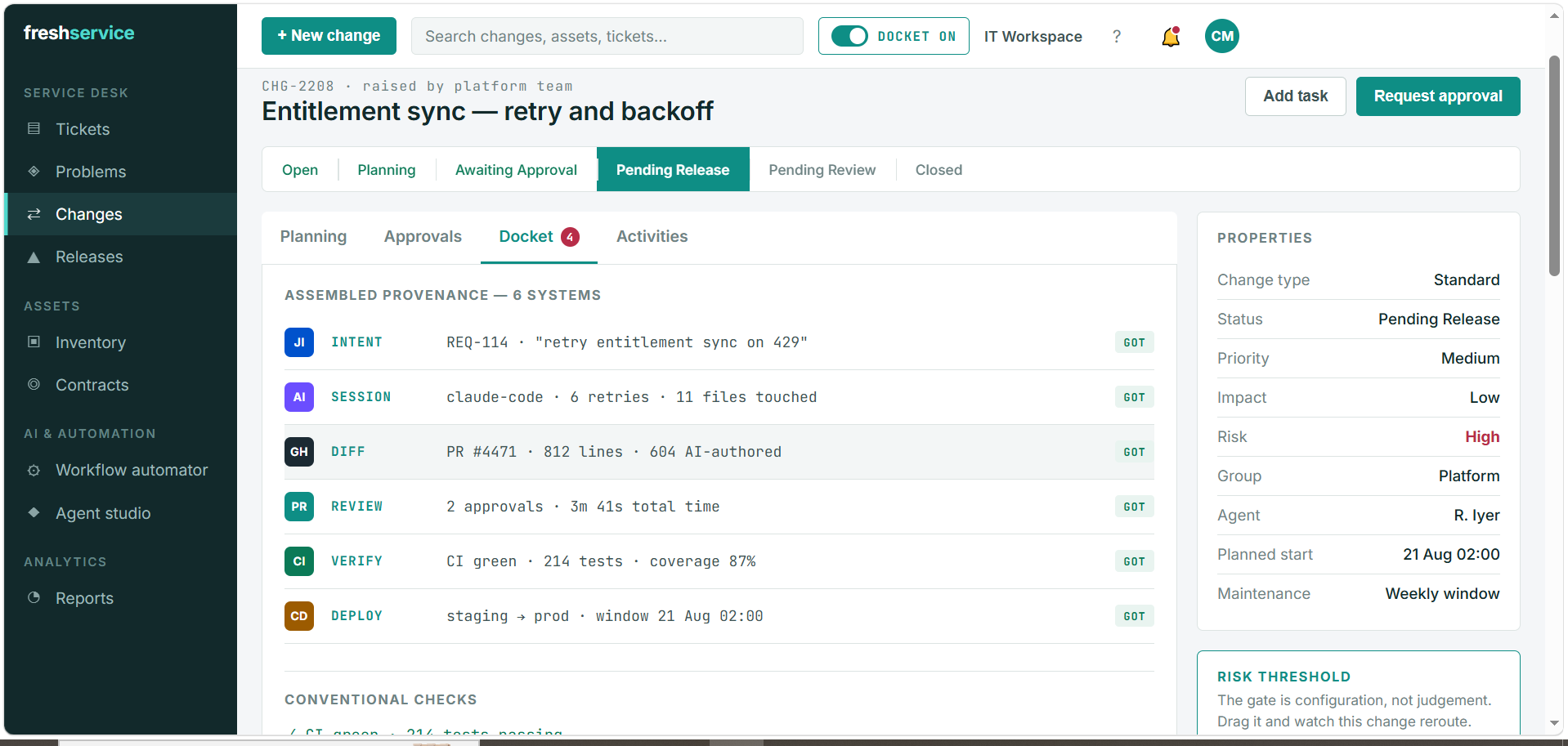
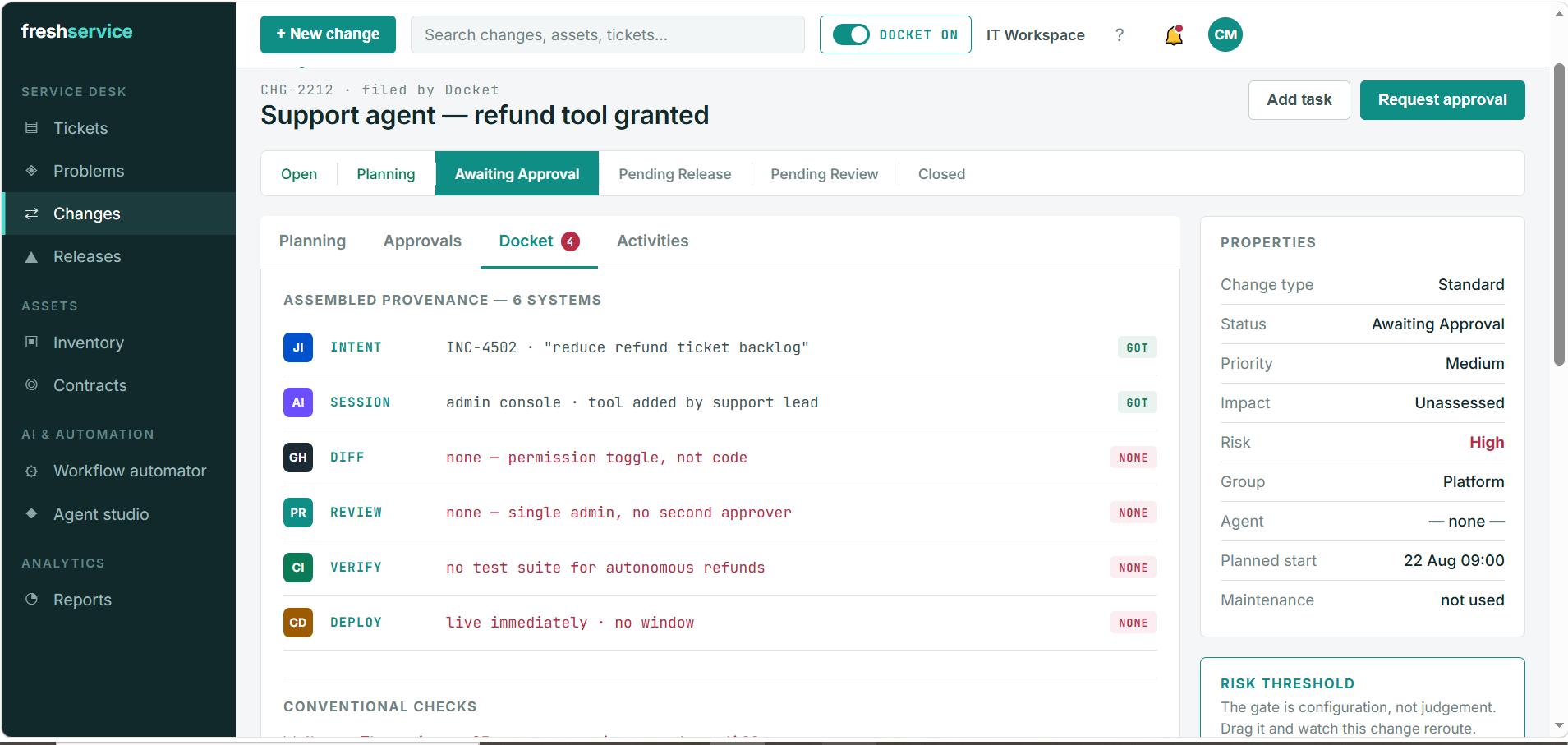
Docket connects requirements, AI sessions, code changes, reviews, CI verification, and deployment into one assembled provenance record.
-
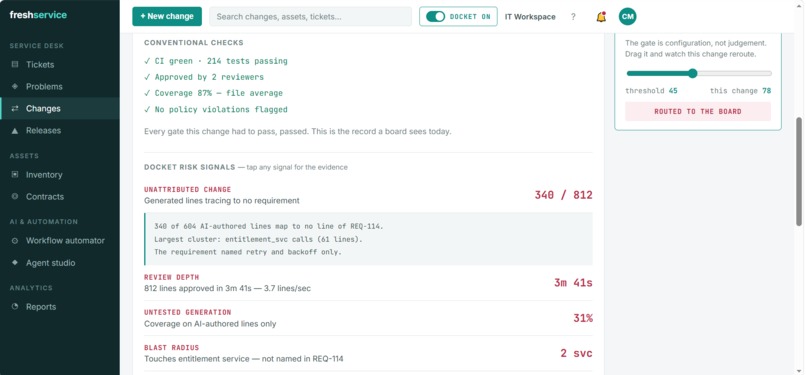
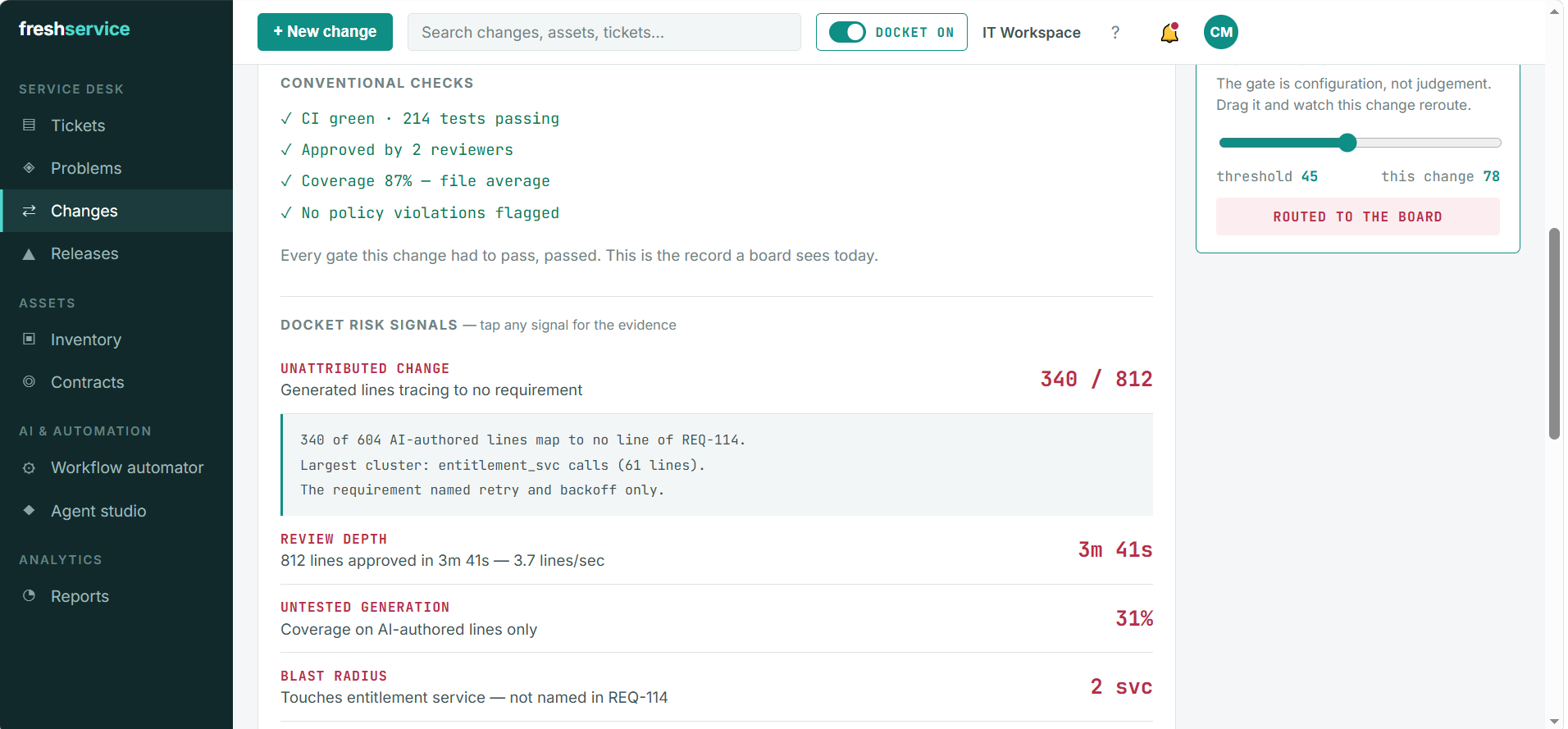
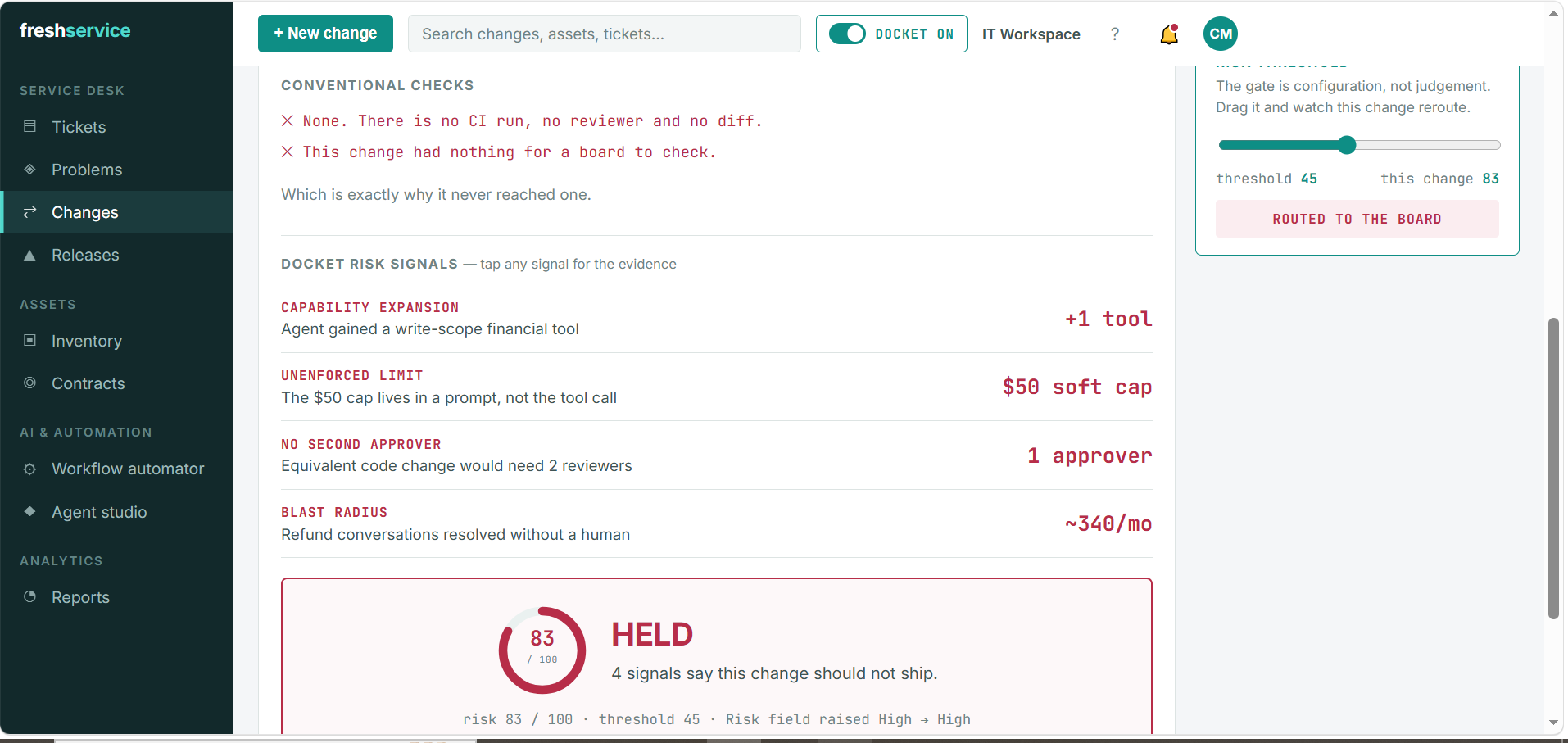
Conventional checks and Docket Risk Signals
-
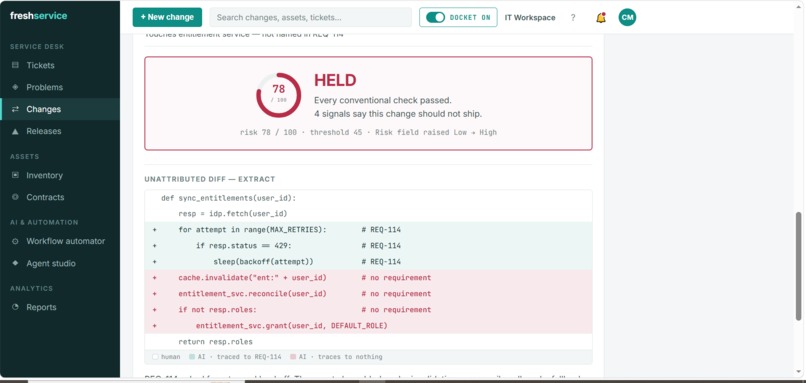
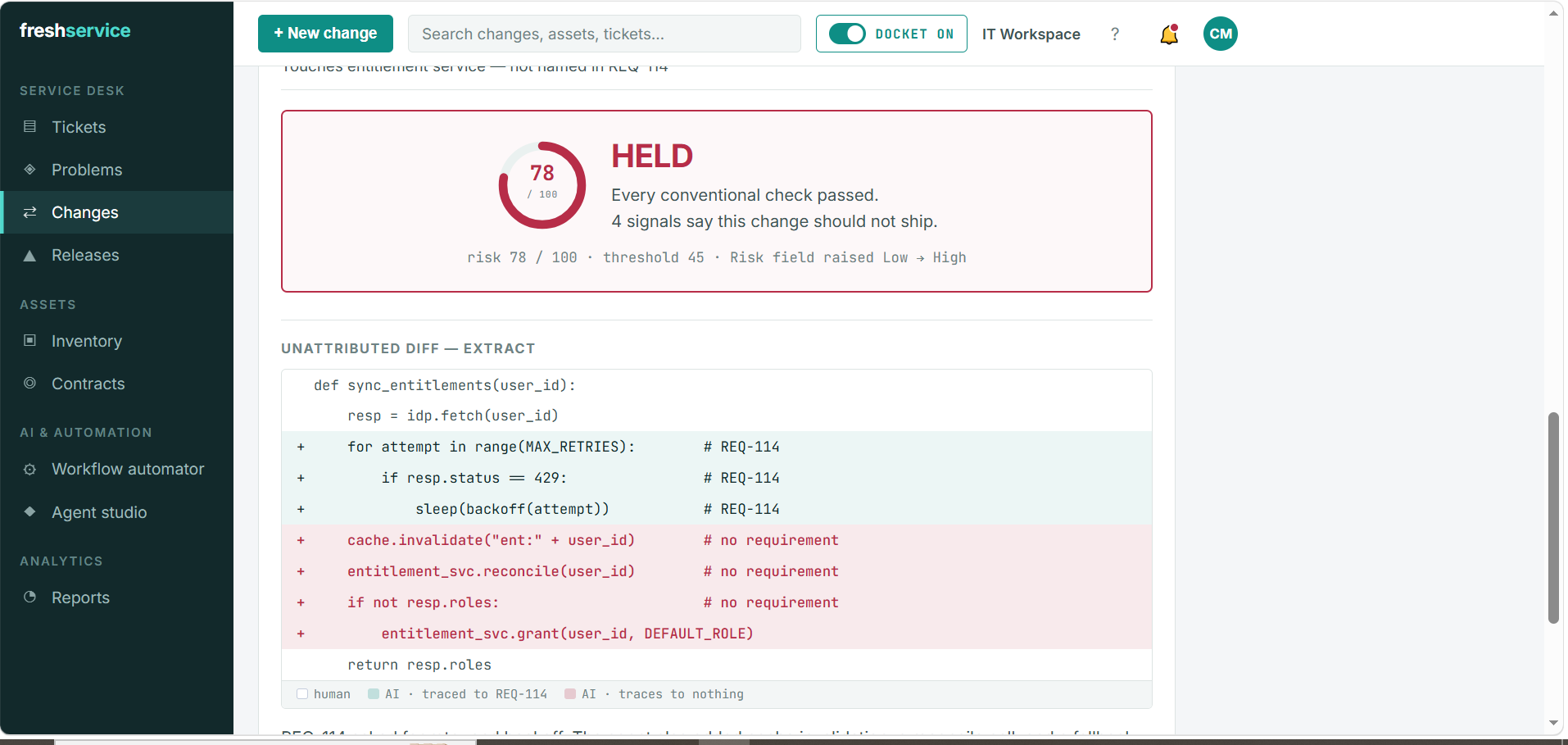
Risk Score
-
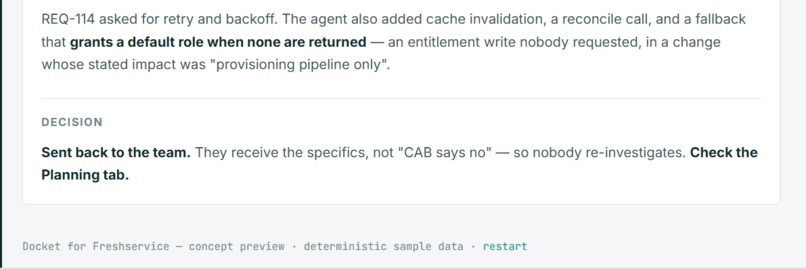
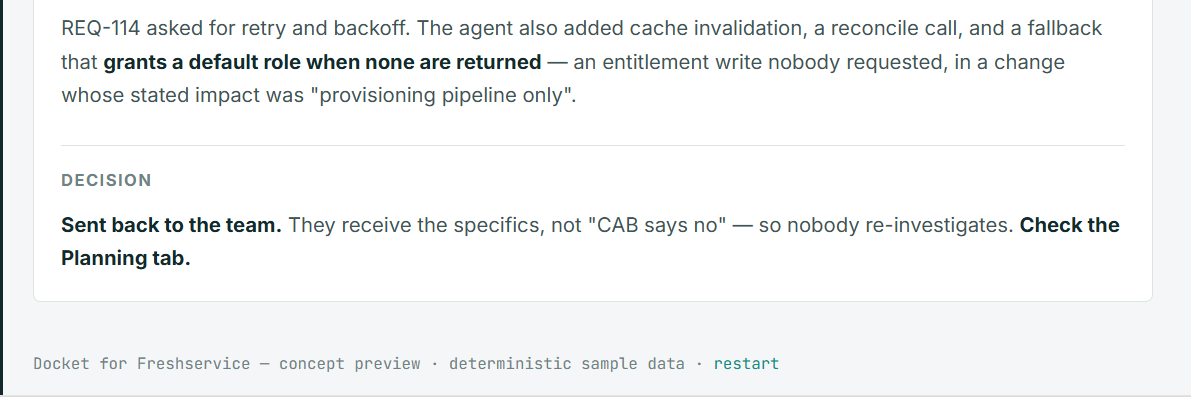
Docket identifies AI-generated changes without requirement traceability and sends the change back to the team with specific evidence .
-
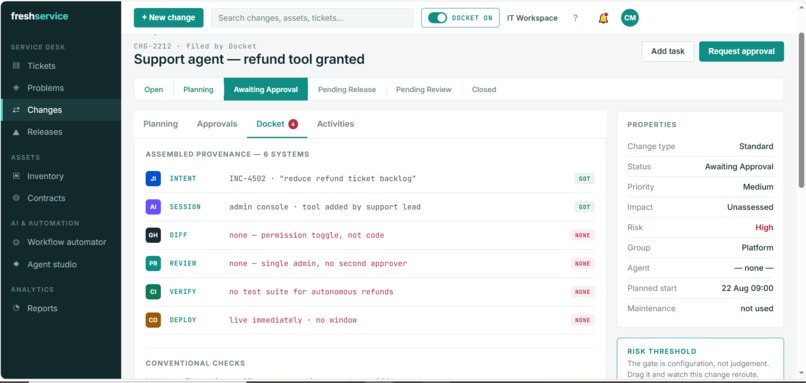
Change where an agent quietly gained the ability to issue refund -no ticket behind it.(Example of Docket )
-
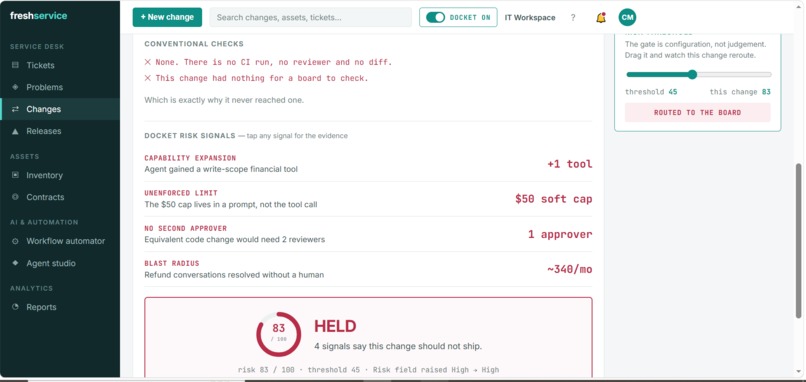
Risk Signals and risk score for above example
Inspiration
Software development is evolving.
Traditionally, teams follow the Software Development Lifecycle (SDLC), where humans design, develop, review, test, and deploy software through established processes.
With AI coding agents becoming part of development, we are moving toward an AI Development Lifecycle (ADLC), where humans increasingly collaborate with AI agents to create and modify software.
This shift does not replace the SDLC or existing ITSM practices. Instead, it introduces a new participant — AI agents — and new context around every change.
Freshservice already provides a strong foundation for change management through planning, assessment, approvals, and tracking. We saw an opportunity to build on that foundation and make the change-management experience more AI-aware.
That led us to Docket — a concept that brings AI-specific context into the existing change workflow, helping teams understand not only what changed, but also what the AI was asked to do, what it actually changed, and what impact it may have.
What it does
Docket complements Freshservice Change Management by adding AI-native context to changes involving AI coding agents.
In a traditional SDLC workflow, a change record can capture important information such as the requester, reason, risk, approvals, and implementation details.
In an ADLC workflow, there is another layer of context: the AI agent that contributed to the change.
Docket brings that context into the existing workflow:
- AI Intent — what the AI agent was asked to accomplish.
- AI Session Context — the interaction that led to the change.
- Change Impact — which files, components, or services were affected.
- Risk Signals — indicators that help assess potential impact.
- Governance Context — whether additional review may be appropriate.
- Traceability — connecting AI activity with the resulting change record.
The goal is simple: keep the existing change-management foundation while making it ready for AI-native development.
How we built it
We started by understanding the existing Freshservice change-management workflow and how it supports traditional SDLC processes.
Then we asked:
What additional context becomes useful when an AI agent participates in that same development lifecycle?
Based on this, we designed Docket as a complementary AI-native layer rather than a replacement for existing Freshservice capabilities.
We built an interactive prototype that demonstrates how a familiar change record can remain at the center while gaining additional AI context when a change originates from an AI coding workflow.
The prototype includes realistic AI-generated change scenarios with different levels of impact and risk. Users can explore the change details and see how AI intent, session context, affected components, and governance information can support better decision-making.
Challenges we ran into
Our biggest challenge was finding the right balance between AI-native governance and existing change-management practices.
We wanted Docket to enhance the workflow without creating another process that developers or change managers would have to maintain.
We also had to determine which AI-generated information would actually be useful to reviewers.
This led us to focus on four questions:
- What was the AI asked to do?
- What did the AI actually change?
- What could that change affect?
- Does the change need additional review or context?
Another challenge was communicating this concept through a prototype that remains familiar to existing Freshservice users while clearly showing the new possibilities created by AI-native development.
Accomplishments that we're proud of
We are proud of creating a concept that connects the traditional SDLC with the emerging ADLC while building on an established ITSM workflow.
Instead of treating AI development as a completely separate process, Docket explores how existing change management can evolve alongside it.
We brought together:
AI Intent → AI Session → Change Impact → Risk → Governance → Existing Change Workflow
This provides a more complete picture of an AI-assisted change while keeping the familiar change-management foundation intact.
Most importantly, Docket is designed to complement, not replace, the capabilities already available in Freshservice.
What we learned
Building Docket helped us understand that the transition from SDLC to ADLC is not simply about using AI to write code faster.
It also changes the context surrounding software changes.
In the traditional SDLC, understanding the developer, code change, testing, approvals, and deployment provides much of the necessary context.
In the ADLC, teams may also need to understand the AI agent's intent, session, actions, and resulting impact.
We learned that organizations do not necessarily need entirely new processes for this transition. Existing ITSM and change-management workflows can evolve by incorporating the additional context created by AI.
Our key insight was:
As software development evolves from SDLC toward ADLC, change management can evolve with it — preserving the existing foundation while becoming more AI-aware.
What's next for Docket — AI-Native Change Governance
Docket is currently a prototype exploring how AI-native context could complement Freshservice Change Management as organizations adopt AI-assisted development.
Next, we would like to explore deeper integrations with AI coding agents and development platforms so relevant information can be captured automatically.
Potential areas include:
- Automatically capturing AI intent and session context.
- Connecting AI-generated changes with existing Freshservice change records.
- Enriching risk assessment with AI-specific signals.
- Connecting changes with services, assets, and CMDB information.
- Supporting organization-specific governance policies.
- Identifying changes that may benefit from additional review.
- Building an end-to-end trace from AI request → AI action → change → approval → deployment → outcome.
Our vision is to help Freshservice evolve naturally alongside the shift from SDLC to ADLC, giving organizations the additional visibility and context they need as AI becomes an increasingly active participant in software development.
Built With
- agentic-ai
- ai
- ai-agents
- ai-governance
- change-management
- css
- enterprise-ai
- freshservice
- freshworks
- generative-ai
- html
- itsm
- javascript
- python

Log in or sign up for Devpost to join the conversation.