Inspiration
Law students often rely on scattered notes, PDFs, documents, and separate study tools to understand complex legal cases. We wanted to bring that fragmented workflow into one focused platform.
Docket was built around a simple idea: legal case management and legal learning should happen in the same workspace.
What it does
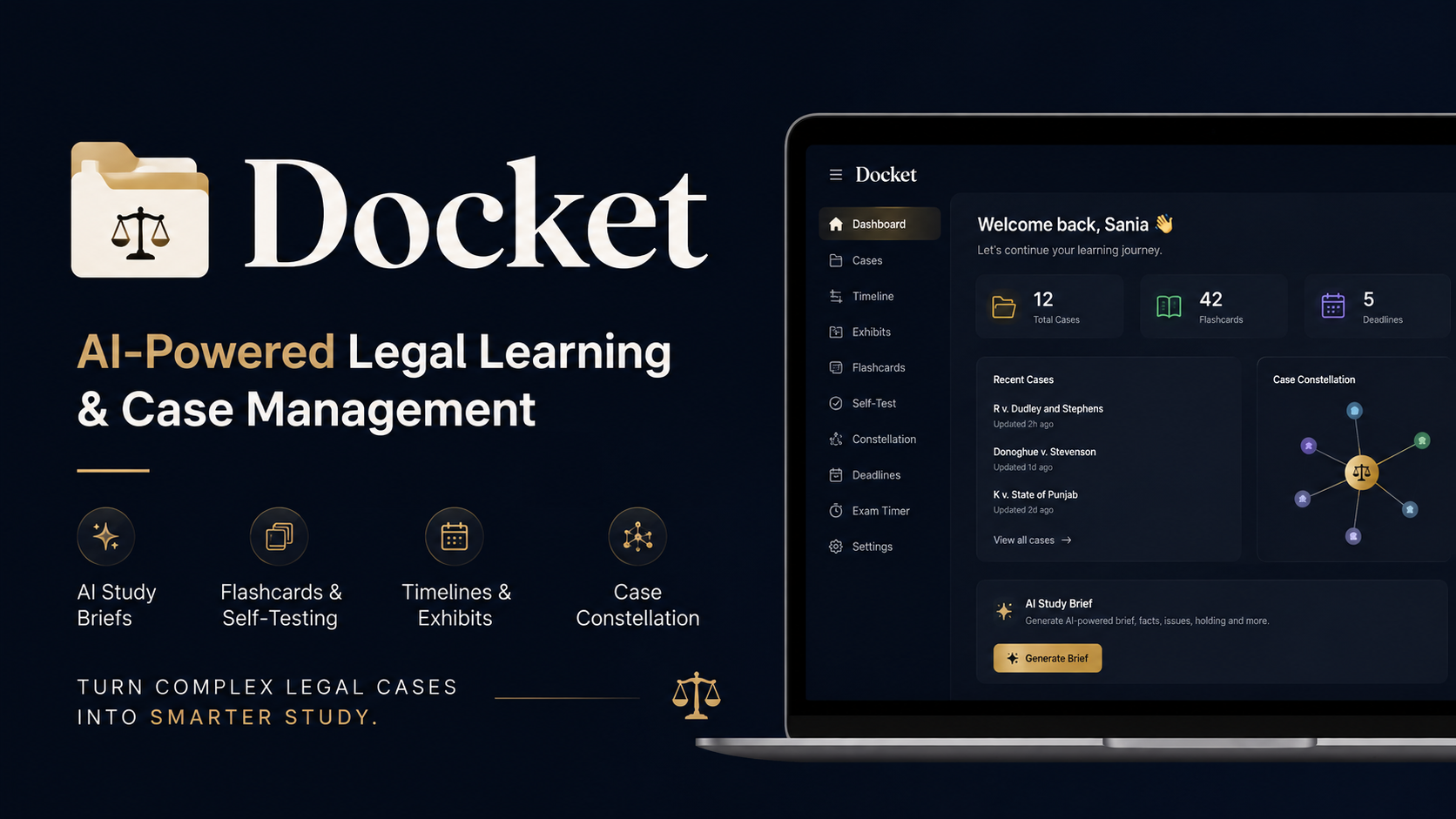
Docket is an AI-powered legal learning and case management platform designed for law students.
Students can organize cases, build case briefs, create timelines, manage exhibits, connect related cases, and use AI to transform case information into useful study material.
Key features include:
- AI-powered case briefs
- AI-generated flashcards
- Self-test questions
- Interactive case timelines
- Case exhibits for images, videos, and PDFs
- Case tags and visual case relationships
- Study tracking
- Exam timer
- Revision sheet generation
Instead of providing a standalone chatbot, Docket integrates AI directly into the student's existing case-study workflow.
How we built it
Docket is a full-stack web application built with React and Vite on the frontend and Node.js with Express.js on the backend.
We use MongoDB and Mongoose for application data, Google Gemini for generative AI capabilities, and Cloudinary for multimedia exhibit storage.
Authentication is handled using JWT and bcrypt, while REST APIs connect the frontend with the backend services.
The application is deployed using cloud infrastructure including Vercel, Render, MongoDB Atlas, and Cloudinary.
We also incorporated automated testing and GitHub Actions CI to improve reliability during development.
Challenges we ran into
One of our biggest challenges was integrating generative AI into a structured product rather than simply creating another chatbot.
AI-generated information needed to become useful study material that could fit naturally into the student's workflow. We therefore had to design structured prompts and application logic around the outputs.
We also had to integrate several services while keeping the interface simple. Managing authentication, databases, AI services, multimedia storage, APIs, and deployment as one application required careful engineering and debugging.
Another challenge was deciding where AI actually added value. We learned that adding AI everywhere does not necessarily make a product better. The strongest experience came from combining AI with well-designed traditional software features.
Accomplishments that we're proud of
We are proud that Docket became a fully deployed, functional product rather than just an AI prototype.
The platform connects case management, AI-assisted analysis, interactive timelines, exhibits, visualization, and study tools into one workflow.
One workflow we are particularly proud of is:
Case → AI Analysis → Structured Understanding → Flashcards → Self-Test → Revision
We also successfully brought together frontend development, backend APIs, database management, authentication, cloud storage, generative AI, automated testing, and deployment into a single application.
Most importantly, Docket addresses a specific problem for a clearly defined user group while providing a foundation that can grow into a specialized legal-learning SaaS product.
What we learned
Building Docket taught us that successful AI products require more than connecting an application to a language model.
We learned how to integrate generative AI into real application workflows, design APIs across multiple services, structure AI outputs, manage persistent application data, and build a user experience around AI.
We also gained practical experience with React, Node.js, Express.js, MongoDB, Gemini, Cloudinary, JWT authentication, REST APIs, automated testing, CI, and cloud deployment.
The biggest lesson was that technology should support the user's workflow rather than become the workflow itself.
What's next for Docket
Our next goal is to continue improving Docket based on real student needs and feedback.
The platform is designed with a potential freemium SaaS model, where essential functionality remains accessible to students while expanded AI usage and advanced capabilities can be offered through a Pro subscription. Universities could eventually access Docket through institutional licensing.
We also want to improve the reliability and usefulness of AI-generated learning material while keeping the interface focused and easy to use.
Our long-term vision is to grow Docket from a student-focused legal learning platform into a broader intelligent workspace for understanding, organizing, and revising complex legal information.
Docket's core philosophy will remain simple: use AI to make complex legal information easier to understand, organize, and learn.
Built With
- actions
- ai
- api
- bcrypt
- cloudinary
- express.js
- gemini
- generative
- github
- javascript
- jwt
- mongodb
- mongoose
- node.js
- react
- render
- rest
- vercel
- vite

Log in or sign up for Devpost to join the conversation.