-
-
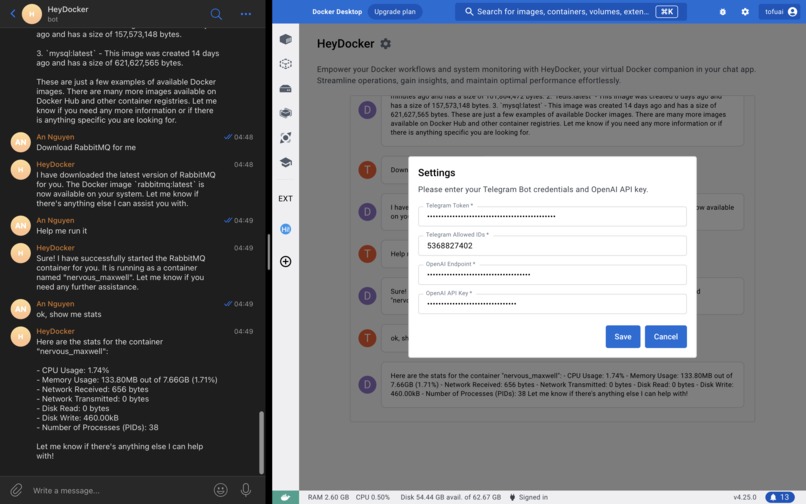
use the Telegram API and the ChatGPT API to remotely control Docker
Inspiration
The inspiration for HeyDocker stemmed from the necessity to ease the management of Docker containers and monitor systems more efficiently. I often found myself toggling between various applications to carry out these tasks, which prompted me to devise a more streamlined solution. HeyDocker is essentially a virtual assistant integrated within common chat applications such as Telegram, Slack, and Discord, designed to simplify Docker container management and enable real-time system monitoring through simple chat commands.
What it does
HeyDocker serves as a virtual assistant that connects with popular chat apps like Telegram, Slack, Discord, and others. It facilitates Docker container management and provides real-time system monitoring capabilities. Users can effortlessly list containers, control their status, run network speed tests, check memory and disk usage, access server time, and retrieve the server's external IP address, all through simple chat interactions.
How I built it
I built HeyDocker using GPT API, Docker's API, and system monitoring utilities, crafting integrations for different chat platforms and a user-friendly interface that interacts with Docker's API to deliver system information. This involved coding in several languages and thorough testing to ensure a smooth user experience.
Challenges I ran into
Constructing HeyDocker posed numerous challenges, such as integrating it with various chat platforms and developing a Docker Extension. There were not many examples available for using Python as a backend.
Accomplishments that I'm proud of
I'm particularly proud of HeyDocker's adaptability and its user-friendly nature, which marks a substantial achievement in managing Docker containers and system monitoring across different chat applications.
What I learned
The process was enlightening; I learned a great deal about API integration, and Docker Extension. I hope I can provide more Docker Extensions in the future.
What's next for HeyDocker
In the future, I plan to expand HeyDocker's capabilities and integrations, making it even more feature-rich and accessible. HeyDocker can support local LLM, such as OLLAMA, or PrivateGPT. I also want to provide easier way to set up the connection between ChatApp and Docker system.

Log in or sign up for Devpost to join the conversation.