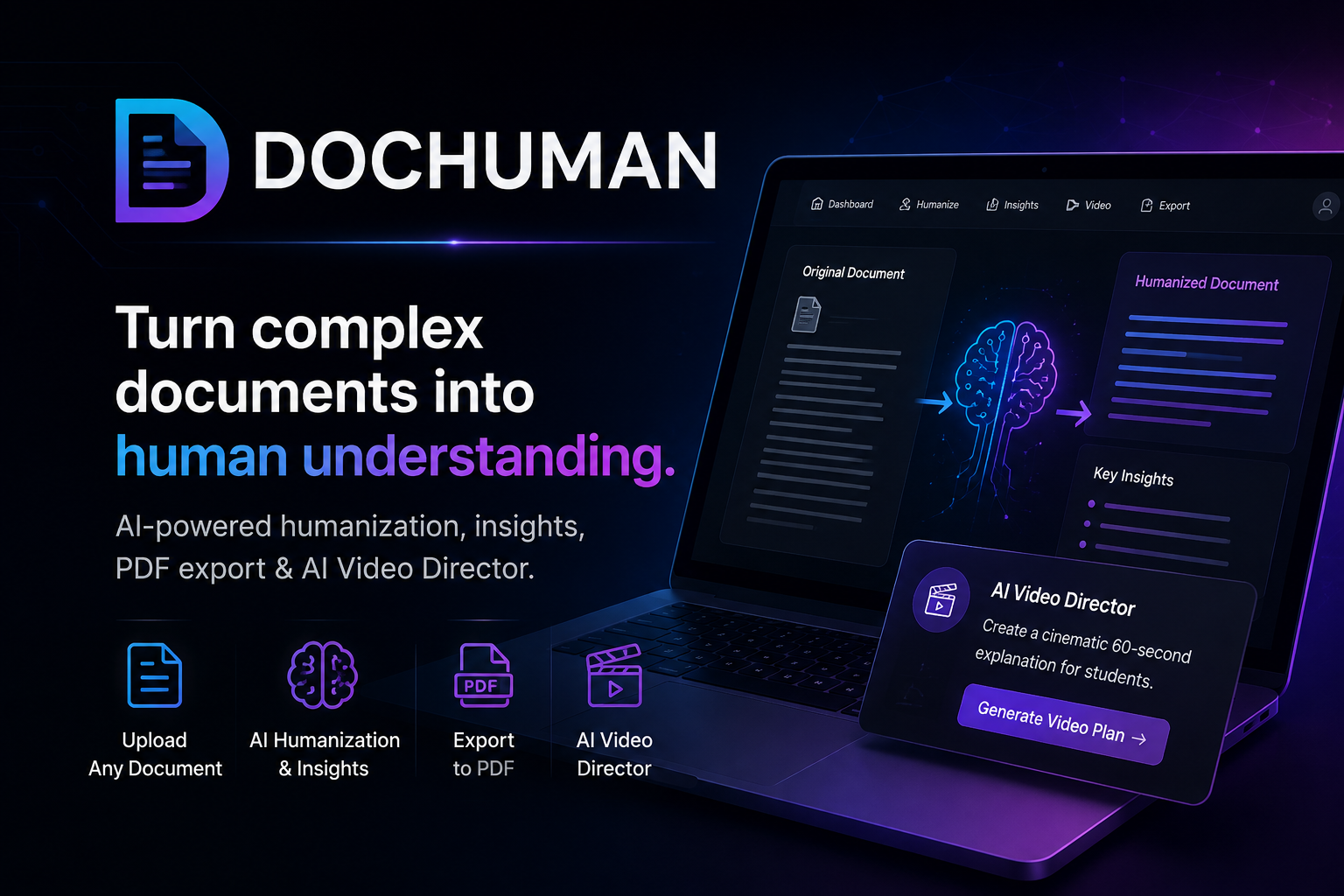
DocHuman — Turn Complex Documents into Human Understanding
The Problem
Important information is often trapped inside documents that are difficult to understand.
Research papers, technical reports, proposals, manuals, and long PDFs can contain valuable knowledge, but users often have to spend hours reading dense language before they can understand the key ideas.
Most AI document tools stop at summarization.
We wanted to build something different:
What if an AI could take a difficult document and transform it into something a person could actually understand, use, and communicate?
Our Solution
DocHuman is an AI document transformation studio.
A user uploads a PDF, DOCX, or TXT document and DocHuman takes it through a complete understanding workflow:
Upload → Understand → Humanize → Extract Insights → Export → Communicate
The system extracts the document, processes its structure, transforms dense writing into clearer and more readable language, identifies important insights, and provides the user with multiple ways to communicate the information.
Instead of only producing a short summary, DocHuman keeps the document's broader context while making difficult material easier to understand.
What DocHuman Does
📄 Document Understanding
DocHuman accepts:
- DOCX
- TXT
The application extracts the document content and identifies its structure so the AI can work with the actual material rather than treating the document as an image or a single block of text.
Longer documents are processed in logical chunks instead of being blindly sent to the AI in one request.
🧠 AI Humanization
The humanization pipeline focuses on editorial transformation rather than simple synonym replacement.
It improves:
- sentence structure
- readability
- unnecessary repetition
- transitions
- excessive formality
- overly complex wording
while attempting to preserve:
- important facts
- names
- dates
- numbers
- technical terminology
- the original meaning
The goal is not to hide the use of AI or bypass AI-detection systems.
The goal is to produce genuinely clearer and more useful writing.
💡 AI Insights
After processing the document, DocHuman extracts the ideas that matter most.
Users can explore:
- key concepts
- important findings
- simplified explanations
- document overview
- humanized content
- original extracted content
This turns a difficult document into a more approachable knowledge experience.
📑 PDF Export
The transformed document can be exported as a professionally formatted PDF.
This makes the result useful beyond the web application and gives users a portable version they can read, share, or present.
🎬 AI Video Director
One of the most experimental parts of DocHuman is the AI Video Director.
Instead of forcing every document into the same video template, users can tell DocHuman what kind of explanation they want.
For example:
"Create a cinematic 60-second explanation for university students. Use simple language, focus on the three most important ideas, and use an energetic but professional tone."
DocHuman turns the instruction into a structured video plan containing:
- audience
- tone
- visual style
- duration
- scenes
- narration
- visual direction
- on-screen text
The user can review the plan before generating the visual explanation.
Why We Built It
The inspiration came from a simple observation:
Access to information is not the same as understanding information.
AI has become extremely good at generating text, but people still struggle with the documents they receive every day.
We wanted to explore whether AI could become a bridge between complex information and human understanding.
Rather than building another generic chatbot, we designed DocHuman around a specific workflow: starting with a document and ending with something useful.
How We Built It
DocHuman uses a React/Vite frontend with a Python FastAPI backend.
The core stack includes:
- React
- Vite
- TypeScript
- Framer Motion
- FastAPI
- Python
- PyMuPDF
- python-docx
- ReportLab
- MoviePy
- FFmpeg / imageio-ffmpeg
- Featherless.ai
- Render
- GitHub
Documents are extracted and processed on the backend. Longer documents are divided into manageable logical chunks before AI processing.
The AI pipeline separates document understanding, humanization, insight extraction, and video planning rather than treating everything as one giant prompt.
The production application is deployed on Render.
Challenges
The biggest engineering challenge was making the application reliable enough to work beyond a small prototype.
We encountered several issues while building:
- long documents exceeding practical model context limits
- AI processing taking too long
- video generation blocking the main request
- temporary video jobs disappearing
- FFmpeg compatibility
- production dependency issues
- maintaining document structure during transformation
- ensuring the frontend worked without localhost API references
We addressed these by introducing document chunking, separate processing stages, configurable document limits, independent video processing, persistent job state, bundled FFmpeg support, production dependency management, and same-origin API routing.
Another important lesson was that a feature can work locally and still fail in production.
Deploying DocHuman on Render forced us to test the complete path:
local code → GitHub → build → dependencies → backend → frontend → production API → real user workflow
What We Learned
The biggest lesson was that AI applications are not only about the model.
The surrounding system matters just as much.
A good AI product needs:
- reliable document ingestion
- controlled context
- predictable API behavior
- useful UI states
- graceful failures
- production deployment
- clear user interaction
We also learned that giving users control over the AI output is powerful.
The AI Video Director is an example of this idea: instead of silently deciding what the final video should look like, DocHuman lets the user describe the outcome they want and then turns that intent into a structured production plan.
What's Next
DocHuman is currently a hackathon prototype, but the architecture gives us a foundation for a larger document-understanding platform.
Future directions include:
- richer document structure preservation
- better multimodal document understanding
- citation-aware transformations
- collaborative document workflows
- personalized explanation levels
- more advanced video generation
- presentation generation
- multilingual document transformation
The Vision
We believe the future of AI is not simply about generating more information.
It is about helping people understand the information they already have.
DocHuman turns complex documents into human understanding.
Built With
- ai
- document
- farmer
- featherless
- ffmpeg
- generative
- github
- language
- learning
- machine
- moviepy
- natural
- processing
- pymupdf
- python
- python-package-index
- react
- render
- reportlab
- typescript
- vite


Log in or sign up for Devpost to join the conversation.