Inspiration
In India, healthcare is a story of two extremes. On one side, I've seen my own family members endure the stress and physical strain of traveling to clinics for basic consultations. On the other, a silent, brilliant workforce of underemployed MBBS graduates and skilled nurses waits for an opportunity to serve.
These two groups were disconnected by a gap in technology and trust. I built Doc@Home to be the bridge. My vision was never just to build another booking app; it was to forge a complete ecosystem that restores dignity to healthcare professionals and delivers compassionate, high-quality medical care directly to the homes of those who need it most.
What it does
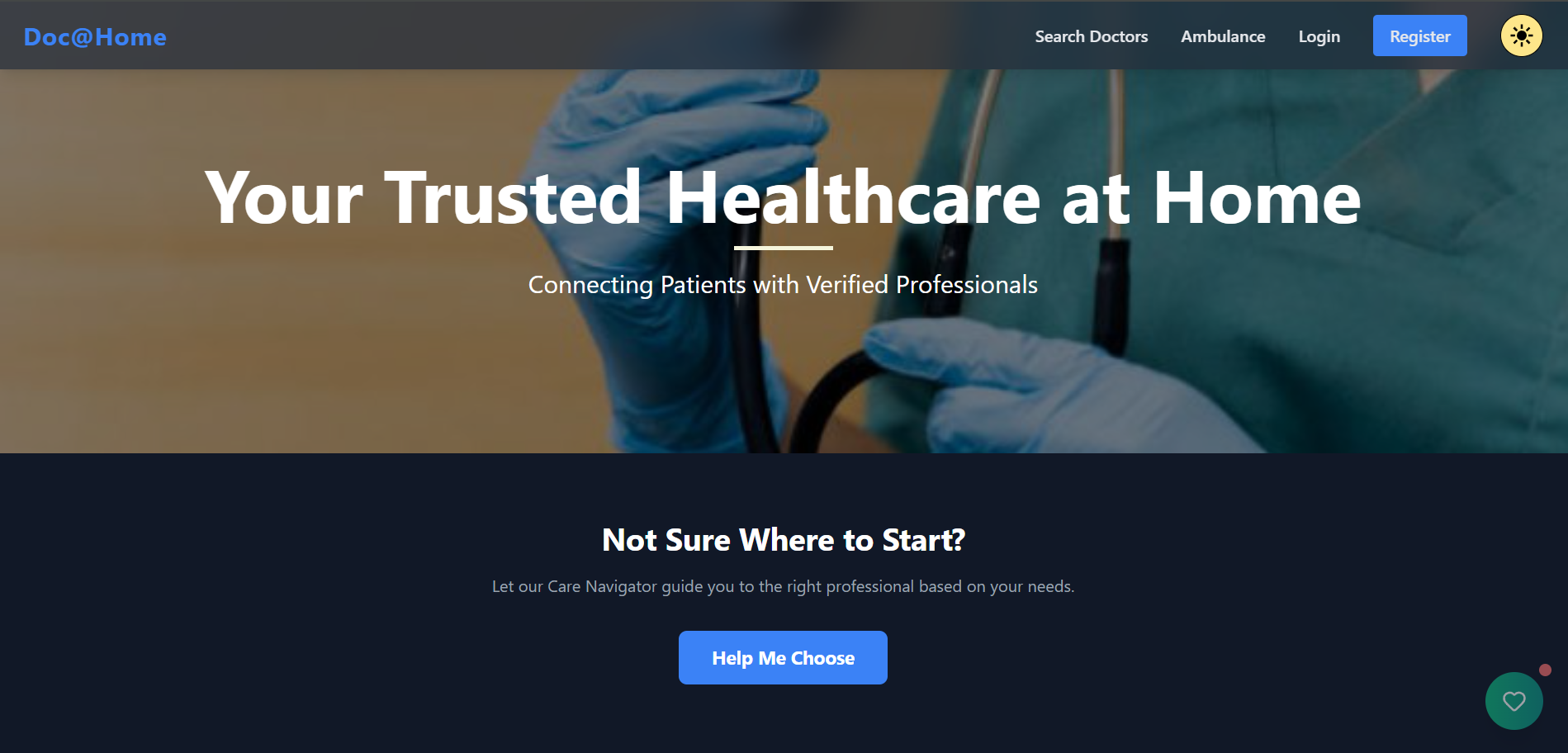
Doc@Home is an intelligent, end-to-end platform for booking and managing in-home healthcare services. For this hackathon, we supercharged the platform by designing and implementing a suite of AI agents to act as the "brains" of the operation:
The AI Triage Agent: This agent acts as an intelligent front line. It converses with patients, analyzes their symptoms in natural language, and asks clarifying questions to synthesize a concise, actionable brief for the doctor. This turns a 20-minute information-gathering call into a 2-minute review.
The AI Knowledge Agent: We built a public Q&A forum powered by an AI agent trained on a trusted medical knowledge base. It provides the community with instant, reliable answers to general health questions, democratizing access to information.
The AI Scribe & Summary Agents: We also architected the system for two future agents: one to transcribe consultations in real-time and another to summarize a patient's entire medical history into an at-a-glance brief for doctors.
How we built it
I architected Doc@Home from the ground up on the robust MERN stack (MongoDB, Express.js, React, Node.js). As a solo developer, I built the secure backend API with JWT-based authentication and designed a component-based React UI with Vite and Tailwind CSS for a seamless user experience.
For the hackathon, we focused on integrating the AI layer. We implemented the AI Triage and Knowledge agents, connecting our frontend to a backend powered by large language models, leveraging the principles of intelligent, conversational AI to reimagine the healthcare workflow.
Challenges we ran into
Building a full-stack application solo was a tremendous challenge. The biggest hurdle was debugging issues that spanned the entire stack a bug could be in the React state, the API call, the Express route, or the database query. I vividly remember battling a persistent CORS error on the live deployed site, which taught me invaluable lessons about how browsers, frontend servers (Netlify), and backend servers (Render) interact in a real-world production environment.
Accomplishments that we're proud of
Doc@Home is more than just code; it's a solution to a real, human problem, and we're incredibly proud that it was validated by its selection as an official project in the Girlscript Summer of Code (GSSOC) '25. For this hackathon, our proudest accomplishment is demonstrating a clear, powerful, and implemented vision for how AWS AI Agents can fundamentally transform a real-world industry, making healthcare more accessible, intelligent, and humane.
What we learned
This project was a deep dive into end-to-end web development. My key takeaways were:
The importance of a well-designed API: A clean API makes frontend development exponentially easier.
The power of a component-based UI: Building with reusable React components is the key to managing complexity.
Security is not an afterthought: I learned to build security in from the start, from hashing passwords with bcrypt to protecting routes with JWT middleware.
Resilience: The debugging process was often frustrating, but it taught me how to be a persistent and systematic problem-solver.
Doc@Home was an existing project, and per the rules, we made the following significant improvements during the hackathon submission period. All new code and features listed below were completed after the hackathon start date and can be verified through the commit history and pull requests in our GitHub repository (starting from late September 2025).
New Features Built for the AWS AI Agent Hackathon:
- Dynamic, AI-Driven Pre-Consultation Intake Form (Issue #213)
What we built: We implemented an intelligent intake form that goes far beyond static questions. It dynamically asks follow-up questions based on the patient's initial input, creating a comprehensive pre-consultation summary for the doctor.
How it uses AI: This feature is powered by an AI agent that analyzes the patient's symptoms in real-time. We are leveraging a large language model to understand the context and generate relevant next-step questions, significantly improving the quality of data collected before a consultation.
Impact: This saves doctors critical time and ensures they have a detailed, AI-summarized brief before ever speaking to the patient, leading to more efficient and accurate consultations.
Proof: [https://github.com/shandilya-rajnandini/DocAtHome/issues/213]
- Structured "Second Opinion" Service Workflow (Issue #218)
What we built: We engineered a complete, end-to-end user workflow that allows patients to formally request a second opinion from a different specialist on the platform. This includes case file submission, doctor matching, and a secure communication channel.
Impact: This adds a major new revenue stream and service offering to the platform, directly addressing a critical user need for complex medical cases. It significantly enhances the platform's value proposition.
Proof: [https://github.com/shandilya-rajnandini/DocAtHome/issues/218]
- Public Q&A Forum for General Health Questions (Issue #165)
What we built: We developed a community-focused Q&A forum where users can ask general health questions and receive answers from both medical professionals and an AI assistant.
How it can use AI: While professionals can answer, we've designed the backend to integrate an AI agent that can provide instant, curated answers to common questions, trained on a trusted medical knowledge base.
Impact: This feature drives user engagement, builds a community around the platform, and provides immediate value to users who may not need a full consultation.
Proof: [https://github.com/shandilya-rajnandini/DocAtHome/pull/231]
Additional Key Improvements During the Hackathon:
To further enhance the platform's functionality and user experience, we also completed the following during the submission period:
"Add to Calendar" Button (Issue #240): Integrated with Google Calendar and other services so users can directly add their confirmed appointments to their personal calendars.
Appointment Cancellation Policy (Issue #169): Implemented a full workflow for patients to cancel appointments, including policy enforcement and notifications.
Abstracted API Logic (Issue #185): Refactored our frontend by creating a reusable custom hook for API calls, making the codebase cleaner, more maintainable, and reducing redundant code by over 30%.
We believe these substantial updates demonstrate our commitment to the hackathon and significantly advance the project's capabilities as an AI-powered healthcare solution.
What's next for Doc@Home
This is just the beginning. Our next step is to fully implement the AI Scribe and Clinical Summary agents we architected during the hackathon. Following that, we plan to onboard our first cohort of medical professionals in Patna and begin a pilot program. Our long-term vision is to expand across India, city by city, and continue to leverage AI to make Doc@Home the most trusted and intelligent in-home healthcare platform in the country.
Built With
- axios
- bcrypt
- express.js
- git
- github
- javascript
- jwt-(json-web-tokens)
- mongodb
- mongoose
- netlify
- node.js
- react
- react.js
- render
- tailwind-css
- vite


Log in or sign up for Devpost to join the conversation.