-
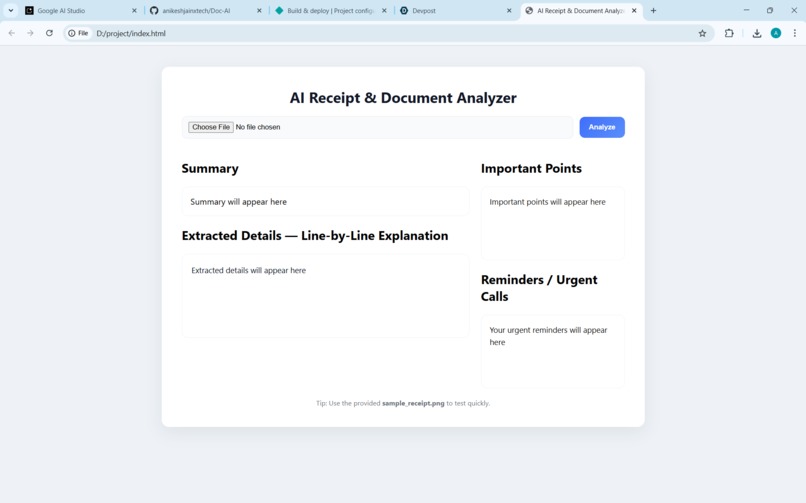
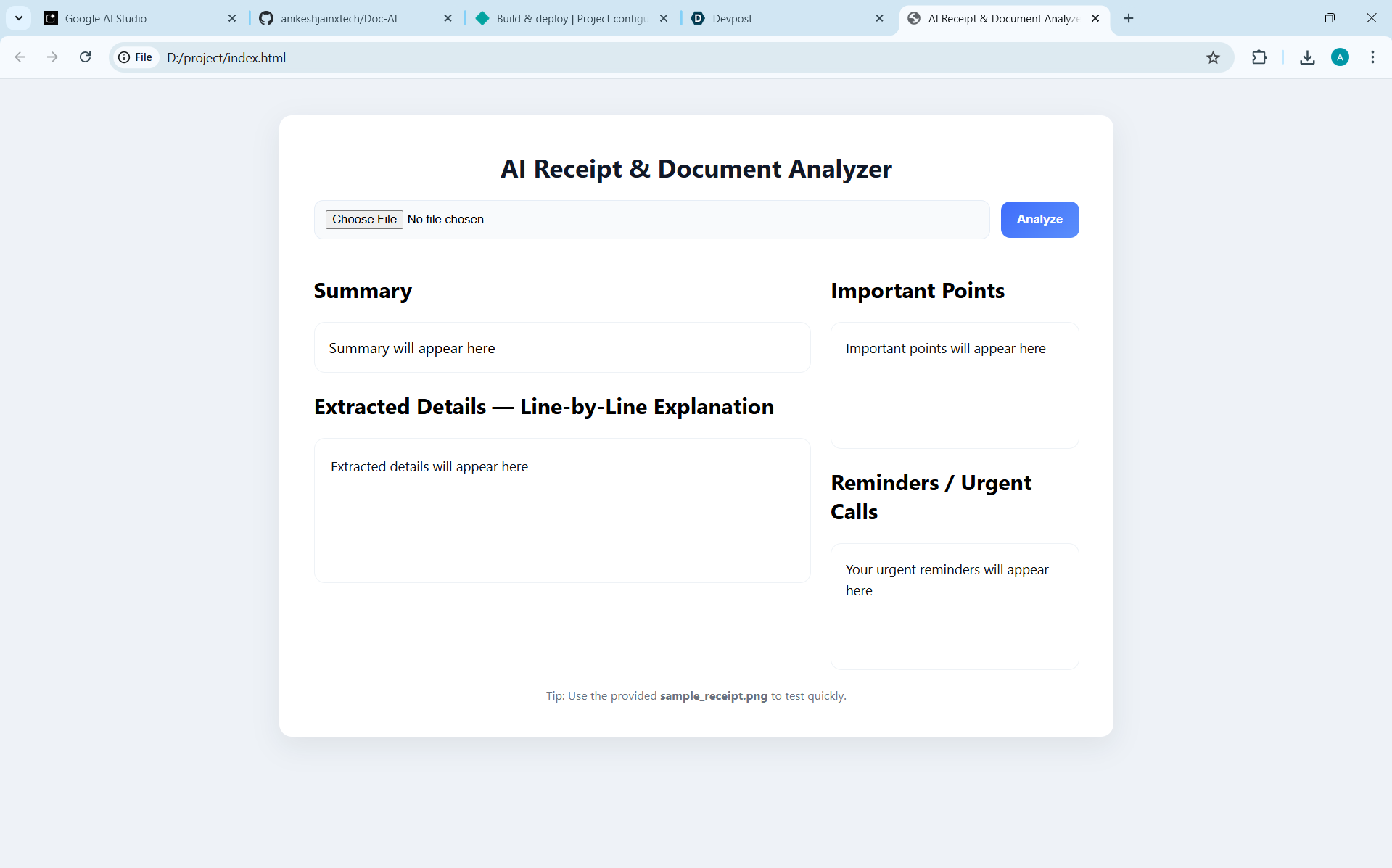
AI Receipt & Document Analyzer
Inspiration
The idea for Doc-AI came from noticing how difficult it can be to manage, search, and understand large collections of documents. Students, professionals, and businesses spend hours going through PDFs, notes, and reports. We wanted to create a tool that uses AI to simplify this process and help users get accurate information instantly.
What it does
Doc-AI allows users to upload documents and get quick insights, summaries, and answers to specific questions. It can extract key points, highlight important information, and provide clear explanations in natural language. The goal is to make document handling faster, smarter, and more interactive.
How we built it
We built Doc-AI using a combination of natural language processing, document-parsing libraries, and a lightweight web interface. The backend handles text extraction and sends it to an AI model trained for summarization and question-answering. The frontend was created using simple, user-friendly UI components to make the experience smooth.
Challenges we ran into
One major challenge was handling different document formats, especially PDFs with complex layouts. Ensuring accurate text extraction was difficult. Another challenge was optimizing the response times when dealing with large files. Finally, we had to fine-tune the AI’s responses to maintain accuracy and relevance.
Accomplishments that we're proud of
We’re proud that Doc-AI can process documents quickly and produce reliable summaries and answers. Building a tool that works smoothly for multiple document types was a big achievement. We are also happy with the clean user interface and overall user experience.
What we learned
We learned how important proper text extraction is for good AI performance. We also gained experience in integrating AI models with a web platform and handling edge cases like scanned documents. Overall, the project helped us better understand real-world applications of NLP.
What's next for Doc-AI
In the future, we plan to add features like multi-document comparison, voice-based queries, and support for scanned images using OCR. We also want to make the system faster and more scalable so it can handle large datasets effectively.


Log in or sign up for Devpost to join the conversation.