-
-
App Logo
-
UIUX Design User Flow
Inspiration
Digitalization has enabled shopping to happen from anywhere, even for those with disabilities who commonly use smartphones in modern times. Utilizing digital solutions to facilitate accessibility of beauty products for individuals with disabilities can not only enable shopping from anywhere but also ensure that everyone has access to the beauty products they need. This way, everyone can feel beautiful and confident.
What it does
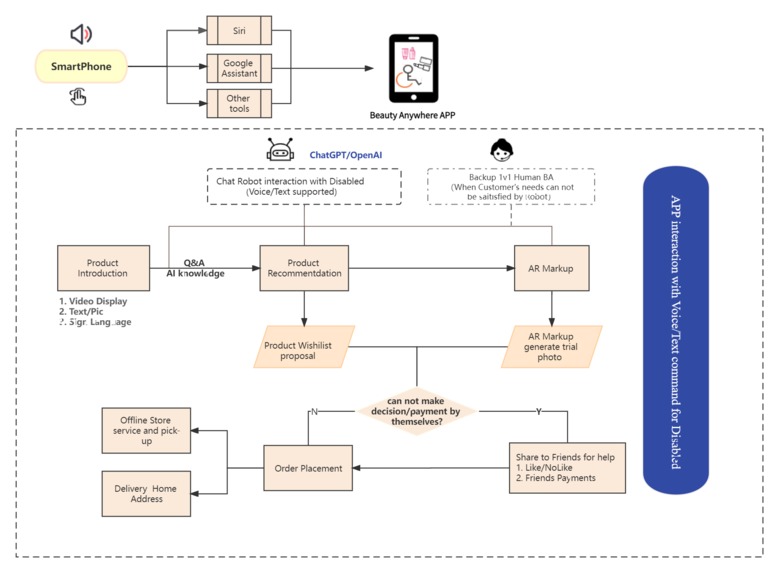
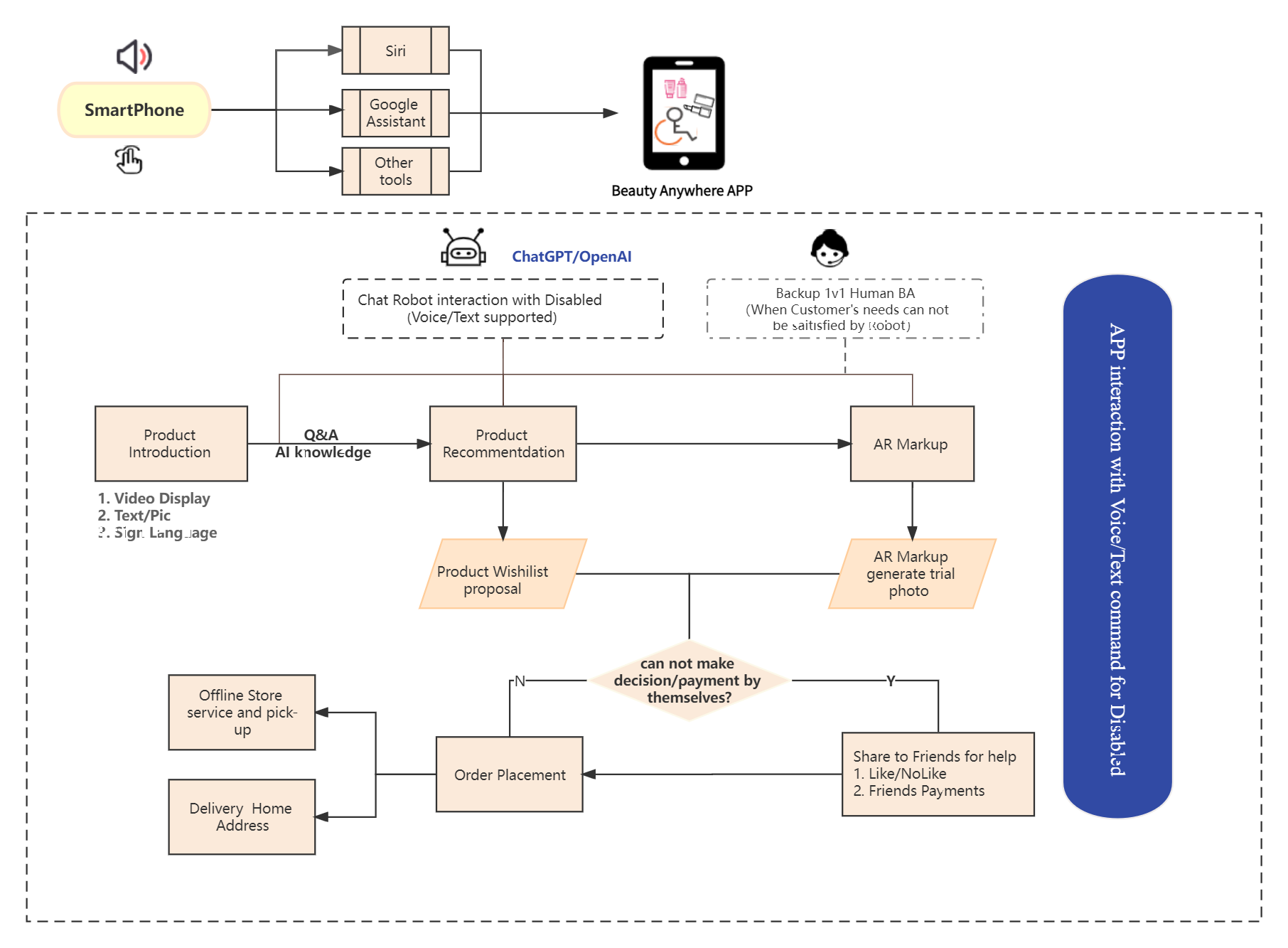
We are inspired to develop a mobile app specifically designed for disabled individuals, providing them with convenient access through tools such as Siri, Google Assistant, and others. Our app offers text, voice, sign language, and video to assist with product understanding. With the integration of ChatGPT and OpenAPI capabilities, we have implemented a chatbot to interact with users and provide product recommendations and shopping assistance. AR makeup trials allow for a more realistic experience. If a disabled user requires assistance in making a decision, they can share an AR makeup photo and product wishlist on their social media account for friends to vote on their preferred products. Payment options include online payment with the assistance of the chatbot, or reserving a BA service/guide in a physical store.
How we built it
- Understood the needs of the target audience: The first step was to understand unique needs and challenges of individuals with disabilities. Conducted research to identify the specific needs of our target audience, and sought feedback from them to ensure our app meets their needs.
- Made the app accessible: Accessibility should be a top priority when designing our app. This includes using clear, simple language and design, providing audio descriptions for images and videos, and ensuring the app is compatible with screen readers and other assistive technologies. Consider incorporating features such as voice commands or gesture controls that allow users to interact with the app without relying on fine motor skills.
- Provided convenient access through tools such as Siri and Google Assistant: Considered integrating our app with voice assistants such as Siri and Google Assistant, which can provide users with an alternative way to interact with the app. For example, users with limited mobility may find it easier to navigate the app using voice commands rather than tapping on small buttons.
- Tested and iterated: When our app was built, it's important to test it thoroughly with individuals with disabilities to ensure it meets their needs. Collected feedback and use it to make improvements and iterate on the app design.
- Promote the app: Finally, it's important to ensure that our app is promoted to the target audience through relevant channels, such as disability organizations and online forums. This did help to raise awareness of our app and made it more accessible to those who can benefit from it. ## Challenges we ran into
- Ensuring accessibility: Ensuring accessibility is one of the most significant challenges in designing an app for individuals with disabilities. Developers must ensure that the app is accessible to all users, regardless of their abilities. This includes incorporating features such as voice commands, gesture controls, and compatibility with screen readers and other assistive technologies.
- Designing for different types of disabilities: Individuals with disabilities have different needs and requirements. Designing an app that meets the needs of all users can be challenging, as some features that work for one type of disability may not work for others.
- Lack of user feedback: Individuals with disabilities may have unique challenges that are not apparent to developers. Therefore, it is essential to seek feedback from individuals with disabilities to ensure that the app is meeting their needs. ## Accomplishments that we're proud of
- Empowering individuals with disabilities: Our app designed specifically for individuals with disabilities can help empower them to take control of their lives and participate more fully in society, we can provide tools and resources to help them achieve their goals and live more independently.
- Raising awareness: By building this app, we helped raising awareness of the unique challenges faced by this population. The app can help educate the public and promote greater understanding and inclusion. ## What we learned
- Collaboration and teamwork: Building the app requires collaboration between stakeholders, including developers, disability advocates, and individuals with disabilities. This collaboration can help us learn about different perspectives and develop products that are more inclusive.
- User-centered design: Building an app specifically for individuals with disabilities requires a user-centered design approach that involves the target audience in the design process. This approach can help developers better understand the unique needs of this population and how to design products that meet their needs. ## What's next for Do BEAUTY Anywhere
- Launch and promotion: Once the app is thoroughly tested and refined, it can be launched and promoted to the target audience. Promotion can involve outreach to disability advocacy groups and marketing efforts to raise awareness and encourage adoption.
- Continuous improvement: To ensure that the app remains accessible and useful to users, it's essential to continuously improve and update it. This can involve incorporating user feedback, keeping up with the latest accessibility standards and technologies, and addressing any issues or bugs that arise.
- Expansion and scaling: If the app is successful, it may be worth considering expansion and scaling to reach a broader audience. This could involve launching the app in other regions, expanding its features and capabilities, and building partnerships with other organizations.
Built With
- apim
- azure-cloud
- chatgpt
- java
- lowcode
- microservice
- ocr-&-chatbot
- openai
- restful-api
- uiux
- vue-frame


Log in or sign up for Devpost to join the conversation.