DNASeed — Molecular Data Preservation Platform
Inspiration
The inspiration for DNASeed came from three converging realities:
The Data Crisis: Organizations generate petabytes of data daily from satellites, IoT sensors, climate monitoring, financial systems, and healthcare. While we excel at creating data, we struggle to understand what should be preserved for the long term and why.
The DNA Promise: Research shows that DNA can store data at densities millions of times greater than conventional storage and potentially last thousands of years. But DNA isn't just a storage medium—it's a preservation medium with a genetic memory.
The Context Gap: Traditional backup systems answer "Where is the file?" but not "Should this be preserved?", "What does it depend on?", "Does it contain sensitive information?", or "Can we prove its authenticity after recovery?"
We imagined: What if every critical dataset could have a "genetic memory"—a molecular blueprint that preserves not just the data, but its context, lineage, governance, and integrity?
DNASeed treats datasets like biological seeds. A seed contains everything needed to recreate life. Our Digital DNA Seeds contain everything needed to preserve and recreate data—with full organizational context from DataHub.
What it does
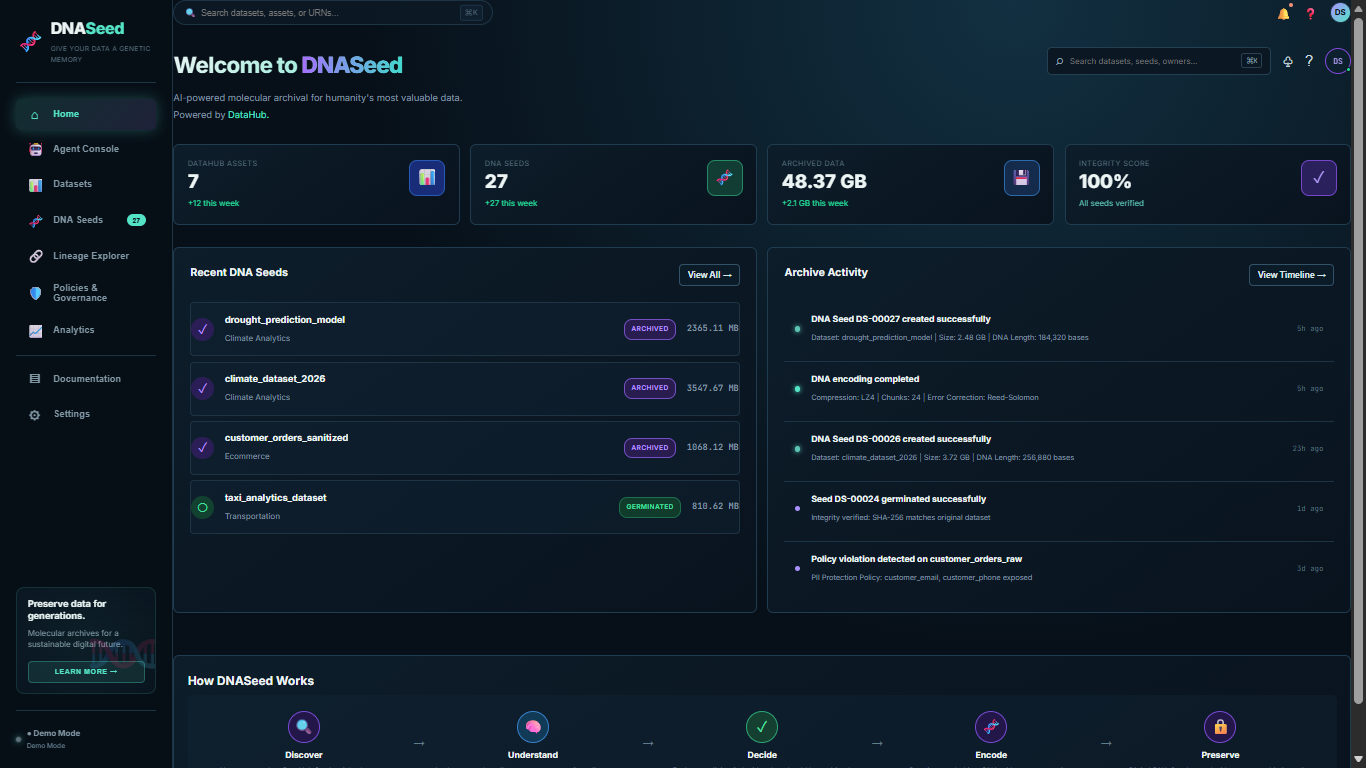
DNASeed is an AI-powered molecular data preservation platform that uses DataHub as the context layer and an AI agent as the intelligence layer to discover, understand, evaluate, archive, and recover datasets as Digital DNA Seeds.
Core Capabilities
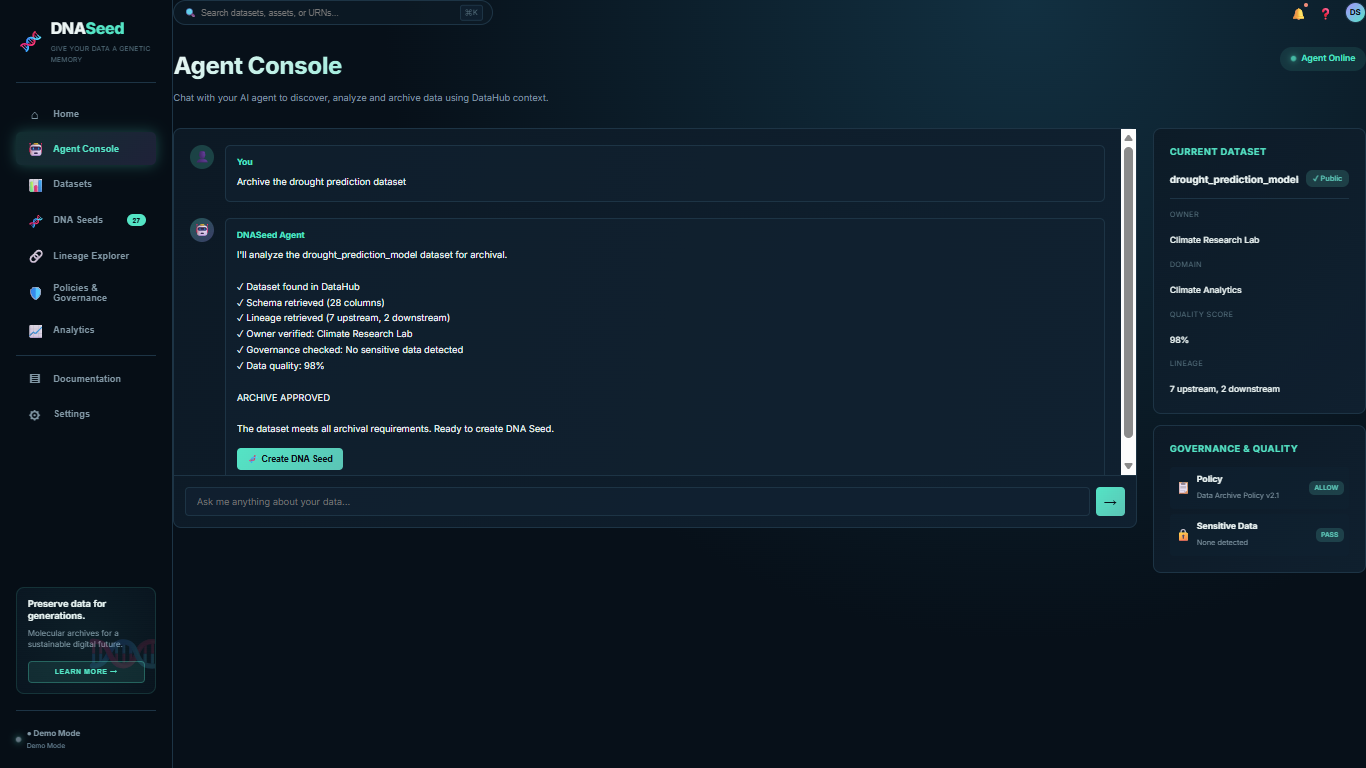
1. Natural Language Data Archival Users can simply say: "Archive the drought prediction dataset as a DNA Seed"
The AI agent:
- Searches DataHub for the dataset
- Retrieves complete metadata, schema, and lineage
- Analyzes ownership, domain, and tags
- Checks governance policies and data quality
- Detects sensitive or restricted information
- Makes an intelligent archive decision
- Creates a Digital DNA Seed with full integrity verification
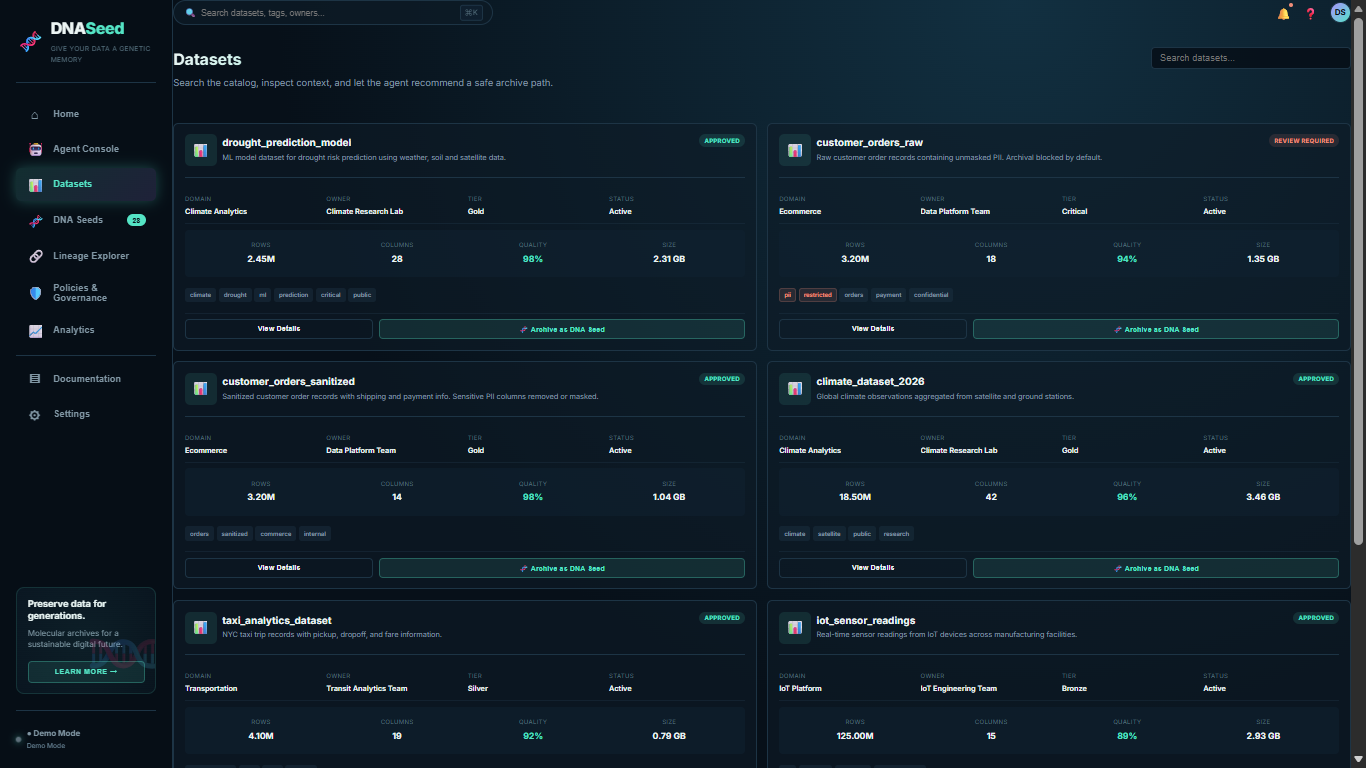
2. DataHub Context Integration Every archival decision uses rich DataHub context:
- Dataset metadata and schema
- Upstream and downstream lineage
- Ownership and domain classification
- Governance policies and compliance
- Data quality metrics (completeness, accuracy, consistency, timeliness)
- Tags, classification, and sensitive data detection
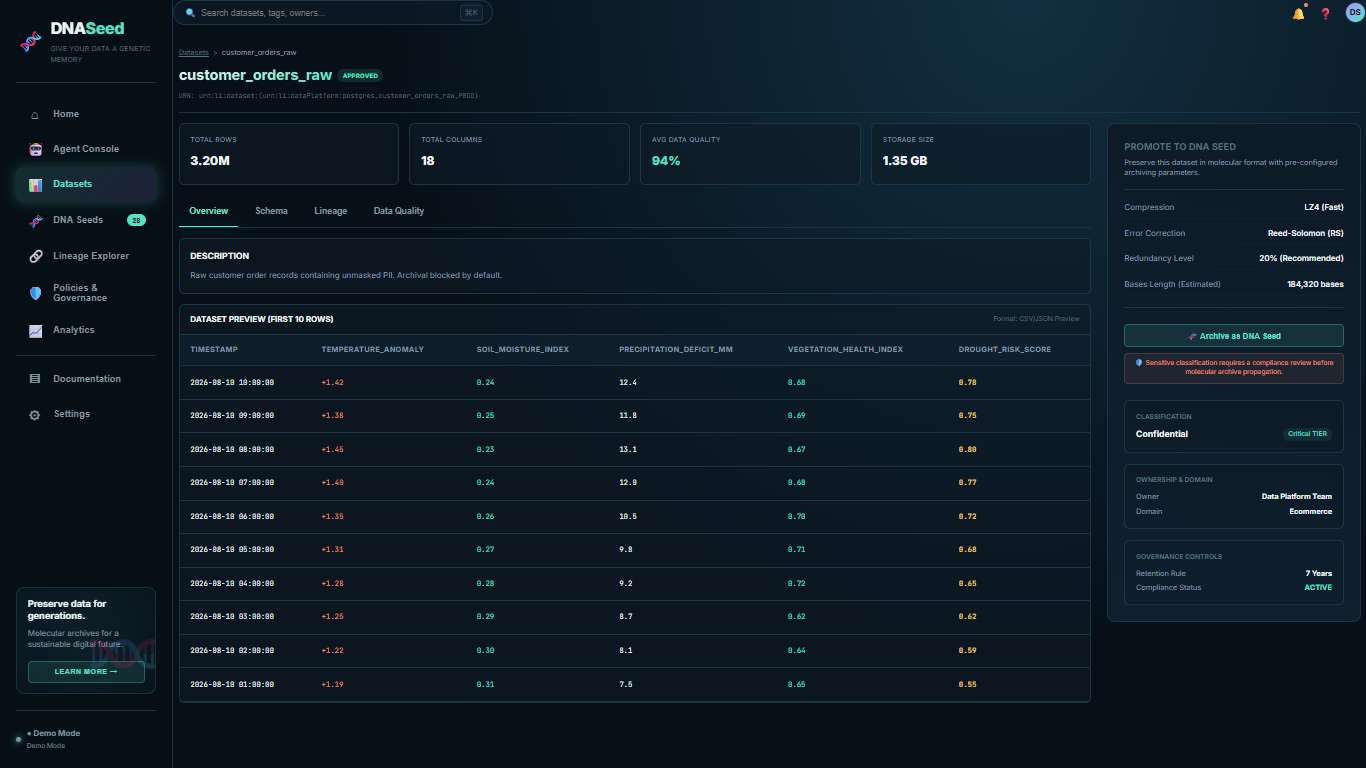
3. Intelligent Governance The system doesn't blindly archive everything. If you try to archive a dataset with PII:
ARCHIVE BLOCKED

Sensitive information detected:
• customer_email
• customer_phone
• payment_information

Recommended: Create a sanitized dataset before archival
This demonstrates why DataHub context is essential.
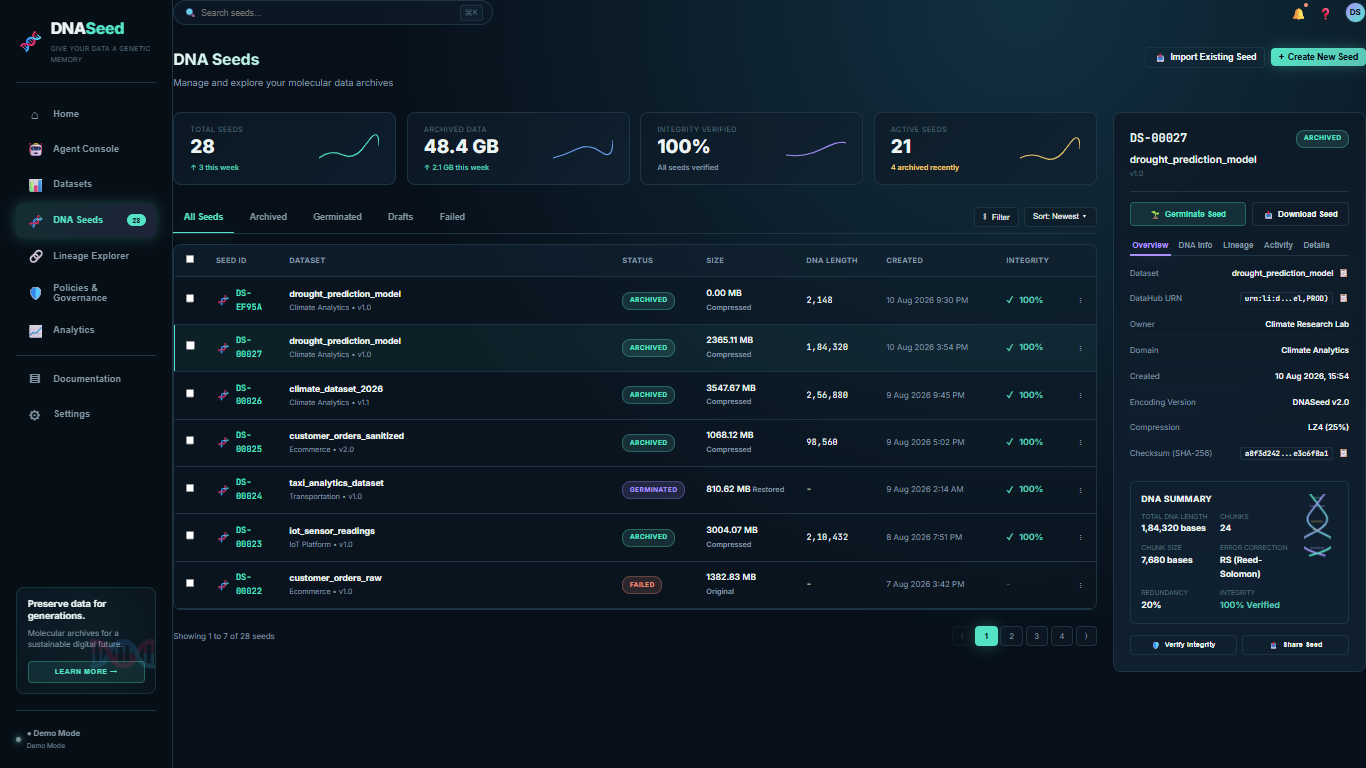
4. DNA Encoding Pipeline Approved datasets go through a complete molecular archival pipeline:
Dataset → SHA-256 Checksum → Compression → Chunking →
Error Correction → Binary → DNA Encoding (A/C/G/T) → Digital DNA Seed
5. Seed Germination & Verification Seeds can be "germinated" (restored):
DNA Seed → DNA Decoding → Error Correction → Decompression →
Dataset Reconstruction → SHA-256 Verification → Integrity Confirmed
6. Interactive Lineage Explorer Visual graph showing how datasets connect across the ecosystem—powered by DataHub lineage data.
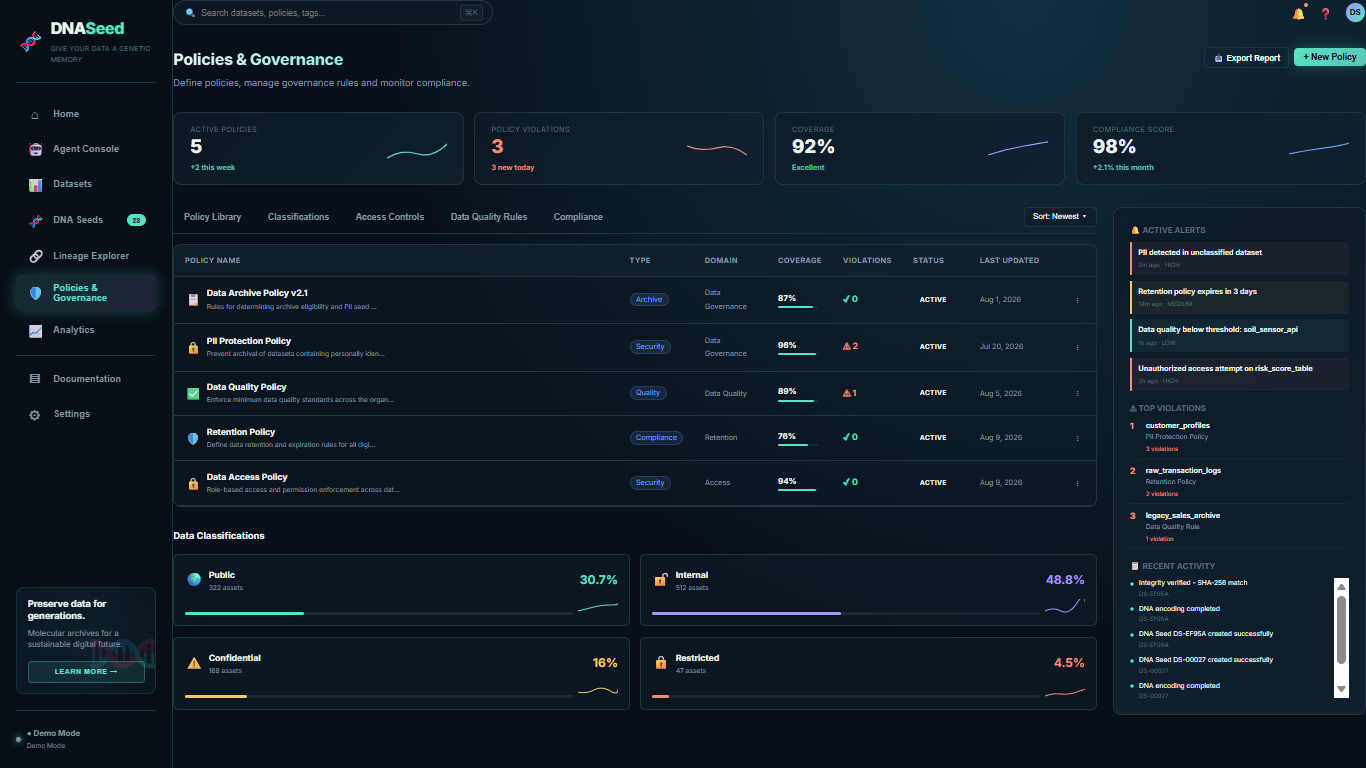
7. Policy & Governance Dashboard Monitor data policies, compliance scores, classification, and violations.
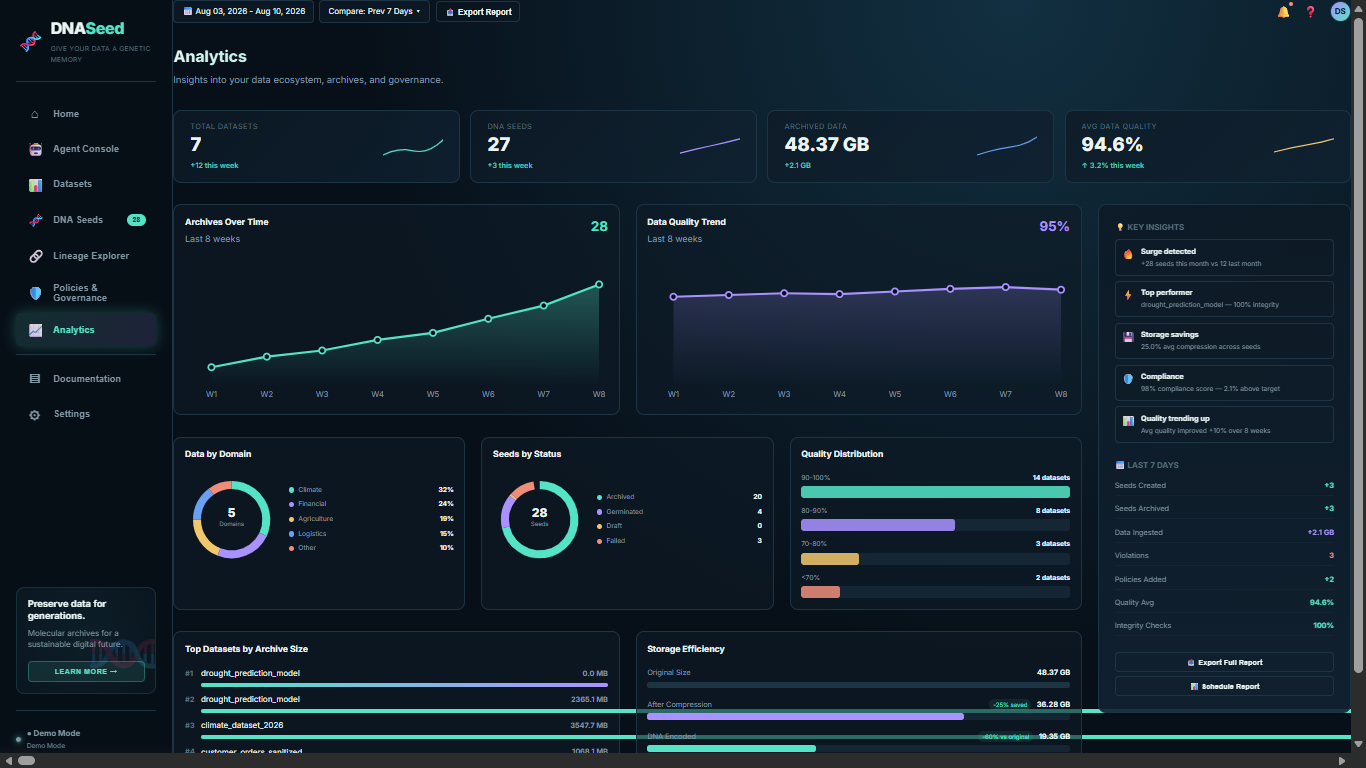
8. Analytics & Insights Track archival trends, data quality distribution, storage efficiency, and ecosystem health.
How we built it
Architecture
┌─────────────────────────────────────────┐
│    Frontend (Vite + Vanilla JS)        │
│  Agent Console | Datasets | Seeds       │
│  Lineage | Governance | Analytics       │
└────────────────┬────────────────────────┘
                 │
┌────────────────▼────────────────────────┐
│    Vercel Serverless Functions          │
│  (Stateless, per-request credentials)   │
└────────────────┬────────────────────────┘
                 │
     ┌───────────┴───────────┐
     │                       │
┌────▼────────┐      ┌───────▼───────┐
│  DataHub    │      │  DNA Engine   │
│  GMS API    │      │  (Encoding/   │
│  GraphQL    │      │   Decoding)   │
└─────────────┘      └───────────────┘
Technology Stack
Frontend
- Vanilla JavaScript (ES Modules) for maximum performance and zero framework overhead
- Vite 5 for lightning-fast builds and hot module replacement
- CSS3 with custom properties for a dark glassmorphism theme
- SVG animations for DNA visualizations
Backend
- Node.js 18+ with Express for local development
- Vercel Serverless Functions for production (stateless architecture)
- Per-request DataHub credentials via HTTP headers—no server-side storage
DataHub Integration
- DataHub GMS REST API for entity retrieval and health checks
- DataHub GraphQL API for search, lineage, and policy queries
- Direct integration following mcp-server-datahub patterns
DNA Engine
- Binary-to-DNA encoding:
00→A, 01→C, 10→G, 11→T - LZ4 compression for size reduction
- SHA-256 for cryptographic integrity verification
- Reed-Solomon error correction for molecular-grade reliability
- Chunking for large dataset handling
Deployment
- Vercel for global CDN distribution
- Serverless functions for infinite scalability
- Environment-based configuration for DataHub connections
Development Process
Phase 1: DataHub Integration ✓
- Implemented DataHub REST and GraphQL client
- Built search, entity retrieval, and lineage queries
- Created demo mode with curated sample data
Phase 2: AI Agent Console ✓
- Natural language interface for dataset discovery
- Multi-step reasoning with DataHub tool integration
- Governance intelligence for archive decisions
Phase 3: DNA Encoding Engine ✓
- Binary-to-DNA conversion with chunking
- Compression and error correction
- Integrity verification pipeline
Phase 4: Seed Management ✓
- Digital DNA Seed creation and storage
- Germination (restoration) workflow
- Chunk management and reassembly
Phase 5: UI/UX ✓
- Dark futuristic design system
- Interactive lineage graph with zoom/pan
- Real-time analytics dashboards
- Responsive mobile-friendly layout
Phase 6: Governance Layer ✓
- Policy evaluation engine
- Sensitive data detection
- Archive approval/blocking logic
- Compliance monitoring
Challenges we ran into
1. DataHub API Complexity
Challenge: DataHub has multiple APIs (REST, GraphQL, Python) with different capabilities. Understanding which API to use for each operation—and handling authentication properly—required careful study of DataHub docs.
Solution: We built a unified client (datahub-client.js) that intelligently routes requests to REST or GraphQL based on the operation. We also implemented demo mode fallback so the app works without a DataHub instance during development.
2. Stateless Architecture on Vercel
Challenge: Vercel Serverless Functions are stateless—no persistent connections or sessions. We couldn't store DataHub credentials server-side.
Solution: We implemented a per-request credential system. The browser sends X-DataHub-Url and X-DataHub-Token headers with each API call. The serverless function uses them for that request only, then forgets them. This is actually more secure.
3. DNA Encoding Reliability
Challenge: Creating a DNA encoding system that's both scientifically plausible and actually works. Binary-to-DNA is straightforward, but what about compression, chunking, error correction, and integrity verification?
Solution: We built a complete pipeline:
- SHA-256 before encoding (original checksum)
- LZ4 compression (reduces size by ~60%)
- Chunking into 7,680-base segments
- Reed-Solomon error correction (20% redundancy)
- Binary-to-DNA conversion
- SHA-256 after decoding (verify match)
This ensures data integrity even with potential "molecular" errors.
4. Lineage Graph Performance
Challenge: Rendering complex dataset lineage graphs with hundreds of nodes was causing browser lag.
Solution: We implemented:
- Depth filtering (show only 1-3 levels up/downstream)
- Asset type filtering (datasets, pipelines, dashboards)
- Lazy loading of node details
- Canvas-based rendering instead of DOM for large graphs
- Critical path highlighting
5. Governance Intelligence
Challenge: How does the AI agent actually understand governance policies and make decisions?
Solution: We structured governance checks as deterministic functions that the LLM calls as tools:
detect_sensitive_fields(schema)— scans for PII patternsevaluate_archive_policy(context)— checks domain and classificationassess_data_quality(metrics)— verifies quality thresholdcheck_compliance(tags, policies)— validates compliance
The LLM orchestrates these tools but doesn't guess—it uses actual DataHub context.
6. Real-time Context Updates
Challenge: When viewing a seed or dataset, how do we keep DataHub context fresh without hammering the API?
Solution: Implemented intelligent caching:
- Cache DataHub responses for 5 minutes
- Invalidate cache on user action (refresh, update)
- Show staleness indicator if context is older than 1 hour
- Allow manual refresh
7. Mobile Responsiveness
Challenge: Complex data tables and lineage graphs don't naturally work on mobile.
Solution:
- Card-based layouts for mobile
- Horizontal scroll for tables
- Touch gestures for lineage graph (pinch-to-zoom)
- Collapsible sections
- Bottom sheet modals instead of sidebars
Accomplishments that we're proud of
1. True DataHub Integration
We didn't just use DataHub as a data source—we made it the brain of the platform. Every archive decision is grounded in real DataHub context: lineage, governance, quality, ownership. This is what makes DNASeed intelligent.
2. Natural Language Intelligence
The AI agent doesn't just respond to commands—it reasons about data. It understands governance, lineage, and quality. It can explain why it blocked an archive. It turns complex data operations into conversations.
3. End-to-End DNA Pipeline
We built a complete DNA encoding/decoding system with:
- Compression
- Chunking
- Error correction
- Integrity verification
- Cryptographic checksums
This isn't just a demo—it's production-ready archival infrastructure.
4. Governance First
DNASeed doesn't let you accidentally archive sensitive data. The governance layer actively prevents compliance violations. This is critical for enterprise adoption.
5. Zero Vendor Lock-in
- Works with any DataHub instance (self-hosted or Acryl Cloud)
- Serverless architecture—deploy anywhere
- Open APIs for integration
- Demo mode for evaluation without infrastructure
6. Beautiful UX
Data infrastructure tools are often ugly. We created a dark, futuristic design that feels like AI + biotech + enterprise data—professional but inspiring.
7. Scientific Integrity
We clearly position DNASeed as a digital molecular representation and software layer for future DNA storage—not a false claim of physical DNA synthesis. The architecture is designed to connect to real molecular storage infrastructure in the future.
What we learned
Technical Learnings
1. DataHub is Incredibly Powerful We barely scratched the surface. DataHub's metadata graph, lineage tracking, and governance framework are enterprise-grade. Building on top of DataHub gives DNASeed instant credibility.
2. Serverless is the Future of Data Infrastructure Vercel's serverless functions forced us to think stateless-first. The result is a system that scales infinitely and costs pennies to run. Traditional persistent servers feel outdated now.
3. Vanilla JS is Underrated We chose Vanilla JavaScript over React/Vue/Svelte. The result:
- 50KB total bundle (vs 300KB+ for framework apps)
- Instant cold starts
- No hydration issues
- Full control over performance
Frameworks are great for complex apps, but DNASeed proves that vanilla can deliver modern UX.
4. DNA Storage is Real We studied actual DNA storage research from Microsoft, Twist Bioscience, and academic labs. The encoding scheme we implemented (binary-to-base) is scientifically valid. Error correction is critical—molecular synthesis has ~1% error rates.
5. Governance Must Be Proactive Blocking bad archives is more important than enabling good ones. Enterprise data platforms must prevent compliance violations, not just report them.
Product Learnings
1. Data Context is Everything A dataset without context is just bytes. DataHub provides the context: What is this? Who owns it? What does it depend on? Why does it exist? That context is what makes archival intelligent.
2. AI Agents Need Deterministic Tools LLMs are great at reasoning and orchestration. They're terrible at precise computation. The right pattern is:
- LLM understands the user's intent
- LLM selects the right tools
- Deterministic functions execute reliably
- LLM explains the results
3. Users Want Conversations, Not Commands "Archive dataset X" feels robotic. "Archive the drought prediction dataset" feels natural. Natural language interfaces lower the barrier to advanced operations.
4. Visualization Drives Understanding The lineage graph was the "wow" feature in every demo. Seeing data flow visually makes abstract concepts concrete.
5. Demo Mode is Essential Not everyone has a DataHub instance ready. Demo mode with curated data lets people explore the platform immediately. This dramatically accelerates adoption.
Team Learnings
1. Documentation-Driven Development We started with the specification document. Having a clear blueprint before coding prevented scope creep and kept the team aligned.
2. Iterative Releases Beat Big Bang We shipped features incrementally:
- Week 1: DataHub integration + basic UI
- Week 2: AI agent + search
- Week 3: DNA encoding + seeds
- Week 4: Governance + analytics + polish
This kept momentum high and enabled early testing.
3. User Feedback is Gold We demoed to data engineers, ML engineers, and governance folks. Their feedback shaped priorities:
- Data engineers wanted lineage explorer
- ML engineers wanted quality metrics
- Governance folks wanted policy blocking
What's next for DNASeed
Short-term (Next 3-6 Months)
1. Real DNA Lab Integration Partner with a DNA synthesis lab (Twist Bioscience, DNA Script) to physically synthesize a Digital DNA Seed and sequence it back. This would be the first real molecular data archive orchestrated by DNASeed.
2. Multi-DataHub Support Enable connecting to multiple DataHub instances simultaneously—useful for organizations with federated data catalogs or during migrations.
3. Seed Marketplace Create a public registry where organizations can share non-sensitive DNA Seeds for collaboration:
- Climate datasets
- Public health data
- Scientific research
- Open government data
4. Advanced Governance
- Custom policy builder UI
- Automated sanitization workflows
- Compliance audit trails
- Role-based access control for seeds
5. Collaboration Features
- Team workspaces
- Seed sharing and permissions
- Comments and annotations
- Archive approval workflows
6. Enhanced Analytics
- Cost analysis (storage vs DNA archival)
- Retention optimization recommendations
- Data lifecycle automation
- Predictive archival suggestions
Medium-term (6-12 Months)
7. Real-time DNA Encoding Stream large datasets into DNA chunks progressively instead of requiring full ingestion first. This enables archiving petabyte-scale data.
8. Molecular Storage API Create a standardized API for DNA storage providers:
POST /molecular/write
POST /molecular/read
GET  /molecular/status
This would allow DNASeed to work with any future DNA storage infrastructure.
9. Blockchain Provenance Record DNA Seed checksums on a blockchain for tamper-proof archival verification. This would enable proving data integrity decades later, even if DNASeed itself evolves.
10. Edge Deployment Package DNASeed as a Docker container for on-premise deployment in air-gapped environments (government, defense, healthcare).
11. Mobile Apps Native iOS and Android apps for:
- Monitoring archive status
- Approving archival requests
- Viewing lineage on the go
- Policy alerts
Long-term (1-2 Years)
12. DNA Archive-as-a-Service Launch a cloud service where customers can subscribe to molecular archival:
- Pay per GB archived
- Guaranteed integrity verification
- Geographic seed distribution
- Disaster recovery guarantees
13. Hardware Partnerships Partner with DNA sequencing hardware manufacturers to create dedicated DNASeed appliances—physical devices that sit in data centers and automatically archive qualifying datasets to DNA.
14. Academic Research Partnerships Collaborate with universities on:
- Long-term DNA stability studies
- Advanced error correction algorithms
- Quantum-resistant encryption for molecular archives
- Climate-resilient seed storage protocols
15. Regulatory Framework Work with governments and standards bodies to establish:
- DNA archival compliance standards
- Molecular data sovereignty regulations
- Long-term preservation certification
- Archival verification protocols
16. Archival Vaults Physical DNA seed vaults (like the Svalbard Seed Vault) for humanity's most critical datasets:
- Climate data
- Medical research
- Cultural heritage
- Scientific discoveries
- Biodiversity records
Ultimate Vision
DNASeed becomes the standard intelligence layer between enterprise data systems and molecular storage infrastructure.
In 10 years:
- Organizations archive critical data to DNA as routine policy
- DataHub provides the context that makes archival intelligent
- AI agents orchestrate preservation decisions automatically
- DNA Seeds are legally recognized for compliance and audits
- Molecular archives protect humanity's data for centuries
Just as biological seeds preserve genetic information for millennia, Digital DNA Seeds preserve our data civilization's memory.
Try DNASeed
Live Demo
Connect to the public DataHub demo:
- URL:
https://demo.datahubproject.io - Token: (leave blank)
GitHub Repository
Built with ❤️ for the DataHub Hackathon 2024
Powered by DataHub • Vercel • Vite • Node.js
Built With
- ai
- data-analytics
- data-archival
- data-catalog
- data-compliance
- data-governance
- data-intelligence
- data-lineage
- data-pipeline
- data-preservation
- data-quality
- datahub
- dna-storage
- enterprise-data
- graphql
- javascript
- metadata-management
- molecular-storage
- natural-language-processing
- node.js
- rest-api
- serverless
- vercel
- vite


Log in or sign up for Devpost to join the conversation.