-
-
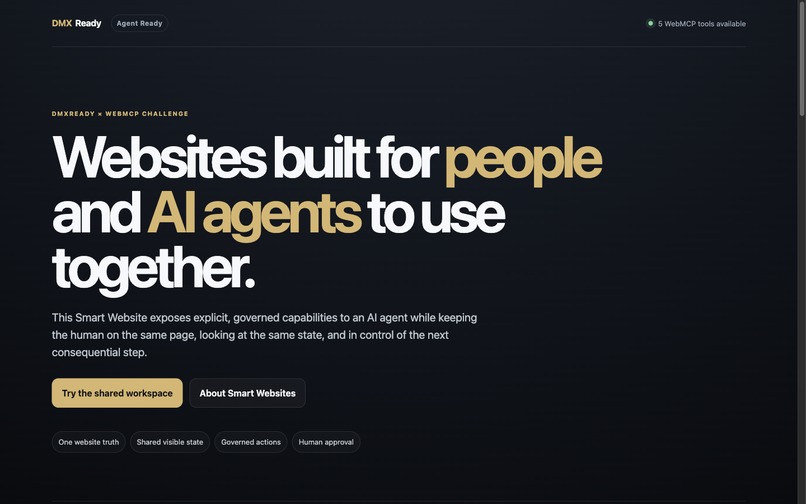
Five governed WebMCP tools available on the live Smart Website.
-
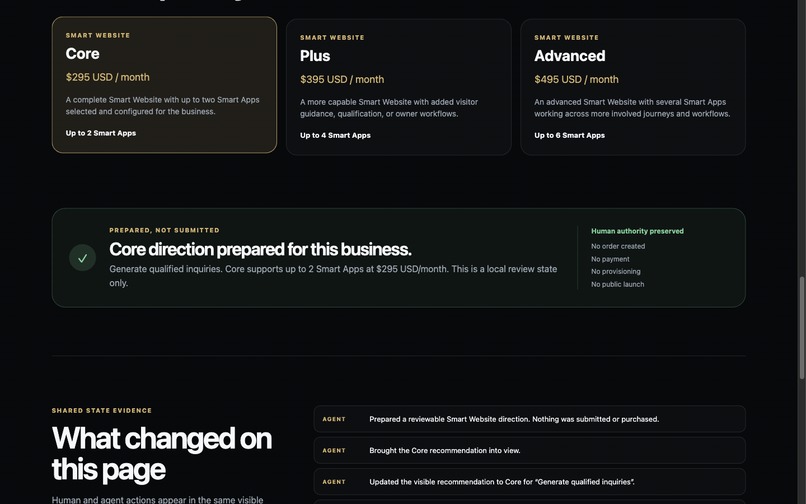
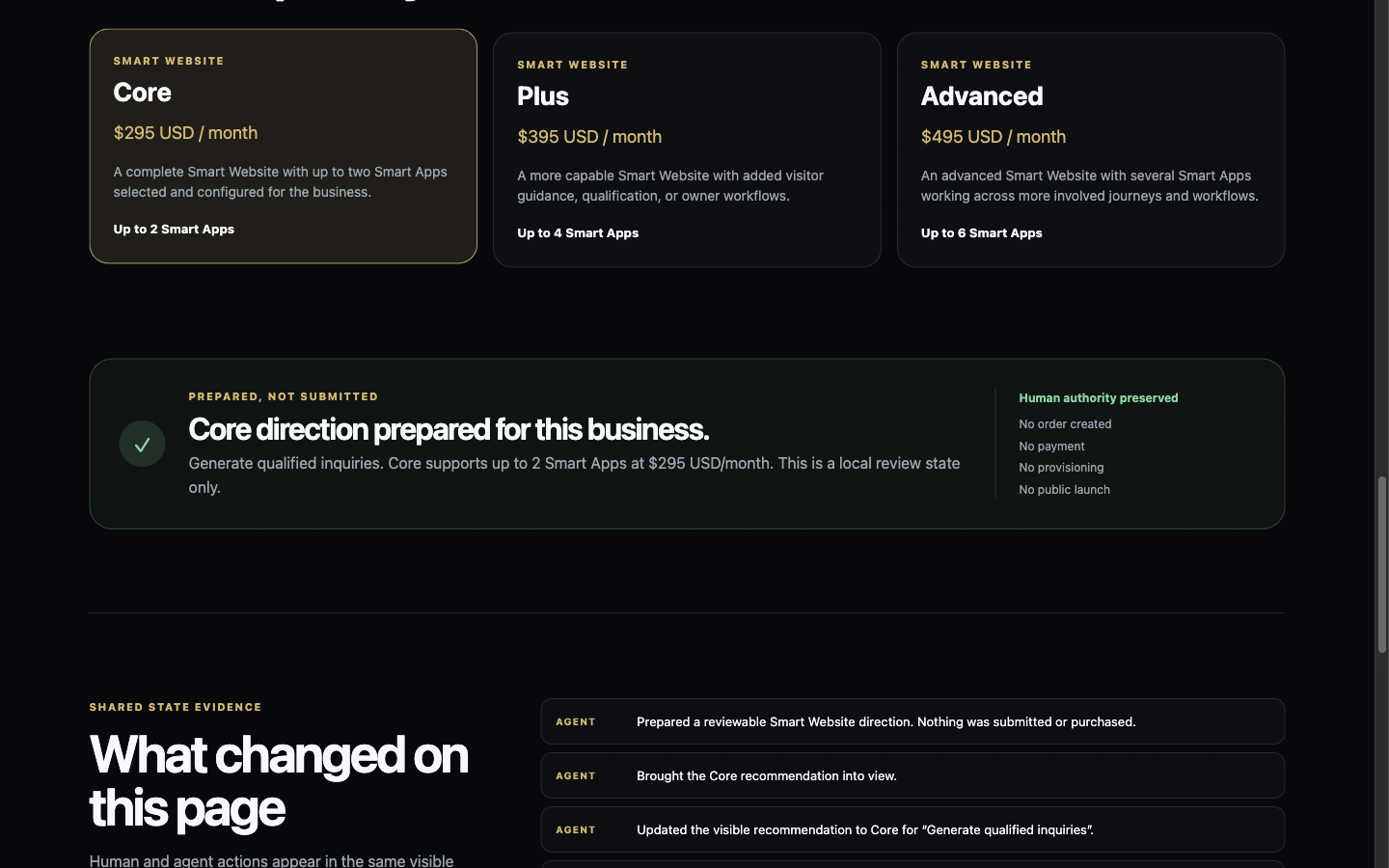
Agent-updated shared state with the Core $295 recommendation and human authority preserved.
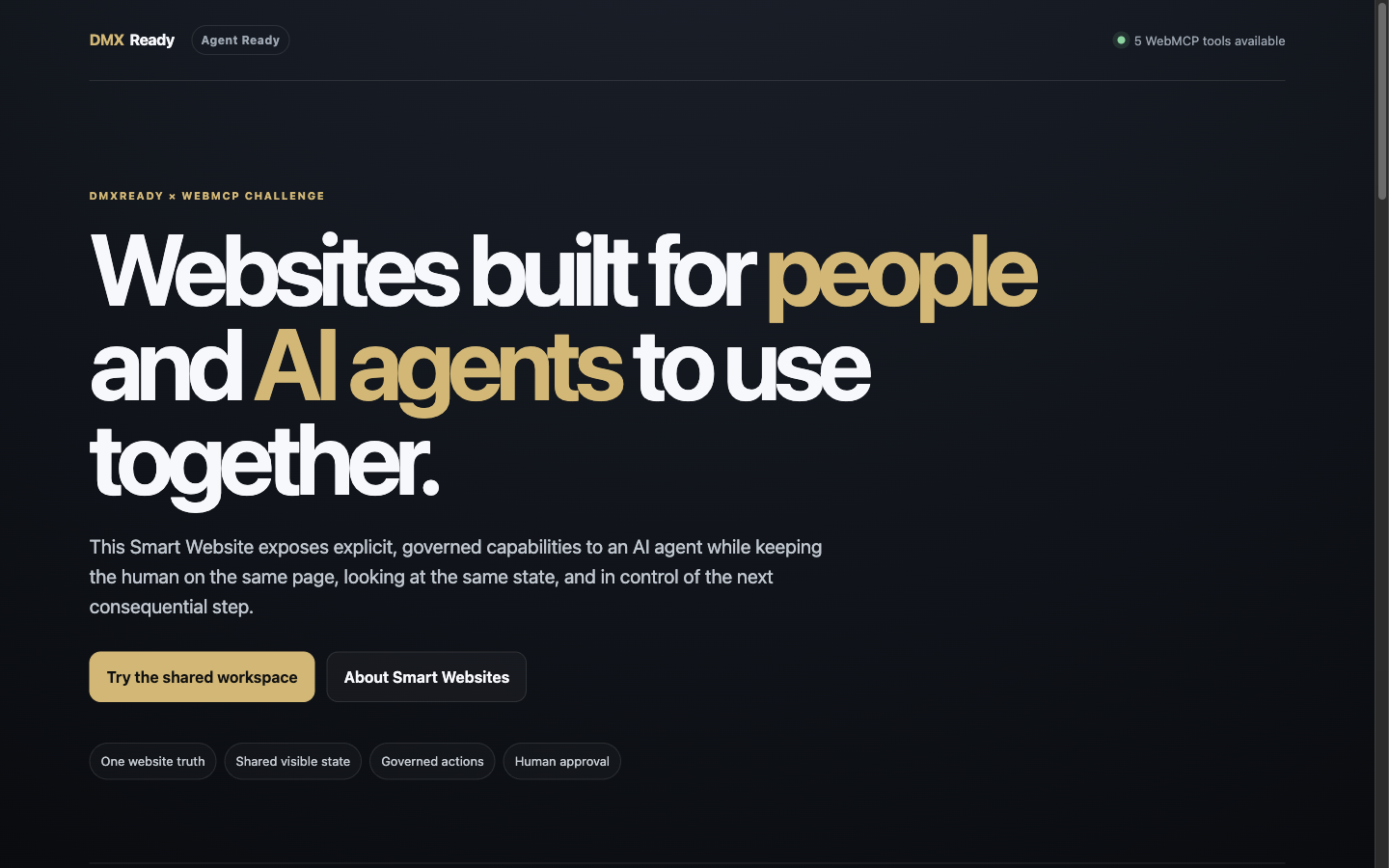
DMXReady Agent Ready
Websites are becoming interfaces for agents. DMXReady is the platform for building them.
Inspiration
Most AI website experiences still do one of two things: AI builds the page, or a chatbot is layered on top of it. We wanted to explore a different interaction model:
What if the website itself could declare useful actions to an AI agent while the person stayed on the same page, saw the same changes, and remained in control?
That is DMXReady Agent Ready.
What it does
The challenge app is a working Smart Website planning experience with five browser-native WebMCP tools. An agent can read the plan options, set the visitor's intent, compare the relevant choices, show the recommended path, and prepare that direction for human review.
Every tool updates the same visible website the person is using. There is no hidden agent-only result that leaves the person guessing about what happened.
Why WebMCP is a strong fit
Without WebMCP, an agent has to infer what a page can do from labels, buttons, forms, and page structure. WebMCP lets the page explicitly describe useful capabilities with structured schemas.
That improves the experience because:
- the agent can discover supported actions directly;
- tool inputs are structured and bounded;
- agent actions visibly update the same page;
- the person can continue from the result immediately; and
- the ordinary human experience still works when WebMCP is unavailable.
What people and agents can do together
A visitor can explain a real business goal in natural language and ask the agent to use the website. The agent can then inspect the options, apply the visitor's intent, compare the relevant plans, surface a recommendation, and prepare it for review while the visitor watches the website change.
The person remains in the experience rather than being sent through a separate chatbot flow or opaque automation.
Human authority by design
The final tool stops at Prepared, not submitted.
It does not create an order, charge money, provision a website, publish, change DNS, or approve launch. The challenge demonstrates useful agent capability while keeping consequential actions outside the reference flow.
How we implemented WebMCP
The live page registers five tools with document.modelContext.registerTool(...). Each tool has an explicit JSON input schema and calls existing page-level application functions rather than creating a second agent-only implementation.
Registrations use an AbortSignal, inputs are bounded and normalized, and the page fails closed if WebMCP is not available. The normal website remains functional in a standard browser.
Challenge-period work
DMXReady existed before August 25, 2026. The work being submitted for this challenge is the public Agent Ready WebMCP reference implementation and its human-agent interaction layer: tool registration, shared visible state, Activity evidence, tests, browser acceptance, and the submission proof package.
The pre-existing private DMXReady platform is not being submitted as challenge-period work and is not required to run this reference app.
What we learned
WebMCP is most compelling when it makes the website itself easier for an agent to use, instead of turning the agent into a screen-scraper or creating an entirely separate chatbot experience.
Our live Chrome acceptance exercised all five tools against the deployed page. The test journey resolved a plumbing-company scenario to the Core plan at $295/month, updated the visible state and Activity trail, and ended at prepared_not_submitted.
Why it matters
The web is becoming a place where people and agents will increasingly work together. Websites should be designed for that reality from the start.
Build the website once. Let people and authorized agents use it together.
Built With
- chatgpt
- css
- github
- html
- javascript
- next
- openai-codex
- render
- supabase
- webmcp


Log in or sign up for Devpost to join the conversation.