-
-
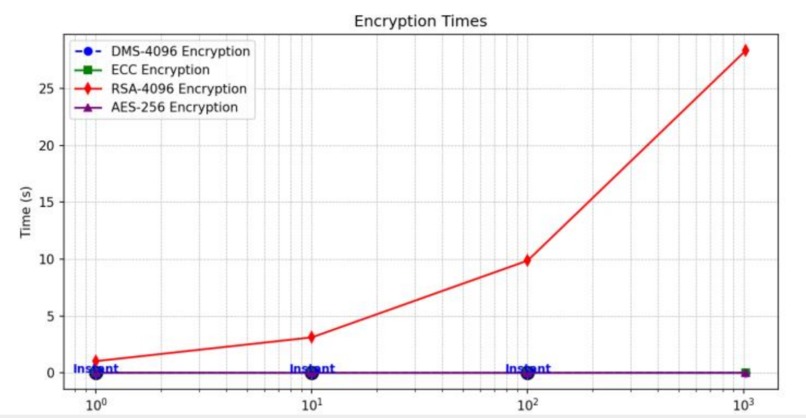
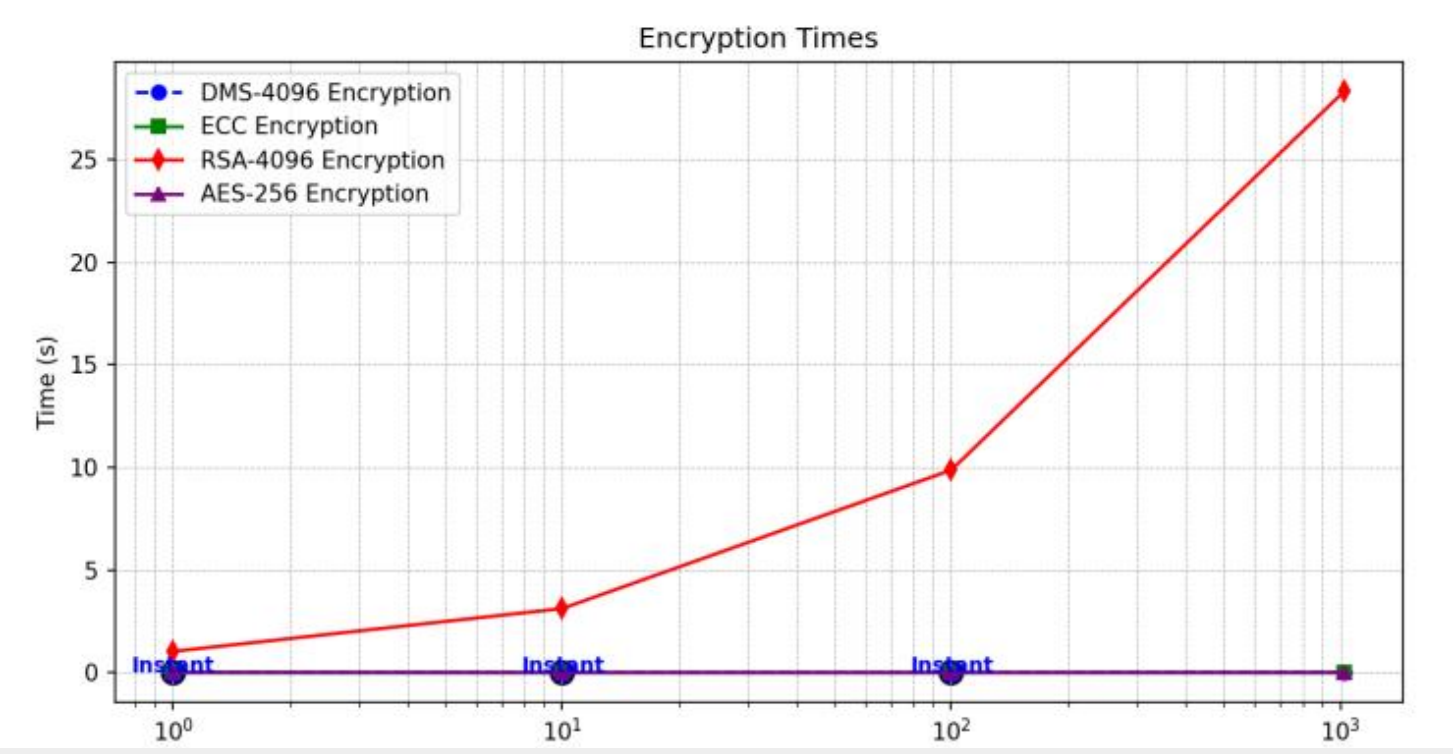
Encryption Speed Comparison
-
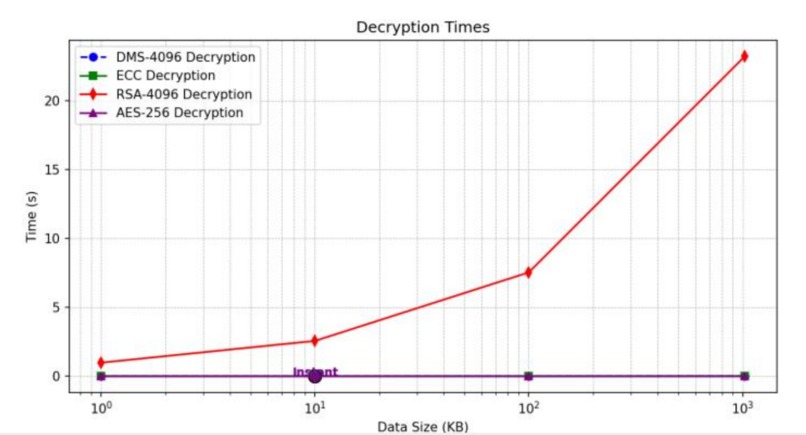
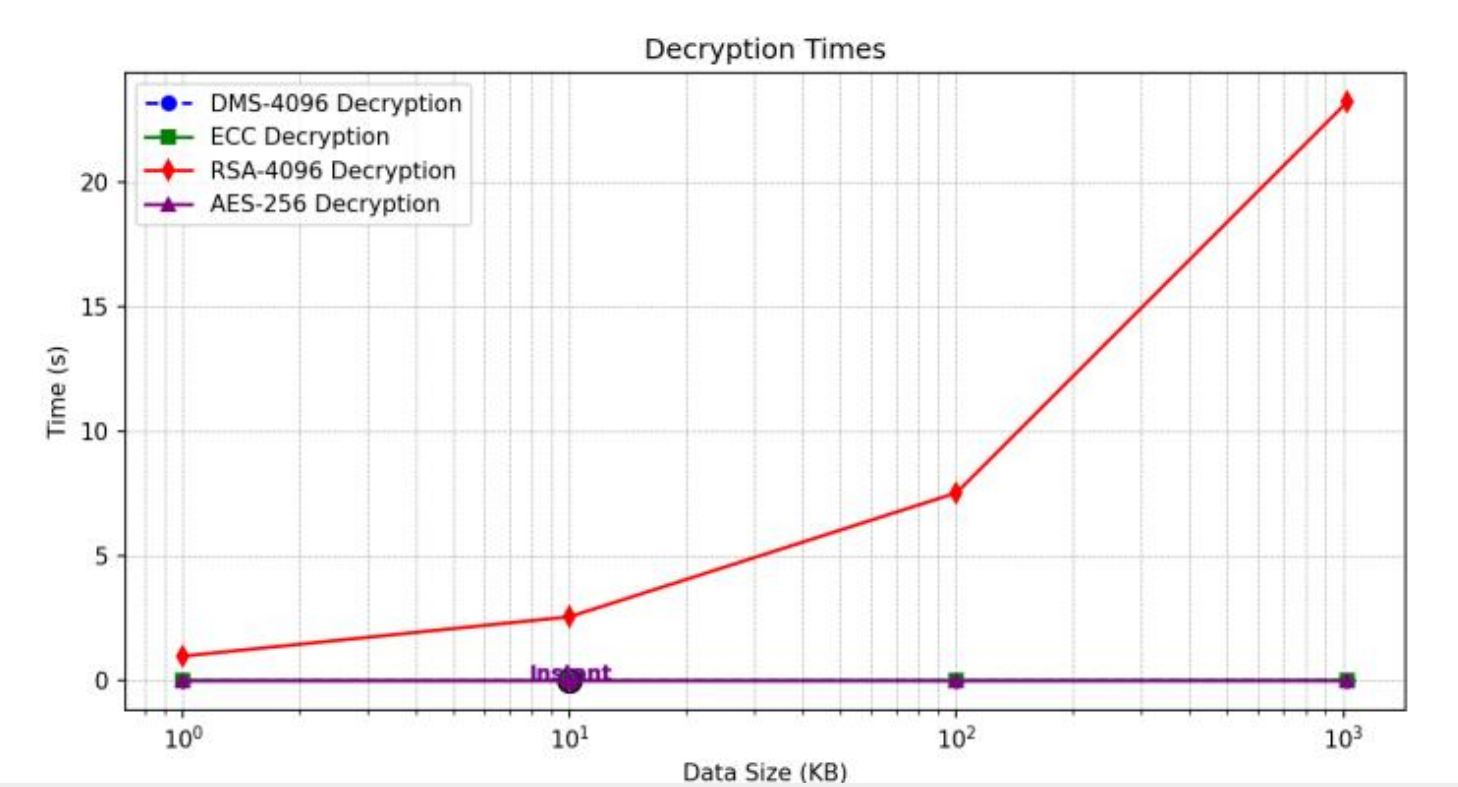
Decryption Speed Comparison
About the Project — DMS4096
Inspiration
Modern cryptographic systems often force an uncomfortable trade-off: either you get strong security with heavy computational cost, or you get speed with reduced cryptographic depth. While studying classical symmetric algorithms like AES and their deployment in real-world systems (cloud workloads, cache-heavy architectures, constrained environments), I noticed that most implementations optimize around hardware, not around cryptographic adaptability.
DMS4096 was inspired by a simple but ambitious question:
Can we significantly increase cryptographic strength and diffusion without breaking real-time performance constraints?
That question became the foundation of this project.
What I Learned
Building DMS4096 forced me to go far beyond textbook cryptography.
Key learnings include:
- How diffusion and confusion actually behave in multi-round encryption, not just theoretically but empirically.
- Why key expansion quality often matters more than raw key size.
- How cache behavior, memory access patterns, and XOR chaining influence both performance and side-channel resistance.
- How to evaluate encryption not just by security claims, but by time complexity, entropy propagation, and scalability.
Most importantly, I learned how to design a system that is defensible under scrutiny, not just impressive on paper.
How I Built the Project
DMS4096 is designed as a multi-stage symmetric encryption architecture rather than a single monolithic cipher.
High-Level Design
At a high level, the system operates as follows:
Key Initialization
- A 4096-bit master key is generated.
- The key is expanded into multiple round keys using a controlled expansion mechanism that prioritizes entropy spread and resistance to correlation attacks.
Block Processing
- Data is divided into fixed-size blocks.
- Each block undergoes multiple transformation rounds involving:
- XOR chaining
- Substitution and permutation layers
- Inter-round dependency to prevent independent block analysis
Chaining & Diffusion
- Inspired by CBC-like principles, each encrypted block influences the next, ensuring that: [ C_i = E(P_i \oplus C_{i-1}, K_i) ] where (P_i) is plaintext, (C_i) is ciphertext, and (K_i) is the round-specific derived key.
Performance Optimization
- Operations are intentionally chosen to be CPU-cache friendly.
- The design avoids expensive asymmetric primitives during encryption, allowing real-time execution.
Why 4096?
The 4096-bit key size is not about brute-force resistance alone. It enables:
- Deep key expansion without entropy reuse
- Strong resistance to future cryptanalytic advances
- A large security margin suitable for long-term data protection
Challenges I Faced
1. Balancing Security and Speed
Increasing rounds and diffusion improves security but hurts performance. Finding the minimum structure that maximizes entropy propagation was the hardest design challenge.
2. Avoiding Over-Engineering
It’s easy to make encryption look complex. The real challenge was ensuring every operation had a clear cryptographic justification, not just added noise.
3. Threat Modeling
I had to clearly define what DMS4096 protects against:
- Brute-force attacks
- Known-plaintext attacks
- Pattern leakage in structured data
…and just as importantly, what it does not claim to solve.
4. Validation
Without relying on black-box claims, I focused on:
- Comparative performance testing
- Structural analysis against standard modes
- Reproducibility and clarity, so others can evaluate the design independently
Closing Thought
DMS4096 is not an attempt to replace existing standards overnight. It is a research-driven, implementation-aware cryptographic system that demonstrates how stronger security margins can coexist with practical performance.
This project represents my approach to engineering:
deeply technical, experimentally grounded, and designed to survive hard questions.

Log in or sign up for Devpost to join the conversation.