-
-
Theme
-
Architecture
DLyog IPChecker
An AI Experiment for the AWS Lambda Hackathon 🚀🧠
Ship software, not subpoenas.
🌟 Inspiration
Today’s engineers live on copy‑paste culture: GitHub gists, Stack Overflow code, open‑source libraries, AI‑generated snippets. All that velocity hides a legal iceberg—copyright, patent, or trademark violations that surface later as nasty cease‑and‑desist letters. We built DLyog IPChecker to be a single‑command, developer‑first guardrail: warn you of potential IP landmines before deploy day and let you keep shipping at top speed.
⚙️ What It Does
- CLI Push –
python cli/dlyogipchecker.py "/path/to/your/project"selects the 10 most recent source files, zips them, and uploads to S3. - S3 Event – the upload instantly fires an AWS Lambda function (no polling, no servers).
- AI Scan – Lambda unzips and calls Perplexity Sonar‑Pro once per file for deep semantic IP analysis.
- HTML Report – Lambda assembles a Tailwind‑styled, color‑coded report and emails it to you in minutes.
Result: instant peace of mind without slowing your pipeline.
🛠️ How We Built It
| Layer | Tech Choices | Why It’s Cool |
|---|---|---|
| CLI | Python 3.11, Typer, boto3 | Smart ignore rules (.git, node_modules, venvs); bundles only high‑signal files to keep token costs low. |
| Storage + Trigger | Amazon S3 event notifications | Bucket both stores bundles and triggers Lambda—zero extra infra. |
| Compute | AWS Lambda (Python 3.11 runtime) | Stateless, scales instantly; 15‑minute timeout guard with graceful skip logic if time runs low. |
| AI Engine | Perplexity Sonar‑Pro API | Returns structured JSON (summary, validation, verdict) for reliable post‑processing. |
| Report Delivery | SMTP (Gmail / Amazon SES) | CSS inlined for bullet‑proof rendering across Gmail, Outlook, Apple Mail. |
| CI / CD | GitHub Actions | Two workflows: 1_deploy_infra (IaC bash script) and 2_deploy_lambda (package & update code). |
| IAM / Security | Least‑privilege role, inline S3 policy, secrets in GitHub | Nothing hard‑coded; credentials live only in GitHub Secrets. |
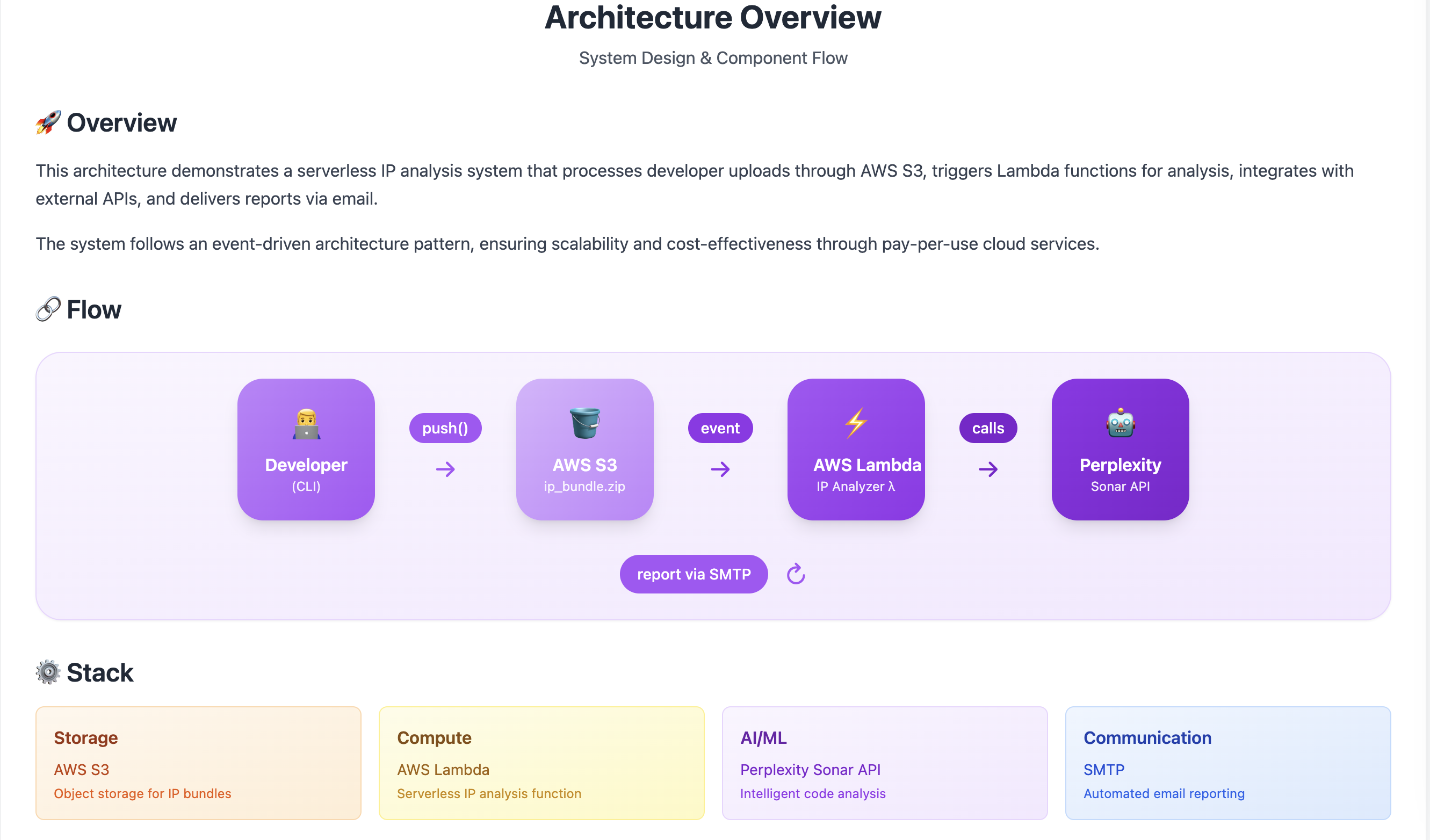
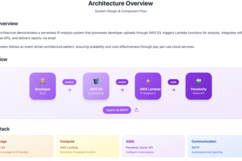
🖼️ Architecture at a Glance
┌──────────────┐      push()      ┌───────────────┐     event     ┌────────────────┐   calls   ┌──────────────┐
│  Developer   │ ────────────▶  │    AWS S3     │ ────────────▶ │   AWS Lambda   │ ────────▶ │ Perplexity  │
│   (CLI)      │                │  ip_bundle.zip │              │  IP Analyzer λ │           │  Sonar API  │
└──────────────┘                └───────────────┘              └────────────────┘           └──────────────┘
         │                                                                               │
         └────────────────────────── report via SMTP ────────────────────────────────────┘
🏗️ Infrastructure‑as‑Code Highlights
create_infra.sh(triggered by1_deploy_infra.yml)- Creates/validates the S3 bucket.
- Provisions the Lambda IAM role, attaches AWSLambdaBasicExecutionRole + an inline S3‑only policy.
- Grants S3 permission to invoke Lambda (
lambda:AddPermission). - Configures an ObjectCreated notification limited to the
ip_bundles/prefix.
2_deploy_lambda.yml- Zips
handler.py+ dependencies, uploads to the bucket. - Creates the Lambda on first run or updates it thereafter.
- Injects all environment variables (SMTP, Sonar key, target email).
- Tunes timeout (900 s) and memory (256 MB).
- Zips
One merge or Run workflow button redeploys the entire stack—no console clicks, ever.
🚧 Key Challenges
- Token & timeout juggling – chunking large files and early‑exit guard when <60 s runtime remains.
- Cross‑client HTML – achieving identical rendering in Gmail, Outlook, and iOS Mail.
- Idempotent IaC – scripts safe to rerun without duplicate resources.
🏆 Accomplishments
- One‑command IP scan with zero persistent servers.
- End‑to‑end GitHub Actions pipeline: infra → code → env vars → ready to run.
- Tailwind‑styled email that even hackathon judges compliment.
- Costs ≈ $0 under AWS free tier; scales automatically for future SaaS expansion.
📚 What We Learned
- Good prompt engineering turns raw AI chatter into deterministic JSON.
- Memory ↑ in Lambda doubles CPU, slashing HTTP round‑trip time.
- Treating S3 as a message bus keeps the architecture minimal yet powerful.
🗂️ Scalability Roadmap
Our hackathon build processes up to 10 files in a single Lambda run. To scale toward full‑size repos without hitting the 15‑minute ceiling we will adopt an AWS Step Functions fan‑out / fan‑in pattern:
- Lambda‑A (Bundle‑Splitter) – triggered by S3, lists every file (or 3 000‑character chunk) and starts a Step Functions execution.
- Map State – spins up Lambda‑B (Analyzer) in parallel for each item (default concurrency ≈40, easily raised). Each worker calls Perplexity Sonar on just its slice, finishing well under timeout even for big repos.
- Lambda‑C (Report‑Merger) – automatically invoked by the Step Function’s reduce phase; aggregates JSON outputs, assembles the Tailwind HTML report, and emails it.
Why this works
- Parallel shards keep individual Lambda runs tiny—that means faster cold starts and deterministic per‑file time budgets.
- Built‑in retries on a per‑branch basis salvage partial results instead of failing the whole job.
- Memory → CPU scaling: Analyzer Lambdas can be bumped to 1 GB to squeeze HTTP latency without wastefully over‑provisioning the merger.
This architecture lets us elastically analyse hundreds of files while staying firmly inside AWS free‑tier limits for typical use‑cases.
🚀 Next Steps
- SPDX license detection + auto‑generated OSS attribution.
- GitHub PR bot that comments inline on suspect lines.
- Web dashboard with historical trends and risk heat‑map.
- Slack / Teams notifications and org‑level multi‑tenant SaaS.
Built with
Python, Typer, boto3, AWS Lambda, Amazon S3, AWS IAM, Amazon CloudWatch Logs, GitHub Actions, Perplexity Sonar API, SMTP (Gmail / SES), HTML, CSS, Requests, Zipfile
📝 Disclaimer
This project uses an AI model to assist with intellectual property risk identification. The results may contain inaccuracies. For legally binding advice or professional review, consult a qualified IP attorney.
Built With
- amazon-web-services
- aws-iam
- aws-lambda
- boto3
- css
- github-actions
- html
- perplexity-sonar-api
- python
- requests
- smtp
- smtp-(gmail/ses)
- typer

Log in or sign up for Devpost to join the conversation.