-
-
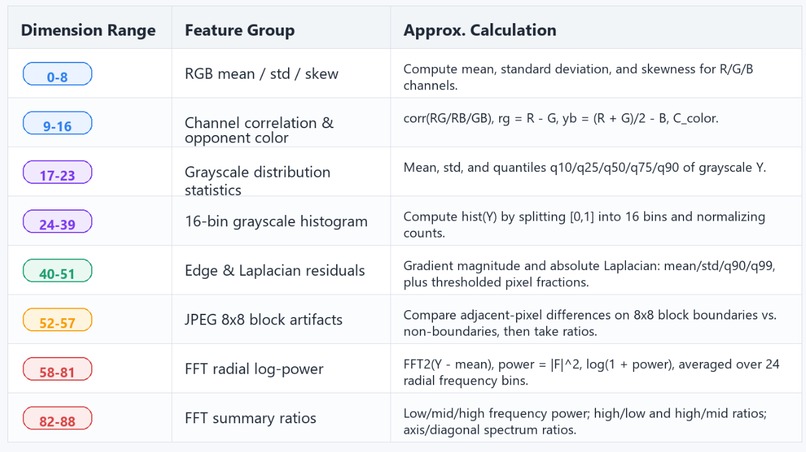
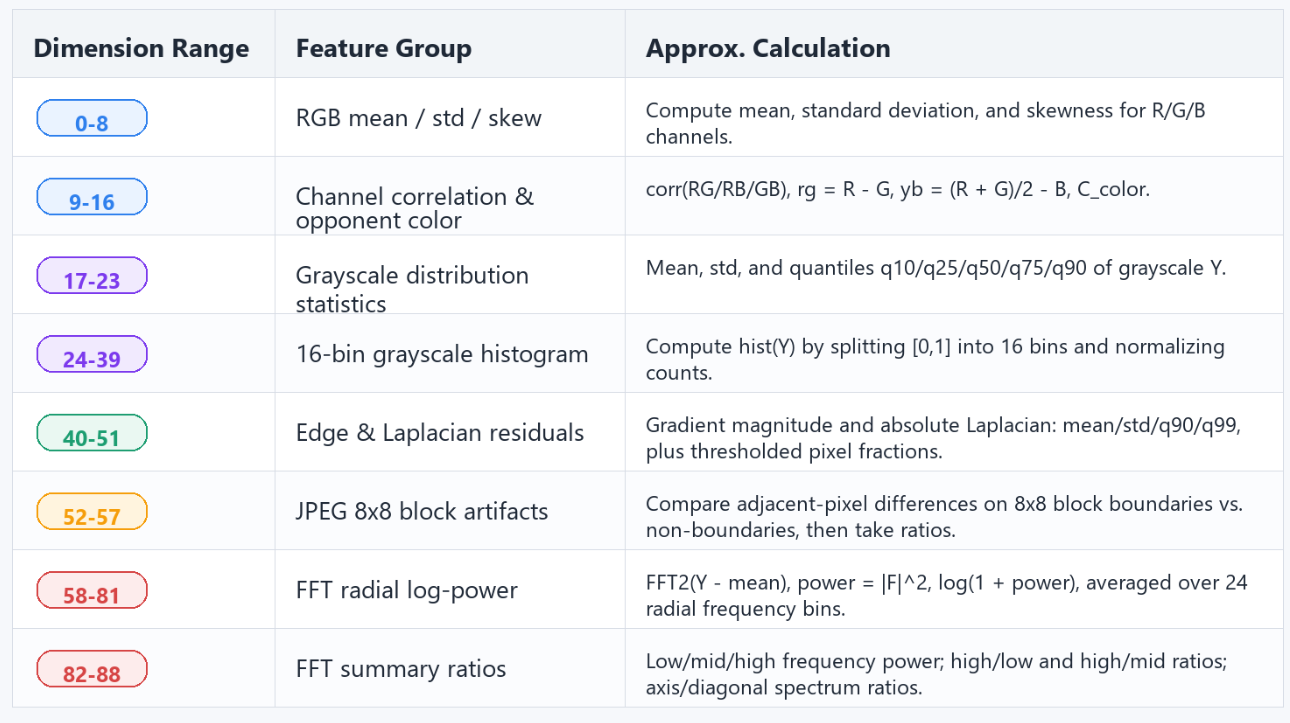
Image feature processing method
-
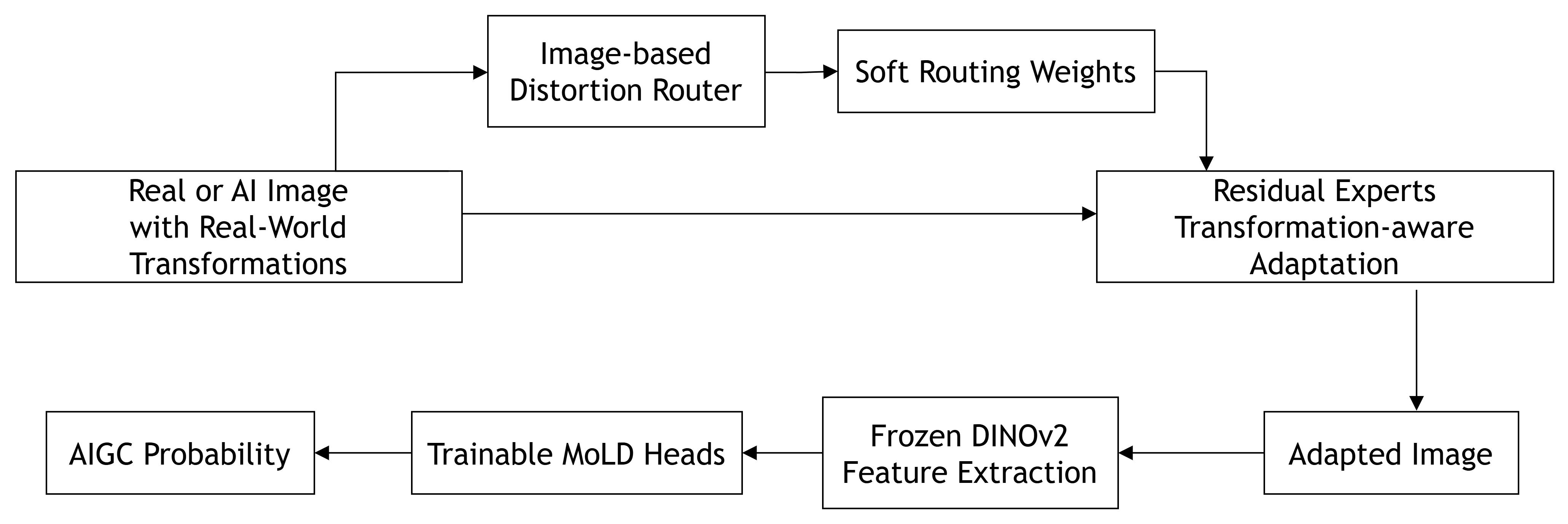
Model structure and workflow
-
Evaluation results
-
Evaluation on slip rate
-
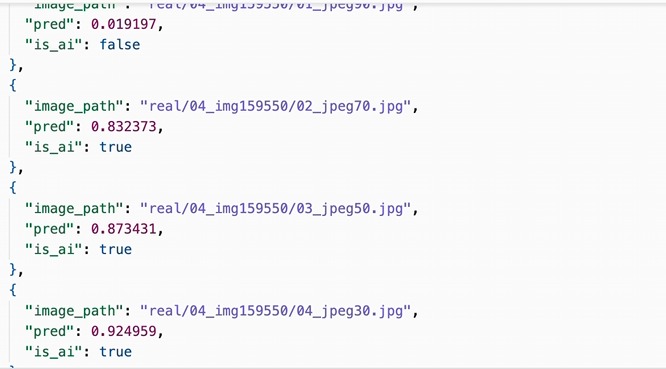
Demo results in json format
-
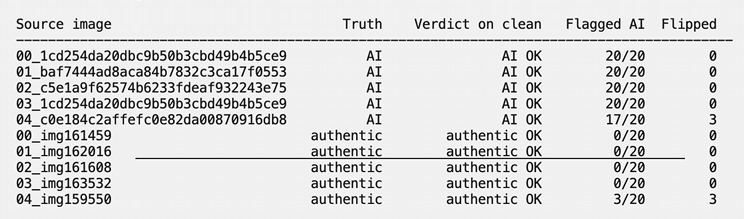
Demo results summary

Inspiration
AI-generated images are becoming increasingly realistic, but detecting them in the real world is harder than detecting them in a controlled dataset. Once an image is uploaded, reposted, or edited, operations such as JPEG compression, blur, resizing, noise, colour adjustment, and cropping can weaken the forensic evidence used by detectors.
This led us to focus on a practical question: can an AIGC detector preserve its judgment after the same image has undergone common real-world transformations?
What it does
DLWW distinguishes AI-generated images from authentic images while improving consistency across transformed versions of the same image.
Our solution combines three complementary components:
Low-cost forensic screening: We extract 89 handcrafted scalar features describing colour statistics, grayscale distributions, edge responses, JPEG blocking artifacts, and frequency-domain energy. A lightweight linear scoring module uses these features to provide an efficient preliminary assessment.
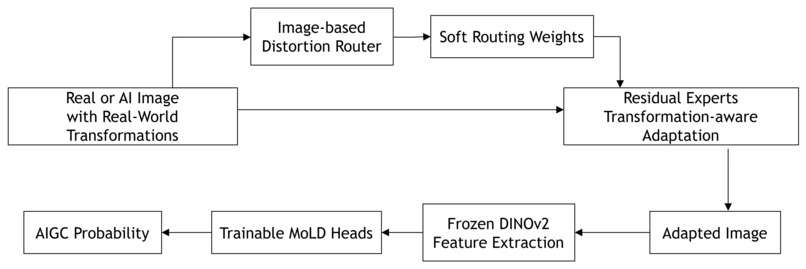
Transformation-aware detection: An image-based router estimates the type of distortion and generates soft routing weights. These weights control multiple residual experts, allowing the model to adapt each image according to its transformation instead of applying one fixed correction.
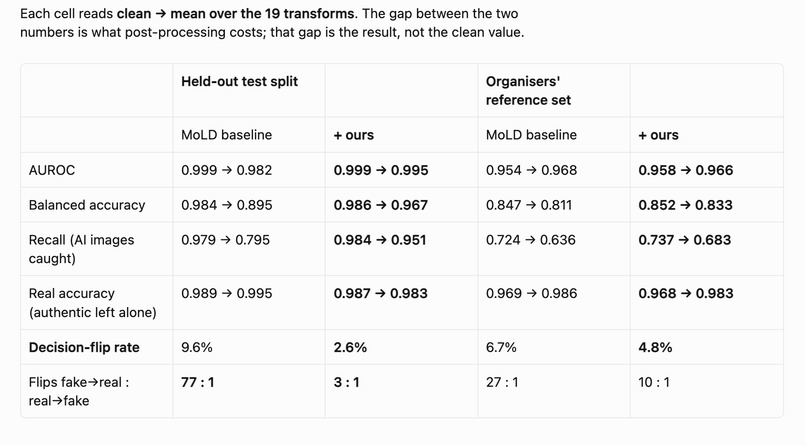
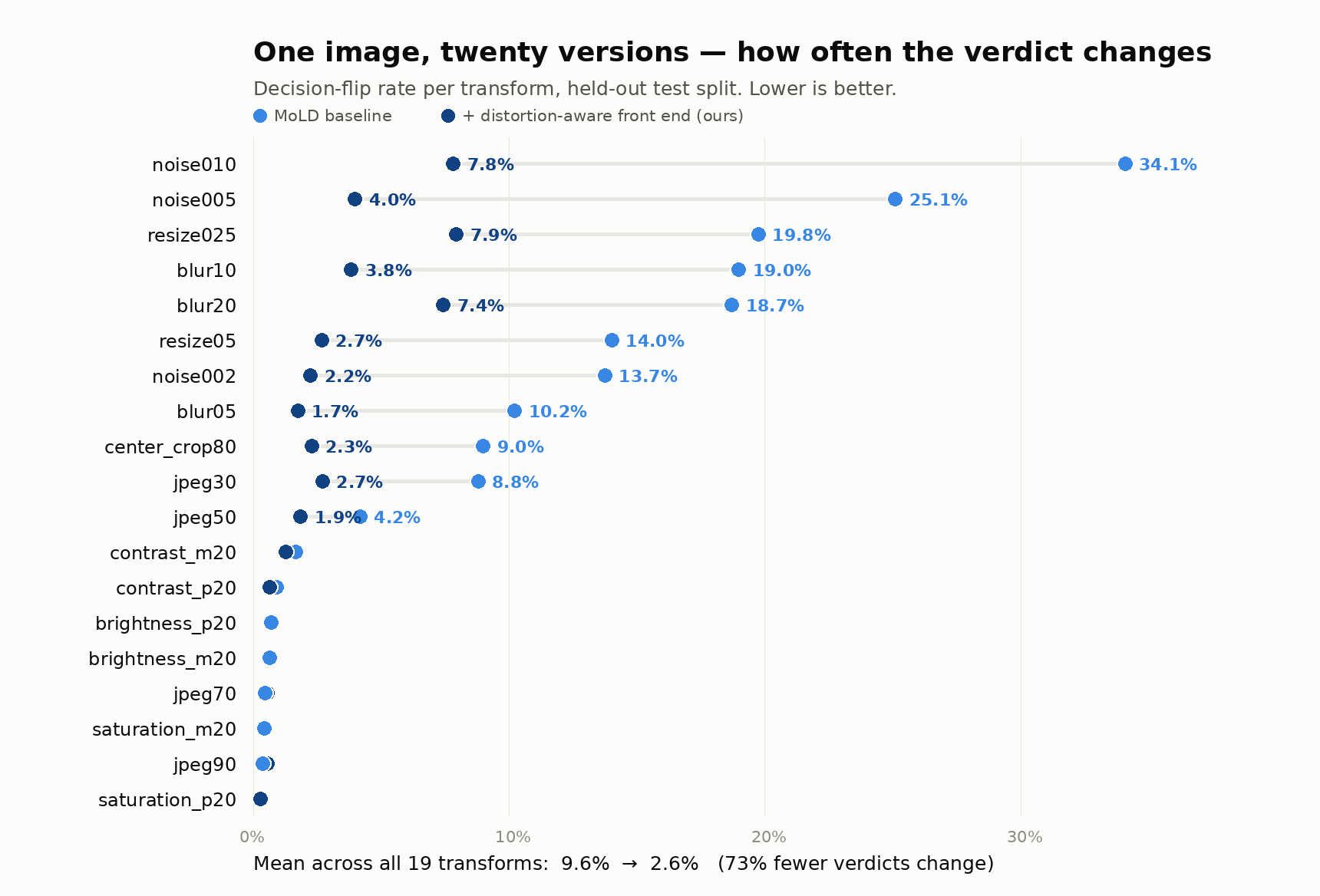
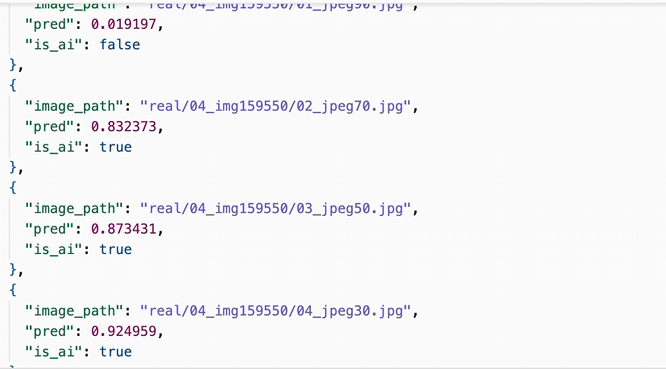
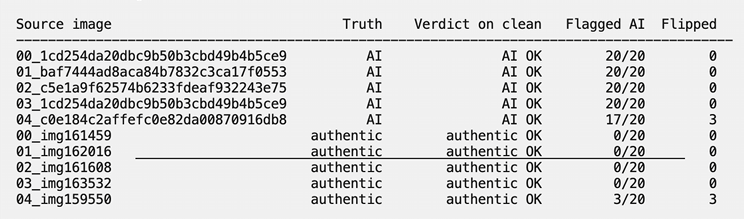
Robustness evaluation: Each clean image is evaluated together with 19 transformed versions. In addition to AUROC, balanced accuracy, and recall, we measure the decision-flip rate—how often a transformation changes the model’s verdict for the same source image.
How we built it
We built the system with Python and PyTorch, using DINOv2-Large as a frozen visual backbone and MoLD as the trainable detection head.
The transformation-aware model processes an image through the following pipeline:
Input image → Distortion Router → Soft Routing Weights → Residual Experts → Adapted Image → Frozen DINOv2 → Trainable MoLD Heads → AIGC Probability
The router recognises six transformation groups: identity, compression, blur/resize, noise, colour adjustment, and cropping. Rather than selecting only one expert, soft routing combines multiple experts so that an uncertain router prediction does not cause an abrupt correction.
Training is divided into three stages:
- Train the distortion router independently.
- Warm up the residual experts while keeping the backbone and MoLD heads frozen.
- Jointly fine-tune the residual experts and MoLD heads while DINOv2 remains frozen.
To prevent data leakage, all transformed versions of the same source image remain in the same train, validation, or test split.
Challenges we ran into
One major challenge was defining robustness correctly. High accuracy on individually transformed images does not necessarily mean that a model makes consistent decisions. We therefore introduced source-paired evaluation and measured whether each transformed image received the same verdict as its clean original.
Training the distortion router was also challenging because the six transformation groups were not naturally balanced. We addressed this using balanced sampling, macro-F1, per-class recall, confusion matrices, and prediction-distribution analysis.
We also tested whether the 89 handcrafted scalar features could improve the deep model through feature fusion. In their current form, they did not improve the final model consistently. This does not mean that frequency information is ineffective: compressing FFT information into global scalar summaries may discard important spatial structure.
Finally, we had to maintain strict separation between training validation, the held-out test split, and the organisers’ reference dataset so that evaluation data could not influence model selection.
Accomplishments that we're proud of
Our main achievement is not only maintaining strong clean-image performance, but making predictions substantially more stable after transformation.
On the held-out test split:
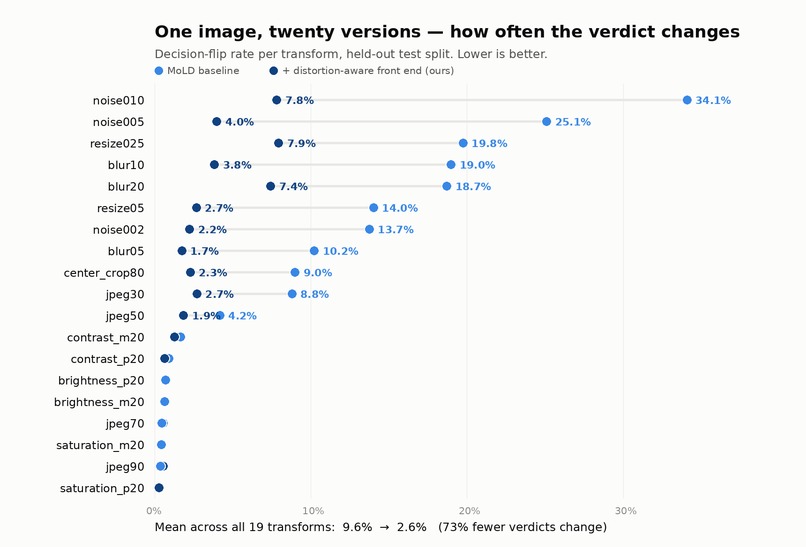
- Mean decision-flip rate decreased from 9.6% to 2.6%.
- This represents 73% fewer verdict changes across the 19 transformations.
- Mean transformed AUROC improved from 0.982 to 0.995.
- Mean transformed balanced accuracy improved from 0.895 to 0.967.
- Mean transformed AI-image recall improved from 0.795 to 0.951.
On the organisers’ reference dataset, the decision-flip rate also decreased from 6.7% to 4.8%.
The largest stability improvements appeared under strong noise, blur, and resizing—transformations that caused the baseline to change its decisions most frequently.
We also built a reproducible pipeline covering source-level dataset splitting, staged training, checkpoint management, validation, held-out testing, per-transformation analysis, and single-image probability output.
What we learned
We learned that robustness is not captured by one aggregate accuracy value. Comparing every transformed image with its own clean source reveals behaviour that ordinary evaluation can hide.
We also learned that soft routing is safer than forcing every image into one distortion category. Multiple experts can contribute when the transformation is ambiguous, producing smoother and more stable adaptation.
Our feature experiments showed that useful information and useful representation are not the same thing. Frequency information may be valuable, but reducing an entire FFT distribution to several scalar values can remove its spatial structure.
Most importantly, we learned that clean performance and transformation consistency should be evaluated together. A detector is more useful in practice when its decision remains stable after an image is reposted or lightly edited.
What's next for DLWW
Our next step is to replace global FFT scalar summaries with spatial FFT feature maps. These maps may preserve where frequency artifacts occur and could be fused with intermediate visual representations rather than only with the final classifier.
We also plan to evaluate the model across more datasets and previously unseen image generators, conduct deeper false-positive and false-negative analysis, and study confidence calibration across different transformation types.
Finally, we would extend the current prototype into a complete user-facing workflow that accepts an image and presents its AIGC probability together with robustness and transformation-related evidence.


Log in or sign up for Devpost to join the conversation.