-
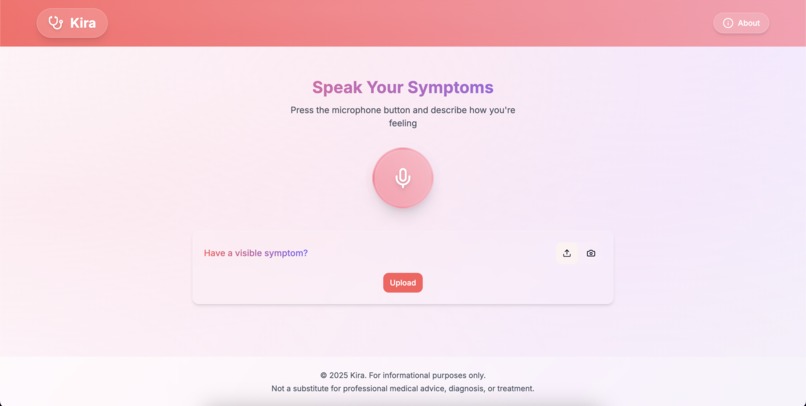
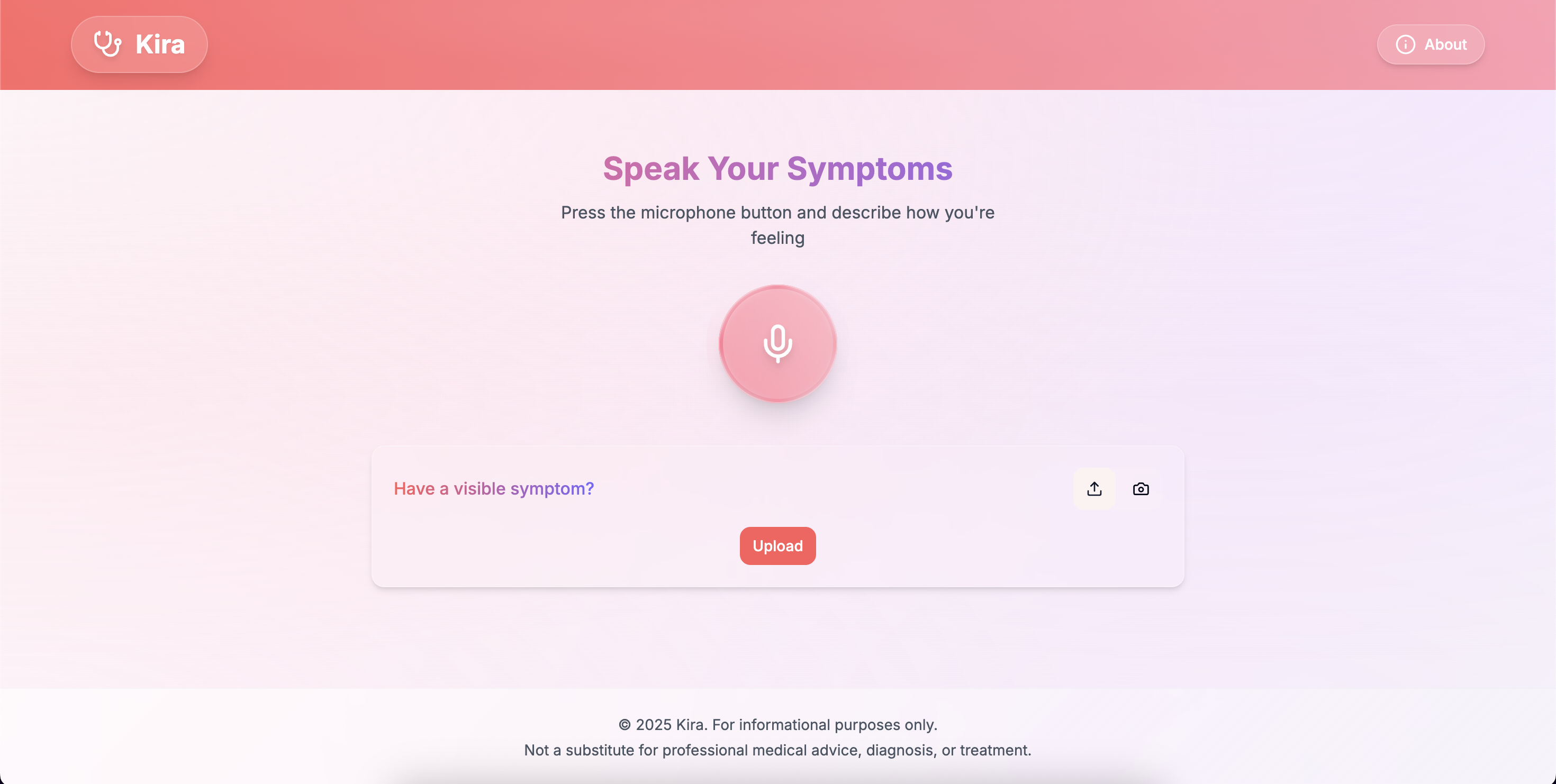
Landing Page
-
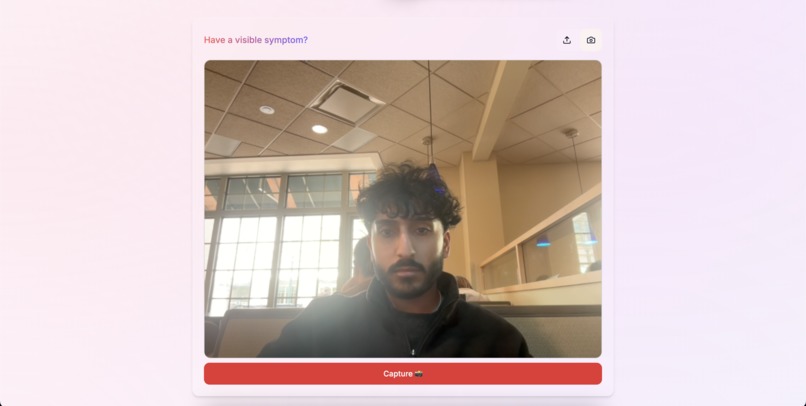
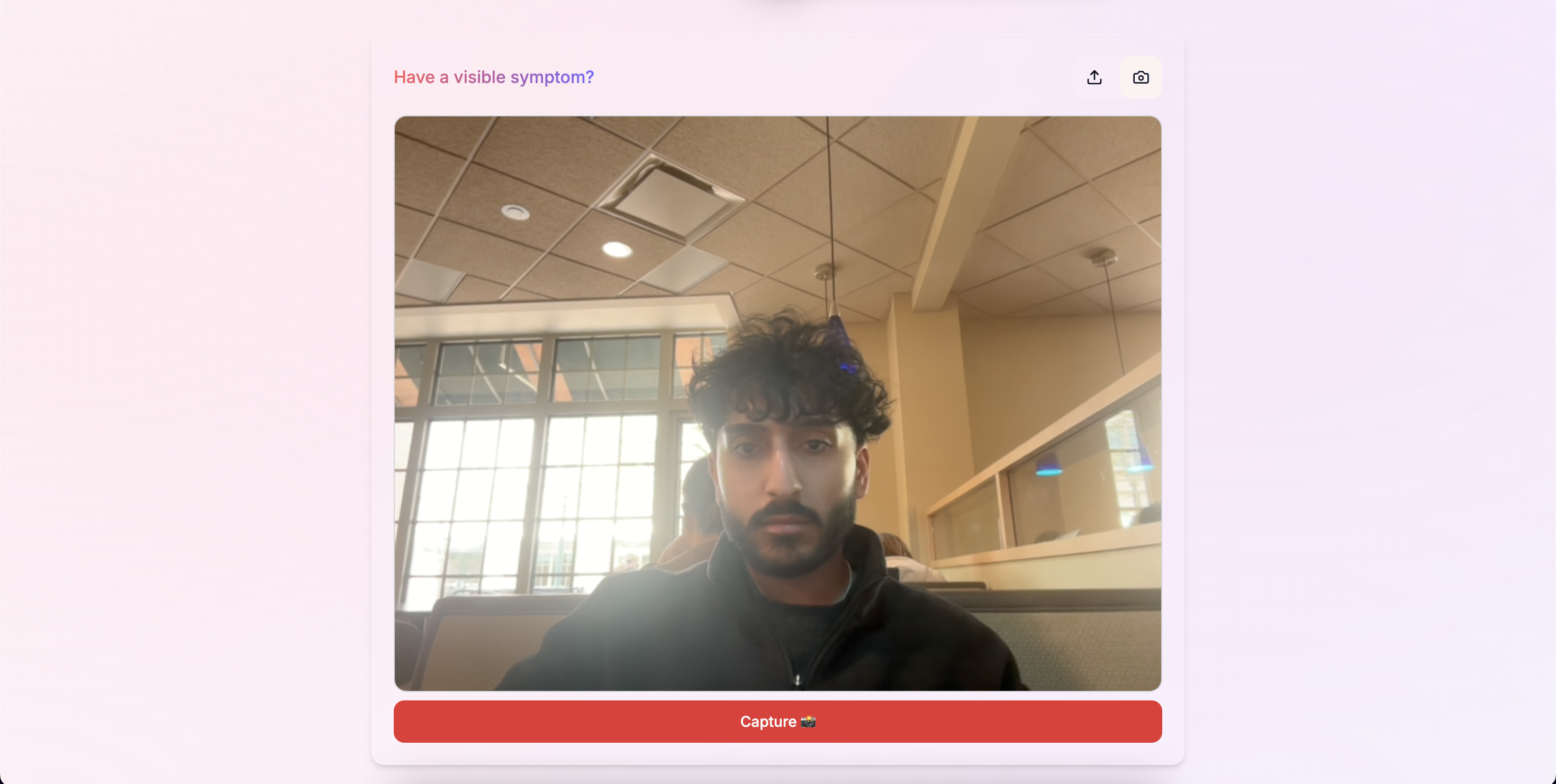
Camera View
-
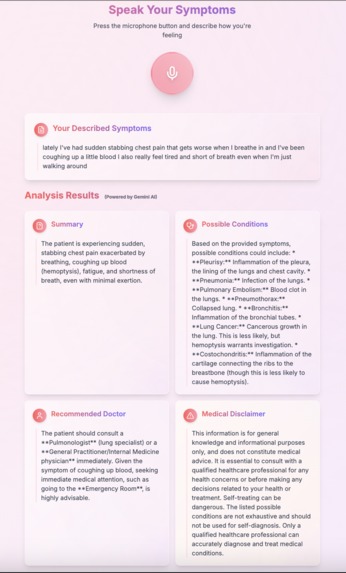
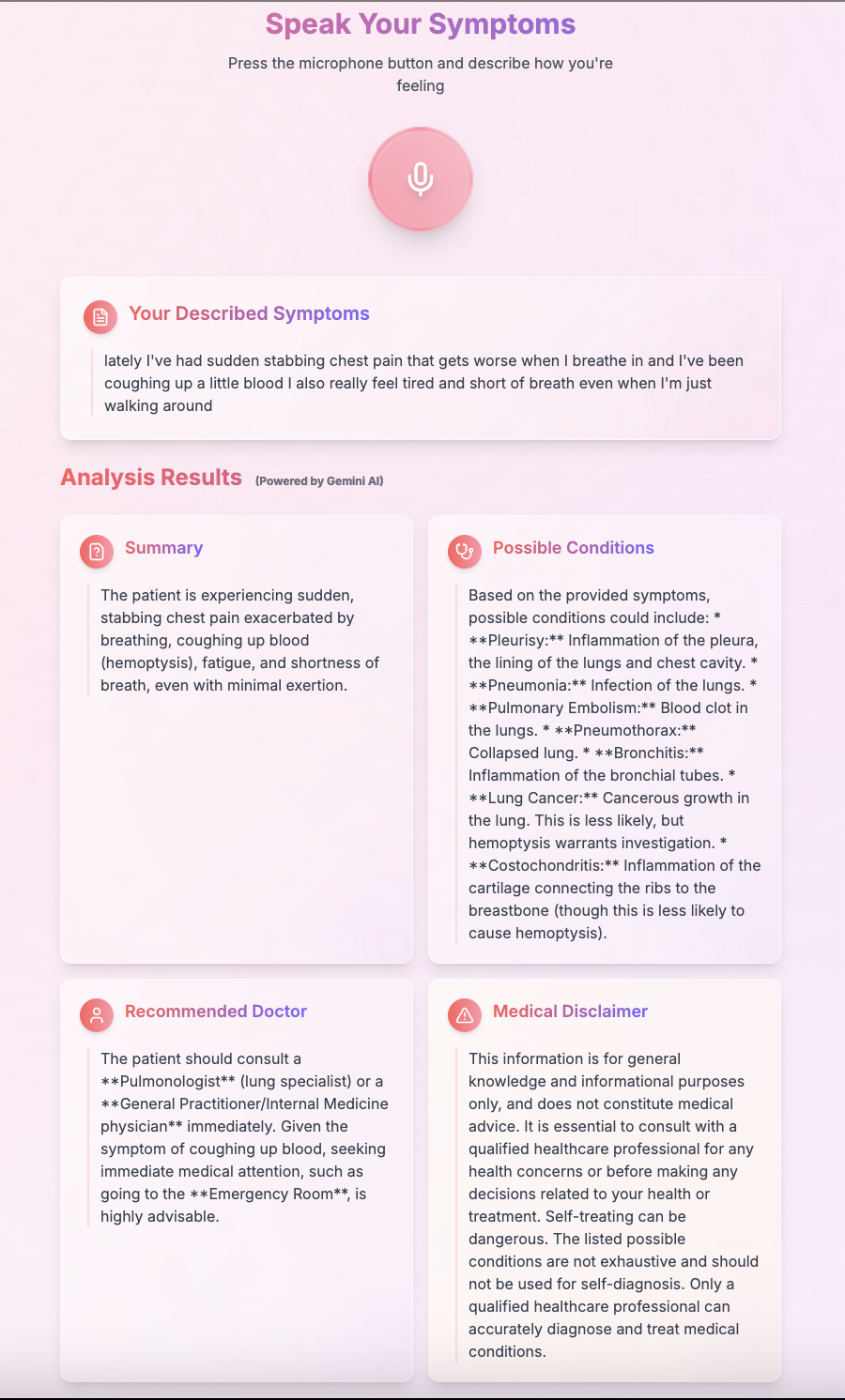
Example
-
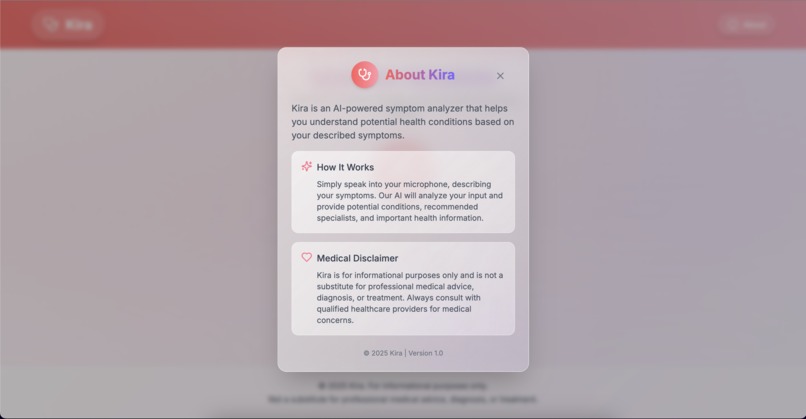
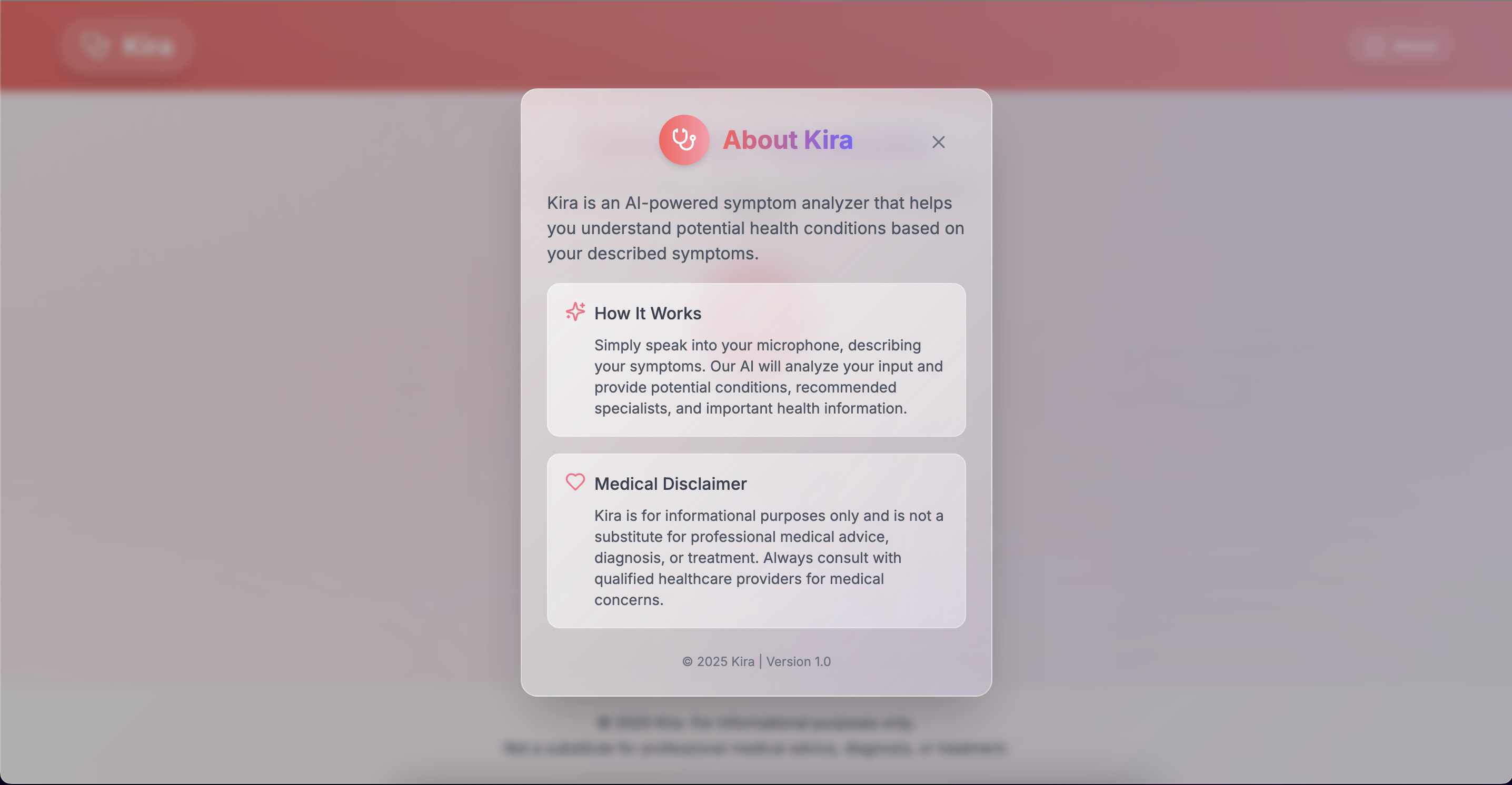
About
Inspiration
When you're feeling unwell, the last thing you want is to scroll through pages of Google results or wait on hold with a clinic. We wanted to create a voice-first AI assistant that gives you clear, calm, and actionable guidance, especially for those who don’t know whether it’s something minor or worth checking out.
What it does
Kira is a voice-powered AI triage assistant that helps users describe their symptoms naturally. It listens, transcribes, and uses the Gemini API to summarize your symptoms, suggest possible conditions, and recommend what kind of care (if any) you may need — all with a friendly disclaimer and clean, easy-to-read output.
In addition to voice input, Kira also lets users upload or take a photo of a visible symptom like a cut, bruise, or swelling and uses AI to factor that into the triage summary, providing an even more accurate and personalized assessment.
How we built it
- Frontend: Built with Next.js and Tailwind CSS for a responsive, healthcare-inspired UI.
- Voice Input: Uses the Web Speech API to transcribe user speech.
- Image Input: Allows users to upload or snap a photo of a visible symptom; images are analyzed using the Gemini API’s multimodal capabilities and interpreted in tandem with the voice input.
- AI Engine: A custom prompt is sent to Gemini API to generate structured triage summaries.
- Output Formatting: Gemini responses are parsed into cards (symptoms, possible causes, care suggestions, and disclaimer) for clarity.
- Design: Clean red/white UI with empathetic UX, mobile-friendly layout, and voice-first interactions.
Challenges we ran into
We started the hackathon working on a gesture-controlled MIDI DJ app powered by computer vision. It was ambitious and fun but we quickly realized two key things:
- The technical complexity (real-time gesture detection + audio synthesis) was too high to execute cleanly in the time we had.
- More importantly, the project didn’t solve a real problem — it was purely for entertainment.
That’s when we made the hard decision to pivot... 16 hours in.
We asked ourselves: What can we build that’s both technically interesting and genuinely useful?
That question led us to Kira, a voice-first AI health triage assistant designed to bring clarity to people unsure about their symptoms.
Even after the pivot, we faced several challenges:
- We had to re-architect everything: new stack, new logic, new UX.
- We had to iteratively refine our LLM interaction design to ensure Kira returned responses that were clear, actionable, and easy to parse.
- Voice input required handling different browsers and fallback cases.
- We had to switch gears mentally from flashy and performative to calm, human-centered, and impactful.
The pivot forced us to focus on problem-solving, not novelty, and we’re proud of where that led us.
That pivot, while risky, is what made Kira possible.
Accomplishments that we're proud of
- We executed a full-scope pivot mid-hackathon — switching from a complex CV + MIDI concept to a voice-based AI health assistant — and still delivered a complete, demo-ready product.
- In under 12 hours, we built Kira, a voice-first, AI-powered health triage tool with structured output, thoughtful UX, and future-ready architecture.
- Our Gemini prompts are finely tuned to deliver clear, actionable, and empathetic medical summaries, proving we deeply understand both AI behavior and real-world user needs.
- We didn’t just ship a working app — we built something that feels like a prototype of a real product, with extensibility in mind (personalization, multilingual support, care mapping, etc.).
- The experience helped us practice product thinking, human-centered design, and prompt-engineering — key pillars for building AI-powered tools people actually trust.
What we learned
- Prompt engineering is everything when working with LLMs; structure matters.
- Voice-first UX feels magical when it works but requires user-centric thinking to feel natural.
- Image analysis is powerful when combined with text, but requires very specific prompts and fallback planning.
- Small things like disclaimers, urgency levels, and empathy in tone make a huge difference in health-focused AI products.
- Simplicity wins. Keeping the product tight made it easier to deliver something meaningful.
What's next for Kira
- Add personalization: age, known conditions, and location-based triage
- Support multilingual voice input and accessibility features
- Build an on-device version with Whisper.js for privacy
- Integrate with Google Maps API to recommend nearby care centers
- Expand into mental health triage with emotion-aware AI responses
- Improve photo triage with clearer feedback and step-by-step visual self-checks
Built With
- geminiapi
- javascript
- mobile
- next.js
- tablet
- tailwindcss
- typescript
- web
- webspeechapi


Log in or sign up for Devpost to join the conversation.