-
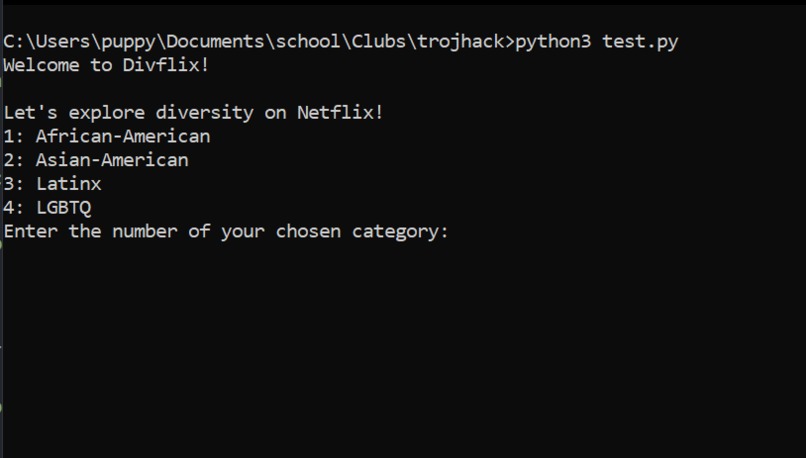
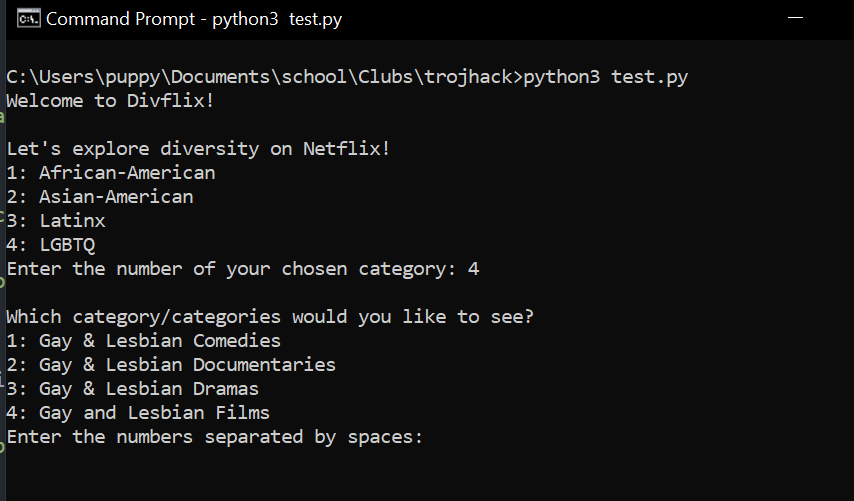
Welcome screen
-
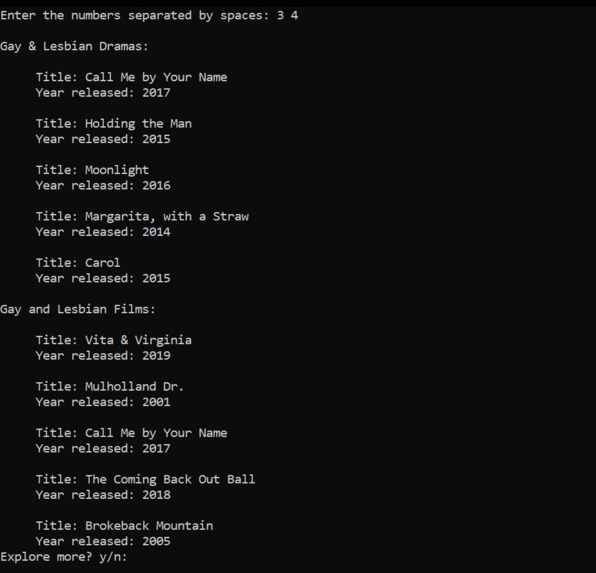
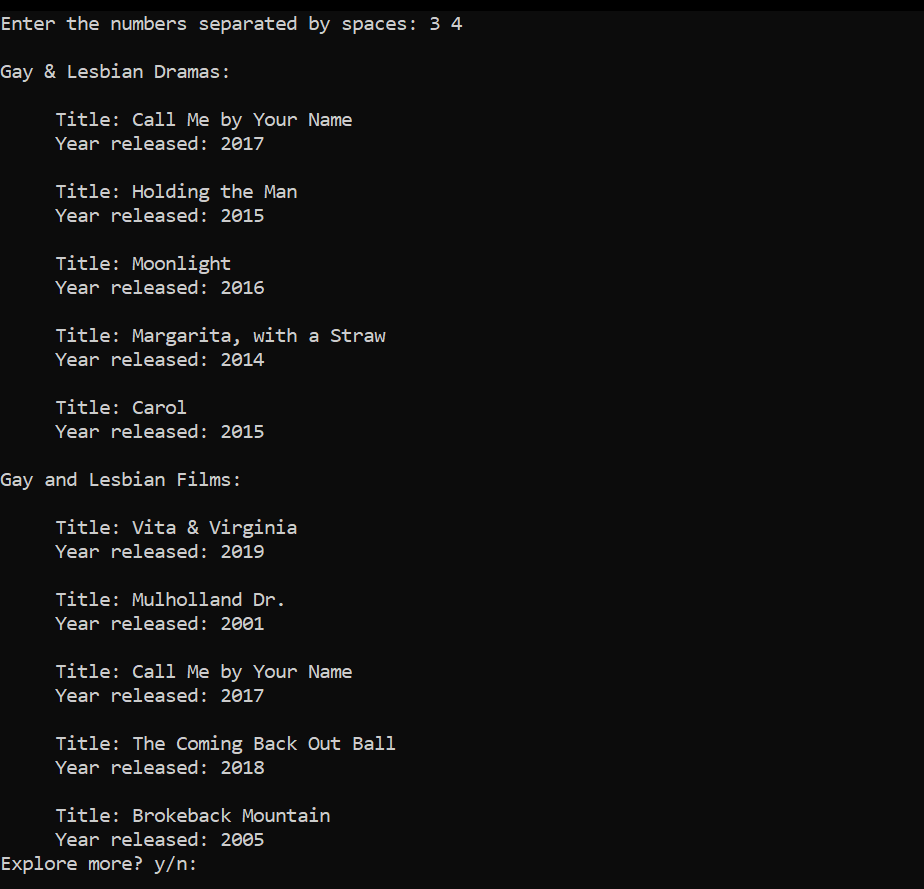
Example of movie recommondations
-
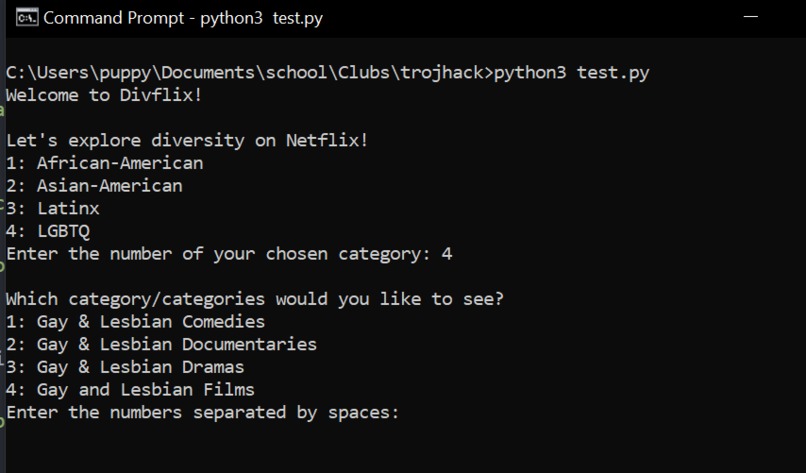
Categories for LGBTQ media
Inspiration
Movies and shows are supposed to be a form of escapism, where we can indulge in another character’s world instead of our own, allowing us to explore another reality with them. However, as POC women in the US, the media presented to us overwhelming follows the status quo. These stories typically center and follow the stories of those who have the “default” characteristics in the US—typically being white, being male, being cisgender and heterosexual. Because we often didn’t see our identities reflected in these works, we were forced to relate to the stories before us, but still with the knowledge that we could never fully do so.
With the lack of representation, we often just accept the status quo as is, where our identities are seen as exceptions rather than the norm. And when we do see our identities on screen, these one-note depictions is usually all that is known for an underrepresented group, leaving to inaccurate reputations that can never seem to shake off. However, as time goes by, we see more media being crafted in response to this issue. New pieces continue to be made that center the stories of people with underrepresented identities. Even so, it is difficult for these works to have the same reach, but we hope to mediate this issue with our project.
What it does
Our program aims to provide the user with film and series recommendations based on which underrepresented group they would like to engage with. In doing so, the user is exposed to new works that center the stories of those in the group, but also elevates works by those a part of the group. It assists on both ends in breaking down what we define as the “default,” helping normalize these stories in the mainstream media.
Upon starting the program, the user will be given a menu with a list of choices to select from, each with a different underrepresented group. After selecting one of these options, they will be asked to select what kind of genre they would like to see options from—these range from drama, comedies, documentaries, TV shows and so on. Once chosen, our program will output a list of recommendations based on the library provided to us, with the title of the piece and release year included. From then on, if the user would like to engage again with the program, they can do so and the process repeats. If not, they are free to leave and exit the program.
How we built it
During our research, we looked for online databases and APIs that already sorted movies into categories such as ethnicity and sexuality. We had trouble since most movie APIs did not do that, so we considered using natural language processing on movie synopsis and movie reviews to find good representations of minority groups. However, we eventually found a Netflix API that would work for us. The Netflix API uses genre IDs to filter by genre, so we had to match our categories to genre IDs using the GET Genres endpoint. Once we found the genre IDs, we implemented a movies function that takes in genre ID, and the number of movies and returns a list of movie information sorted by rating. We then display to the user only the movie titles and year released of their chosen category.
Challenges we ran into
Most APIs we initially found had no categories for race or sexuality. When we found an API that did contain those, we spent several hours testing and building code until we realized that the results always returned 0 movies. So, we went back to square one and found another API that does the same thing and works. Another issue was that the genres given to us by the API did not match what we were initially looking for. For example, we wanted categories such as all African-American media, all African-American tv shows, etc, but the API only has specific genres such as African-American comedies and African-American Stand-up comedy. So instead of sorting each category of film into media type and genre, we had to use the genres that the API gave us.
Accomplishments that we're proud of
We are proud of all of the research, learning, and work that we did to finally see our idea come to fruition. We are very proud that everyone on the team learned more about how to use APIs since some of us had no previous experience with it. Lastly, we are proud of overcoming all of the obstacles we bumped into that felt impossible to overcome and for persevering even when we had to start back at square one.
What we learned
We learned how to use APIs, how to parse information, and how Netflix categorizes its media!
What's next for Divflix: Diversity in Movies and Shows
Although in the early stages right now, we hope that Divflix can continue to grow its library and allow for the users to have a more refined search. There are some underrepresented groups that unfortunately our dataset didn’t contain any works for, but with an expanded library, we would be able to include it on our recommendations. Moreso, a greater refined search would allow for recommendations for people of different ages, those looking for a greater variety of the type of media, and so on. Thus, the user can be exposed to even more works focusing on stories that often don’t get heard. Implementing this project as an extension or a website would further expand the reach it has, allowing the user to more easily engage with our program.
Built With
- api
- python
- unogsng

Log in or sign up for Devpost to join the conversation.